
As a researcher in structural health monitoring, I have long been fascinated by the challenge of measuring bridge vibrations with high precision. Bridges are critical infrastructure, and their continuous assessment is vital for public safety. Traditional methods like accelerometers, total stations, or GNSS often involve contact-based installations, high costs, and logistical difficulties, especially for bridges over water or in rugged terrain. In recent years, Unmanned Aerial Vehicles (UAV drones) have emerged as a flexible platform for non-contact monitoring. However, a significant bottleneck remains: the inherent motion of the UAV drone during hovering contaminates displacement measurements, severely limiting accuracy. In this article, I present a novel method that leverages a monocular tilt-shift vision system mounted on a UAV drone to achieve sub-millimeter precision in bridge displacement measurement, effectively compensating for the platform’s motion.
The core innovation lies in two synergistic aspects. First, by linearly arranging targets along the bridge deck and employing tilt-shift imaging based on the Scheimpflug principle, we extend the depth of field without widening the field of view. This ensures all targets are imaged sharply within the UAV drone’s limited frame, preserving image resolution for high-accuracy, multi-point synchronous measurement. Second, we develop a robust onboard camera motion model. This model decomposes the UAV drone’s movement and uses geometric relationships with reference targets—assumed to have zero displacement at bridge piers or abutments—to isolate and subtract the motion-induced error from the raw data, revealing the structure’s true dynamic response.
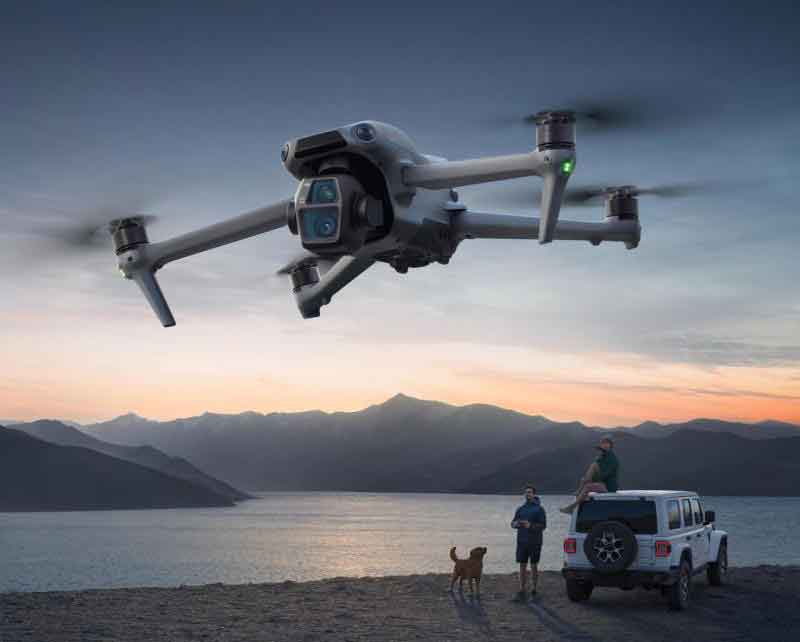
The potential of UAV drones for remote sensing is immense, but translating that potential into metrology-grade measurement requires solving fundamental problems like motion compensation. Our approach directly addresses this. The measurement setup involves a UAV drone equipped with a custom tilt-shift camera. The camera consists of a long-focal-length lens (e.g., 85mm) coupled to an image sensor via a tilt adapter, allowing the sensor plane to be rotated relative to the lens plane. Targets, each featuring two precisely spaced cross-shaped corner points, are installed along the side of the bridge girder. During operation, the UAV drone hovers in front of the bridge span, with its camera axis horizontal and approximately aligned with the line of targets. This linear configuration, combined with the tilt-shift adjustment, brings all targets into sharp focus simultaneously.
The principle of tilt-shift imaging is governed by the Scheimpflug rule. In a conventional camera, the lens plane, image plane, and object plane of focus are parallel. When the lens is tilted, these three planes intersect along a single line. By aligning this intersection line with the direction of the target array (approximately the bridge deck direction), the depth of field is dramatically extended along the camera’s line of sight. The required tilt angle α can be pre-calculated based on the UAV drone’s standoff distance and the geometry of the scene. For a UAV drone positioned at a distance D from the bridge side and with the first target at a slant range n, the theoretical tilt angle is derived from geometric relations. This setup is crucial for a UAV drone-based system because it enables the use of a long-focal-length lens for high resolution without sacrificing the ability to image multiple distant points.
The measurement procedure begins with image acquisition. The UAV drone hovers at a predetermined station, and the onboard tilt-shift camera captures a video sequence at a high frame rate (e.g., 100 Hz). Each frame contains images of all targets. The primary data is the image coordinates of the corner points for each target. Let’s denote the targets as \(M_a\), \(M_b\), \(M_c\), etc., where \(M_a\) and \(M_c\) are reference targets at stable locations, and \(M_b\) is a measurement target on the vibrating bridge girder. Each target has two corner points: for target \(M_a\), the points are \(M_{a1}(x_{a1}, y_{a1})\) and \(M_{a2}(x_{a2}, y_{a2})\) in image coordinates. The physical spacing between these corners, \(P\), is known and is used for scale calculation.
The raw displacement in pixels for any point between frame \(i\) and an initial reference frame is computed using standard computer vision tracking algorithms (e.g., based on cross-correlation or feature matching). For high precision, we use a specialized cross-target corner detection algorithm that achieves sub-pixel localization accuracy. The raw vertical pixel displacement for corner point \(M_{a1}\) is denoted as \(\Delta y_{a1}^{raw}\). However, this raw displacement \(\Delta \mathbf{d}^{raw}\) is a mixture of the true bridge displacement \(\Delta \mathbf{d}^{bridge}\) and the apparent displacement caused by the UAV drone’s camera motion \(\Delta \mathbf{d}^{camera}\):
$$ \Delta \mathbf{d}^{raw} = \Delta \mathbf{d}^{bridge} + \Delta \mathbf{d}^{camera} $$
The challenge is to solve for \(\Delta \mathbf{d}^{bridge}\). Our camera motion model decomposes \(\Delta \mathbf{d}^{camera}\) into components caused by different types of UAV drone movement. We define a coordinate system where the X-axis is horizontal (lateral), the Y-axis is vertical, and the Z-axis is along the camera’s optical axis (approximately along the bridge deck). The UAV drone’s motion includes translations \((T_x, T_y, T_z)\) and rotations \((R_x, R_y, R_z)\) around these axes. For a UAV drone in hover, motion along the Z-axis (towards the bridge) is typically small relative to the working distance and has negligible impact on the scale of the image. Therefore, we focus on compensating for \(T_x\), \(T_y\), \(R_x\), \(R_y\), and \(R_z\).
The apparent image coordinate change for a target point due to camera motion can be expressed as the sum of components from rotation about Z (\(cz\)), translation in X/Y (\(ct\)), and rotation about X/Y (\(cr\)). For the vertical displacement of reference target \(M_a\)’s corner points, we have:
$$
\begin{cases}
\Delta y_{a1}^{raw} = cz_{a1}^{y} + ct_{a1}^{y} + cr_{a1}^{y} \\
\Delta y_{a2}^{raw} = cz_{a2}^{y} + ct_{a2}^{y} + cr_{a2}^{y}
\end{cases}
$$
Since \(M_a\) is a reference target with zero true displacement, \(\Delta y_{a1}^{bridge} = \Delta y_{a2}^{bridge} = 0\). For a measurement target \(M_b\), the equation includes the true bridge displacement \(C\Delta y_{b}^{bridge}\):
$$
\begin{cases}
\Delta y_{b1}^{raw} = C\Delta y_{b1}^{bridge} + cz_{b1}^{y} + ct_{b1}^{y} + cr_{b1}^{y} \\
\Delta y_{b2}^{raw} = C\Delta y_{b2}^{bridge} + cz_{b2}^{y} + ct_{b2}^{y} + cr_{b2}^{y}
\end{cases}
$$
Our goal is to solve for the motion components \(cz\), \(ct\), and \(cr\) using the reference targets, then subtract them from the raw data of the measurement target. We proceed step-by-step, exploiting geometric constraints.
Step 1: Solving for Rotation about Z-axis (\(cz^y\))
When the camera rotates by a small angle \(\theta\) around the Z-axis, the change in image coordinates for a point \((x, y)\) is approximately:
$$
cz^{x} \approx y \sin\theta, \quad cz^{y} \approx -x \sin\theta
$$
This approximation holds because \(\cos\theta \approx 1\) for small angles (typical UAV drone yaw variations are within ±5°). For the two corners of the same target, we can subtract their equations to eliminate \(ct^y\) and \(cr^y\), which are identical for both corners on a rigid target. From the reference target \(M_a\):
$$ \Delta y_{a1}^{raw} – \Delta y_{a2}^{raw} = cz_{a1}^{y} – cz_{a2}^{y} = (-x_{a1} \sin\theta) – (-x_{a2} \sin\theta) = (x_{a2} – x_{a1}) \sin\theta $$
All terms on the left are known from image measurements. The initial image coordinates \(x_{a1}, x_{a2}\) are known. Thus, we can solve for \(\sin\theta\):
$$ \sin\theta = \frac{\Delta y_{a1}^{raw} – \Delta y_{a2}^{raw}}{x_{a2} – x_{a1}} $$
Once \(\sin\theta\) is known, \(cz_{a1}^{y}, cz_{a2}^{y}, cz_{b1}^{y}, cz_{b2}^{y},\) etc., can be computed using \(cz^{y} = -x \sin\theta\).
Step 2: Solving for Translation in Y-axis (\(ct^y\))
Translation of the UAV drone in the Y direction causes an image shift that is inversely proportional to the distance from the camera. For two targets at different distances, the ratio of their image shifts equals the inverse ratio of their distances. However, distance is not directly measurable. Instead, we use the scale factor \(s\) (mm/pixel) for each target plane, which is proportional to distance. The scale factor \(s_a\) for target \(M_a\) is computed from the known physical spacing \(P\) (mm) between its corners and their measured pixel distance \(p_a\) (pixels) in the image: \(s_a = P / p_a\).
Therefore, for reference targets \(M_a\) and \(M_c\):
$$ \frac{ct_{a}^{y}}{ct_{c}^{y}} = \frac{s_c}{s_a} $$
Furthermore, for the same target, \(ct_{a1}^{y} = ct_{a2}^{y}\). Using the equations for \(M_a\) and \(M_c\), and after subtracting the already computed \(cz^y\) components, we have:
$$ \Delta y_{a}^{raw} – \Delta y_{c}^{raw} + (cz_{c}^{y} – cz_{a}^{y}) = ct_{a}^{y} \left(1 – \frac{s_a}{s_c}\right) $$
This allows solving for \(ct_{a}^{y}\). Then, using the ratio, we find \(ct_{c}^{y}\) and \(ct_{b}^{y}\) (for the measurement target):
$$ ct_{b}^{y} = ct_{a}^{y} \cdot \frac{s_a}{s_b} $$
Step 3: Solving for Rotation about X-axis (\(cr^y\))
Rotation of the camera around the X-axis (tilt) causes a nearly identical vertical image shift for all targets, regardless of their distance, because the rotation center is at the projection center. Therefore:
$$ cr_{a}^{y} \approx cr_{b}^{y} \approx cr_{c}^{y} $$
After solving for \(cz_{a}^{y}\) and \(ct_{a}^{y}\) from previous steps, we can compute \(cr_{a}^{y}\) from the equation for reference target \(M_a\):
$$ cr_{a}^{y} = \Delta y_{a}^{raw} – cz_{a}^{y} – ct_{a}^{y} $$
This value is then assigned to \(cr_{b}^{y}\) and \(cr_{c}^{y}\).
Step 4: Computing True Bridge Displacement
Finally, for measurement target \(M_b\), we subtract all estimated camera motion components from the raw displacement:
$$ C\Delta y_{b}^{bridge} = \Delta y_{b}^{raw} – cz_{b}^{y} – ct_{b}^{y} – cr_{b}^{y} $$
This is done for both corner points, and the results are averaged. The final physical displacement in millimeters is obtained by applying the scale factor \(s_b\):
$$ \Delta Y_{b} = s_b \cdot \left( \frac{C\Delta y_{b1}^{bridge} + C\Delta y_{b2}^{bridge}}{2} \right) $$
The entire process is executed for each frame in the sequence, yielding a time-history of displacement for each measurement target. This method is robust because it uses the geometric configuration and multiple reference points inherent to the UAV drone-based setup, without requiring prior camera calibration or complex filtering that might distort signal content.
To validate the method, we conducted two experiments: a simulated bridge measurement and a real-world bridge test. In the simulation, we installed five targets on a building facade, spaced 8 meters apart, mimicking a bridge span. The two outermost targets served as references. A UAV drone equipped with the tilt-shift camera hovered approximately 20 meters away. We manually induced displacements on the central targets using precision translation stages. A separate, fixed close-range camera provided ground truth displacement data. The UAV drone captured images at 100 Hz for 20 seconds. The results for one measurement target showed that the raw displacement from the UAV drone was heavily corrupted by platform motion, with fluctuations over 400 mm. After applying our compensation algorithm, the displacement curve closely matched the ground truth. The accuracy metrics are summarized in the table below.
| Accuracy Metric | Raw UAV Displacement | Compensated Displacement (Our Method) |
|---|---|---|
| Root Mean Square Error (RMSE) | 159.24 mm | 0.27 mm |
| Maximum Error | 409.50 mm | 1.07 mm |
| Mean Error | 32.03 mm | -0.06 mm |
The second experiment was performed on the Lunzhou Bridge in China, a 45-meter span highway bridge over a river. This environment is ideal for showcasing a UAV drone’s capability, as installing fixed sensors is challenging. We placed five targets along the bridge railing: T1 and T5 on the piers (references), and T2, T3, T4 at quarter, mid, and three-quarter spans (measurement points). Each target had two cross corners with known spacing (100 mm or 150 mm). A fixed tilt-shift camera was also installed on the bridge to independently monitor the same section, providing a benchmark. The UAV drone hovered over the water, about 30 meters from the near pier and 6 meters from the bridge side. Both cameras recorded simultaneously at 100 Hz for 20 seconds. The table below shows the scale factors, which increase with distance, highlighting the importance of per-target scaling in a UAV drone-based system.
| Target | Approx. Distance from UAV (m) | Scale Factor (mm/pixel) |
|---|---|---|
| T1 (Reference) | 30 | 2.28 |
| T2 (Measurement) | 41.25 | 3.06 |
| T3 (Measurement) | 52.50 | 3.84 |
| T4 (Measurement) | 63.75 | 4.60 |
| T5 (Reference) | 75 | 5.36 |
The displacement time histories extracted from the UAV drone data after compensation showed clear correlation with heavy vehicle crossings. The mid-span target (T3) exhibited the largest deflection. Comparing our UAV drone-derived displacements with the fixed camera benchmark confirmed high accuracy. The following table quantifies the performance for the three measurement points.
| Measurement Target | RMSE vs. Fixed Camera | Maximum Absolute Error |
|---|---|---|
| T2 | 0.42 mm | 1.23 mm |
| T3 | 0.35 mm | 1.24 mm |
| T4 | 0.32 mm | 1.24 mm |
All RMSE values are below 0.5 mm, demonstrating stable sub-millimeter accuracy in a real outdoor environment with a flying UAV drone. The consistency across multiple points validates the method’s capability for synchronous multi-point monitoring. The UAV drone’s motion, which included perturbations from wind, was effectively separated from the bridge’s vibrational signal.
The advantages of this UAV drone-based approach are multifold. It is a truly non-contact method, eliminating any risk of damaging the structure or disrupting traffic. The use of a tilt-shift camera solves the depth-of-field problem inherent in monitoring long, linear structures with a single, high-resolution camera on a UAV drone. The motion compensation algorithm is geometrically grounded and does not rely on frequency separation assumptions, making it applicable to a wide range of vibration scenarios. Perhaps importantly for practical deployment, the method requires no prior calibration of the camera’s intrinsic parameters because the scale factor is derived directly from the known target geometry in each image. This is a significant simplification for field operations with a UAV drone.
There are, of course, practical considerations and limitations. The current system uses a lens with an 85mm focal length. For very long-span bridges, the distance to the farthest targets may become too great, reducing the image resolution and consequently the displacement sensitivity. Future work could integrate zoom lenses or higher-resolution sensors on the UAV drone. The assumption that reference targets at piers have zero displacement holds well for short to medium spans under short-term dynamic loads, but for long-term monitoring or bridges with flexible substructures, this may need refinement. Nevertheless, for the vast majority of diagnostic load tests and routine inspections, this method provides a powerful tool.
In conclusion, the integration of tilt-shift optics with a robust motion model enables a UAV drone to transcend its role as a simple imaging platform and become a high-precision metrology instrument. This method successfully tackles the core challenge of UAV drone-based displacement measurement—platform motion corruption—and delivers accuracy comparable to fixed sensors. It opens the door for efficient, low-cost, and detailed assessment of bridge health and other linear infrastructure like dams, towers, and pipelines. The ability to rapidly deploy a UAV drone for synchronized multi-point measurement without any on-structure installation is a game-changer for infrastructure management. As UAV drone technology continues to advance, with improvements in stability, payload, and flight time, the precision and scope of such vision-based monitoring will only increase, solidifying the role of UAV drones in the future of civil engineering diagnostics and structural health monitoring.