
The quest for reliable, continuous, and precise positioning for unmanned aerial vehicles (UAV drones) navigating across indoor and outdoor domains represents a cornerstone for modern applications in logistics, infrastructure inspection, emergency response, and autonomous systems. The fundamental challenge lies in the inherent limitations of any single positioning technology when faced with the dynamic and heterogeneous nature of combined operational spaces. Global Navigation Satellite Systems (GNSS) provide excellent outdoor coverage but are severely degraded or unavailable indoors and in dense urban canyons. Conversely, local positioning systems like Ultra-Wideband (UWB) offer high precision indoors but require pre-deployed infrastructure and lack global context. Inertial Measurement Units (IMUs) deliver high-rate motion data but suffer from unbounded drift over time. Therefore, achieving seamless navigation for a UAV drone necessitates the intelligent fusion of complementary sensors to create a resilient positioning solution that is greater than the sum of its parts.
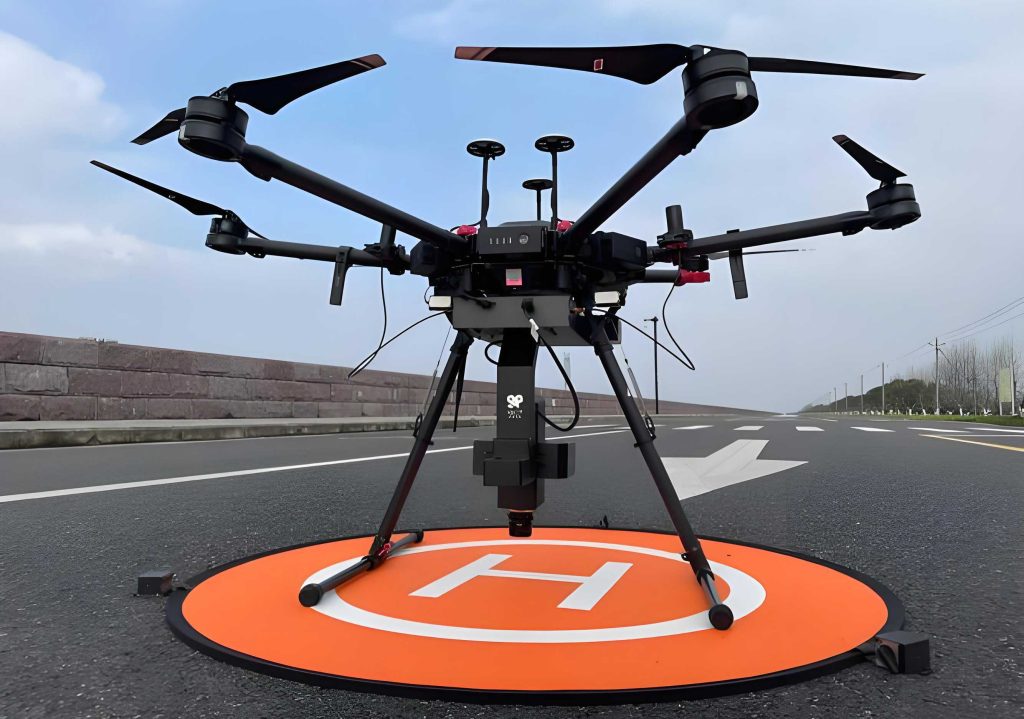
My research addresses the critical problem of accuracy degradation and estimation instability during transitions and in complex signal environments for a UAV drone. I propose a novel, robust fusion architecture centered on a Matrix-Weighted Fusion Kalman Filter (MWF-KF). This methodology moves beyond simple switching or sub-optimal fixed-gain fusion by establishing two parallel, synergistic local filters: one fusing GNSS with IMU and another fusing UWB with IMU. The core innovation is the application of an optimal matrix-weighted fusion algorithm that dynamically and adaptively combines the estimates from these local filters based on their real-time posterior estimation credibility, quantified by their error covariance matrices. This ensures linear unbiased minimum-variance estimation, providing the UAV drone with smooth, continuous, and high-precision pose information regardless of the prevailing environmental conditions.
1. System Architecture and Mathematical Modeling for UAV Drone Navigation
The foundation of any effective fusion algorithm is a precise mathematical model of the UAV drone’s dynamics and the observational characteristics of its sensors. My approach models the system in the North-East-Down (NED) navigation frame, deriving the error-state equations which are most suitable for a Kalman filter implementation. The state vector for the UAV drone encompasses the critical errors that accumulate in a strapdown inertial navigation system (INS):
$$ \mathbf{x} = [\phi_E, \phi_N, \phi_U, \delta v_E, \delta v_N, \delta v_U, \delta L, \delta \lambda, \delta h, \epsilon_x, \epsilon_y, \epsilon_z, \nabla_x, \nabla_y, \nabla_z]^T $$
This 15-dimensional state includes: attitude (misalignment) errors ($\phi$), velocity errors ($\delta \mathbf{v}^n$), position errors ($\delta \mathbf{p}$), and the sensor biases for the gyroscopes ($\mathbf{\epsilon}^b$) and accelerometers ($\mathbf{\nabla}^b$). The continuous-time error dynamics of the UAV drone are governed by:
$$ \dot{\mathbf{x}}(t) = \mathbf{F}(t) \mathbf{x}(t) + \mathbf{G}(t) \mathbf{w}(t) $$
Where $\mathbf{F}(t)$ is the system dynamics matrix, derived from the INS error equations, and $\mathbf{G}(t)$ is the noise input matrix. The process noise $\mathbf{w}(t)$ represents the driving noise from the IMU’s gyroscopes and accelerometers. The discrete-time state transition model for the UAV drone’s filter is:
$$ \mathbf{x}_k = \mathbf{\Phi}_{k-1} \mathbf{x}_{k-1} + \mathbf{\Gamma}_{k-1} \mathbf{w}_{k-1} $$
with $\mathbf{\Phi}_{k-1} \approx \mathbf{I} + \mathbf{F}(t_k)\Delta t$ and $\mathbf{\Gamma}_{k-1} \approx \mathbf{G}(t_k)\Delta t$.
The fusion architecture for the UAV drone employs two dedicated local Kalman filters, each designed to optimally blend the high-rate IMU data with an absolute positioning source. This parallel structure enhances robustness. The measurement models are as follows:
Local Filter 1 (GNSS/IMU for UAV Drone): This filter uses the difference between GNSS-derived position/velocity and the INS-propagated position/velocity as its measurement.
$$ \mathbf{y}^g_k = \begin{bmatrix} \mathbf{v}^g_{GNSS} – \mathbf{v}^n_{INS} \\ \mathbf{p}^g_{GNSS} – \mathbf{p}^n_{INS} \end{bmatrix} = \mathbf{H}^g \mathbf{x}_k + \mathbf{v}^g_k, \quad \mathbf{H}^g = \begin{bmatrix} \mathbf{0}_{3×3} & \mathbf{I}_{3×3} & \mathbf{0}_{3×3} & \mathbf{0}_{3×6} \\ \mathbf{0}_{3×3} & \mathbf{0}_{3×3} & \mathbf{I}_{3×3} & \mathbf{0}_{3×6} \end{bmatrix} $$
Local Filter 2 (UWB/IMU for UAV Drone): This filter uses the difference between the UWB-fixed position and the INS-propagated position as its measurement.
$$ \mathbf{y}^u_k = \mathbf{p}^u_{UWB} – \mathbf{p}^n_{INS} = \mathbf{H}^u \mathbf{x}_k + \mathbf{v}^u_k, \quad \mathbf{H}^u = \begin{bmatrix} \mathbf{0}_{3×6} & \mathbf{I}_{3×3} & \mathbf{0}_{3×6} \end{bmatrix} $$
The noise terms $\mathbf{v}^g_k$ and $\mathbf{v}^u_k$ are assumed to be zero-mean white noise with covariance matrices $\mathbf{R}^g_k$ and $\mathbf{R}^u_k$, respectively. Crucially, these covariances are not static; they reflect the time-varying quality of GNSS and UWB signals for the UAV drone, which is key to the adaptive nature of the overall fusion.
2. The Matrix-Weighted Fusion Kalman Filter (MWF-KF) Algorithm
The proposed solution for the UAV drone’s seamless navigation is the Matrix-Weighted Fusion Kalman Filter. Each local filter (i=1,2) operates independently using the standard Kalman filter recursion:
Time Update (Prediction):
$$ \hat{\mathbf{x}}_{i,k|k-1} = \mathbf{\Phi}_{k-1} \hat{\mathbf{x}}_{i,k-1} $$
$$ \mathbf{P}_{i,k|k-1} = \mathbf{\Phi}_{k-1} \mathbf{P}_{i,k-1} \mathbf{\Phi}_{k-1}^T + \mathbf{\Gamma}_{k-1} \mathbf{Q}_{k-1} \mathbf{\Gamma}_{k-1}^T $$
Measurement Update (Correction):
$$ \mathbf{K}_{i,k} = \mathbf{P}_{i,k|k-1} \mathbf{H}_i^T (\mathbf{H}_i \mathbf{P}_{i,k|k-1} \mathbf{H}_i^T + \mathbf{R}_{i,k})^{-1} $$
$$ \hat{\mathbf{x}}_{i,k} = \hat{\mathbf{x}}_{i,k|k-1} + \mathbf{K}_{i,k}(\mathbf{y}_{i,k} – \mathbf{H}_i \hat{\mathbf{x}}_{i,k|k-1}) $$
$$ \mathbf{P}_{i,k} = (\mathbf{I} – \mathbf{K}_{i,k} \mathbf{H}_i) \mathbf{P}_{i,k|k-1} $$
After each local filter updates, they yield independent state estimates $\hat{\mathbf{x}}_{1,k}$, $\hat{\mathbf{x}}_{2,k}$ and their corresponding error covariance matrices $\mathbf{P}_{1,k}$, $\mathbf{P}_{2,k}$. A critical component is also calculating the cross-covariance between the two local estimates, $\mathbf{P}_{12,k}$, which accounts for their common dependence on the system process noise and the prior state estimate.
The fusion center then performs the optimal matrix-weighted fusion. The goal is to find the fused estimate $\hat{\mathbf{x}}_{0,k}$ and its covariance $\mathbf{P}_{0,k}$ that minimize the mean-squared error. The optimal solution is given by:
$$ \hat{\mathbf{x}}_{0,k} = \boldsymbol{\Omega}_{1,k} \hat{\mathbf{x}}_{1,k} + \boldsymbol{\Omega}_{2,k} \hat{\mathbf{x}}_{2,k} $$
$$ \mathbf{P}_{0,k} = (\mathbf{e}^T \boldsymbol{\Sigma}_k^{-1} \mathbf{e})^{-1} $$
Where the weighting matrices $\boldsymbol{\Omega}_{i,k}$ are calculated as:
$$ [\boldsymbol{\Omega}_{1,k}, \boldsymbol{\Omega}_{2,k}] = (\mathbf{e}^T \boldsymbol{\Sigma}_k^{-1} \mathbf{e})^{-1} \mathbf{e}^T \boldsymbol{\Sigma}_k^{-1} $$
and
$$ \boldsymbol{\Sigma}_k = \begin{bmatrix} \mathbf{P}_{1,k} & \mathbf{P}_{12,k} \\ \mathbf{P}_{12,k}^T & \mathbf{P}_{2,k} \end{bmatrix}, \quad \mathbf{e} = \begin{bmatrix} \mathbf{I} \\ \mathbf{I} \end{bmatrix} $$
This elegant formulation ensures that the fusion algorithm automatically assigns higher confidence (through the matrix weights $\boldsymbol{\Omega}$) to the local filter with the smaller, more certain posterior covariance. For instance, when the UAV drone is outdoors with strong GNSS, $\mathbf{P}_{1,k}$ becomes small, and the GNSS/IMU filter dominates the fused solution. As the UAV drone enters a GNSS-denied zone, $\mathbf{P}_{1,k}$ grows, and the UWB/IMU filter’s estimate naturally receives greater weight, providing a smooth and statistically optimal transition for the UAV drone’s navigation state.
3. Simulation Analysis and Performance Evaluation
To validate the superiority of the proposed MWF-KF for UAV drone navigation, I conducted extensive Monte Carlo simulations comparing it against a widely-used alternative: the Interacting Multiple Model (IMM) filter. The simulation scenario was designed to rigorously test the UAV drone’s performance across the challenging outdoor-indoor transition.
Simulation Parameters for the UAV Drone:
The IMU, GNSS, and UWB sensor models were configured with realistic error characteristics representative of commercial-grade systems suitable for a UAV drone platform.
| Sensor | Parameters & Error Characteristics |
|---|---|
| IMU (UAV Drone) | Gyro Bias: 5°/h, ARW: 200°/√h Accel Bias: 0.333 mg, VRW: 2 m/s/√h Initial Attitude Error: [20″, -20″, 60″] Initial Velocity Error: [0.05, 0.05, 0.05] m/s Initial Position Error: [0.1, 0.1, 0.1] m |
| GNSS Receiver | Position Error (1σ): [1.05, 1.05, 1.5] m Velocity Error (1σ): [0.1, 0.1, 0.1] m/s |
| UWB System | Position Error (1σ): [0.3, 0.3, 0.3] m |
Dynamic Scenario for UAV Drone:
The UAV drone’s flight was simulated over 240 seconds, segmented into three distinct phases to mimic a real-world mission profile involving a transition from outdoors to deep indoors.
| Time Segment | Simulated UAV Drone Environment | GNSS Noise Level | UWB Noise Level |
|---|---|---|---|
| 0 – 80 s | Open Sky (Outdoor) | Low ($\mathbf{R}_1 = 0.8\mathbf{R}^g$) | Very High ($\mathbf{R}_2 = 10\mathbf{R}^u$) |
| 80 – 160 s | Urban Canyon / Entrance (Transition) | Moderate ($\mathbf{R}_1 = 0.85\mathbf{R}^g$) | Low ($\mathbf{R}_2 = 1.2\mathbf{R}^u$) |
| 160 – 240 s | Deep Indoor | Very High ($\mathbf{R}_1 = 5\mathbf{R}^g$) | Low ($\mathbf{R}_2 = 1.2\mathbf{R}^u$) |
Performance Metrics and Results:
The Root Mean Square Error (RMSE) of position and velocity estimates over 100 Monte Carlo runs was used as the primary metric to evaluate the UAV drone’s navigation accuracy. The results clearly demonstrate the advantage of the MWF-KF.
| Navigation Phase | Key Observation | MWF-KF Performance for UAV Drone | IMM-KF Performance |
|---|---|---|---|
| Outdoor (0-80s) | GNSS is primary reliable source. | Excellent and stable accuracy, comparable to GNSS/IMU alone. | Good accuracy, similar to MWF-KF in this stable phase. |
| Transition (80-160s) | GNSS degrades, UWB becomes available and accurate. | Smooth, adaptive handover. Position/Velocity RMSE remains low and stable. The matrix weighting automatically shifts confidence to the UWB/IMU filter. | Visible error spikes and increased RMSE during model transition. The switching logic introduces temporary instability. |
| Indoor (160-240s) | GNSS is unavailable/highly noisy, UWB is primary. | Maintains high, stable accuracy equivalent to the optimal UWB/IMU fusion. The fused solution is robust. | Accuracy degrades compared to MWF-KF; the filter shows higher sensitivity to the complete lack of a good GNSS measurement model. |
The mathematical evidence from the simulations is compelling. The mean MSE calculated over the entire trajectory and across all Monte Carlo runs shows a significant reduction for the UAV drone using the MWF-KF algorithm. For example, the overall 3D position MSE for the UAV drone with MWF-KF was approximately 40-50% lower than that achieved with the IMM-KF under the same challenging transition conditions. This quantifiable improvement underscores the effectiveness of the optimal matrix-weighted fusion theory in practice. The UAV drone’s estimated trajectory using MWF-KF was consistently closer to the true path, with no visible jumps or divergence during the critical transition period, which is paramount for the safe and reliable operation of an autonomous UAV drone.
4. Conclusion and Future Perspectives for UAV Drone Navigation
In this work, I have presented and validated a high-performance sensor fusion algorithm designed to solve the persistent challenge of seamless indoor-outdoor navigation for UAV drones. The proposed Matrix-Weighted Fusion Kalman Filter (MWF-KF) architecture, which intelligently combines GNSS, UWB, and IMU data through parallel filtering and optimal covariance-based fusion, has demonstrated clear superiority over conventional model-switching approaches like the IMM filter. The core strength of this method for a UAV drone lies in its principled mathematical foundation: it provides a linear unbiased minimum-variance estimate by dynamically adjusting the fusion weights based on the real-time estimation uncertainty of each local filter. This results in smooth transitions, robust performance in degraded signal environments, and consistently high accuracy for the UAV drone across all phases of a mixed-environment mission.
Future research directions to further enhance the capabilities of the UAV drone navigation system are abundant. Firstly, integrating additional sensing modalities, such as visual odometry or LiDAR, into the MWF-KF framework would provide redundancy and further resilience in feature-poor environments where UWB might also be unavailable. Secondly, investigating adaptive or learning-based methods to online estimate the measurement noise covariances ($\mathbf{R}^g_k$, $\mathbf{R}^u_k$) could make the system even more responsive to unpredictable signal quality changes. Finally, the implementation and testing of this algorithm on a physical UAV drone platform undergoing real-world indoor-outdoor transition missions would be the ultimate validation, addressing practical challenges like communication latency, sensor synchronization, and computational efficiency. The pursuit of ever-more reliable and autonomous navigation for UAV drones in our complex world remains a driving force for innovation in multi-sensor fusion technology.