
In the rapidly evolving field of unmanned aerial vehicles (UAV drones), the demand for lightweight, high-strength, and multifunctional materials is paramount. My research focuses on the development and application of high-performance organic fiber paper-based composites, specifically tailored for UAV drone structures. These composites, derived from aramid fibers, offer exceptional mechanical, thermal, and electrical properties that are ideal for aerospace applications. This article presents a comprehensive study on the modified preparation of these composites using silk fibroin as a reinforcing agent, evaluating their performance for use in UAV drones. The integration of such advanced materials can significantly enhance the durability, efficiency, and operational capabilities of UAV drones, making them more reliable for various missions, from surveillance to delivery.
The core of this investigation lies in the utilization of organic aramid fibers, which are known for their high tensile strength, modulus, and thermal stability. For UAV drones, weight reduction without compromising strength is critical, as it directly impacts flight time, payload capacity, and maneuverability. Paper-based composites, fabricated through wet-laying processes, provide a unique combination of flexibility, low density, and design adaptability. In my work, I modified aramid nanofibers with silk fibroin to improve interfacial bonding and overall composite performance. The following sections detail the methodology, results, and implications of this study, emphasizing how these composites can revolutionize material science for UAV drones.
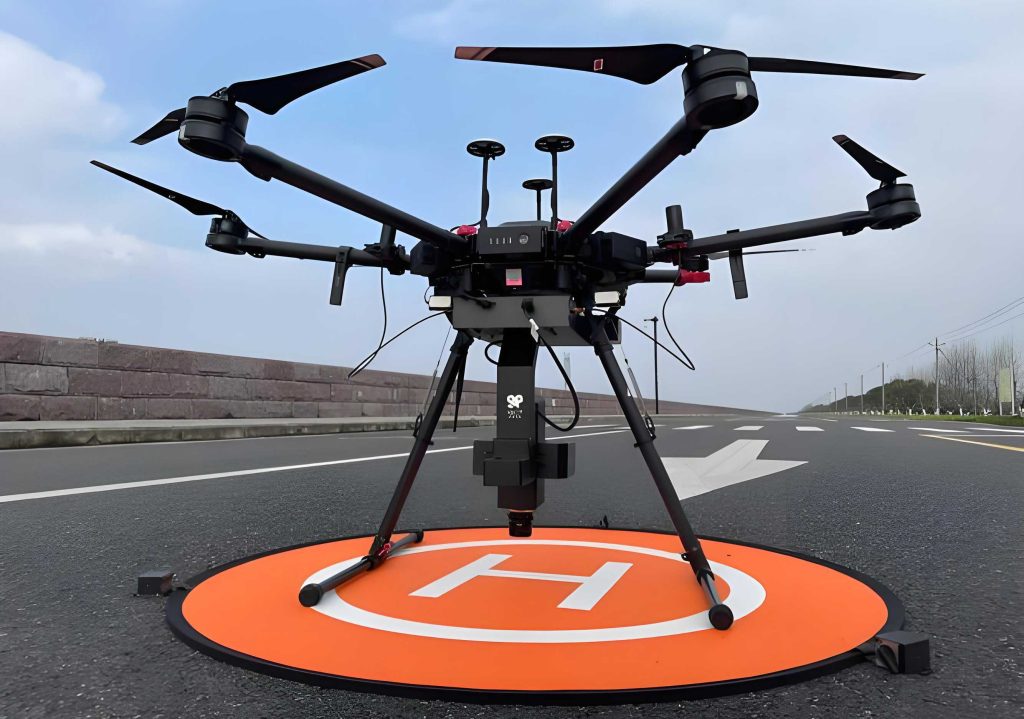
UAV drones have become integral in modern technology, with applications spanning military, agricultural, environmental monitoring, and logistics. Their success hinges on advanced materials that can withstand harsh conditions while maintaining structural integrity. Organic aramid fibers, particularly para-aramid variants, exhibit outstanding properties such as high strength-to-weight ratio, resistance to impact, and excellent thermal insulation. These attributes make them suitable for UAV drone components like fuselage panels, wings, and internal supports. Paper-based composites from aramid fibers further enhance these benefits by incorporating paper-like processability, allowing for complex shapes and lightweight designs. In my research, I aimed to optimize these composites for UAV drone use by addressing key performance metrics: mechanical strength, thermal conductivity, electrical insulation, and wetting behavior.
The current application landscape of organic aramid fibers in UAV drones includes their use as reinforcement in honeycomb cores and structural laminates. Honeycomb materials, derived from aramid paper composites, offer high stiffness and energy absorption, crucial for crashworthiness in UAV drones. However, challenges such as interfacial adhesion and moisture sensitivity persist. To overcome these, I introduced silk fibroin, a natural protein known for its biocompatibility and mechanical robustness, as a modifier. Silk fibroin can form hydrogen bonds with aramid fibers, enhancing cohesion and reducing defects. This modification not only improves mechanical properties but also tailors other characteristics essential for UAV drones, such as dielectric strength for electronic insulation and thermal management for prolonged operation.
In this study, I prepared high-performance organic aramid nanofiber paper-based composites through a series of steps. First, aramid short fibers were pretreated with phosphoric acid to remove impurities and improve surface activity. Then, silica nanoparticles were in-situ synthesized on the fiber surfaces via a sol-gel process, resulting in aramid nanofibers with enhanced interfacial properties. These nanofibers were dispersed in dimethyl sulfoxide (DMSO) to form a stable suspension. Simultaneously, silk fibroin was purified and dissolved to create a homogeneous solution. The two components were mixed in varying proportions, with silk fibroin amounts ranging from 0 to 2.5 grams, to produce composite slurries. These slurries were vacuum-filtered into wet sheets and dried under controlled conditions to yield the final paper-based composites. The entire process was designed to ensure uniform fiber distribution and strong bonding, which are vital for consistent performance in UAV drone applications.
To characterize the composites, I conducted multiple tests. Mechanical properties were evaluated using tensile testing, with parameters such as tensile strength, elongation at break, and toughness calculated. Toughness, defined as the energy absorbed per unit volume before failure, was derived from the integral of the stress-strain curve: $$Q = \int_0^{\epsilon_0} \sigma d\epsilon$$ where $Q$ is the absorbed energy (MJ/mm³), $\epsilon_0$ is the elongation at break (\%), $\epsilon$ is strain, and $\sigma$ is stress. Thermal conductivity was measured with a heat constant analyzer, and dielectric strength was assessed via breakdown voltage tests, fitted with a Weibull distribution function for accuracy: $$E = \frac{U}{d}$$ and $$F(E) = 1 – \exp\left[-\left(\frac{E}{E_0}\right)^\beta\right]$$ where $E$ is dielectric strength (kV/mm), $U$ is breakdown voltage (kV), $d$ is thickness (mm), $F$ is failure probability (\%), $E_0$ is characteristic strength (kV/mm), and $\beta$ is the Weibull coefficient. Wetting behavior was analyzed through water contact angle measurements. All tests were repeated five times for reliability, with averages reported. These comprehensive evaluations ensure that the composites meet the stringent requirements for UAV drones, where performance under diverse environmental conditions is critical.
The results revealed significant improvements in composite properties with silk fibroin modification. Table 1 summarizes the mechanical performance, showing that tensile strength, elongation, and toughness initially increased with silk fibroin content, peaking at 1.5 grams, then declined. This trend indicates an optimal reinforcement level, where silk fibroin enhances interfacial bonding via hydrogen interactions and β-sheet structures, but excess amounts lead to agglomeration and defects. For UAV drones, this optimal point translates to better load-bearing capacity and impact resistance, essential for withstanding aerodynamic forces and potential collisions.
| Silk Fibroin Amount (g) | Tensile Strength (MPa) | Elongation at Break (%) | Toughness (MJ/mm³) |
|---|---|---|---|
| 0 | 167.3 | 10.4 | 11.4 |
| 1.0 | 248.8 | 19.3 | 34.0 |
| 1.5 | 263.0 | 24.7 | 38.6 |
| 2.0 | 230.9 | 21.8 | 34.4 |
| 2.5 | 218.0 | 19.4 | 27.5 |
Thermal conductivity, as shown in Table 2, exhibited a slight increase with higher silk fibroin content, but remained low overall. This is advantageous for UAV drones, as it suggests good thermal insulation, preventing heat buildup from electronic components or external sources. The slight rise may be attributed to the protein’s inherent properties, yet it does not compromise the composite’s ability to manage thermal loads in UAV drone operations.
| Silk Fibroin Amount (g) | Thermal Conductivity (W/(m·K)) |
|---|---|
| 0 | 0.035 |
| 1.0 | 0.038 |
| 1.5 | 0.040 |
| 2.0 | 0.043 |
| 2.5 | 0.044 |
Dielectric strength, critical for insulating UAV drone electronics, improved progressively with silk fibroin addition, as detailed in Table 3. The Weibull fitting confirmed this enhancement, with higher values indicating better resistance to electrical breakdown. For UAV drones, this means enhanced safety and reliability in humid or high-voltage environments, reducing the risk of short circuits that could compromise mission integrity.
| Silk Fibroin Amount (g) | Dielectric Strength (kV/mm) |
|---|---|
| 0 | 41.5 |
| 1.0 | 41.8 |
| 1.5 | 47.2 |
| 2.0 | 49.5 |
| 2.5 | 63.0 |
Wetting behavior, assessed through water contact angles, showed a clear increase with silk fibroin content, as presented in Table 4. Higher contact angles imply greater hydrophobicity, which is beneficial for UAV drones operating in rainy or humid conditions, as it reduces water absorption and prevents degradation of mechanical and electrical properties. This characteristic helps maintain the structural integrity of UAV drones over time, extending their service life.
| Silk Fibroin Amount (g) | Water Contact Angle (°) |
|---|---|
| 0 | 45.6 |
| 1.0 | 52.9 |
| 1.5 | 66.3 |
| 2.0 | 77.0 |
| 2.5 | 84.4 |
The discussion of these results highlights the multifaceted benefits of silk fibroin modification. Mechanically, the optimal silk fibroin content of 1.5 grams maximizes hydrogen bonding and β-sheet formation, leading to superior tensile strength and toughness. This is crucial for UAV drones, which experience dynamic stresses during flight. The toughness integral, $$Q = \int_0^{\epsilon_0} \sigma d\epsilon$$, underscores the energy absorption capability, a key factor for impact resistance in UAV drones. Thermally, the low conductivity values ensure that the composites act as effective insulators, protecting sensitive UAV drone components from overheating. The slight increase with silk fibroin may be due to improved matrix density, but it remains within acceptable limits for UAV drone applications.
Electrically, the enhanced dielectric strength, modeled by $$F(E) = 1 – \exp\left[-\left(\frac{E}{E_0}\right)^\beta\right]$$, demonstrates that silk fibroin fills voids and restricts charge migration, reducing the likelihood of dielectric failure. For UAV drones, this translates to robust insulation for onboard electronics, enhancing operational safety in diverse environments. In terms of wetting, the increased contact angles indicate a more hydrophobic surface, which minimizes water ingress and associated issues like swelling or corrosion. This property is particularly valuable for UAV drones deployed in maritime or rainy regions, where moisture resistance is essential for longevity.
From a broader perspective, the application of these high-performance composites in UAV drones can revolutionize design paradigms. For instance, lighter structures allow for increased payload capacity or extended flight times, directly boosting the efficiency of UAV drones. The composites’ flexibility enables complex aerodynamic shapes, improving flight stability and control. Moreover, their insulation properties safeguard against electromagnetic interference, a common challenge in crowded airspaces. In my research, I also considered scalability; the wet-laying process used is industrially feasible, making mass production for UAV drones economically viable. Future work could explore hybrid modifications with other nanomaterials to further enhance properties like fire resistance or self-healing, pushing the boundaries of what UAV drones can achieve.
In conclusion, my study demonstrates that silk fibroin-modified organic aramid nanofiber paper-based composites offer a promising material solution for UAV drones. With optimal silk fibroin content, these composites exhibit enhanced mechanical strength, adequate thermal insulation, improved dielectric properties, and favorable wetting behavior. These attributes align perfectly with the demands of modern UAV drones, supporting their advancement in various sectors. As UAV drone technology continues to evolve, such high-performance composites will play a pivotal role in enabling lighter, safer, and more durable aerial platforms. Further research should focus on long-term durability testing and integration into actual UAV drone prototypes to validate real-world performance. Ultimately, the synergy between material science and UAV drone engineering holds immense potential for innovation, driving progress in aerospace and beyond.
The implications of this work extend beyond UAV drones to other aerospace and automotive applications, where lightweight composites are increasingly sought. However, the specific focus on UAV drones underscores their growing importance in global technology landscapes. By tailoring materials to meet the unique challenges of UAV drones, we can unlock new capabilities and efficiencies. In my ongoing investigations, I plan to explore environmental impacts and recyclability of these composites, ensuring sustainable development for UAV drone industries. The journey toward optimal materials for UAV drones is continuous, and this research represents a significant step forward in that endeavor.
To summarize the key equations used in this study: the toughness calculation $$Q = \int_0^{\epsilon_0} \sigma d\epsilon$$ provides insight into mechanical resilience, while the dielectric strength formulas $$E = \frac{U}{d}$$ and $$F(E) = 1 – \exp\left[-\left(\frac{E}{E_0}\right)^\beta\right]$$ offer a statistical understanding of electrical performance. These mathematical frameworks are essential for quantifying composite behavior and guiding design choices for UAV drones. As UAV drone applications diversify, from delivery services to environmental monitoring, the need for reliable data-driven material selection becomes ever more critical, and this research contributes to that foundation.
In final reflection, the integration of high-performance organic fiber composites into UAV drones represents a convergence of chemistry, physics, and engineering. My work highlights how simple modifications, like silk fibroin addition, can yield substantial improvements, making UAV drones more robust and versatile. The tables presented herein encapsulate the empirical evidence, showcasing trends that inform future material optimizations. As we advance, collaboration across disciplines will be key to harnessing the full potential of these composites for UAV drones, ultimately shaping the future of unmanned aviation.