
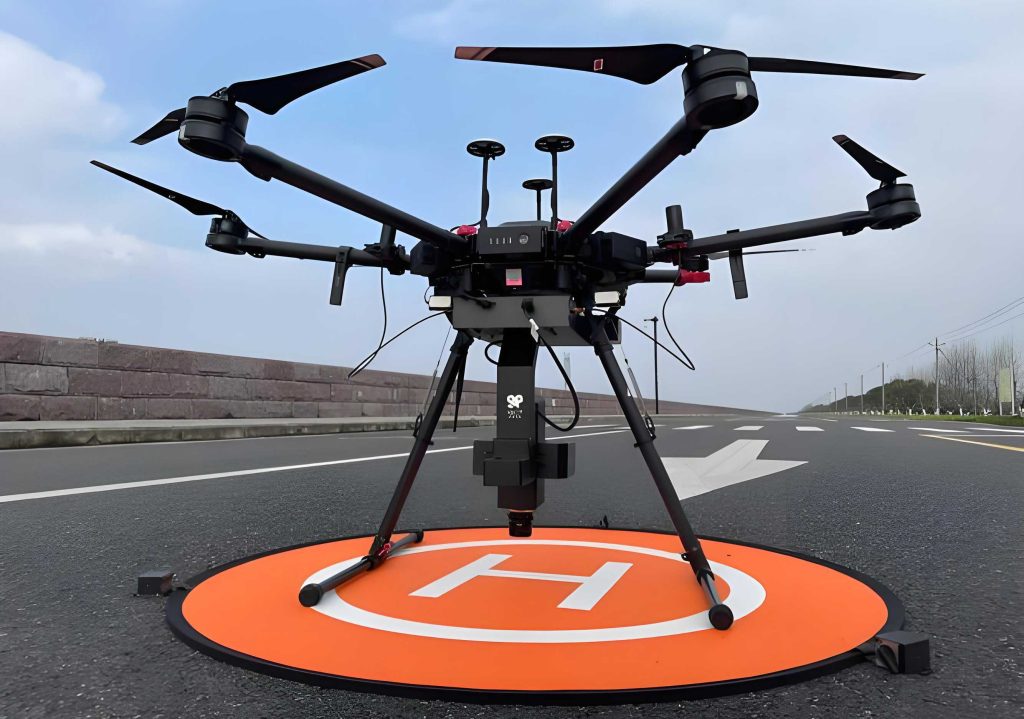
The modern battlefield, as well as numerous post-disaster and remote-area scenarios, presents a severe communication paradox. While the need for reliable, real-time information exchange is paramount, the very infrastructure enabling it—terrestrial base stations—is highly vulnerable to destruction. This vulnerability creates critical communication blackouts, crippling coordination, situational awareness, and command efficacy. To bridge this gap, our work turns to the skies, proposing an intelligent, resilient communication architecture built upon the coordinated operation of **UAV drone** swarms.
Traditional single **UAV drone** solutions are often inadequate for this task, constrained by limited endurance, payload capacity, and the sheer complexity of autonomous navigation in contested environments. The paradigm shift lies in **UAV drone** swarm technology, where multiple drones collaborate, creating a collective capability far exceeding the sum of its parts. Inspired by swarm intelligence observed in nature, we can design systems where simple rules followed by individual agents lead to sophisticated, emergent group behaviors—perfect for adaptive path planning and task allocation in dynamic, resource-constrained settings like a battlefield.
In this article, we address the critical challenge of information ferrying in a hostile, base-station-denied environment. We envision a hierarchical, space-air-ground integrated network. At its core are stationary Relay **UAV drone**s (R-UAVs), each deployed over a key sector or “theater” of operations. These R-UAVs act as aerial data hubs, collecting intelligence from ground units or other drones within their sector. The question then becomes: how to efficiently gather this distributed data and relay it to a secure, global command center? Our answer is a mobile Ferry **UAV drone** (F-UAV). This **UAV drone** acts as a “data mule,” cruising between the stationary R-UAVs, downloading their cached data, and eventually uploading the aggregated intelligence to a Low Earth Orbit (LEO) satellite for long-haul transmission.
The efficiency of this entire system hinges on one critical factor: the total delay from data generation at the R-UAVs to its reception by the satellite gateway. This delay is a composite of the F-UAV’s flight time between nodes, the data transfer time at each hover point, and the final uplink time to the LEO. Conventional **UAV drone** path planning often focuses narrowly on minimizing flight distance, treating communication as a binary, fixed-rate event. We argue this is a suboptimal approach. The position where the F-UAV hovers to communicate with an R-UAV dramatically influences the data transfer rate due to distance-dependent path loss. Therefore, a globally optimal solution requires *jointly* optimizing the F-UAV’s *traveling path* (the sequence of visiting R-UAVs) and its *precise hovering position* near each R-UAV.
This is a complex, three-dimensional optimization problem. To solve it, we propose the Ferry Cruising Optimization (FCO) algorithm. The FCO algorithm is a novel two-stage, swarm-intelligence-inspired method. In its first stage, it solves the optimal visitation sequence—a classic Traveling Salesman Problem (TSP) variant—using a principle akin to ant colony optimization, where virtual pheromones guide the search for the shortest cyclic path. In its second, innovative stage, it breaks from tradition. Instead of simply hovering directly above each R-UAV, FCO employs a geometric similarity principle to compute an optimal hover point that shortens the flight leg to the *next* R-UAV while maintaining a high-quality communication link with the current one. This joint optimization outputs a globally efficient 3D cruise trajectory, minimizing the system’s total delay.
Our simulations, conducted in a simulated hostile region, demonstrate that the FCO algorithm significantly outperforms other intelligent optimization techniques like Simulated Annealing (SA) and a Discrete Particle Swarm Optimization (DPSO) in planning shorter flight paths, especially as the number of theaters increases. Furthermore, the hover position optimization stage provides an additional measurable reduction in total travel distance. This work underscores the power of bio-inspired swarm intelligence in solving complex logistics problems for **UAV drone** networks, paving the way for more robust and efficient communication systems in the most demanding environments.
## System Model and Problem Statement
We model the operational area as a grid divided into \( L \) distinct sectors or theaters. Each theater \( l \), where \( l \in \{1, 2, …, L\} \), has a central command point or Military Center (MC). A Relay **UAV drone** (R-UAV), denoted \( RU_l \), is deployed and stationed at the MC’s location, serving as the aerial communication hub for that sector. The position of \( RU_l \) is fixed and known, represented as \( (x_l^R, y_l^R, h_l^R) \). This **UAV drone** is responsible for aggregating data from assets within its theater.
A dedicated Ferry **UAV drone** (F-UAV) operates from a central, secure Ferry Charging Station (FCS), located at \( (x_0^F, y_0^F, 0) \). This **UAV drone** is the mobile courier. Its mission is to take off from the FCS, visit each of the \( L \) R-UAVs in a specific order to collect their data, return to the FCS, and finally transmit the complete aggregated dataset to an LEO satellite.
Let the planned cruise path be an ordered set \( S = \{ RU_{s_1}, RU_{s_2}, …, RU_{s_L} \} \), where \( s_m \in \{1, 2, …, L\} \) denotes the index of the R-UAV that is the \( m \)-th stop on the tour. The F-UAV’s hovering position when communicating with \( RU_{s_m} \) is \( (x_{s_m}^F, y_{s_m}^F, h_{s_m}^F) \). A minimum safe distance \( d_{safe} \) must be maintained between the F-UAV and any R-UAV to avoid collision, so we have the constraint: \( \sqrt{(x_{s_m}^F – x_{s_m}^R)^2 + (y_{s_m}^F – y_{s_m}^R)^2 + (h_{s_m}^F – h_{s_m}^R)^2} \geq d_{safe} \).
The total system delay \( T_{total} \) is the primary performance metric. It comprises three components:
1. **Flight Delay (\( T_f \))**: The time for the F-UAV to travel the entire cruise path.
2. **Data Transfer Delay (\( T_d \))**: The total time spent by the F-UAV hovering and downloading data from all \( L \) R-UAVs.
3. **Data Upload Delay (\( T_u \))**: The time for the F-UAV to transmit the complete collected dataset to the LEO satellite from the FCS.
Our objective is to minimize this total delay:
$$ \min T_{total} = T_f + T_d + T_u $$
The core challenge is that \( T_f \) depends on the path length (a function of sequence \( S \) and hover positions), while \( T_d \) depends on the data transfer rate at each hover point (a function of the F-UAV to R-UAV distance, which is influenced by the hover position). This creates the need for the joint optimization of path and hover points.
## UAV Swarm Communication Models
The performance of our FCO algorithm hinges on accurate models for the two critical communication links: between the **UAV drone**s themselves (F-UAV to R-UAV) and between the **UAV drone** and the satellite (F-UAV to LEO).
### F-UAV to LEO Satellite Link
The LEO satellite provides the wide-area backhaul. We assume the F-UAV only engages this link when stationary at the FCS. Given the satellite’s altitude \( h_L \) (e.g., 550 km) is much larger than variations in **UAV drone** altitude, the distance is approximately constant. The achievable uplink data rate \( R_{F,L} \) is modeled as:
The received power at the LEO is:
$$ P_{F,L}^{Rx} = \frac{P_{F,L}^{Tx} G_F^{Tx} G_L^{Rx} \lambda_s^2}{(4\pi h_L)^2} $$
where \( P_{F,L}^{Tx} \) is the F-UAV’s transmit power, \( G_F^{Tx} \) and \( G_L^{Rx} \) are the antenna gains of the **UAV drone** and satellite, respectively, and \( \lambda_s \) is the wavelength.
The uplink data rate is then:
$$ R_{F,L} = B_{F,L} \log_2\left(1 + \frac{P_{F,L}^{Rx}}{B_{F,L} \tau \epsilon}\right) $$
Here, \( B_{F,L} \) is the allocated bandwidth for the **UAV drone**-LEO link, \( \tau \) is the noise temperature, and \( \epsilon \) is Boltzmann’s constant.
### F-UAV to R-UAV Communication Link
For the inter-**UAV drone** links, we assume a free-space path loss model, which is suitable for the relatively clear aerial environment. The channel power gain \( g_{s_m} \) between the F-UAV and \( RU_{s_m} \) is:
$$ g_{s_m} = \frac{g_0}{d_{s_m}^2} $$
where \( g_0 \) is the channel gain at a reference distance of 1 meter, and \( d_{s_m} \) is the Euclidean distance between them:
$$ d_{s_m} = \sqrt{(x_{s_m}^F – x_{s_m}^R)^2 + (y_{s_m}^F – y_{s_m}^R)^2 + (h_{s_m}^F – h_{s_m}^R)^2} $$
The data transfer rate \( R_{s_m} \) for downloading data from \( RU_{s_m} \) is:
$$ R_{s_m} = B_{s_m} \log_2\left(1 + \frac{p_{s_m} g_{s_m}}{N_0 B_{s_m}}\right) $$
In this equation, \( B_{s_m} \) is the channel bandwidth, \( p_{s_m} \) is the transmit power of the R-UAV, and \( N_0 \) is the noise power spectral density. It is clear that \( R_{s_m} \) is highly sensitive to \( d_{s_m} \); minimizing this distance during communication is crucial for reducing \( T_d \), but it cannot be reduced below \( d_{safe} \).
## Delay Model and Problem Formulation
Based on the communication models, we now formalize the three delay components.
### 1. Flight Delay (\( T_f \))
Assuming the F-UAV flies at a constant velocity \( v_f \), the flight delay is simply the total travel distance divided by speed. The distance is the sum of all legs of the journey:
$$ D_{total} = d_{0,s_1}^f + \sum_{m=1}^{L-1} d_{s_m, s_{m+1}}^f + d_{s_L,0}^f $$
where
$$ d_{0,s_1}^f = \sqrt{(x_{s_1}^F – x_0^F)^2 + (y_{s_1}^F – y_0^F)^2 + (h_{s_1}^F)^2} $$
$$ d_{s_m, s_{m+1}}^f = \sqrt{(x_{s_{m+1}}^F – x_{s_m}^F)^2 + (y_{s_{m+1}}^F – y_{s_m}^F)^2 + (h_{s_{m+1}}^F – h_{s_m}^F)^2} $$
$$ d_{s_L,0}^f = \sqrt{(x_0^F – x_{s_L}^F)^2 + (y_0^F – y_{s_L}^F)^2 + (h_{s_L}^F)^2} $$
Thus,
$$ T_f = \frac{D_{total}}{v_f} $$
### 2. Data Transfer Delay (\( T_d \))
This is the sum of the time required to download the cached data \( Data_{s_m} \) from each R-UAV at the achieved rate \( R_{s_m} \):
$$ T_d = \sum_{m=1}^{L} \frac{Data_{s_m}}{R_{s_m}} $$
As \( R_{s_m} \) depends on \( d_{s_m} \), and we enforce \( d_{s_m} \ge d_{safe} \), the theoretical minimum for \( T_d \) occurs when \( d_{s_m} = d_{safe} \) for all \( m \). This gives a lower bound:
$$ T_d^{min} = \sum_{m=1}^{L} \frac{Data_{s_m}}{B_{s_m} \log_2\left(1 + \frac{p_{s_m} g_0}{N_0 B_{s_m} d_{safe}^2}\right)} $$
### 3. Data Upload Delay (\( T_u \))
After returning to the FCS, the F-UAV uploads all collected data \( \sum_{m=1}^{L} Data_{s_m} \) to the LEO at rate \( R_{F,L} \):
$$ T_u = \frac{\sum_{m=1}^{L} Data_{s_m}}{R_{F,L}} $$
### Joint Optimization Problem
The complete optimization problem can be stated as:
$$
\begin{aligned}
& \underset{S, \, \{x_{s_m}^F, y_{s_m}^F, h_{s_m}^F\}_{m=1}^L}{\text{minimize}}
& & T_{total} = \frac{D_{total}}{v_f} + \sum_{m=1}^{L} \frac{Data_{s_m}}{R_{s_m}} + \frac{\sum_{m=1}^{L} Data_{s_m}}{R_{F,L}} \\
& \text{subject to}
& & d_{s_m} \geq d_{safe}, \quad \forall m \in \{1, …, L\} \\
& & & S \text{ is a permutation of } \{1, 2, …, L\} \\
& & & R_{s_m} = B_{s_m} \log_2\left(1 + \frac{p_{s_m} g_0}{N_0 B_{s_m} d_{s_m}^2}\right) \\
& & & \text{Definitions for } D_{total}, d_{s_m} \text{ as above.}
\end{aligned}
$$
This is a mixed-variable optimization problem involving a discrete permutation (the path \( S \)) and continuous variables (the hover positions). The FCO algorithm is designed to tackle this problem efficiently.
## The Ferry Cruising Optimization (FCO) Algorithm
The FCO algorithm intelligently decouples and solves the joint optimization problem in two synergistic stages. The key insight is that while the optimal hover position influences the optimal path, the sensitivity is limited if hover adjustments are local. Therefore, we first find a high-quality visitation sequence assuming nominal hover points, and then refine the hover points to shorten the overall path for that specific sequence.
### Stage 1: F-UAV Cruise Path Planning via Swarm Intelligence
Finding the sequence \( S \) that minimizes the flight distance \( D_{total} \) (assuming hover points are right above each R-UAV at \( d_{safe} \)) is a classic TSP. We employ an Ant Colony Optimization (ACO)-inspired swarm intelligence algorithm. In this metaphor, a population of “ants” (solution constructors) probabilistically builds tours based on “pheromone” trails \( \tau_{i,j} \) and a heuristic desirability \( \eta_{i,j} \), which is typically the inverse of the distance between nodes \( i \) and \(j\).
**Algorithm Steps:**
1. **Initialization:** Set parameters (population size \( pop \), max iterations \( max\_iter \), pheromone evaporation rate \( \rho \), etc.). Initialize pheromone trails \( \tau_{i,j}(0) \) to a small constant. Define the heuristic as \( \eta_{i,j} = 1 / d_{i,j}^f \), where \( d_{i,j}^f \) is the distance between the nominal hover points near R-UAV \( i \) and \( j \).
2. **Solution Construction:** For each ant \( k \) in every generation:
* Start at the FCS (node 0).
* Choose the next unvisited R-UAV \( j \) from the current node \( i \) with a probability \( p_{i,j}^k \) given by:
$$ p_{i,j}^k = \frac{[\tau_{i,j}(t)]^\alpha [\eta_{i,j}]^\beta}{\sum_{l \in \text{allowed}_k} [\tau_{i,l}(t)]^\alpha [\eta_{i,l}]^\beta} \quad \text{if } j \in \text{allowed}_k $$
where \( \alpha \) and \( \beta \) control the relative importance of pheromone versus heuristic, and \( allowed_k \) is the set of R-UAVs not yet visited by ant \( k \).
* Repeat until all R-UAVs are visited, then return to the FCS.
3. **Pheromone Update:**
* **Evaporation:** All pheromone trails weaken: \( \tau_{i,j}(t+1) = (1-\rho) \cdot \tau_{i,j}(t) \).
* **Deposition:** Only the ant (or ants) that found the best tour in the iteration (e.g., the shortest \( D_{total} \)) deposit additional pheromone on the edges of their path:
$$ \tau_{i,j}(t+1) \leftarrow \tau_{i,j}(t+1) + \frac{Q}{D_{best}} \quad \text{for all } (i,j) \in \text{best\_tour} $$
where \( Q \) is a constant and \( D_{best} \) is the length of the best tour.
4. **Termination:** Repeat steps 2-3 until \( max\_iter \) is reached. Output the best-found sequence \( S^* \).
This process allows the swarm to collectively “learn” and converge on an efficient visitation order, leveraging positive feedback from shorter paths.
### Stage 2: F-UAV Hover Position Optimization
Once \( S^* = \{ RU_{s_1}, RU_{s_2}, …, RU_{s_L} \} \) is determined, we can refine the hover positions to reduce \( D_{total} \) further. The naive approach is to hover at the point on the sphere of radius \( d_{safe} \) around \( RU_{s_m} \) that is closest to \( RU_{s_{m+1}} \). However, this myopic optimization might not be globally optimal. FCO uses a smarter, geometry-aware adjustment.
Consider the F-UAV traveling from hover point \( \mathbf{H}_m = (x_m^F, y_m^F, h_m^F) \) near \( RU_{s_m} \) to the next R-UAV location \( \mathbf{R}_{s_{m+1}} = (x_{s_{m+1}}^R, y_{s_{m+1}}^R, h_{s_{m+1}}^R) \). The nominal next hover point \( \mathbf{H}_{m+1}^{nom} \) is directly above \( \mathbf{R}_{s_{m+1}} \) at a distance \( d_{safe} \). The key idea is to choose a new hover point \( \mathbf{H}_{m+1}^{opt} \) that lies on the line connecting \( \mathbf{R}_{s_{m+1}} \) and \( \mathbf{H}_{m+1}^{nom} \), but shifted towards \( \mathbf{H}_m \), thereby shortening the flight leg \( \| \mathbf{H}_{m+1}^{opt} – \mathbf{H}_m \| \).
This is solved using similar triangles. The vector from \( \mathbf{R}_{s_{m+1}} \) to \( \mathbf{H}_{m+1}^{nom} \) is known. We project the vector from \( \mathbf{R}_{s_{m+1}} \) to \( \mathbf{H}_m \) onto this direction. The optimal hover point is determined such that the distance from \( \mathbf{R}_{s_{m+1}} \) is still \( d_{safe} \), but it is the point on the sphere closest to the *line* from \( \mathbf{H}_m \) to \( \mathbf{R}_{s_{m+1}} \). The new coordinates for \( \mathbf{H}_{m+1}^{opt} = (x_{m+1}^{F’}, y_{m+1}^{F’}, h_{m+1}^{F’}) \) are calculated as:
$$ x_{m+1}^{F’} = x_{s_{m+1}}^R + \frac{d_{safe}}{d_{m, s_{m+1}}} (x_m^F – x_{s_{m+1}}^R) $$
$$ y_{m+1}^{F’} = y_{s_{m+1}}^R + \frac{d_{safe}}{d_{m, s_{m+1}}} (y_m^F – y_{s_{m+1}}^R) $$
$$ h_{m+1}^{F’} = h_{s_{m+1}}^R + \frac{d_{safe}}{d_{m, s_{m+1}}} (h_m^F – h_{s_{m+1}}^R) $$
where \( d_{m, s_{m+1}} = \| \mathbf{H}_m – \mathbf{R}_{s_{m+1}} \| \). This process is applied sequentially along the tour \( S^* \), starting from the first hover point (which is simply \( d_{safe} \) above the first R-UAV in the direction from the FCS). The result is a smooth, spatially optimized 3D trajectory where the **UAV drone** “cuts corners” between communication stops, minimizing flight time without compromising the data transfer rate.
## Simulation Results and Analysis
To validate the FCO algorithm, we conducted extensive simulations in a simulated \( 10 \text{ km} \times 10 \text{ km} \) hostile region. Key simulation parameters are listed below.
**Table 1: Key Simulation Parameters**
| Parameter | Symbol | Value |
| :— | :— | :— |
| Area Size | – | 10 km x 10 km |
| Number of Theaters (R-UAVs) | \( L \) | Variable (10, 15, 20, 25) |
| F-UAV Speed | \( v_f \) | 15 m/s |
| Safe Communication Distance | \( d_{safe} \) | 100 m |
| R-UAV Transmit Power | \( p_{s_m} \) | 10 dBm (10 mW) |
| UAV-UAV Bandwidth | \( B_{s_m} \) | 10 MHz |
| Reference Channel Gain | \( g_0 \) | -50 dB |
| Noise PSD | \( N_0 \) | -174 dBm/Hz |
| LEO Altitude | \( h_L \) | 550 km |
| LEO-UAV Bandwidth | \( B_{F,L} \) | 40 MHz |
| FCS Location | \( (x_0^F, y_0^F) \) | (0, 0) m |
**Table 2: Example R-UAV Locations for L=15 Scenario**
| R-UAV (\( l \)) | \( x_l^R \) (m) | \( y_l^R \) (m) | \( h_l^R \) (m) |
| :— | :— | :— | :— |
| 1 | 200 | 250 | 300 |
| 2 | 800 | 9000 | 350 |
| 3 | 1500 | 600 | 500 |
| … | … | … | … |
| 15 | 4000 | 4850 | 550 |
### Performance of Path Planning (Stage 1)
We first compare the FCO algorithm’s path planning capability against two other prominent intelligent algorithms: Simulated Annealing (SA) and a Discrete Particle Swarm Optimization (DPSO) algorithm. The metric is the total planned flight distance \( D_{total} \).
**Table 3: Comparison of Optimized Flight Distance (D_total in meters)**
| Number of R-UAVs (L) | FCO Algorithm | DPSO Algorithm | SA Algorithm |
| :— | :— | :— | :— |
| 10 | **22,150** | 22,480 | 23,110 |
| 15 | **34,632** | 35,210 | 37,850 |
| 20 | **45,780** | 47,650 | 52,330 |
| 25 | **58,910** | 61,200 | 68,740 |
The results clearly show that the FCO algorithm consistently finds the shortest flight path. While all algorithms perform comparably for a small number of nodes (L=10), the performance gap widens as the problem complexity increases. The swarm intelligence approach of FCO, with its positive feedback mechanism, demonstrates superior scalability and solution quality in finding efficient visitation sequences for the data-mule **UAV drone**. The SA algorithm, while effective, shows a more pronounced degradation in performance with increasing problem size.
### Benefit of Hover Position Optimization (Stage 2)
Applying the second stage of FCO to the L=15 scenario with the path found in Stage 1, we observe a significant further reduction in path length. The nominal path length (hovering directly above each R-UAV) was 34,632 meters. After optimizing the hover points using the geometric similarity principle, the total flight distance was reduced to 33,005 meters.
**This represents a 4.7% reduction in flight distance solely from intelligent hover positioning.** This translates directly into a proportional reduction in flight delay \( T_f \). The following table breaks down the final system delay for the optimized L=15 scenario, assuming each R-UAV has a random data cache between 4 and 6 Gb.
**Table 4: System Delay Breakdown for Optimized L=15 Scenario**
| Delay Component | Formula | Calculated Value (seconds) | Percentage of \( T_{total} \) |
| :— | :— | :— | :— |
| Flight Delay (\( T_f \)) | \( D_{total}^{opt} / v_f \) | 33005 / 15 = 2200.3 s | 90.0 % |
| Data Transfer Delay (\( T_d \)) | \( \sum Data_{s_m}/R_{s_m} \) (at \( d_{safe} \)) | ~176.9 s | 7.2 % |
| Data Upload Delay (\( T_u \)) | \( \sum Data_{s_m}/R_{F,L} \) | ~66.5 s | 2.8 % |
| **Total Delay (\( T_{total} \))** | **\( T_f + T_d + T_u \)** | **~2443.7 s** | **100 %** |
The analysis confirms that the flight delay is the dominant component of total system delay, accounting for approximately 90% in this setup. This justifies our algorithm’s primary focus on minimizing the **UAV drone**’s travel path. The hover optimization stage of FCO directly attacks this major cost factor. The data transfer and upload delays, while smaller, are fixed based on physical communication constraints and the total data volume; their minimization is indirectly achieved by ensuring \( d_{s_m} = d_{safe} \) during downloads.
### Convergence Behavior
The convergence plot of the FCO algorithm’s Stage 1 for different values of \( L \) shows the characteristic of swarm intelligence algorithms: rapid initial improvement followed by refinement. For larger \( L \), more iterations are needed to converge to a high-quality solution, but the algorithm consistently finds a good path quickly, which is essential for time-sensitive mission planning in dynamic environments where a **UAV drone** network may need to be re-tasked.
## Conclusion and Future Work
In this work, we have presented the Ferry Cruising Optimization (FCO) algorithm, a novel swarm-intelligence-based solution for optimizing data-mule **UAV drone** operations in communication-denied environments. By modeling a realistic space-air-ground integrated network with relay and ferry **UAV drone**s, we formulated the crucial problem of minimizing total information transfer delay. The core contribution of FCO is its two-stage approach that jointly optimizes the ferry **UAV drone**’s visitation path and its communication hover positions—a significant advancement over traditional path-only planning.
Our simulations demonstrate that FCO outperforms other intelligent optimization algorithms like DPSO and SA in finding shorter flight paths, with its advantage growing as the network scales. Furthermore, the innovative hover position optimization stage provides an additional, practically significant reduction in travel distance (4.7% in our test case), directly translating to lower mission completion times. This proves that intelligent micro-adjustments in 3D space, guided by simple geometric principles, can yield substantial system-level gains for **UAV drone** swarm logistics.
For future work, several avenues are promising. First, incorporating dynamic elements such as moving R-UAVs (e.g., on convoy protection) or time-varying data generation rates would increase the model’s fidelity. Second, integrating energy consumption models for the **UAV drone**s, balancing delay minimization with energy efficiency, is a critical step towards long-endurance operations. Third, extending the swarm intelligence framework to manage multiple cooperative ferry **UAV drone**s simultaneously could further enhance the throughput and robustness of the network. Finally, testing the FCO algorithm in real-world **UAV drone** swarm testbeds with practical communication hardware would validate its performance under real channel conditions and operational constraints.