
In the rapidly evolving field of low-altitude economy, UAV drones have become ubiquitous, offering immense benefits in logistics, disaster response, and aerial photography. However, their proliferation also introduces significant security risks, including potential use in illicit activities and threats to public safety. Radar systems, with their all-weather, long-range capabilities, are pivotal for UAV drone surveillance and identification. Traditional UAV drone recognition methods heavily rely on micro-Doppler signatures, which are derived from the subtle movements of rotating propellers and other parts. While effective under high signal-to-noise ratio (SNR) conditions, the performance of these methods deteriorates sharply when radar echoes suffer from low SNR, a common scenario in practical deployments. This limitation has driven the exploration of complementary features, particularly as radar technology advances toward multi-frequency, multi-polarization, and multi-angle systems. Polarimetric features, which capture the scattering behavior of targets under different polarization states, offer a promising avenue to enhance UAV drone recognition, especially in challenging environments. In this work, we propose a novel recognition method that leverages multidimensional polarimetric features, augmented by discriminant analysis, to achieve robust UAV drone classification even at low SNR levels.
The core idea is to harness the rich information embedded in fully polarimetric radar returns. When a radar transmits and receives signals in different polarization combinations (e.g., horizontal-horizontal HH, horizontal-vertical HV, vertical-horizontal VH, vertical-vertical VV), it forms a polarimetric scattering matrix for each time sample. This matrix encapsulates the target’s electromagnetic scattering properties, which are influenced by its physical structure, material composition, and geometric orientation. For UAV drones, which often consist of complex assemblies like fuselage, wings, and rotating propellers, the polarimetric response can provide distinctive signatures beyond mere micro-Doppler shifts. We systematically extract a comprehensive set of polarimetric features, including polarization cross-correlation parameters, polarimetric scattering descriptors from various decompositions, and polarization invariants. These features collectively form a multidimensional representation of the UAV drone target. However, to mitigate the impact of noise and enhance discriminative power, we further process the Doppler spectrum using Linear Discriminant Analysis (LDA). LDA projects the high-dimensional spectral data onto a subspace that maximizes inter-class separation while minimizing intra-class variance, effectively extracting “strong inter-class discriminant features.” These enhanced features are then fused with the polarimetric feature set to create a robust input for a classifier based on the Random Forest algorithm. Our experiments, conducted on a proprietary dataset of seven UAV drone types, demonstrate that this multidimensional feature enhancement approach significantly boosts recognition rates under low SNR conditions compared to conventional methods relying solely on raw micro-Doppler features.
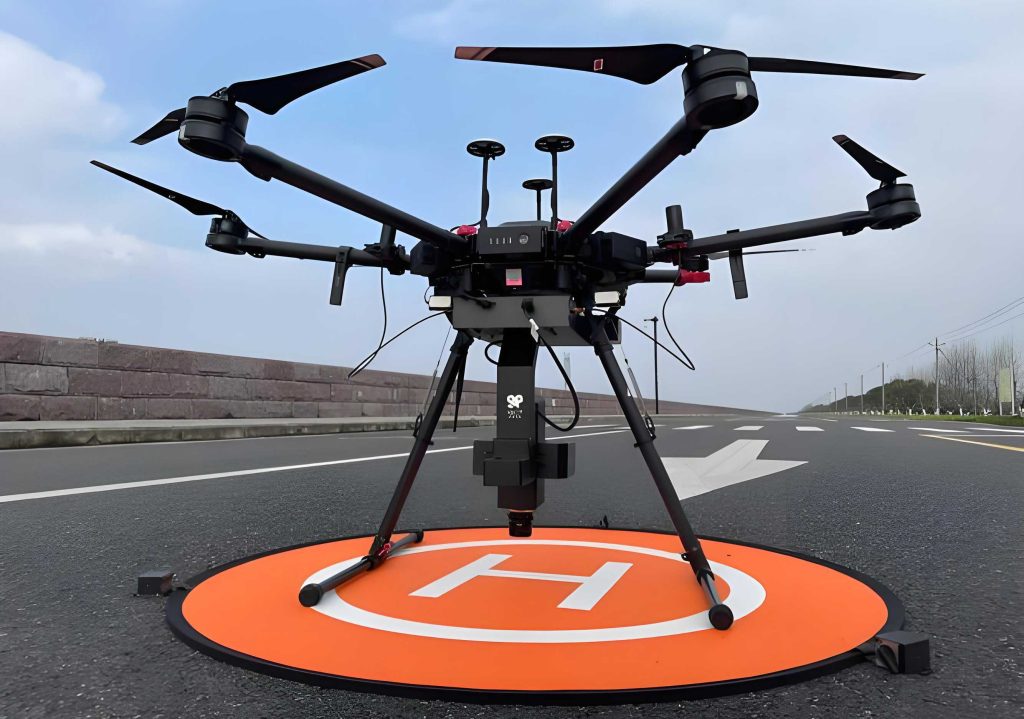
The polarimetric radar data processing begins with the formation of the scattering matrix for each time instance. Assuming we have a sequence of $N$ observations, the polarimetric scattering matrix at the $n$-th time sample is represented as:
$$ \mathbf{S}_n = \begin{bmatrix} S_{hh} & S_{hv} \\ S_{vh} & S_{vv} \end{bmatrix} $$
where $S_{hh}$, $S_{hv}$, $S_{vh}$, and $S_{vv}$ are the complex scattering coefficients for the respective polarization channels. For monostatic radar systems under the reciprocity assumption, $S_{hv} = S_{vh}$. To compute stable features, we segment the long sequence of scattering matrices into contiguous blocks, each containing $d$ matrices (e.g., $d=256$). Statistical averaging over these blocks is then applied to derive the polarimetric features, reducing noise and capturing consistent scattering characteristics of the UAV drone target.
The extracted polarimetric features can be categorized into three main groups, each providing unique insights into the UAV drone’s properties. The first group comprises Polarization Cross-Correlation Parameters, which are derived directly from the scattering matrix elements. These parameters include the linear depolarization ratio (LDR), differential reflectivity (ZDR), co-polarization correlation coefficient ($\rho_{co}$), and cross-polarization correlation coefficients ($\beta$ and $\epsilon$). Their mathematical definitions are summarized in Table 1. For instance, the linear depolarization ratio, which measures the depolarization capability of the target, is calculated as:
$$ \text{LDR} = \frac{\langle |S_{hv}|^2 \rangle}{\langle |S_{hh}|^2 \rangle} $$
where $\langle \cdot \rangle$ denotes the ensemble average over the segment. A higher LDR value for a UAV drone may indicate significant depolarization caused by complex structures like rotating propellers.
| Feature Name | Symbol | Mathematical Expression |
|---|---|---|
| Linear Depolarization Ratio | LDR | $\frac{\langle |S_{hv}|^2 \rangle}{\langle |S_{hh}|^2 \rangle}$ |
| Differential Reflectivity | ZDR | $\frac{\langle |S_{vv}|^2 \rangle}{\langle |S_{hh}|^2 \rangle}$ |
| Co-polarization Correlation Coefficient | $\rho_{co}$ | $\frac{\langle S_{hh} S_{vv}^* \rangle}{\sqrt{\langle |S_{hh}|^2 \rangle \langle |S_{vv}|^2 \rangle}}$ |
| Cross-Polarization Correlation Coefficient (HH-HV) | $\beta$ | $\frac{\langle S_{hh} S_{hv}^* \rangle}{\sqrt{\langle |S_{hh}|^2 \rangle \langle |S_{hv}|^2 \rangle}}$ |
| Cross-Polarization Correlation Coefficient (VV-HV) | $\epsilon$ | $\frac{\langle S_{vv} S_{hv}^* \rangle}{\sqrt{\langle |S_{vv}|^2 \rangle \langle |S_{hv}|^2 \rangle}}$ |
The second group consists of Polarimetric Scattering Features obtained through matrix decompositions that interpret the scattering mechanisms. These are crucial for characterizing the physical interactions between the radar wave and the UAV drone structure. We employ four established decomposition techniques: Cloude-Pottier, Pauli, Krogager, and Freeman decompositions. Each decomposition breaks down the scattering process into canonical components, providing features like scattering entropy, mean scattering angle, and contributions from surface, dihedral, volume, helix, and sphere scattering mechanisms. For example, the Cloude-Pottier decomposition starts by forming the coherence matrix $\mathbf{T}$ from the scattering vectors. After multi-look processing and eigenvalue decomposition, we obtain eigenvalues $\lambda_1, \lambda_2, \lambda_3$ ($\lambda_1 \geq \lambda_2 \geq \lambda_3$) and corresponding eigenvectors. The scattering entropy $H$, mean scattering angle $\bar{\alpha}$, and anisotropy $A$ are then computed as:
$$ H = -\sum_{i=1}^{3} p_i \log_3 p_i, \quad \text{where } p_i = \frac{\lambda_i}{\sum_{j=1}^{3} \lambda_j} $$
$$ \bar{\alpha} = \sum_{i=1}^{3} p_i \alpha_i $$
$$ A = \frac{\lambda_2 – \lambda_3}{\lambda_2 + \lambda_3} $$
Here, $\alpha_i$ is derived from the eigenvectors. A high entropy $H$ value for a UAV drone suggests a random scattering process, possibly due to rapidly moving parts like propellers, while a low $\bar{\alpha}$ might indicate dominant surface scattering from the smooth fuselage. The Pauli decomposition yields the amplitudes of surface ($|a|$), dihedral ($|b|$), and volume ($|c|$) scattering components:
$$ |a| = |\langle S_{hh} \rangle + \langle S_{vv} \rangle|, \quad |b| = |\langle S_{hh} \rangle – \langle S_{vv} \rangle|, \quad |c| = \sqrt{2} |\langle S_{hv} \rangle| $$
For a UAV drone, the rotating blades may contribute to volume scattering ($|c|$), while the junction between wings and body could produce dihedral scattering ($|b|$). The Krogager decomposition, expressed in the circular polarization basis, provides coefficients for sphere ($k_s$), diplane ($k_d$), and helix ($k_h$) scattering. The Freeman decomposition separates the total power into surface ($P_s$), double-bounce ($P_d$), and volume ($P_v$) scattering contributions by modeling the covariance matrix. These features collectively offer a multidimensional portrait of the UAV drone’s scattering behavior, which is less sensitive to noise than instantaneous micro-Doppler signatures because they rely on statistical averages.
The third group encompasses Polarization Invariants, which are scalar quantities derived from the scattering matrix that remain unchanged under certain transformations. They include the modulus of the scattering matrix determinant ($|\Delta|$), the trace of the power matrix ($P_1$), the depolarization index ($D$), the characteristic polarization state direction angle ($\phi_d$), and the characteristic polarization ellipse angle ($\tau_d$). For instance, the depolarization index $D$ is calculated as:
$$ D = 1 – \frac{4 |\det(\mathbf{S}_n)|^2}{(\text{tr}(\mathbf{S}_n \mathbf{S}_n^H))^2} $$
where $\det(\cdot)$ is the determinant and $\text{tr}(\cdot)$ is the trace. A value of $D$ close to 0.5 or above may indicate the presence of multiple scattering centers on the UAV drone, such as the body and propellers combined. These invariants provide complementary information about the target’s symmetry, complexity, and overall scattering strength.
After extracting these polarimetric features, we obtain an initial feature vector. However, our analysis revealed that not all features contribute equally to UAV drone classification. Using the Out-Of-Bag (OOB) error reduction method with a Random Forest classifier, we quantified the importance of each polarimetric feature. The results indicated that polarization correlation coefficients (like $\rho_{co}$, $\beta$, $\epsilon$) exhibited very low contribution, as their separation indices across UAV drone classes were consistently below 0.5, implying poor inter-class discriminability. Therefore, we excluded these three correlation features, retaining the remaining 19 polarimetric features for the final model. This feature selection step helps reduce dimensionality and focus on the most informative characteristics for distinguishing different UAV drone models.
To further enhance the feature set, we incorporate information from the Doppler spectrum, but process it to extract maximally discriminant components. For each polarization channel (HH, HV, VH, VV) separately, we compute the Doppler spectrum $F$ for each data segment via the Fourier Transform. Instead of using the high-dimensional raw spectrum (e.g., 256 points), we apply Linear Discriminant Analysis (LDA) to project the spectrum onto a lower-dimensional subspace that emphasizes differences between UAV drone classes. Given $K$ classes of UAV drones, LDA seeks a projection matrix $\mathbf{W}$ that maximizes the ratio of between-class scatter to within-class scatter. The between-class scatter matrix $\mathbf{S}_B$ and within-class scatter matrix $\mathbf{S}_W$ are defined as:
$$ \mathbf{S}_B = \sum_{i=1}^{K} n_i (\boldsymbol{\mu}_i – \boldsymbol{\mu})(\boldsymbol{\mu}_i – \boldsymbol{\mu})^T $$
$$ \mathbf{S}_W = \sum_{i=1}^{K} \sum_{\mathbf{F} \in D_i} (\mathbf{F} – \boldsymbol{\mu}_i)(\mathbf{F} – \boldsymbol{\mu}_i)^T $$
where $\boldsymbol{\mu}_i$ is the mean spectrum vector for class $i$, $n_i$ is the number of samples in class $i$, $\boldsymbol{\mu}$ is the overall mean spectrum vector, and $D_i$ is the set of spectrum samples for class $i$. The optimal projection is found by solving the generalized eigenvalue problem $\mathbf{S}_B \mathbf{w} = \lambda \mathbf{S}_W \mathbf{w}$. The eigenvectors corresponding to the largest eigenvalues form the columns of $\mathbf{W}$. Since the rank of $\mathbf{S}_B$ is at most $K-1$, we reduce the Doppler spectrum dimension to $K-1$ per polarization channel. For our seven-class UAV drone problem, this means reducing from 256 dimensions to 6 dimensions per channel. After processing all four polarization channels, we obtain $4 \times 6 = 24$ LDA-enhanced Doppler features, which we refer to as “strong inter-class discriminant features.” These features capture the most class-separating aspects of the micro-Doppler signature while being robust to noise due to the discriminant projection.
The final feature vector for each data segment is the concatenation of the 19 selected polarimetric features and the 24 LDA-enhanced Doppler features, resulting in a 43-dimensional representation. This multidimensional feature set is designed to synergistically combine the physical scattering attributes from polarimetry with the kinematic discriminants from processed Doppler information. We employ a Random Forest classifier for the final UAV drone recognition task. Random Forest is an ensemble learning method that constructs multiple decision trees during training and outputs the class mode of the individual trees. It is well-suited for our application due to its robustness to overfitting, ability to handle high-dimensional features, and inherent feature importance evaluation. The training process involves bootstrap sampling from the dataset to build each tree, and at each node split, a random subset of features is considered to maximize diversity. The classification of a new sample is performed by aggregating the votes from all trees. The use of Random Forest also allows us to validate the contribution of different feature groups through OOB error analysis.
To validate our proposed method, we conducted extensive experiments using a fully polarimetric radar system operating in the Ka-band (34.5-35.5 GHz) with 1 GHz bandwidth, providing a range resolution of 0.2 m. The radar captured data for seven different UAV drone models, each performing hover and circular flight maneuvers. The dataset was segmented into samples, each containing 256 consecutive pulses, yielding 768 samples per UAV drone type. We evaluated performance under various SNR conditions by adding synthetic noise to the radar echoes to simulate different main Doppler SNR levels: no noise, 30 dB, 20 dB, and 10 dB. The recognition rates were computed using 5-fold cross-validation to ensure statistical reliability.
| Feature Category | Specific Feature | Relative Importance Score (Normalized) |
|---|---|---|
| Cloude-Pottier Decomposition | Scattering Entropy (H) | 0.95 |
| Mean Scattering Angle ($\bar{\alpha}$) | 0.88 | |
| Anisotropy (A) | 0.76 | |
| Pauli Decomposition | Surface Scattering ($|a|$) | 0.82 |
| Dihedral Scattering ($|b|$) | 0.79 | |
| Volume Scattering ($|c|$) | 0.91 | |
| Krogager Decomposition | Sphere Scattering ($k_s$) | 0.73 |
| Diplane Scattering ($k_d$) | 0.85 | |
| Helix Scattering ($k_h$) | 0.89 | |
| Freeman Decomposition | Surface Scattering Power ($P_s$) | 0.80 |
| Double-Bounce Scattering Power ($P_d$) | 0.77 | |
| Volume Scattering Power ($P_v$) | 0.92 | |
| Polarization Invariants | Determinant Modulus ($|\Delta|$) | 0.70 |
| Power Matrix Trace ($P_1$) | 0.81 | |
| Depolarization Index (D) | 0.86 | |
| Characteristic Direction Angle ($\phi_d$) | 0.75 | |
| Characteristic Ellipse Angle ($\tau_d$) | 0.78 | |
| Cross-Correlation Parameters | Linear Depolarization Ratio (LDR) | 0.84 |
| Differential Reflectivity (ZDR) | 0.79 |
The contribution analysis, summarized in Table 2, shows that features related to volume scattering (e.g., from Freeman and Pauli decompositions) and scattering entropy are among the most important for distinguishing UAV drone types. This aligns with the physical expectation that rotating propellers generate significant volume scattering and increase randomness. The LDA-enhanced Doppler features also proved highly valuable, as they condense the discriminative micro-Doppler information into a compact form.
We compared our proposed method (Scheme 5) against four baseline schemes to demonstrate its effectiveness. Scheme 1 uses only the 19 polarimetric features. Scheme 2 uses the raw Doppler spectra from all four polarization channels (1024-dimensional). Scheme 3 uses only the LDA-enhanced Doppler features (24-dimensional). Scheme 4 concatenates the features of Schemes 1 and 2 (1043-dimensional). Scheme 5, our method, concatenates the features of Schemes 1 and 3 (43-dimensional). The recognition rates across different SNR levels are presented in Table 3. The results clearly show that at high SNR (no noise), all methods involving Doppler information perform well, with Scheme 2 achieving 94.74% and Scheme 5 achieving 93.79%. However, as SNR decreases, the advantage of our multidimensional feature enhancement becomes pronounced. At a main Doppler SNR of 20 dB, Scheme 2 (raw Doppler) drops to 63.50%, while Scheme 5 maintains 77.21%, an improvement of 13.71 percentage points. At 10 dB SNR, Scheme 2 yields 50.20%, whereas Scheme 5 achieves 59.90%, a gain of 9.70 percentage points. This demonstrates that combining polarimetric features with LDA-processed Doppler features provides robustness against noise. The polarimetric features, being derived from statistical averages and nonlinear operations, are inherently less sensitive to additive noise. Meanwhile, LDA acts as a noise-reducing projection for the Doppler spectrum by focusing on inter-class differences. The synergy between these two feature types allows for stable recognition even when the micro-Doppler signature is corrupted by noise. Notably, Scheme 4 (raw Doppler + polarimetric) performs slightly worse than Scheme 5 at low SNR, indicating that the high dimensionality and noise in raw Doppler can hinder the classifier, and that LDA preprocessing is beneficial.
| SNR Level | Scheme 1: Polarimetric Features Only | Scheme 2: Raw Doppler Features | Scheme 3: LDA-Enhanced Doppler Only | Scheme 4: Raw Doppler + Polarimetric | Scheme 5: Proposed (LDA-Doppler + Polarimetric) |
|---|---|---|---|---|---|
| No Noise | 67.81 | 94.74 | 93.06 | 94.66 | 93.79 |
| 30 dB | 63.52 | 83.76 | 87.17 | 83.56 | 87.93 |
| 20 dB | 56.60 | 63.50 | 75.07 | 64.47 | 77.21 |
| 10 dB | 49.24 | 50.20 | 55.95 | 52.72 | 59.90 |
The physical interpretation of why polarimetric features aid UAV drone recognition in low SNR conditions is multifaceted. UAV drones are complex targets with multiple scattering centers: the main body often acts as a conductive surface producing surface-like scattering; the propellers, due to their rapid rotation, behave like a cloud of point scatterers leading to volume scattering and increased depolarization; and structural junctions (e.g., between wings and fuselage) can cause double-bounce or dihedral scattering. These mechanisms are captured by the decomposition features. Moreover, polarization invariants like the depolarization index reflect the overall complexity of the target. In contrast, micro-Doppler features primarily capture kinematic information (blade rotation rates, harmonics), which is more susceptible to contamination by noise because it relies on precise frequency estimation. By fusing both domains, we create a representation that is rich in both physical structure and motion characteristics. The LDA step further refines the motion-related information by suppressing intra-class variations and noise, effectively extracting a “signature” that emphasizes differences between UAV drone models. For instance, different UAV drone models may have distinct propeller configurations (number of blades, blade length, rotation speed) that affect both the micro-Doppler spectrum and the polarimetric response due to differing scattering geometries. Our method captures these intertwined aspects.
From a signal processing perspective, the polarimetric feature extraction involves nonlinear operations (e.g., computing eigenvalues, decompositions) and multi-look averaging, which naturally suppress Gaussian noise to some extent. The LDA projection for Doppler can be expressed as:
$$ \mathbf{y} = \mathbf{W}^T \mathbf{F} $$
where $\mathbf{F}$ is the original Doppler spectrum vector and $\mathbf{y}$ is the reduced-dimensional feature. The projection matrix $\mathbf{W}$ is learned from training data to maximize class separation. Since noise components often lie in directions not aligned with inter-class differences, they are attenuated in the projected space. This is particularly beneficial for UAV drone recognition where the useful micro-Doppler features might be concentrated in a few spectral bins corresponding to blade flash harmonics, while noise is spread across the spectrum.
We also analyzed the separation index for feature groups to quantify discriminability. The separation index $SI$ for a set of features is defined as the ratio of average inter-class distance to average intra-class distance:
$$ SI = \frac{\langle \text{inter}_{i,j} \rangle_{i \ne j}}{\langle \text{intra}_i \rangle} $$
where $\text{inter}_{i,j} = ||\boldsymbol{\mu}_i – \boldsymbol{\mu}_j||_2$ is the Euclidean distance between class means, and $\text{intra}_i$ is the average pairwise distance between samples within class $i$. A higher $SI$ indicates better class separation. For our retained polarimetric features, the overall $SI$ was 0.84, confirming reasonable discriminability. In contrast, the discarded polarization correlation features had an $SI$ of only 0.28, justifying their exclusion. The LDA-enhanced Doppler features achieved an $SI$ of 1.45, demonstrating their strong class-separating power, which is crucial for maintaining performance under noise.
Looking forward, the proposed multidimensional feature enhancement framework opens several avenues for further research. One direction is to explore deep learning architectures that can automatically learn optimal feature representations from raw polarimetric radar data, potentially capturing even more subtle discriminative patterns for UAV drone identification. However, deep learning typically requires large amounts of labeled data, which can be challenging to acquire for radar applications. Our method, based on handcrafted features and Random Forest, offers a practical solution with lower data requirements. Another direction is to extend the feature set to include time-evolving polarimetric characteristics, as UAV drones often exhibit dynamic scattering changes during maneuvers. Incorporating sequential models like recurrent neural networks could leverage these temporal dependencies. Additionally, the integration of features from multiple frequency bands (e.g., combining X-band and Ka-band) could further improve recognition, as different frequencies probe different scattering mechanisms of the UAV drone structure. The polarization features might also be used for other tasks, such as estimating the size, orientation, or material composition of UAV drones, which could aid in threat assessment.
In conclusion, we have presented a robust method for UAV drone recognition that leverages multidimensional features from polarimetric radar, enhanced by discriminant analysis of the Doppler spectrum. The method extracts a comprehensive set of polarimetric descriptors, selects the most contributive ones, and fuses them with noise-resistant discriminant features from the Doppler domain. Experimental results on a diverse dataset of seven UAV drone models confirm that this approach significantly improves recognition accuracy under low SNR conditions, outperforming traditional methods that rely solely on raw micro-Doppler features. The improvement is attributed to the complementary nature of polarimetric and processed Doppler features: polarimetry provides stable physical scattering characteristics, while LDA-processed Doppler captures kinematic distinctions in a noise-robust manner. This work underscores the value of polarimetric radar for modern UAV drone surveillance and contributes to the development of reliable identification systems for the burgeoning low-altitude economy.