
In recent years, the convergence of Artificial Intelligence (AI) models and Unmanned Aerial Vehicle (UAV) drone technology has unlocked transformative potential across numerous sectors. While applications in public services, mining, photovoltaic, and power grid inspections are becoming commonplace, a critical domain ripe for innovation is the maintenance and inspection of broadcasting transmission stations. Traditional inspection methodologies at these facilities predominantly rely on manual labor—involving hazardous climbs and visual checks—supplemented by basic UAV drone operations. This approach is plagued by inefficiency, significant safety risks, a high rate of missed defects, and poor performance of standard UAV drones in challenging environments characterized by strong electromagnetic interference and complex topography. To address these shortcomings, our research focuses on integrating advanced AI model capabilities with traditional UAV drone flight control systems. This integration is designed to drastically enhance the autonomous decision-making, resilience, and precision of UAV drones operating in these complex scenarios, thereby supporting the high-quality, safe, and stable broadcast of television and radio programs.
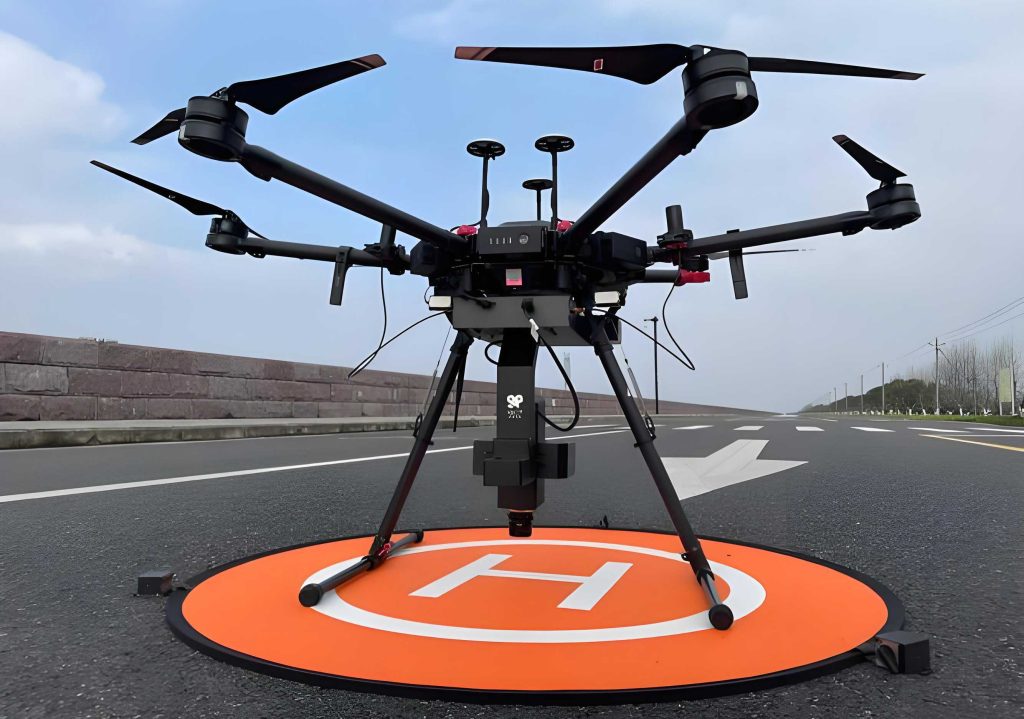
The core design philosophy of our intelligent UAV drone inspection system is built upon a triad of fundamental improvements: efficiency, safety, and precision. By deploying an AI-powered UAV drone, a single operator can achieve comprehensive coverage of a transmission station, including 360-degree inspection of tower surfaces. This capability persists even in extreme weather conditions like heavy snowfall, where ground access is restricted. From a safety perspective, the AI-enhanced UAV drone can perform close-range observations in high electromagnetic field environments and navigate complex terrain, thereby minimizing the need for personnel to enter hazardous zones. In terms of precision, the analytical power of AI models far surpasses human visual inspection in scanning and identifying anomalies. The system can detect minor corrosion, cracks, and predict future maintenance needs, such as bolt loosening trends, by learning from historical data, effectively preventing potential equipment failures and safety incidents.
System Architecture and Design
The proposed UAV drone intelligent inspection system is architected around a three-layer “Perception-Decision-Execution” paradigm, integrating hardware, software, and ground support into a cohesive workflow.
| System Layer | Components & Function |
|---|---|
| Perception Layer | UAV Drone platform equipped with multimodal sensors: LiDAR, Visible-light/Infrared dual-spectrum gimbal, hyperspectral camera, and Active Phased Array Radar for environmental and target data acquisition. |
| Decision Layer | Core AI algorithm modules (Dynamic Path Planning, Multi-UAV drone Coordination, Predictive Warning) and the Edge-Cloud collaborative computing framework for real-time data processing and intelligent command generation. |
| Execution Layer | Ground support systems including Fixed Drone Hangars and Mobile Vehicle-mounted Docks for automated deployment, recovery, and charging; backend systems for maintenance order dispatch and human-drone interaction. |
Core Technological Framework
1. Advanced AI Algorithm Modules
The intelligence of the UAV drone is driven by several sophisticated AI modules:
a) Dynamic Path Planning Module: This module utilizes an improved Group Relative Policy Optimization (GRPO) algorithm combined with deep reinforcement learning. It processes real-time 3D semantic maps generated by the UAV drone’s LiDAR, incorporating multi-dimensional constraints such as task priority, energy efficiency, and safety margins to generate and continuously optimize globally optimal inspection paths. The mathematical formulation for the cost function minimized during planning can be expressed as:
$$
J(\pi) = \mathbb{E}_{\tau \sim \pi} \left[ \sum_{t=0}^{T} \gamma^t \left( C_{\text{collision}}(s_t) + \lambda_1 C_{\text{energy}}(a_t) + \lambda_2 C_{\text{deadline}}(t, P) \right) \right]
$$
where $ \pi $ is the policy, $ \tau $ is a trajectory, $ \gamma $ is a discount factor, $ C_{\text{collision}} $ penalizes proximity to obstacles, $ C_{\text{energy}} $ penalizes high-energy actions, $ C_{\text{deadline}} $ penalizes delays relative to task progress $ P $, and $ \lambda $ are weighting parameters.
b) Multi-UAV Drone Collaborative Scheduling Module: For large-scale stations, a distributed swarm intelligence algorithm based on Particle Swam Optimization (PSO) manages a fleet of UAV drones. It dynamically partitions the inspection area, balances workload based on real-time battery and task progress monitoring, and ensures seamless task handover in case of a single UAV drone failure. Communication is optimized using Time-Division Multiple Access (TDMA) protocols.
c) Predictive Warning and Analysis Module: Built on a Transformer-based architecture, this module performs intelligent change detection by comparing periodic scan data. It learns from historical inspection logs and failure data to predict potential fault trends, such as the probability of bolt loosening over time. It can be represented as a sequence learning problem:
$$
P(\text{Fault}_{t+\Delta t} | \mathbf{X}_{1:t}) = \text{Transformer}(\mathbf{X}_{1:t}; \theta)
$$
where $ \mathbf{X}_{1:t} $ is the sequence of multimodal sensor data and historical states up to time $ t $, and $ \theta $ are the model parameters.
2. Edge-Cloud Collaborative Computing Architecture
To overcome the latency of cloud-only AI inference which can hinder real-time UAV drone control, we employ a three-tier “Device-Edge-Cloud” computational framework:
- Device (UAV Drone): Runs lightweight, real-time algorithms (e.g., YOLOv7-tiny) for immediate obstacle detection and basic tracking.
- Edge Node (Ground Station/Vehicle): Hosts optimized inference engines (e.g., TensorRT) for faster processing of dynamic path planning and detailed analysis, significantly reducing single-frame processing time.
- Cloud: Handles heavy-duty model training, complex scenario simulation, long-term data analytics, and fleet management. Stream-computation decoupling techniques minimize end-to-end latency for critical commands.
3. System Implementation: Software and Hardware
The system is developed using open-source Software Development Kits (SDKs) like DJI’s Mobile SDK (MSDK) and Onboard SDK (OSDK) to interface with commercial UAV drone flight controllers. A hardware abstraction layer is created to ensure compatibility across different UAV drone models, allowing core functions like gimbal control, RTK positioning, and data acquisition to be standardized.
Key hardware integrations include:
- Multimodal Sensor Fusion: The UAV drone is equipped with a sensor suite. LiDAR and visual cameras build 3D maps, Active Phased Array Radar enhances detection of thin cables (guy wires) in cluttered environments, and hyperspectral cameras identify material defects and corrosion.
- Automated Ground Infrastructure:
- Fixed Drone Hangars: Deployed at the transmission station, featuring robotic arms for automatic battery swap, satellite communication modules, and battery health monitoring via CNN models.
- Mobile Vehicle-mounted Docks: Extend the operational range for remote inspections, providing mobile charging and data offloading capabilities.
Application in Broadcasting Scenarios: A Quantitative Leap
The deployment of this AI-enhanced UAV drone system fundamentally transforms inspection workflows for broadcasting transmission stations. The following table contrasts the old and new paradigms:
| Aspect | Traditional Manual Inspection | AI-UAV Drone Intelligent Inspection System |
|---|---|---|
| Operation Mode | Manual climbing, visual checks, handheld tools. | Fully or semi-autonomous UAV drone flight with multimodal sensing and AI decision-making. |
| Personnel & Efficiency | Requires a team of 3-5 people for a single inspection. Slow and weather-dependent. | Managed by a single operator. UAV drone can cover entire site rapidly, irrespective of most ground obstacles. |
| High risk of falls, electrical hazards, and traffic accidents during transit. | Personnel operate remotely, eliminating direct exposure to hazardous environments. | |
| Defect Detection Rate | Relies on inspector experience; high miss rate for small defects. | AI-powered analysis of hyperspectral and thermal data ensures high-precision identification of rust, cracks, and hotspots. |
| Coverage & Accessibility | Limited by terrain; often impossible in severe weather. | Capable of beyond-visual-line-of-sight (BVLOS) operations up to 30km, effective in high-wind and complex electromagnetic settings. |
Key Capabilities Demonstrated by the UAV Drone System
1. Enhanced Operational Efficiency and Response: The UAV drone system automates the entire “detect-analyze-act” chain. It identifies typical station hazards (e.g., rust on towers, loose bolts, overheated feeder line connections, water pooling) and immediately generates a maintenance work order with precise GPS coordinates and severity level, dispatched directly to relevant personnel.
2. Simplified Complex Operations: Through natural language processing (NLP) and gesture recognition interfaces, operators can issue high-level commands (e.g., “Perform a 15-meter radius orbit around tower A”). The AI decomposes this into a sequence of low-level flight and gimbal control actions, which are first validated in a digital twin simulation before execution by the UAV drone.
3. Resilience in Challenging Environments:
- Anti-interference Communication: The UAV drone’s AI dynamically monitors and switches between 2.4 GHz and 5.8 GHz channels to avoid electromagnetic interference from broadcast antennas. It employs sensor fusion (RTK/PPK with IMU) to maintain positioning accuracy, ensuring stable hover even near powerful transmitters. The link stability $ S $ can be modeled as a function of signal-to-interference-plus-noise ratio (SINR):
$$
S = f(\text{SINR}) = \begin{cases}
1 & \text{if } \text{SINR} > \theta_{\text{high}} \\
\frac{\text{SINR} – \theta_{\text{low}}}{\theta_{\text{high}} – \theta_{\text{low}}} & \text{if } \theta_{\text{low}} \leq \text{SINR} \leq \theta_{\text{high}} \\
0 & \text{if } \text{SINR} < \theta_{\text{low}}
\end{cases}
$$
where $ \theta_{\text{high}} $ and $ \theta_{\text{low}} $ are thresholds for reliable and failed communication, respectively.
- All-Weather and All-Terrain Capability: The system adjusts flight parameters in real-time based on fused sensor data and weather inputs. For night operations, it leverages thermal imaging and low-light cameras. Using 5G standalone network slicing, it achieves reliable BVLOS control for inspections of remote, mountainous transmission sites up to 30 km away.
4. Predictive Maintenance and Energy Management
The AI system transitions maintenance from reactive to predictive. By analyzing time-series data from the UAV drone inspections, it forecasts potential failures. Furthermore, it optimizes the flight paths for energy efficiency, which is crucial for extending the operational range of each UAV drone sortie, especially in BVLOS missions. The energy consumption model for a UAV drone mission can be approximated as:
$$
E_{\text{total}} = \sum_{i=1}^{N} \left( P_{\text{hover}}(v_i, w_i) \cdot t_{\text{inspect}, i} + E_{\text{transit}}(d_i) \right) + E_{\text{comms}}
$$
where $ P_{\text{hover}} $ is the power consumed while inspecting point $ i $ (a function of local wind speed $ v_i $ and UAV drone weight $ w_i $), $ t_{\text{inspect}, i} $ is the inspection time, $ E_{\text{transit}} $ is the energy to travel distance $ d_i $ between points, and $ E_{\text{comms}} $ is the energy for communication. The path planning algorithm explicitly minimizes $ E_{\text{total}} $.
| Metric | Target/Performance |
|---|---|
| Inspection Coverage per Sortie | Full 360° scan of primary broadcast tower and surrounding infrastructure. |
| Defect Detection Accuracy (Bolts/Corrosion) | > 98% (on validated test sets). |
| Response Time (Detection to Alert) | < 5 minutes for critical anomalies. |
| Operational Range (BVLOS) | Up to 30 km with 5G/4G backhaul. |
| Positioning Accuracy in High-EMF Zones | < ±0.5 m (with sensor fusion). |
| Weather Resistance | Sustained winds up to 15 m/s; operation in light rain/dust. |
Conclusion and Future Outlook
The integration of sophisticated AI models with robust UAV drone platforms creates a powerful intelligent inspection system tailored for the demanding environment of broadcasting transmission stations. This system revolutionizes the traditional paradigm by delivering unprecedented gains in efficiency, safety, and predictive capability through fully automated workflows and data-driven insights. The AI-enhanced UAV drone is not merely a tool but a core component of a new, proactive maintenance ecosystem. Looking forward, the advent of satellite internet constellations (e.g., low-earth orbit networks) promises to eliminate the last remaining coverage gaps in remote areas. This will enable truly ubiquitous deployment of intelligent UAV drone inspection systems, ensuring that even the most isolated transmission stations can benefit from autonomous, intelligent, and continuous monitoring. This evolution will be instrumental in driving the comprehensive digital and intelligent transformation of the broadcasting transmission industry, securing the infrastructure that underpins our global information landscape.