
In recent years, the rapid advancement of unmanned aerial vehicle (UAV) technology has propelled its integration into diverse fields such as agricultural inspection, disaster response, and smart city management. Intelligent perception algorithms, encompassing tasks like object detection, recognition, and semantic segmentation, serve as the “brain” and “sensory organs” for UAV drones, enabling autonomous decision-making and adaptation to complex, dynamic environments. As artificial intelligence continues to evolve, UAV drones are transitioning from simple tools to intelligent, swarm-capable systems, where the role of intelligent perception algorithms becomes increasingly critical. However, in the context of experimental education for UAV drone-based intelligent perception, a significant disconnect between theory and practice persists, characterized by high costs, substantial risks, and lengthy validation cycles. This paper, from my perspective as an educator and researcher, proposes a three-stage progressive experimental teaching model—”virtual-simulation-real flight”—to systematically cultivate students’ comprehensive abilities in developing, deploying, and validating intelligent perception algorithms for UAV drones.
The traditional approach to teaching UAV drone intelligent perception algorithms often relies on theoretical instruction or limited simulations, failing to provide hands-on experience with real-world constraints. The high cost of UAV drone platforms and sensors restricts large-scale experimental deployment, while the risk of crashes due to algorithmic flaws or environmental interference compresses practical flight training. Moreover, the algorithm validation process is fragmented, involving separate phases of simulation, hardware adaptation, and flight testing, leading to inefficient iterations. To address these challenges, I have designed and implemented a progressive framework that seamlessly connects virtual experiments, simulation-based hardware testing, and actual flight validation. This model not only reduces costs and risks but also enhances learning outcomes by building a complete capability chain from conceptual understanding to engineering implementation.
The core of this progressive design lies in its structured, stage-wise objectives that align with cognitive and skill development. In the virtual experiment stage, students focus on the full-process logic validation of intelligent perception algorithms using simulated environments. The hardware simulation stage introduces embedded system constraints, requiring algorithm migration and real-time performance testing on platforms identical to UAV drone onboard computers. Finally, the real-flight stage evaluates algorithm performance under actual operational conditions, fostering problem-solving skills in dynamic scenarios. Throughout these stages, the keyword “UAV drone” is emphasized to reinforce the application context, ensuring that students consistently link algorithmic concepts to their deployment on aerial platforms.
To elaborate, the virtual experiment phase leverages high-fidelity simulation tools like AirSim to create realistic UAV drone operational scenarios. Students engage in tasks such as data collection, algorithm selection, model training, and performance evaluation entirely in a virtual setting. For instance, in a typical object detection experiment, students might implement a YOLO-based model to identify obstacles in a simulated urban environment. The performance can be quantified using metrics like mean Average Precision (mAP), defined as:
$$ mAP = \frac{1}{N} \sum_{i=1}^{N} AP_i $$
where \( AP_i \) is the average precision for class \( i \), and \( N \) is the number of classes. Precision and recall are calculated as:
$$ \text{Precision} = \frac{TP}{TP + FP}, \quad \text{Recall} = \frac{TP}{TP + FN} $$
with \( TP \), \( FP \), and \( FN \) representing true positives, false positives, and false negatives, respectively. Through iterative development in this risk-free environment, students grasp the end-to-end workflow of intelligent perception algorithms for UAV drones, from problem analysis to validation.
The hardware simulation phase bridges the gap between software algorithms and physical deployment. Students port their algorithms to embedded AI chips, such as Jetson Orin, which mirror the computational hardware used in actual UAV drones. This stage emphasizes practical skills like environment configuration, model optimization for resource constraints, and hardware-in-the-loop testing. A key aspect is evaluating real-time performance, often measured by latency:
$$ \text{Latency} = t_{\text{output}} – t_{\text{input}} $$
where \( t_{\text{input}} \) and \( t_{\text{output}} \) are the times of data acquisition and result generation, respectively. Students also assess resource usage, such as CPU/GPU utilization and memory footprint, to ensure compatibility with UAV drone onboard systems. Experiments may include multi-sensor fusion, where visible and infrared images are combined at pixel, feature, or decision levels to enhance robustness. For example, feature-level fusion can be expressed as:
$$ F_{\text{fused}} = \phi(F_{\text{visible}}, F_{\text{infrared}}) $$
with \( \phi \) denoting a fusion function (e.g., concatenation) and \( F \) representing feature maps. This phase cultivates an understanding of the engineering trade-offs involved in deploying intelligent perception algorithms on resource-constrained UAV drone platforms.
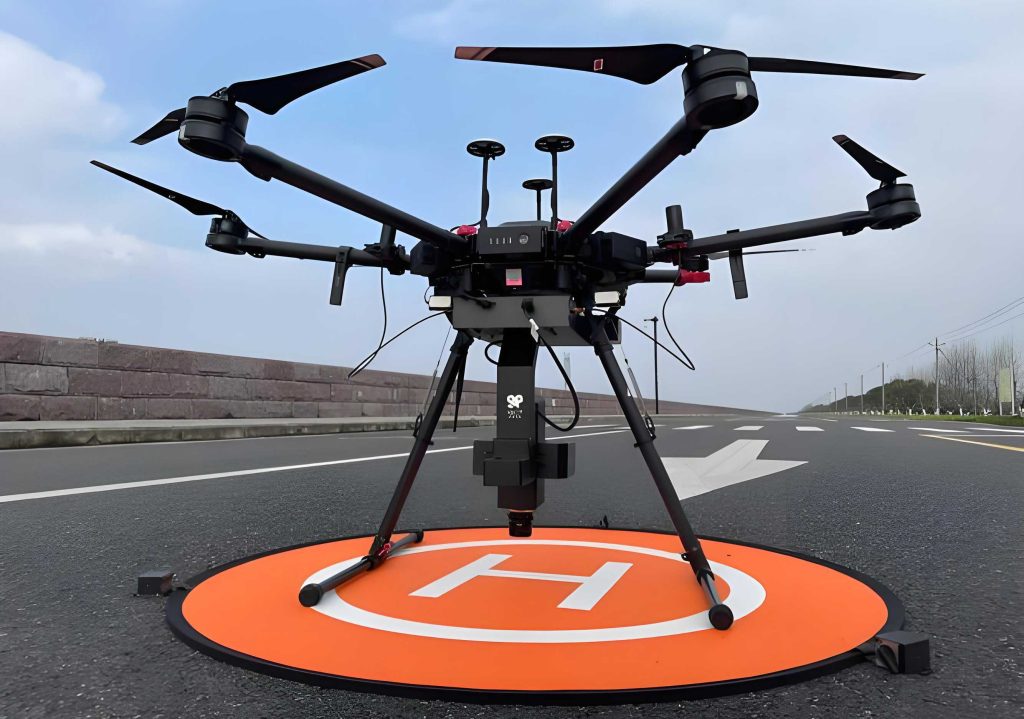
The real-flight phase culminates the learning process by testing algorithms on actual UAV drones in controlled outdoor environments. Students confront real-world challenges such as varying lighting conditions, motion blur, and communication delays. Performance metrics shift towards operational reliability, including detection accuracy in dynamic scenes and system stability. For multi-UAV drone collaborative tasks, additional metrics like coordination efficiency and data consistency become relevant. This stage not only validates algorithmic efficacy but also hones skills in flight operations, troubleshooting, and adaptive optimization. The progressive design ensures that students are well-prepared for this phase, having already addressed many technical hurdles in earlier stages.
To systematically illustrate the three-stage framework, I have developed detailed experimental modules and evaluation criteria. The following tables summarize the stage-wise objectives, key activities, and assessment metrics that guide the learning journey for UAV drone intelligent perception algorithms.
| Stage | Primary Learning Objectives | Key Experimental Activities |
|---|---|---|
| Virtual Experiment | Master full-process algorithm development logic; validate performance in simulated environments. | Simulation setup with AirSim; data collection; algorithm design (e.g., YOLO); model training and evaluation; iterative refinement. |
| Hardware Simulation | Develop skills in embedded system deployment; understand hardware-software co-design; test real-time performance. | Embedded AI chip configuration (e.g., Jetson Orin); algorithm porting and optimization; hardware-in-the-loop testing; multi-sensor fusion experiments. |
| Real-Flight Experiment | Apply algorithms in real-world scenarios; handle dynamic environmental factors; enhance problem-solving and teamwork. | UAV drone platform integration (e.g., quadcopters or VTOL drones); field testing for object detection or navigation; performance analysis under actual conditions; troubleshooting and optimization. |
The effectiveness of this progressive model is further quantified through a multi-dimensional assessment system. Each stage employs tailored metrics to evaluate student performance, ensuring comprehensive skill development. The table below outlines the quantitative and qualitative indicators used across stages, emphasizing both algorithmic proficiency and engineering practice for UAV drone applications.
| Stage | Quantitative Metrics | Qualitative Metrics |
|---|---|---|
| Virtual Experiment | Mean Average Precision (mAP), True Positive Rate (TPR), False Positive Rate (FPR), inference speed (FPS). | Clarity of experimental analysis, adherence to development protocols, creativity in algorithm design. |
| Hardware Simulation | mAP, TPR, FPR, latency (ms), CPU/GPU utilization (%), memory usage (MB). | Ability to configure hardware interfaces, effectiveness of hardware-in-the-loop setups, hands-on debugging skills. |
| Real-Flight Experiment | Detection accuracy in field conditions (%), real-time processing capability, mission completion rate (%). | Team coordination during flights, problem diagnosis and resolution, adaptability to unforeseen challenges, innovation in optimization. |
In practice, this progressive design has been implemented in UAV drone intelligent perception courses, yielding significant improvements. The virtual and simulation stages allow scalable experimentation, accommodating more students without the need for extensive UAV drone fleets. For example, a single AirSim setup can support multiple concurrent users, while embedded boards are relatively affordable compared to full UAV drone systems. This scalability enhances access and reduces per-student costs. Moreover, pre-flight testing in hardware simulations drastically increases the success rate of real-flight experiments, as most integration issues are resolved beforehand. Student feedback indicates high engagement and a deeper understanding of the interplay between algorithm theory and UAV drone practical constraints.
From a pedagogical perspective, the model aligns with constructivist learning theories, where knowledge is built incrementally through hands-on experiences. The progression from virtual to physical mirrors the engineering design process, fostering critical thinking and resilience. For instance, when students encounter latency issues in hardware simulations, they learn to optimize models using techniques like pruning or quantization, which can be mathematically expressed as minimizing a loss function under constraints:
$$ \min_{\theta} \mathcal{L}(\theta) \quad \text{subject to} \quad \text{Resource}(\theta) \leq B $$
where \( \theta \) represents model parameters, \( \mathcal{L} \) is the loss, and \( B \) is a resource budget (e.g., memory or computation). Such experiences are invaluable for preparing students to develop efficient intelligent perception algorithms for resource-limited UAV drones.
Furthermore, the model encourages exploration of advanced topics, such as multi-UAV drone collaboration and federated learning. In collaborative target detection, multiple UAV drones share perception data to improve accuracy. The fusion of detections from \( K \) UAV drones can be formulated as:
$$ D_{\text{fused}} = \Psi(D_1, D_2, \dots, D_K) $$
where \( D_i \) denotes the detection set from the \( i \)-th UAV drone, and \( \Psi \) is a fusion operator (e.g., weighted averaging or voting). Students can experiment with such strategies in virtual and simulation stages before attempting real-flight validation. This not only reinforces algorithmic concepts but also highlights the system-level considerations in UAV drone swarm operations.
The integration of quantitative assessment with qualitative feedback creates a holistic evaluation framework. For example, in the real-flight stage, students are assessed not only on detection accuracy but also on their ability to diagnose and rectify failures, such as sensor malfunctions or communication dropouts. This mimics real-world engineering scenarios, where UAV drone operators must balance algorithmic performance with operational reliability. The progressive design ensures that students develop these competencies gradually, reducing the learning curve and building confidence.
Looking ahead, this progressive experimental model can be extended to more complex UAV drone applications, such as autonomous navigation in dynamic environments or adversarial scenario testing. The virtual stage can incorporate advanced simulators with photorealistic rendering and physical modeling, while the hardware stage can include a wider array of embedded processors common in UAV drones. The real-flight stage can evolve to include larger-scale swarm experiments or integration with other autonomous systems. Additionally, automated testing tools can be developed to streamline the evaluation process across stages, further reducing iteration time and enhancing learning efficiency.
In conclusion, the “virtual-simulation-real flight” progressive experimental design offers a robust solution to the challenges in teaching UAV drone intelligent perception algorithms. By structuring learning into sequenced stages, it systematically develops students’ abilities in algorithm development, hardware deployment, and real-world validation. The use of simulations and embedded testing lowers barriers to entry, while the emphasis on actual flight ensures practical relevance. Through this approach, students gain a comprehensive skill set that bridges theory and practice, preparing them to contribute to the advancing field of intelligent UAV drones. As UAV drone technology continues to permeate various sectors, such educational frameworks will be essential for cultivating the next generation of engineers capable of harnessing the full potential of autonomous aerial systems.
To further illustrate the technical depth, consider the mathematical formulations involved in optimizing a perception algorithm for a UAV drone. The overall goal is to maximize detection performance while minimizing resource consumption, which can be framed as a multi-objective optimization problem:
$$ \max_{f} \left( \text{Performance}(f), -\text{Cost}(f) \right) $$
where \( f \) is the perception model. Performance can be measured by mAP, and Cost may include latency, energy usage, or memory. In the hardware simulation stage, students might explore Pareto optimal solutions by trading off accuracy for speed, a critical consideration for real-time UAV drone applications. For instance, simplifying a neural network architecture reduces parameters, potentially speeding up inference as:
$$ \text{Speed} \propto \frac{1}{\text{Number of Parameters}} $$
but may decrease accuracy. Such trade-offs are best explored in a progressive manner, starting from virtual experiments where rapid iterations are possible, moving to hardware for realistic profiling, and finally validating in flight where environmental factors introduce additional variability.
Another key aspect is the calibration of sensors on UAV drones, which affects perception accuracy. In the hardware simulation stage, students can practice camera calibration using techniques like Zhang’s method, which involves solving for intrinsic and extrinsic parameters based on known patterns. The projection of a 3D point \( \mathbf{X} \) to a 2D image point \( \mathbf{x} \) is given by:
$$ \mathbf{x} = \mathbf{K} [\mathbf{R} | \mathbf{t}] \mathbf{X} $$
where \( \mathbf{K} \) is the intrinsic matrix, and \( \mathbf{R} \) and \( \mathbf{t} \) are rotation and translation matrices. Understanding these fundamentals in a simulated environment prepares students for real-flight adjustments, where factors like vibration or temperature may drift calibration.
Overall, the progressive experimental design not only teaches specific algorithms but also instills a systems engineering mindset. Students learn to consider the entire UAV drone ecosystem, from software algorithms to hardware limitations and operational constraints. This holistic approach is essential for developing intelligent perception systems that are both effective and reliable in real-world UAV drone deployments. As the demand for autonomous UAV drones grows across industries, educational models like this will play a pivotal role in shaping a skilled workforce capable of driving innovation forward.