
As a leading research and development team in unmanned aerial systems, we have long been driven by the challenge of overcoming geographical barriers through innovative technology. Our recent breakthrough centers on a groundbreaking vertical take-off and landing unmanned aerial vehicle, or VTOL UAV, specifically designed for maritime and island environments. This VTOL UAV represents a significant leap forward in addressing critical logistics bottlenecks in remote regions. The development of this advanced VTOL UAV system was motivated by the pressing need for reliable, weather-resilient transportation in archipelagos, where traditional methods like ferries are often disrupted. Our mission is to harness the potential of low-altitude economy, with the VTOL UAV serving as a cornerstone technology.
The core of our innovation lies in the “Tianmushan Series” multi-role VTOL UAV platform. This VTOL UAV is engineered for versatility, capable of operating from both land and water surfaces, making it uniquely suited for island-hopping missions. The design philosophy integrates the hover efficiency of multirotor systems with the forward-flight economy of fixed-wing aircraft. This hybrid configuration allows our VTOL UAV to take off and land vertically on confined spaces, such as small vessels or coastal platforms, and then transition to efficient cruise flight for covering distances over water. The aerodynamic and structural considerations for such a VTOL UAV are complex, balancing lift, drag, and stability across flight regimes.
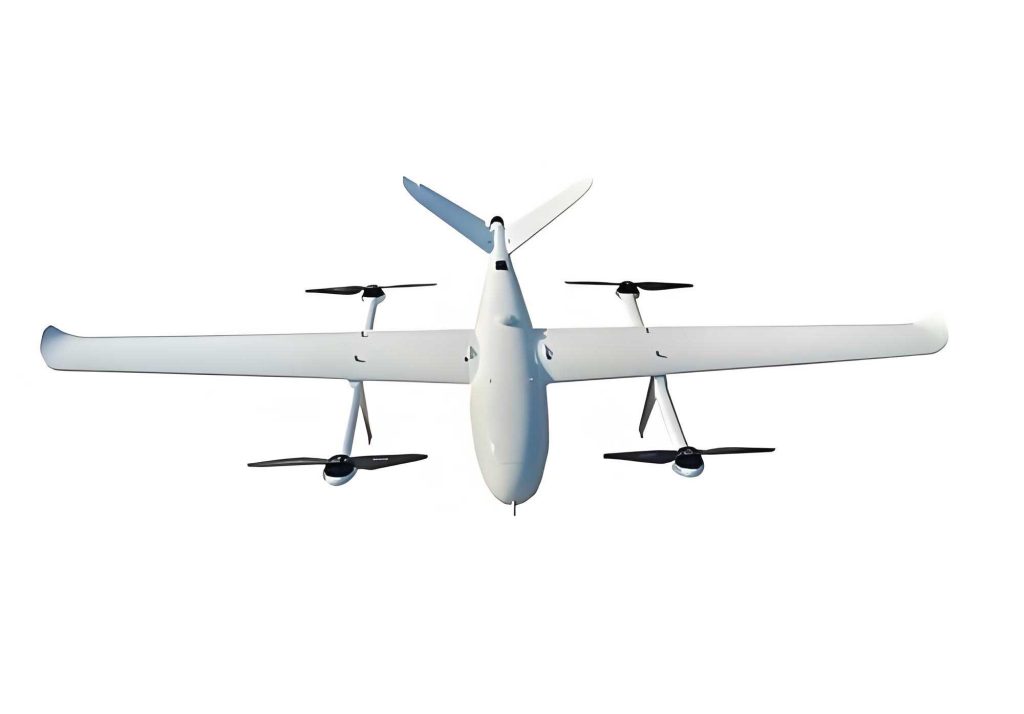
To quantify the performance envelope of our VTOL UAV, we have established key design parameters and validated them through rigorous simulation and testing. The following table summarizes the primary specifications of our flagship VTOL UAV model used in the recent demonstration:
| Parameter | Specification | Notes |
|---|---|---|
| Designation | Series-IV Maritime VTOL UAV | Primary platform for island logistics |
| Maximum Takeoff Weight | 45 kg | Including payload and fuel/battery |
| Payload Capacity | 5-10 kg | Configurable for medical supplies, parcels, sensors |
| Endurance (Cruise) | 3 hours | At optimal cruise speed |
| Range | Up to 150 km | Dependent on payload and weather conditions |
| Cruise Speed | 70 km/h | Efficient forward flight speed |
| Max Wind Resistance | Level 7 (15-17 m/s) | Validated in field tests |
| Communication | 5G C2 Link + Satellite Backup | Enables Beyond Visual Line of Sight (BVLOS) operations |
| Takeoff/Landing Surface | Land, Water (Calm to Moderate Seas) | Amphibious capability is a key feature |
The aerodynamic performance of a VTOL UAV can be modeled using fundamental flight mechanics equations. For instance, during the hover phase, the thrust required must counteract the weight and any wind-induced forces. The required thrust $T$ can be expressed as:
$$T = \frac{W}{\cos(\phi)} + \frac{1}{2} \rho A C_D v_w^2$$
where $W$ is the total weight of the VTOL UAV, $\phi$ is the aircraft tilt angle in wind, $\rho$ is air density, $A$ is the reference area, $C_D$ is the drag coefficient, and $v_w$ is the wind velocity component. This equation highlights the challenges a VTOL UAV faces in high-wind conditions, which our design actively mitigates through robust control algorithms.
The transition phase, where the VTOL UAV shifts from vertical to horizontal flight, is critically analyzed using stability derivatives. The longitudinal motion can be described by a state-space model:
$$\dot{\mathbf{x}} = A\mathbf{x} + B\mathbf{u}$$
with state vector $\mathbf{x} = [u, w, q, \theta]^T$ representing perturbations in forward velocity, vertical velocity, pitch rate, and pitch angle, respectively. The control system of our VTOL UAV continuously solves for optimal inputs $\mathbf{u}$ (e.g., rotor speeds, control surface deflections) to ensure a smooth and stable transition, a non-trivial task for any hybrid VTOL UAV.
Our recent maiden flight campaign was a comprehensive validation of this VTOL UAV’s capabilities in an authentic, challenging environment. Conducted in a remote island chain known for volatile weather, the test involved a fully autonomous 50-kilometer round trip over open water. The VTOL UAV carried a standardized 5kg transport container, simulating a real logistics payload. The entire mission was monitored in real-time via a secure 5G link, a testament to the VTOL UAV’s integrated communication suite. Despite encountering variable crosswinds ranging between 5 to 7 on the Beaufort scale (approximately 30-60 km/h), the VTOL UAV maintained exceptional trajectory stability and completed all mission waypoints successfully. The table below breaks down key metrics from this seminal flight test:
| Flight Phase | Duration | Distance Covered | Avg. Speed | Max Wind Gust Encountered | Payload Status |
|---|---|---|---|---|---|
| Vertical Takeoff | 1.5 min | — | — | 8 m/s | Secure |
| Transition & Climb | 2.0 min | 1.5 km | 45 km/h | 10 m/s | Secure |
| Cruise (Outbound) | 38 min | 25 km | 70 km/h | 15 m/s | Secure |
| Loiter & Simulated Delivery | 5 min | — | Hover | 12 m/s | Deployed |
| Cruise (Return) | 40 min | 25 km | 68 km/h | 14 m/s | — |
| Transition & Water Landing | 2.5 min | 1.0 km | 40 km/h | 9 m/s | — |
The success of this flight fundamentally validated the operational reliability of our VTOL UAV in complex maritime meteorological conditions. It proved that a well-engineered VTOL UAV can perform precise logistics functions where traditional means fail. The implications are profound, especially for island communities. The logistical efficiency $E$ of a transport system can be conceptualized as a function of reliability $R$, speed $S$, and cost $C$. For a VTOL UAV network versus ferries, a comparative model can be sketched:
$$E_{UAV} = \frac{R_{UAV} \cdot S_{UAV}}{C_{UAV}} \quad \text{vs} \quad E_{Ferry} = \frac{R_{Ferry} \cdot S_{Ferry}}{C_{Ferry}}$$
where $R_{UAV}$ (reliability in moderate weather) and $S_{UAV}$ (direct point-to-point speed) are significantly higher for the VTOL UAV system, despite a potentially higher per-unit cost $C_{UAV}$. This equation frames the value proposition of integrating VTOL UAVs into existing supply chains.
The application spectrum for this VTOL UAV technology is vast. Beyond routine island-to-island parcel and medical supply transport, the platform is readily adaptable for emergency response, maritime search and rescue, environmental monitoring, and coastal surveillance. The VTOL UAV’s amphibious nature means it can deploy from a ship or a shore station without requiring a runway, making it an ideal first responder. We envision networks of these VTOL UAVs operating from distributed hubs, creating a resilient aerial logistics mesh. The operational availability $A_o$ of such a VTOL UAV network, considering multiple vehicles and maintenance cycles, can be estimated using reliability engineering principles:
$$A_o = \frac{MTBF}{MTBF + MTTR}$$
where $MTBF$ is the Mean Time Between Failures for the VTOL UAV fleet, and $MTTR$ is the Mean Time To Repair. Our design focuses on maximizing $MTBF$ through redundant systems and simplified maintenance procedures.
Looking forward, our development roadmap is aggressively focused on enhancing this VTOL UAV platform. Key areas of research include energy density improvements for extended range, artificial intelligence for fully adaptive flight control in stormy conditions, and swarm coordination algorithms for multiple VTOL UAVs operating collaboratively. We are also exploring advanced materials to reduce the structural weight of the VTOL UAV without compromising its robustness against saltwater corrosion. The power consumption $P_{total}$ of the VTOL UAV is a critical metric, broken down as:
$$P_{total} = P_{propulsion} + P_{avionics} + P_{payload}$$
$$P_{propulsion} \approx \frac{T v}{\eta_{prop}} + \frac{1}{2} \rho A_{disk} (v_{hover}^3) C_T$$
where $\eta_{prop}$ is the propeller efficiency, $A_{disk}$ is the total rotor disk area, $v_{hover}$ is the induced velocity in hover, and $C_T$ is the thrust coefficient. Our next-generation VTOL UAV aims to reduce $P_{propulsion}$ significantly through more efficient electric or hybrid-electric propulsion systems.
The integration of this VTOL UAV technology into the broader low-altitude economy ecosystem is a strategic priority. We are actively collaborating with regulatory bodies to define safe and scalable operational protocols for BVLOS flights over water. The economic impact potential is summarized in the following comparative analysis, projecting the effects over a five-year period in a hypothetical island region:
| Aspect | Traditional Ferry-Based Logistics | VTOL UAV-Enhanced Logistics | Projected Change |
|---|---|---|---|
| Average Delivery Time (Inter-island) | 6-12 hours (weather dependent) | 1-2 hours (weather resilient) | -80% |
| Operational Availability (Days/Year) | ~280 days | ~340 days | +21% |
| Emergency Response Time (To remote island) | >3 hours | < 1 hour | -67% |
| Cost per kg-km (Operational at scale) | $X | ~$1.2X – $1.5X | +20-50% (but with higher value) |
| Carbon Footprint (g CO2/kg-km) | High (Diesel ferries) | Low to Zero (Electric VTOL UAV) | -70% to -100% |
| Infrastructure Investment Needed | Ports, large vessels | Small landing pads, charging stations | Lower initial capital |
This VTOL UAV initiative is more than a single product; it is a catalyst for systemic change. By proving the feasibility and robustness of maritime VTOL UAV operations, we have created a replicable model. This model demonstrates that VTOL UAVs can form the backbone of sustainable, efficient, and reliable transportation networks in geographically constrained areas worldwide. The path ahead involves continuous iteration, scaling production, and deepening integration with digital logistics platforms. Every advancement in sensor fusion, battery technology, and airspace management directly translates to enhanced capabilities for our VTOL UAV fleet.
In conclusion, the development and successful deployment of our advanced VTOL UAV mark a pivotal moment in aerial robotics and logistics. This VTOL UAV platform has conclusively demonstrated its ability to overcome some of the most persistent challenges in island and coastal connectivity. The reliability, flexibility, and efficiency of this VTOL UAV system open new horizons for the low-altitude economy, promising to bridge gaps not just over water, but in accessibility, economic opportunity, and emergency preparedness. We are committed to pushing the boundaries of what a VTOL UAV can achieve, driving innovation that connects communities and fosters sustainable economic growth. The future of logistics is vertical, intelligent, and resilient, embodied in the evolution of the VTOL UAV.