
The transition between flight modes in a Vertical Take-Off and Landing (VTOL) drone is a critical phase that demands precise control to ensure safety, stability, and operational efficacy. As a researcher deeply invested in the advancement of unmanned aerial systems, I have focused my efforts on tackling the inherent challenges of this transition phase, particularly for tail-sitter configurations. These VTOL drones, which take off and land on their tails, offer a compelling blend of the hover capability of multirotors and the efficient forward flight of fixed-wing aircraft. However, the period where the vehicle pitches over from a vertical to a near-horizontal attitude—the transition mode—presents a complex control problem characterized by nonlinear dynamics and shifting force balances. This article presents a comprehensive analysis, from first-principles modeling to simulation and experimental validation, of control strategies designed to master this challenging flight regime. The core of our work introduces and validates an optimized strategy that significantly improves upon conventional methods.
The allure of the VTOL drone lies in its operational flexibility. It can operate in confined spaces without the need for runways, yet it can also cover long distances efficiently. This makes it ideal for applications ranging from infrastructure inspection and precision agriculture to emergency response and communication relay. The tail-sitter design is particularly mechanically simple, as it uses the same set of propellers for both lift and thrust, eliminating the need for complex tilting mechanisms. Yet, this simplicity shifts the complexity to the control system. During transition, the lift generation shifts primarily from the propellers to the wings, and the vehicle’s dynamics change radically. A poor transition strategy can lead to significant altitude loss, excessive control effort, instability, or even a crash. Therefore, developing robust, efficient, and predictable transition strategies is paramount for the reliable deployment of these versatile VTOL drones.
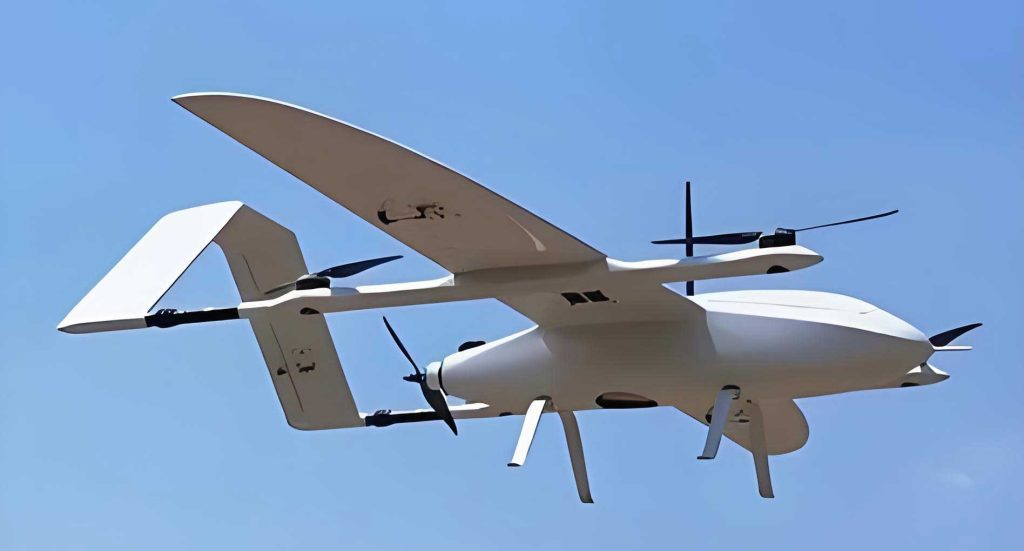
Our investigation begins with the establishment of a rigorous dynamic model for the tail-sitter VTOL drone. We define two primary coordinate frames: the body frame \( \mathcal{F}_b \) (O\(_b\)x\(_b\)y\(_b\)z\(_b\)) fixed to the drone, and the inertial or ground frame \( \mathcal{F}_g \) (O\(_g\)x\(_g\)y\(_g\)z\(_g\)). The x\(_b\)-axis points forward through the nose, the y\(_b\)-axis points to the right, and the z\(_b\)-axis points downward, completing the right-handed system. The forces acting on the VTOL drone include gravity (\( \mathbf{F}_G \)), thrust from the four propellers (\( \mathbf{F}_T \)), and aerodynamic forces from the wings (\( \mathbf{F}_A \)). The total force vector is:
$$ \mathbf{F} = \mathbf{F}_G + \mathbf{F}_T + \mathbf{F}_A = m \frac{d\mathbf{v}}{dt} $$
where \( m \) is the mass and \( \mathbf{v} \) is the velocity vector. In the body frame, gravity is expressed using Euler angles (roll \( \phi \), pitch \( \theta \), yaw \( \psi \)):
$$ \mathbf{F}_G^b = m \begin{bmatrix} -\sin\theta \\ \cos\theta \sin\phi \\ \cos\theta \cos\phi \end{bmatrix} g $$
The total propeller thrust is the sum of individual thrusts, \( \mathbf{F}_T = \sum_{i=1}^{4} \mathbf{F}_i \), where each \( \mathbf{F}_i \) acts along the negative z\(_b\)-axis. The aerodynamic force is decomposed into lift (\( \mathbf{F}_L \)) and drag (\( \mathbf{F}_D \)), which are functions of the airspeed \( V \), air density \( \rho \), wing area \( S \), and aerodynamic coefficients (\( C_L, C_D \)):
$$ F_L = \frac{1}{2} \rho V^2 S C_L(\alpha), \quad F_D = \frac{1}{2} \rho V^2 S C_D(\alpha) $$
Here, \( \alpha \) is the angle of attack. For a tail-sitter in transition, \( \alpha \) is closely related to the pitch angle \( \theta \). Expanding the translational dynamics in the body frame yields:
$$ \begin{aligned}
a_x &= \omega_z v_y – \omega_y v_z – \frac{F_L \cos\alpha + F_D}{m} + g \cos\theta \cos\phi \\
a_y &= \omega_x v_z – \omega_z v_x + g \cos\theta \sin\phi \\
a_z &= \omega_y v_x – \omega_x v_y – \frac{F_L \sin\alpha – |\mathbf{F}_T|}{m} + g \sin\theta
\end{aligned} $$
where \( (a_x, a_y, a_z) \), \( (v_x, v_y, v_z) \), and \( (\omega_x, \omega_y, \omega_z) \) are body-frame accelerations, velocities, and angular rates, respectively.
The rotational dynamics are derived from the moment equation \( \mathbf{M} = \frac{d\mathbf{L}}{dt} \). The total external moment \( \mathbf{M} \) includes moments from propeller forces (\( \mathbf{M}_{Tc} \)), gyroscopic effects (\( \mathbf{M}_{Tg} \)), and wing aerodynamics (\( \mathbf{M}_A \)):
$$ \mathbf{M} = \mathbf{M}_{Tc} + \mathbf{M}_{Tg} + \mathbf{M}_A $$
The control moments from differential propeller thrust, assuming an X-configuration with motors numbered 1 to 4, are:
$$ \begin{aligned}
M_{x_c} &= d ( -F_1 + F_2 + F_3 – F_4 ) \\
M_{y_c} &= d ( F_1 + F_2 – F_3 – F_4 ) \\
M_{z_c} &= d ( F_1 – F_2 + F_3 – F_4 )
\end{aligned} $$
where \( d \) is the moment arm. The gyroscopic moments are given by:
$$ \begin{aligned}
M_{x_g} &= J_z \omega_z \sum_{i=1}^{4} (-1)^i n_i \\
M_{y_g} &= J_z \omega_y \sum_{i=1}^{4} (-1)^i n_i \\
M_{z_g} &= 0
\end{aligned} $$
where \( J_z \) is the propeller’s moment of inertia and \( n_i \) is the rotational speed. The primary aerodynamic moment is the pitching moment from the wings, modeled as:
$$ M_{y_A} = M_w + M_r = \frac{1}{2} C_{m,\alpha} \rho S \bar{c} V^2 + \frac{1}{2} C_{m,q} \rho S \bar{c}^2 V \omega_y $$
where \( \bar{c} \) is the mean aerodynamic chord, \( C_{m,\alpha} \) is the static pitching moment coefficient, and \( C_{m,q} \) is the damping moment coefficient. The full rotational dynamics become:
$$ \begin{aligned}
\dot{\omega}_x &= \frac{(I_{yy} – I_{zz}) \omega_y \omega_z + M_{x_c} – M_{x_g}}{I_{xx}} \\
\dot{\omega}_y &= \frac{(I_{zz} – I_{xx}) \omega_x \omega_z + M_{y_c} + M_{y_A} – M_{y_g}}{I_{yy}} \\
\dot{\omega}_z &= \frac{(I_{xx} – I_{yy}) \omega_x \omega_y + M_{z_c}}{I_{zz}}
\end{aligned} $$
This model forms the basis for designing and simulating control strategies for the VTOL drone. The key parameters for our specific platform are summarized below.
| Parameter | Symbol | Value |
|---|---|---|
| Mass | \( m \) | 0.96 kg |
| Cruise Speed | \( V_{cruise} \) | 12.5 m/s |
| Cruise Angle of Attack | \( \alpha_{cruise} \) | 14° |
| Corresponding Pitch Angle | \( \theta_{cruise} \) | -76° |
| Maximum Flight Time | – | ≥ 18 min |
| Wing Airfoil | – | FX63-137 |
With the model established, we define the three flight modes for our VTOL drone. The Hover Mode is characterized by \( \theta \approx 0^\circ \) and \( v_x \approx 0 \). The Cruise Mode is defined by \( \alpha = 14^\circ \) (\( \theta = -76^\circ \)) and \( v_x = 12.5 \) m/s. The Transition Mode is the dynamic process where \( \theta \) varies from \( 0^\circ \) to \( -76^\circ \) and \( v_x \) accelerates from 0 to 12.5 m/s. The core challenge is to control this transition optimally.
We analyze three distinct control strategies. The first is the Classical PID Control Strategy. This is a baseline approach where separate PID controllers regulate the drone’s attitude (pitch) and horizontal velocity during transition. A high-level controller commands a pitch angle rate, and a lower-level attitude PID controller generates the required pitching moment \( M_{y_c} \). Simultaneously, a separate controller manages collective thrust to maintain a desired altitude reference. While this method is straightforward and can achieve transition, it often results in suboptimal performance because it does not explicitly account for the coupled dynamics between pitch rotation, forward acceleration, and altitude hold. The controllers work independently, potentially leading to a slow and oscillatory response.
The second strategy is the Fastest Mode Transition Control Strategy. This strategy aims to minimize the transition time by maximizing the pitch angular acceleration \( \dot{\omega}_y \) throughout the maneuver. It treats the transition as an optimization problem:
$$
\begin{aligned}
& \underset{F_1, F_2, F_3, F_4}{\text{maximize}}
& & | \dot{\omega}_y(F_1, F_2, F_3, F_4) | \\
& \text{subject to}
& & F_{min} \leq F_i \leq F_{max}, \quad i = 1, \ldots, 4.
\end{aligned}
$$
By constantly commanding the maximum allowable pitching moment, this strategy rotates the VTOL drone to the target cruise attitude very quickly. However, it pays no regard to the vertical force balance. As the drone pitches forward rapidly, the vertical component of propeller thrust (\( |\mathbf{F}_T| \cos\theta \)) decreases sharply. The wing lift (\( F_L \)), which is a function of the square of the forward velocity (\( v_x^2 \)), builds up more slowly. Consequently, a significant net downward force arises, causing a large and potentially destabilizing loss of altitude. This is a critical flaw for a practical VTOL drone operation, especially near the ground or obstacles.
To overcome the limitations of the previous two strategies, we propose the Fastest Mode Transition with Constant Altitude Control Strategy. This is our novel contribution. The objective is twofold: to transition as quickly as possible while explicitly maintaining near-zero vertical acceleration to prevent altitude loss. This is enforced as a hard constraint in the optimization problem. The vertical force balance equation, simplified by assuming small roll and sideslip, is:
$$ m \dot{v}_z \approx |\mathbf{F}_T| \cos\theta + F_L \sin\alpha – mg = 0 $$
We aim to keep \( \dot{v}_z = 0 \). Therefore, the combined optimization problem for our proposed VTOL drone control strategy becomes:
$$
\begin{aligned}
& \underset{F_1, F_2, F_3, F_4}{\text{maximize}}
& & | \dot{\omega}_y(F_1, F_2, F_3, F_4) | \\
& \text{subject to}
& & |\mathbf{F}_T| \cos\theta + F_L(\alpha, v_x) – mg = 0, \\
& & & F_{min} \leq F_i \leq F_{max}, \quad i = 1, \ldots, 4.
\end{aligned}
$$
This strategy intelligently coordinates the pitch rotation rate with the forward acceleration. It does not simply pitch as fast as possible; instead, it finds the maximum pitch acceleration that can be achieved while simultaneously adjusting the total thrust \( |\mathbf{F}_T| \) to compensate for the evolving wing lift \( F_L \), thereby maintaining vertical equilibrium. The solution to this problem, which we obtain using sequential quadratic programming (SQP), provides an optimal thrust profile for each motor as a function of the current state (\( \theta, v_x \)). This ensures that the VTOL drone reaches the cruise attitude (\( \theta = -76^\circ \)) and cruise speed (\( v_x = 12.5 \) m/s) nearly simultaneously, minimizing both transition time and altitude deviation.
We implemented a hierarchical control architecture to execute these strategies. The high-level strategy block (PID, Fastest Transition, or our proposed Constant Altitude strategy) calculates the desired total thrust \( F_T^{cmd} \) and pitching moment \( M_y^{cmd} \). A control allocation module then solves for the individual motor thrusts \( F_i \). For the PID case, this is straightforward mixing. For the optimization-based strategies, the allocation is implicit in solving the optimization problem. Finally, motor controllers translate the thrust commands into electronic speed controller (ESC) signals.
The performance of the three strategies was rigorously evaluated in simulation. The initial conditions were set to hover: \( \theta=0^\circ, v_x=0, h=0 \) m. The desired final state was cruise: \( \theta=-76^\circ, v_x=12.5 \) m/s, \( h=0 \) m. The table below summarizes the key simulation results, clearly demonstrating the advantages of our proposed strategy for the VTOL drone.
| Control Strategy | Time to Reach Cruise Pitch (s) | Time to Reach Cruise Speed (s) | Total Transition Time (s) | Altitude Change (m) |
|---|---|---|---|---|
| Classical PID | 2.12 | 2.95 | 2.95 | -2.83 |
| Fastest Transition | 1.74 | 2.45 | 2.45 | -1.47 | Fastest Transition with Constant Altitude (Proposed) | 1.97 | 1.97 | 1.97 | -0.56 |
The analysis of these results is insightful. The Classical PID strategy performed the worst, with the longest transition time (2.95 s) and the largest altitude drop (2.83 m). Its decoupled control loops led to a sequential process: pitch over first, then accelerate. The Fastest Transition strategy lived up to its name in rotating the VTOL drone quickly (1.74 s to target pitch), but the speed lagged behind, resulting in a 2.45 s total transition and a still-substantial 1.47 m altitude loss due to the lack of vertical force constraint.
Our proposed Fastest Transition with Constant Altitude strategy for the VTOL drone delivered the best overall performance. It synchronized the pitch and speed evolution masterfully, with both reaching their targets at the same time (1.97 s). This synchronization is the key to minimizing altitude deviation. By enforcing the vertical force balance constraint, the controller ensured that the increase in wing lift closely matched the decrease in the vertical component of propeller thrust. This resulted in a dramatically smaller altitude loss of only 0.56 m, which is over 80% better than the PID strategy and 62% better than the unconstrained fastest transition strategy. Furthermore, its total transition time was 33% faster than PID and 20% faster than the unconstrained strategy when considering the synchronized completion of both pitch and speed objectives.
The ultimate validation for any VTOL drone control strategy comes from flight testing. We constructed a tail-sitter VTOL drone prototype based on the modeled parameters. The airframe was built with composite materials, and it was equipped with a standard autopilot suite: an inertial measurement unit (IMU), GPS, barometer, and a microprocessor running the control algorithms. We implemented our proposed Fastest Transition with Constant Altitude control strategy on this platform.
In the flight test, the VTOL drone commenced in a stable hover. Upon command, it initiated the transition to forward flight. The logged data showed that the pitch angle tracked the planned profile effectively, rotating from \( 0^\circ \) to approximately \( -76^\circ \) in under 2 seconds, which closely matched the simulation. The forward velocity increased smoothly and reached the target cruise speed in a comparable timeframe. Most importantly, the altitude change during the entire maneuver was measured to be approximately 1.5 meters, which is slightly larger than the simulated 0.56 meters but still represents excellent performance. This discrepancy is attributed to real-world factors not fully captured in the simulation, such as motor dynamics and response delays, unmodeled aerodynamic effects, and sensor noise. Nevertheless, the flight test conclusively demonstrated that the proposed strategy enables a rapid, stable, and controlled mode transition for a practical VTOL drone, effectively solving the pronounced altitude loss problem observed with simpler strategies.
In conclusion, the transition phase is a defining challenge for the operational capability of a VTOL drone. Through detailed dynamic modeling and analysis, we have systematically compared prevalent control approaches and identified their limitations. The Classical PID strategy, while simple, is inefficient and leads to poor performance. The Fastest Transition strategy improves speed but exacerbates altitude control issues. Our proposed Fastest Mode Transition with Constant Altitude control strategy fundamentally addresses these shortcomings by framing the transition as a constrained optimization problem that maximizes pitch rate while strictly maintaining vertical force equilibrium. Simulation and experimental results confirm that this strategy enables a VTOL drone to transition between flight modes significantly faster and with drastically reduced altitude variation compared to conventional methods. This work provides a robust and practical control solution that enhances the safety, reliability, and performance of tail-sitter VTOL drones, paving the way for their more widespread adoption in demanding applications. Future work will focus on extending this strategy to account for wind disturbances, implementing robust adaptive elements, and integrating it with full trajectory planning for fully autonomous VTOL drone missions from take-off to landing.