
In recent years, vertical take-off and landing (VTOL) drones have garnered significant attention due to their versatility in applications such as tactical reconnaissance, aerial photography, pipeline inspection, and agricultural assessment. Among various VTOL configurations, the tail-sitter VTOL drone stands out as an optimal design, combining the advantages of multi-rotor and fixed-wing drones. This type of VTOL drone can hover vertically, cruise horizontally at high speeds, and requires minimal landing space, making it highly adaptable. However, a major limitation hindering its widespread practical use is its poor anti-wind performance during vertical states, such as hover and landing. Strong wind disturbances can severely degrade position tracking accuracy, posing challenges for stable operation. Therefore, in this article, we focus on analyzing the longitudinal anti-wind performance of a quadrotor tail-sitter VTOL drone. We aim to establish a longitudinal dynamic model, evaluate its maximum wind resistance boundary, and propose an enhanced control strategy to improve robustness under windy conditions.
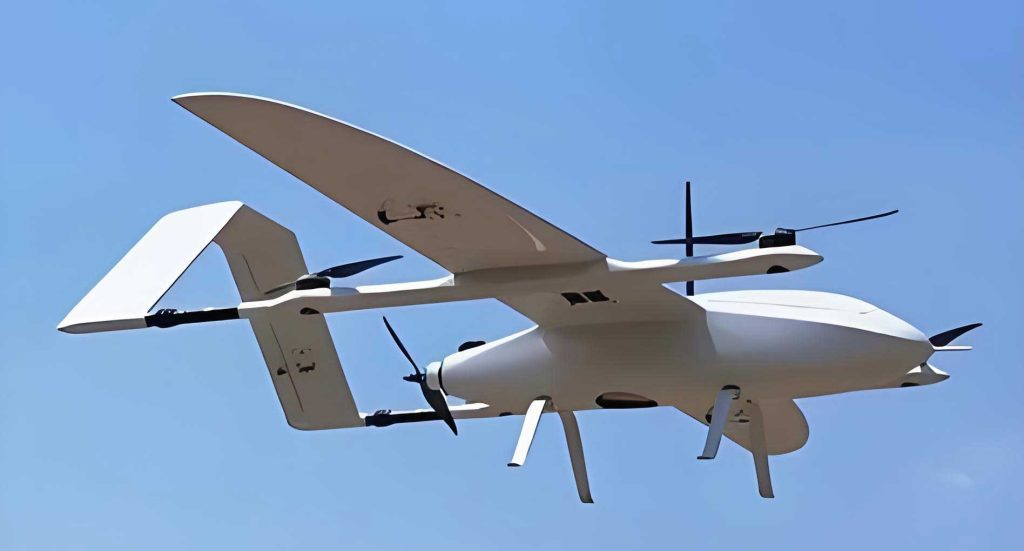
The tail-sitter VTOL drone typically features a flying-wing aerodynamic layout, with four rotors arranged in an “X” configuration at the wingtips to minimize propeller slipstream interference. It operates through various flight phases, including vertical take-off and landing, horizontal cruise, hover, loiter, and transitions between vertical and horizontal modes. Among these, hover and vertical landing are the most critical stages where the VTOL drone presents its largest cross-sectional area to wind, demands high position tracking precision, and is most sensitive to disturbances. Thus, our analysis concentrates on these states to address the core issues affecting the performance of VTOL drones. Understanding the longitudinal dynamics is essential for designing effective control systems that can mitigate wind effects and ensure reliable operation of VTOL drones in real-world environments.
To begin, we analyze the longitudinal forces acting on the quadrotor tail-sitter VTOL drone. In the longitudinal plane, the VTOL drone is subjected to gravity, thrust, lift, drag, aerodynamic pitching moment, and pitch control moment. We define coordinate systems: the ground frame (Ogxgzg), body frame (Obxbzb), and wind frame (Oaxaza). Key angles include the angle of attack (α), pitch angle (θ), and flight path angle (μ), with μ = θ – α for longitudinal motion. The aerodynamic forces and moments are expressed as:
$$F_L = \frac{1}{2} \rho V^2 S C_L$$
$$F_D = \frac{1}{2} \rho V^2 S C_D$$
$$M_a = \frac{1}{2} \rho V^2 S c C_m$$
Here, ρ is air density (assumed constant at 1.225 kg/m³ for low-altitude flight), V is airspeed (the vector sum of ground speed and wind velocity), S is wing reference area (0.1444 m²), c is mean aerodynamic chord (0.193 m), and CL, CD, Cm are coefficients dependent on α, derived from computational fluid dynamics (CFD) simulations. The thrust from the four propellers is given by:
$$T_{\sum} = \sum_{i=1}^{4} T_i = \sum_{i=1}^{4} \rho n_i^2 D^4 C_T$$
where ni is the rotational speed of the i-th propeller, D is propeller diameter, and CT is the thrust coefficient, which varies nonlinearly with n and axial inflow velocity Vx. As wind speed increases, CT decreases, potentially reducing thrust to zero at high inflows. The pitch control moment generated by differential propeller speeds is:
$$M_c = \frac{d}{2} T_{\delta e}$$
where d is the short-axis distance between propellers, and Tδe = T1 + T3 – T2 – T4 is the pitch control force. For longitudinal motion, we assume T1 = T3 and T2 = T4. The net forces and moments in the wind frame are:
$$F^x_a = T_{\sum} \cos \alpha – F_D – G \sin \mu$$
$$F^z_a = -T_{\sum} \sin \alpha – F_L + G \cos \mu$$
$$M^y_a = M_a + M_c$$
where G is gravitational force. The longitudinal equations of motion, derived from Newton’s second law, are:
$$m \dot{V} = F^x_a$$
$$m V \dot{\mu} = -F^z_a$$
$$m V \dot{\alpha} = F^z_a + m V q$$
$$\dot{\theta} = q$$
$$I_y \dot{q} = M^y_a$$
with navigation equations:
$$\dot{x}_g = V \cos \mu$$
$$\dot{h}_g = V \sin \mu$$
Here, m is mass, Iy is moment of inertia, q is pitch rate, xg is horizontal position, and hg is altitude. These equations form the basis for analyzing the anti-wind performance of the VTOL drone. To determine the maximum wind resistance, we consider steady-state horizontal flight conditions where $\dot{x}_g \equiv 0$ and q ≡ 0. This leads to a system of equations:
$$0 = T_{\sum}(n_{1,3}, n_{2,4}, \alpha, V) \cos \alpha – F_D(\alpha, V) – mg \sin \mu$$
$$0 = -T_{\sum}(n_{1,3}, n_{2,4}, \alpha, V) \sin \alpha – F_L(\alpha, V) + mg \cos \mu$$
$$0 = M_a(\alpha, V) + \frac{d}{2} T_{\delta e}(n_{1,3}, n_{2,4}, \alpha, V)$$
$$0 = q$$
$$0 = \theta – \alpha – \mu$$
With unknowns V, α, θ, μ, q, n1,3, and n2,4, we solve for equilibrium points under constraints n1,3, n2,4 ≤ nmax (e.g., nmax = 9000 rpm). By varying V and μ, we obtain discrete equilibrium distributions. For instance, at μ = 0° (hover), the airspeed V equals the wind speed due to relative motion. The analysis reveals that the theoretical maximum horizontal wind resistance is 25 m/s, achieved in a -5° dive. However, practical limitations arise from pitch control system responsiveness. As wind speed increases, the required pitch angle θ becomes highly sensitive, necessitating rapid control adjustments. For wind speeds above 11 m/s, the pitch angle changes abruptly, making stable hover challenging without a fast-responding controller. Thus, the actual anti-wind capability for VTOL drones is often lower, around 11 m/s, highlighting the need for advanced control strategies to enhance performance.
To address the issue of poor position tracking accuracy under strong wind disturbances, we introduce iterative learning control (ILC). ILC is an intelligent control method that improves performance for systems executing repetitive tasks by learning from previous iterations. It is advantageous for VTOL drones as it does not require an exact mathematical model and can achieve perfect tracking of desired trajectories. The basic principle involves adjusting control inputs based on output errors from prior runs. For a system described by:
$$\dot{x}(t) = f[t, x(t), u(t)]$$
$$y(t) = g[t, x(t), u(t)]$$
where x is state, y is output, and u is input, the goal over time t ∈ [0, T] is to have y(t) track yd(t) through repeated iterations. The error at the k-th iteration is ek(t) = yd(t) – yk(t). A common ILC law is the closed-loop PID-type:
$$u_{k+1}(t) = u_k(t) + k_p e_{k+1}(t) + k_d \frac{de_{k+1}(t)}{dt} + k_i \int_0^t e_{k+1}(s) ds$$
where kp, kd, ki are learning gains. This approach has been applied to robotics and other repetitive systems but faces limitations for VTOL drones due to non-repeatability in take-off and landing phases. For example, a landing operation is not immediately repeated, and environmental conditions may change over time, violating the repetition assumption. To overcome this, we propose a segmented iterative learning control method. This method divides a non-repetitive control process into small segments, assuming that wind disturbances and desired trajectories are approximately constant or slowly varying within each segment. Thus, each segment serves as an iteration of the previous one, enabling continuous learning. The control structure is illustrated below, and the mathematical expression is:
$$u_{k+1}(t) = k_c u_k(t) + k_p e_{k+1}(t)$$
or in pure time-domain form:
$$u(t) = k_c u(t – \tau) + k_p e(t)$$
Here, τ is the segment length, and kc, kp are weighting coefficients for historical control output and current error, respectively. This segmented ILC allows the VTOL drone to adapt to wind disturbances in real-time, improving tracking accuracy during critical phases like hover and landing for VTOL drones.
We validate the proposed control method through simulation experiments using Simulink. The longitudinal control of the VTOL drone is divided into vertical height and horizontal position channels. Each channel employs a cascaded PID controller as the baseline, with parameters tuned via genetic algorithms. The segmented ILC is then incorporated into both channels. Initial conditions set the VTOL drone in vertical hover at altitude h = 20 m, pitch angle θ = 90°, ground speed Vg = 0 m/s, and wind speed Vwind = 0 m/s from the negative x-direction. The controller parameters are summarized in the following table:
| Controller | Height Channel | Position Channel |
|---|---|---|
| Velocity/Angular Rate PID [Kp, Ki, Kd] | [9.4, 0.18, 3.3] | [10, 0, 1.5] |
| Attitude Angle PID [Kp, Ki, Kd] | — | [8, 3, 0] |
| Height/Position PID [Kp, Ki, Kd] | [27, 0.2, 0] | [6.9, 1.1, 12.5] |
| Segmented ILC [kp, kc, τ] | [4, 0.6, 0.1 s] | [0.8, 0.6, 0.1 s] |
In the first experiment, wind speed steps from 0 to 5 m/s at t=0, with desired height hd = 20 m and position xd = 0 m. Results show that with cascaded PID alone, maximum height error is 2.2 m and maximum horizontal displacement is 1.96 m. With segmented ILC, these reduce to 0.18 m and 0.48 m, respectively. The pitch angle response is faster with segmented ILC, though with some overshoot and oscillation that quickly dampens. The segmented ILC output provides corrective signals to counteract wind effects, demonstrating its effectiveness for VTOL drones. In a second experiment, wind speed ramps up from 0 to varying maximum speeds over 2 seconds, starting at t=4 s. We record maximum tracking errors for height and position. The results are summarized below:
| Maximum Wind Speed (m/s) | Cascaded PID: Max Height Error (m) | Cascaded PID: Max Position Error (m) | Segmented ILC: Max Height Error (m) | Segmented ILC: Max Position Error (m) |
|---|---|---|---|---|
| 5 | 2.2 | 1.96 | 0.18 | 0.48 |
| 6 | 2.8 | 2.5 | 0.25 | 0.55 |
| 7 | 3.5 | 3.1 | 0.32 | 0.65 |
| 8 | 4.2 (unstable) | 3.8 (unstable) | 0.40 | 0.78 |
| 9 | — (unstable) | — (unstable) | 0.50 | 0.92 |
Clearly, segmented ILC significantly outperforms cascaded PID across all wind speeds, with errors increasing gradually rather than abruptly. For wind speeds above 8 m/s, the cascaded PID fails to stabilize the VTOL drone, whereas segmented ILC maintains control up to 9 m/s, showcasing its robustness for VTOL drones in windy conditions. A third experiment simulates a realistic wind environment combining gusts and turbulence, as shown in the wind profile. The VTOL drone undergoes a full landing process from hover to touchdown. With cascaded PID, maximum height and position errors are 1.81 m and 1.71 m, respectively. With segmented ILC, these reduce to 0.35 m and 0.43 m. The vertical velocity profile is smoother with segmented ILC, indicating improved stability. These simulations confirm that segmented ILC enhances the anti-wind performance of VTOL drones, even under non-constant wind and changing desired trajectories, making it suitable for real-world applications.
In conclusion, we have analyzed the longitudinal anti-wind performance of a quadrotor tail-sitter VTOL drone through dynamic modeling and control design. The longitudinal dynamics reveal that the theoretical wind resistance boundary is influenced by aerodynamic and propulsion parameters, but practical limits are imposed by pitch control capabilities. To address tracking precision issues under strong winds, we proposed a segmented iterative learning control method that adapts to non-repetitive processes like landing. Simulation results demonstrate that this method reduces height and position errors substantially compared to traditional cascaded PID control, especially at higher wind speeds. It also extends the stable operational range of VTOL drones, allowing them to withstand winds up to 9 m/s. Future work could explore the integration of segmented ILC with other advanced control techniques, such as adaptive or robust control, to further enhance the resilience of VTOL drones in complex environments. Additionally, experimental validation with physical VTOL drone platforms would be valuable to confirm these findings in real-world scenarios. Overall, this study contributes to improving the reliability and performance of VTOL drones, paving the way for their broader adoption in demanding operational conditions.