
In this article, I delve into the intricate world of Vertical Take-Off and Landing (VTOL) drone technology, exploring its fundamental principles, design methodologies, and expansive applications. As an enthusiast and researcher in unmanned aerial systems, I have witnessed the rapid evolution of VTOL drones, which combine the flexibility of helicopters with the endurance of fixed-wing aircraft. The core advantage of a VTOL drone lies in its ability to operate in confined spaces without requiring runways, making it indispensable for both civilian and military missions. Throughout this discussion, I will emphasize the multifaceted nature of VTOL drone systems, incorporating mathematical models and comparative data to provide a thorough understanding.
The operational concept of a VTOL drone revolves around its propulsion mechanism, which must generate sufficient lift for vertical ascent and transition to forward flight. I often consider the basic physics involved: the thrust force ($T$) must overcome the weight ($W$) during take-off. This can be expressed as:
$$ T > W = m \cdot g $$
where $m$ is the mass of the VTOL drone and $g$ is the acceleration due to gravity. For a VTOL drone utilizing multiple rotors, the total thrust is the sum of individual rotor thrusts. If we assume $n$ rotors, each producing a thrust $T_i$, then:
$$ T_{\text{total}} = \sum_{i=1}^{n} T_i $$
This simple formula underscores the importance of power distribution in VTOL drone design. Additionally, the power required for hover ($P_{\text{hover}}$) can be approximated using momentum theory:
$$ P_{\text{hover}} = \frac{T^{3/2}}{\sqrt{2 \rho A}} $$
where $\rho$ is air density and $A$ is the rotor disk area. These equations highlight the energy demands inherent in VTOL drone operations, influencing battery technology and endurance.
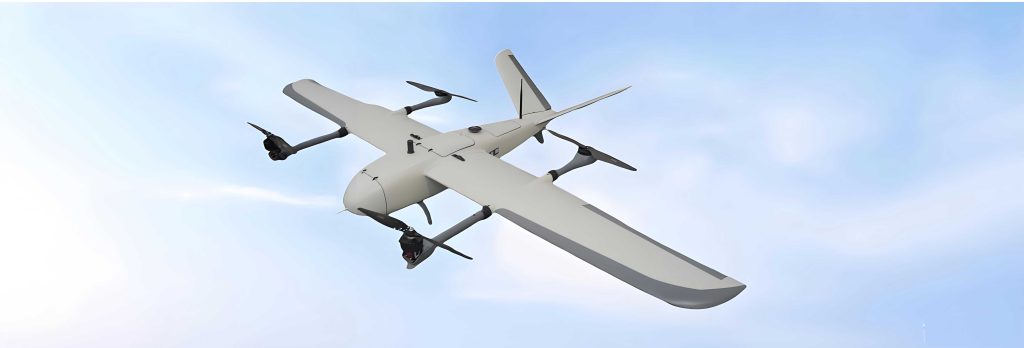
Transitioning from vertical to horizontal flight is a critical phase for any VTOL drone. I analyze this using a simplified dynamic model. Let the VTOL drone have a velocity vector $\vec{v} = (v_x, v_y, v_z)$ and orientation defined by Euler angles ($\phi, \theta, \psi$). The equations of motion during transition can be linearized for small angles:
$$ \ddot{x} = g \theta, \quad \ddot{y} = -g \phi, \quad \ddot{z} = \frac{T}{m} – g $$
Here, $x$ and $y$ are horizontal positions, and $z$ is altitude. Control inputs include thrust $T$ and attitude angles. This model helps in designing flight controllers for VTOL drones, ensuring stable transition. Moreover, the aerodynamic drag force ($D$) during forward flight affects the VTOL drone’s speed and energy consumption:
$$ D = \frac{1}{2} \rho C_D A_f v^2 $$
where $C_D$ is the drag coefficient and $A_f$ is the frontal area. Optimizing these parameters is crucial for enhancing the range of a VTOL drone.
When examining design considerations, I focus on key components that define a VTOL drone’s performance. The propulsion system, often electric or hybrid, must balance power output and weight. For instance, the specific energy of batteries ($E_{\text{specific}}$ in Wh/kg) directly impacts flight time. If a VTOL drone has a battery mass $m_b$ and total mass $m$, the available energy is:
$$ E_{\text{available}} = E_{\text{specific}} \cdot m_b $$
Then, the endurance ($E_{\text{endurance}}$) in hover can be estimated as:
$$ E_{\text{endurance}} = \frac{E_{\text{available}}}{P_{\text{hover}}} $$
This relationship shows why advancements in battery technology are pivotal for VTOL drone development. Additionally, structural materials like carbon fiber reduce weight, improving payload capacity. A typical VTOL drone design involves trade-offs between endurance, payload, and maneuverability, which I summarize in the following table comparing hypothetical models:
| VTOL Drone Model | Max Take-Off Weight (kg) | Endurance (minutes) | Payload Capacity (kg) | Propulsion Type |
|---|---|---|---|---|
| Model A (Multirotor VTOL drone) | 25 | 40 | 5 | Electric |
| Model B (Tiltrotor VTOL drone) | 100 | 120 | 20 | Hybrid |
| Model C (Compound VTOL drone) | 150 | 180 | 30 | Fuel Cell |
| Model D (Lightweight VTOL drone) | 10 | 30 | 2 | Electric |
This table illustrates the diversity in VTOL drone capabilities, catering to different missions. For example, a VTOL drone designed for long-endurance surveillance requires high energy density, whereas a VTOL drone for agile delivery prioritizes lightweight structures.
In terms of applications, the versatility of a VTOL drone is remarkable. I have observed their use in sectors such as agriculture, where VTOL drones perform crop monitoring using multispectral sensors. The data collected can be processed to generate vegetation indices, like the Normalized Difference Vegetation Index (NDVI):
$$ \text{NDVI} = \frac{\text{NIR} – \text{Red}}{\text{NIR} + \text{Red}} $$
where NIR and Red are reflectances in near-infrared and red bands. This index helps assess plant health, showcasing how a VTOL drone enables precision farming. Similarly, in search and rescue, a VTOL drone equipped with thermal cameras can detect heat signatures, improving response times. The military domain also heavily employs VTOL drones for reconnaissance and electronic warfare, as referenced in earlier discussions on radar systems, but here I focus on the platform itself. For instance, a VTOL drone can be integrated with radar jamming systems, leveraging its mobility to deploy countermeasures. The effectiveness of such a VTOL drone in electronic support measures (ESM) depends on its loiter time and payload power, which ties back to the endurance equations.
Another critical aspect is the communication and control of VTOL drones. I often model the data link reliability using signal-to-noise ratio (SNR). For a VTOL drone transmitting at a distance $d$, the received power $P_r$ is:
$$ P_r = P_t G_t G_r \left( \frac{\lambda}{4 \pi d} \right)^2 $$
where $P_t$ is transmitted power, $G_t$ and $G_r$ are antenna gains, and $\lambda$ is wavelength. Maintaining a high SNR is essential for real-time control of a VTOL drone, especially in beyond-visual-line-of-sight (BVLOS) operations. Furthermore, autonomous navigation relies on sensor fusion algorithms, combining GPS, inertial measurement units (IMUs), and computer vision. The state estimation for a VTOL drone can be formulated using a Kalman filter, with state vector $\mathbf{x} = [x, y, z, \dot{x}, \dot{y}, \dot{z}, \phi, \theta, \psi]^T$ and measurements from various sensors. This complexity underscores the advanced avionics required for a modern VTOL drone.
To delve deeper into performance metrics, I present a mathematical framework for evaluating VTOL drone efficiency. The lift-to-drag ratio ($L/D$) during cruise is a key indicator. For a VTOL drone in forward flight, lift $L$ equals weight in steady flight, so:
$$ \frac{L}{D} = \frac{W}{D} $$
Higher $L/D$ ratios imply better aerodynamic efficiency, extending the range. The range ($R$) of a VTOL drone can be approximated using the Breguet range equation for electric aircraft:
$$ R = \frac{E_{\text{available}} \cdot \eta}{P_{\text{cruise}}} \cdot v $$
where $\eta$ is the overall efficiency (motor, propeller, etc.), $P_{\text{cruise}}$ is power during cruise, and $v$ is velocity. Optimizing these parameters is a continuous challenge for VTOL drone designers.
In the context of military applications, such as the MUX program mentioned in related materials, VTOL drones are envisioned for carrier-based operations. These VTOL drones must withstand harsh naval environments and integrate with existing systems. I analyze the take-off requirements from amphibious ships: the VTOL drone needs to achieve a certain climb rate ($\dot{z}$) to clear obstacles. Using Newton’s second law:
$$ \dot{z} = \frac{T – D – W}{m} \cdot \Delta t $$
where $\Delta t$ is time increment. This equation highlights the thrust margins necessary for safe operations of a VTOL drone on confined decks. Additionally, the radar cross-section (RCS) of a VTOL drone is crucial for stealth. While detailed RCS formulas are classified, a simplified model for a sphere of radius $a$ at wavelength $\lambda$ is:
$$ \text{RCS} = \pi a^2 \quad \text{for } a \gg \lambda $$
Reducing RCS through shaping and materials enhances the survivability of a VTOL drone in contested airspace.
The integration of VTOL drones into urban air mobility (UAM) is another area I explore. Here, a VTOL drone functions as an air taxi, requiring stringent safety standards. The probability of system failure ($P_f$) must be extremely low. If a VTOL drone has $n$ redundant systems, each with failure rate $\lambda$, the probability of total failure over time $t$ is:
$$ P_f(t) = (1 – e^{-\lambda t})^n $$
This reliability analysis is vital for certifying VTOL drones for passenger transport. Moreover, noise pollution from VTOL drones is a concern; sound pressure level ($L_p$) in decibels is given by:
$$ L_p = 20 \log_{10} \left( \frac{p}{p_0} \right) $$
where $p$ is sound pressure and $p_0$ is reference pressure. Quieter propulsion systems are thus a focus for VTOL drone developers aiming for urban integration.
To further illustrate technical specifications, I provide another table summarizing sensor payloads commonly used on VTOL drones. These payloads define the mission capabilities of a VTOL drone, from photogrammetry to signal intelligence.
| Sensor Type | Typical Weight (kg) | Power Consumption (W) | Data Rate (Mbps) | Application in VTOL Drone |
|---|---|---|---|---|
| Electro-Optical Camera | 1.5 | 15 | 50 | Visual reconnaissance |
| LiDAR Scanner | 3.0 | 30 | 100 | 3D mapping |
| Synthetic Aperture Radar | 5.0 | 50 | 200 | All-weather surveillance |
| Communication Jammer | 4.0 | 40 | N/A | Electronic attack |
| Multispectral Imager | 2.0 | 20 | 80 | Agricultural monitoring |
This table demonstrates how payload selection tailors a VTOL drone for specific roles. For instance, a VTOL drone equipped with SAR can penetrate cloud cover, providing persistent surveillance—a feature highlighted in radar literature. The interplay between sensor performance and VTOL drone endurance is critical; heavier payloads reduce flight time, as seen in the endurance formula earlier.
Looking at future trends, I anticipate advancements in artificial intelligence for autonomous VTOL drones. Machine learning algorithms can optimize flight paths for energy efficiency. Consider a VTOL drone navigating waypoints; the total energy consumption ($E_{\text{total}}$) is:
$$ E_{\text{total}} = \sum_{i=1}^{N} \left( \frac{P_i \cdot d_i}{v_i} \right) $$
where $P_i$ is power on segment $i$, $d_i$ is distance, and $v_i$ is velocity. Reinforcement learning can minimize $E_{\text{total}}$ by adjusting speeds and altitudes. Additionally, swarming technology enables multiple VTOL drones to collaborate, forming a networked system. The coordination of a VTOL drone swarm can be modeled using consensus algorithms, where each VTOL drone updates its state based on neighbors’ states:
$$ \dot{x}_i = \sum_{j \in N_i} (x_j – x_i) $$
where $x_i$ is the state of VTOL drone $i$, and $N_i$ is its neighbor set. This allows for scalable operations, such as distributed sensing with a VTOL drone fleet.
In conclusion, the VTOL drone represents a transformative technology with broad implications. From mathematical models to practical tables, I have attempted to cover the essential aspects of VTOL drone systems. The continuous innovation in propulsion, materials, and autonomy will further expand the horizons for VTOL drones. As I reflect on the progress, it is clear that the VTOL drone is not just a tool but a catalyst for new applications across industries. Whether for civilian logistics or military defense, the versatility of a VTOL drone ensures its growing relevance. I encourage ongoing research and development to address challenges like energy storage and regulatory frameworks, paving the way for next-generation VTOL drones.