
In the relentless pursuit of technological advancement, two seemingly disparate domains—the microscopic world of integrated circuit (IC) reliability and the macroscopic realm of advanced aerial systems—converge on a fundamental principle: the critical importance of precise measurement, robust design, and environmental adaptability. My analysis begins with a detailed examination of foundational practices in electronics assessment, which inherently inform the design philosophies behind modern, sophisticated platforms like the Vertical Take-Off and Landing (VTOL) drone.
A quintessential example in semiconductor quality evaluation is the measurement of pin capacitance. This parameter, though seemingly simple, is fraught with methodological nuances that directly impact the interpretation of data and, by extension, the perceived reliability of a component. The prevailing consensus in rigorous assessment advocates for a specific, simplified condition: measuring the zero-bias capacitance of a pin while its associated power rail is left floating (disconnected). This approach is championed for several compelling reasons, which can be systematically compared as follows:
| Measurement Condition | Typical Capacitance Value | Practical Complexity | Diagnostic Value for Design/Process |
|---|---|---|---|
| Power Floating, Zero Bias (Recommended) | Reference Value (Cmin) | Low (Easy to implement, low noise) | High (Isolates intrinsic device physics) |
| Power Floating, Positive Bias | C ≈ Cmin + Δ (Δ is very small) | Medium | Low (Incremental change) |
| With Active Power Supply Applied | C ≈ Cmin + Δ’ (Δ’ is small) | High (Requires AC isolation, prone to interference) | Low |
The underlying rationale is deeply rooted in device physics. The capacitance of a MOS structure, for instance, is a function of the applied voltage and the state of the silicon surface. The zero-bias, floating condition provides a stable, reproducible point that reflects the fundamental gate oxide capacitance \(C_{ox}\) and minimal depletion capacitance, offering a clean metric for process comparison. The functional impact of pin capacitance—on signal propagation delay \(t_{pd}\) and dynamic power consumption \(P_{dyn}\)—is more effectively and directly characterized during Automatic Test Equipment (ATE) runs using established relationships:
$$
t_{pd} \propto R_{driver} \cdot C_{load}
$$
$$
P_{dyn} = \alpha \cdot C_{load} \cdot V_{DD}^2 \cdot f
$$
where \(R_{driver}\) is the driving transistor’s resistance, \(C_{load}\) is the total load capacitance (including pin capacitance), \(\alpha\) is the activity factor, \(V_{DD}\) is the supply voltage, and \(f\) is the operating frequency. Therefore, pursuing complex LCR meter setups for marginal capacitance variations under different biasing conditions offers diminishing returns for quality control. This principle of seeking the most representative, noise-resistant, and implementable measurement translates directly to higher-level system engineering. Just as we isolate a pin to understand its core characteristics, engineers isolate and optimize subsystems to build a reliable whole. This mindset is paramount in the development of complex systems like a modern VTOL drone.
The evolution of unmanned aerial systems has been dramatically accelerated by advancements in microelectronics, battery technology, and composite materials. However, a persistent limitation has been the operational dependency on runways or launch systems. The VTOL drone concept shatters this constraint, merging the endurance and speed of fixed-wing aircraft with the versatile deployment capabilities of helicopters. The drive for such a platform mirrors the drive for simpler, more reliable test methods: it seeks to eliminate extraneous complexity (the runway) to achieve more robust and flexible operation. The recent development initiatives, particularly the program backed by significant defense funding, aim to create a VTOL drone capable of 741 km/h flight speeds while maintaining the agility to land in confined, unprepared areas.
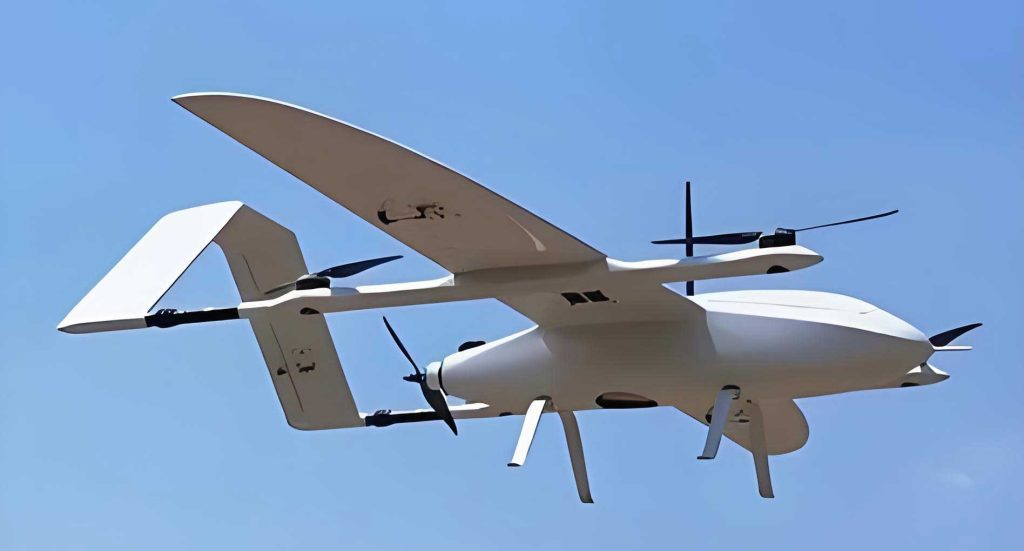
The proposed design philosophy for this advanced VTOL drone is a masterclass in integrated systems engineering. It moves beyond simple ducted fan concepts to a distributed electric propulsion (DEP) architecture. The airframe resembles a tandem or blended-wing body with integrated propulsion systems. Key to its performance is an array of 24+ ducted fans embedded within the primary and forward wings. During vertical take-off and landing, these fans provide direct lift. For forward flight, the entire wing section, along with the fans, rotates to a horizontal position, transforming the system into a conventional, high-lift flying wing. A turboshaft engine acts as a high-density electrical generator, providing power to the multitude of electric motors driving the fans. This design elegantly solves the core challenge of VTOL efficiency: minimizing the penalty for carrying VTOL machinery during cruise flight. The embedded fans contribute to the wing’s area and camber in cruise mode, rather than acting as pure drag elements.
The performance targets for this next-generation VTOL drone highlight its transformative potential. We can summarize its key parameters:
| Performance Metric | Target Value | Significance |
|---|---|---|
| Maximum Speed | 741 km/h (≈ 400 knots) | Comparable to high-performance turboprop aircraft, enabling rapid response. |
| Cruise Speed for Extended Range | 556 km/h (≈ 300 knots) | Optimized for mission endurance and sensor coverage. |
| Mission Radius (at cruise speed) | > 555 km (≈ 300 nautical miles) | Provides substantial operational footprint from a forward base. |
| Hover Efficiency Gain | ~75% improvement over legacy designs | Direct result of DEP and optimized ducted fans, reducing power loss. |
| Payload Capacity | 4.5 – 5.4 kg | Sufficient for sophisticated ISR (Intelligence, Surveillance, Reconnaissance) packages, comms relays, or light payload delivery. |
The aerodynamic and power analysis of such a VTOL drone requires modeling its dual regimes. In hover, the total thrust \(T_{hover}\) must exceed the weight \(W\):
$$
T_{hover} = \sum_{i=1}^{n} k_t \cdot (V_i)^2 > W
$$
where \(n\) is the number of fans, \(k_t\) is a thrust constant for each ducted fan, and \(V_i\) is related to the power input to the i-th motor. In forward flight, the lift \(L\) is generated by the wing and the embedded lifting bodies:
$$
L = \frac{1}{2} \rho V^2 S C_L = W
$$
where \(\rho\) is air density, \(V\) is airspeed, \(S\) is the effective wing area, and \(C_L\) is the lift coefficient. The critical figure of merit, the lift-to-drag ratio \((L/D)\), is dramatically improved in this configuration compared to a standard helicopter or multitrotor VTOL drone in forward flight, directly enabling its high speed and range. The power required in cruise \(P_{cruise}\) is:
$$
P_{cruise} \approx \frac{D \cdot V}{\eta_{prop}} = \frac{W \cdot V}{(L/D) \cdot \eta_{prop}}
$$
where \(D\) is drag, and \(\eta_{prop}\) is the propulsive efficiency of the fans in forward flight mode. The 75% hover efficiency claim suggests a revolutionary reduction in the induced power \(P_{ind}\) during VTOL, which scales with the square root of disk loading:
$$
P_{ind} \propto \sqrt{\frac{T}{2 \rho A}}
$$
The distributed fans increase the total disk area \(A\), thereby lowering disk loading and induced power for a given thrust.
The implications of a successful, high-performance VTOL drone platform extend far beyond its initial defense applications. The technology maturation pathway—from a funded prototype aiming for first flight in the near future to potential production—follows a familiar pattern in aerospace. The initial VTOL drone serves as a low-risk technology demonstrator for systems that will eventually migrate to manned aircraft. The core advantages are universal:
- Deployment Flexibility: Operating from ships, small clearings, urban rooftops, or mobile platforms.
- Survivability: High speed and potentially low acoustic signature enhance survivability in contested environments.
- Multi-Role Capability: The same airframe can be rapidly reconfigured for reconnaissance, communication, or light logistics.
- Cost-Effectiveness: Unmanned operation removes life-support systems and reduces risk, allowing for more aggressive design optimization and mission profiles.
Looking forward, the convergence of this VTOL drone architecture with trends in electrification and autonomy is inevitable. The current model uses a turboshaft generator, but a future iteration with advanced high-specific-energy batteries could become a truly all-electric, silent VTOL drone. Furthermore, the DEP system, with its multitude of independently controlled fans, is inherently conducive to advanced flight control algorithms and provides exceptional redundancy. The failure of one or several fans can be compensated for by the remaining units, a feature impossible in a conventional helicopter with a single main rotor.
In conclusion, the journey from scrutinizing the nanofarad-level capacitance of an IC pin using disciplined, simplified methods to envisioning a 741 km/h VTOL drone is a testament to scalable engineering principles. Both endeavors demand a clear understanding of first principles, a strategic avoidance of unnecessary complexity, and a rigorous focus on the most representative data or performance parameters. The measurement of a capacitor under floating, zero-bias conditions provides the purest insight into semiconductor process health. Similarly, the development of a hybrid-wing VTOL drone with distributed electric propulsion seeks the purest synthesis of vertical agility and forward-flight efficiency. As the prototype VTOL drone progresses toward its flight tests, it carries with it the culmination of lessons learned across the spectrum of technological reliability, promising to redefine the possibilities of unmanned flight and, ultimately, pave the way for a new class of versatile manned aircraft. The synergy between reliability engineering at the component level and visionary design at the system level is what ultimately brings transformative concepts like the advanced VTOL drone from conceptual schematics into tangible reality.