
The rapid expansion of the low-altitude economy, encompassing sectors from aerial logistics and geographic surveying to specialized aerial services, has placed unmanned aerial vehicles (UAVs) at the forefront of technological adoption. Large fixed-wing drones, with their superior endurance, range, and payload capacity, are particularly critical for these advanced applications. However, their operational complexity, stringent safety requirements, and sophisticated system interdependencies create a significant barrier to entry: the lack of a skilled, certified workforce. Effective drone training is no longer a supplementary service but a fundamental cornerstone for safe, efficient, and scalable drone operations. This article details the construction of a systematic user drone training framework, developed from the perspective of a UAV manufacturer, based on the cyclical principle of “Needs Analysis – Curriculum Design – Training Implementation – Assessment & Certification.”
The current landscape for drone training in many regions is often fragmented, heavily focused on smaller multi-rotor or basic fixed-wing platforms. A pronounced gap exists for standardized, in-depth training programs tailored to the unique characteristics of large fixed-wing systems. This gap presents a direct risk to operational safety and limits the potential return on investment for end-users. Therefore, developing a robust drone training ecosystem is imperative. It serves a dual purpose: empowering users to fully realize the capabilities of their UAV assets and fostering the standardized, professional development of the industry as a whole. A manufacturer-led drone training program ensures that deep system knowledge is transferred directly, enhancing product efficacy, user satisfaction, and long-term operational safety.
Phase 1: Foundational Needs Analysis for Targeted Drone Training
The first and most critical step in building an effective drone training program is a meticulous needs analysis. A one-size-fits-all approach is ineffective given the diverse user profiles. The analysis must segment the target audience and identify specific knowledge gaps and performance objectives. Primary user groups typically include:
- Flight Crew (Aircrew): Pilots/Operators and Mission Payload Specialists.
- Ground Crew: Maintenance Technicians, Launch & Recovery Personnel, and Mission Planners.
Each group has distinct learning objectives. A pilot requires deep knowledge of flight dynamics, control laws, and emergency procedures, while a maintenance technician needs detailed understanding of airframe structures, propulsion systems, and diagnostic protocols. The needs analysis employs surveys, interviews, and task analyses to map these required competencies against the trainees’ incoming skill levels. The output is a clear set of behavioral objectives for each role, which directly informs the modular structure of the drone training curriculum. This ensures the drone training is relevant, efficient, and directly tied to operational outcomes.
Phase 2: Modular Curriculum Design: The Core of Systematic Drone Training
Based on the needs analysis, the curriculum is designed in a modular fashion. Modularity allows for customization, scalability, and targeted skill development. The curriculum is structured around the major systems of a large fixed-wing UAV, progressing from fundamental knowledge to advanced application. The core system categorization for drone training is outlined in the table below:
| Training Level | System Module | Key Components & Focus |
|---|---|---|
| Platform-Level (Ground Crew Focus) | Airframe & Structures | Fuselage, wings, empennage, structural integrity, and armament hardpoints. |
| Propulsion & Fuel | Engine, propeller, fuel system, lubrication, cooling, and associated control units. | |
| Landing Gear | Main and nose gear assemblies, shock struts, retraction mechanisms, and controls. | |
| Avionics & Electrical | Power generation/distribution, wiring harnesses, lighting, and basic onboard electronics. | |
| System-Level (Aircrew & Specialist Focus) | Flight Control & Navigation | Autopilot, flight computer, servo actuators, inertial measurement units (IMU), GPS, and air data sensors. |
| Command & Control (C2) Data Link | Ground Control Station (GCS), airborne data terminal, antennas, telemetry, and command uplink/downlink. | |
| Mission Payloads | Electro-Optical/Infrared (EO/IR) cameras, Synthetic Aperture Radar (SAR), communications relays, or specialized sensors. |
For each module, the drone training is stratified into three tiers:
Tier 1: Theoretical & Familiarization Training. This foundational tier establishes cognitive understanding. It covers system architecture, operational principles, performance envelopes, and standard operating procedures (SOPs). The learning objective is for the trainee to comprehend the “what” and “why” behind system functions.
Tier 2: Practical & Procedural Training. This tier builds psychomotor skills. For ground crew, it involves hands-on tasks: component installation/removal, routine servicing, functional testing, and pre-/post-flight inspections. For aircrew, it focuses on operating procedures: GCS software navigation, mission planning workflows, payload control interfaces, and normal flight mode operations. Safety protocols are ingrained at this stage.
Tier 3: Advanced & Integrative Training. This final tier develops analytical and problem-solving competencies. It includes:
- Fault Diagnosis & Data Analysis: Trainees learn to interpret system logs, telemetry anomalies, and performance trends to isolate faults. A simplified diagnostic logic flow can be represented as:
$$ \text{Fault Identified} \rightarrow \text{Data Review (Logs/Telemetry)} \rightarrow \text{Subsystem Isolation} \rightarrow \text{Root Cause Hypothesis} \rightarrow \text{Test & Verify} $$
- Emergency & Contingency Response: Trained responses to in-flight failures (e.g., engine loss, data link degradation), adverse weather, and aborted mission scenarios are simulated and drilled.
- Mission-Centric Application: Trainees practice complex, multi-phase mission planning and execution, integrating flight control, payload operation, and data management to achieve a specific task objective.
Phase 3: Implementing Effective Drone Training: Resources and Environments
Successful implementation of the drone training curriculum hinges on two pillars: comprehensive training materials and purpose-built training environments.
Training Materials Development: We create proprietary training suites. Theoretical content is delivered via interactive digital modules, technical animations, and illustrated manuals. Practical drone training relies on a complete set of official documentation, including the Flight Manual (FM), Maintenance Manual (MM), Illustrated Parts Catalog (IPC), Fault Isolation Manual (FIM), and detailed checklists for all procedures.
Training Environment Construction: A tiered approach to facilities ensures progressive learning:
- Theory Classrooms & E-Learning: Equipped with system cutaways, component mock-ups, and interactive diagrams.
- Practical Workshops: Contain dedicated stations for airframe, propulsion, and landing gear hands-on training, complete with real components, special tools, and measurement equipment.
- Simulation Suites: This is a critical component. High-fidelity Flight Training Devices (FTDs) and mission simulator pods replicate the GCS and payload operator stations. They provide a risk-free environment for practicing normal and emergency procedures. The effectiveness of simulator-based drone training can be correlated to reduced real-world incident rates.
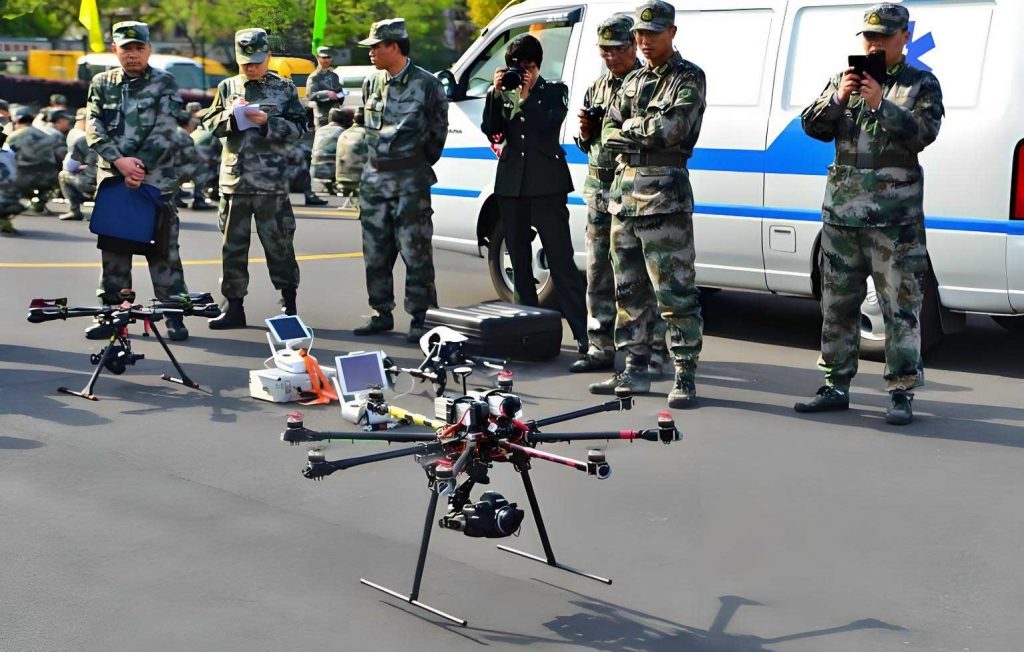
Live-Flight Training Ranges: Finally, training transitions to controlled airspace at authorized flight ranges. Here, trainees apply all accumulated skills under instructor supervision, managing actual flight operations, mission execution, and ground handling with the physical UAV system. This complete ecosystem—from classroom to simulator to field—ensures the drone training is both thorough and robust.
Phase 4: Competency Assessment and Tiered Certification
The final phase validates the effectiveness of the entire drone training pipeline. A rigorous, multi-dimensional assessment framework ensures that certification is a true mark of competency, not just attendance.
Assessment Methodology: Evaluation combines quantitative and qualitative measures across four domains:
- Theoretical Knowledge: Assessed via written or computerized exams.
- Practical Skill Proficiency: Evaluated through observed, graded practical tests (e.g., “Perform a compass calibration,” “Replace a fuel pump”).
- Safety & Situational Awareness: Judged during simulations and live exercises by evaluating decision-making against SOPs and risk matrices.
- Integrated Task Performance: Assessed through complex scenario-based evaluations that test problem-solving, resource management, and crew coordination.
A composite score ($ S_c $) for a trainee can be derived from weighted components:
$$ S_c = w_t \cdot S_t + w_p \cdot S_p + w_s \cdot S_s + w_i \cdot S_i $$
where $ S_t, S_p, S_s, S_i $ are scores for Theory, Practical, Safety, and Integrated performance, respectively, and $ w_t + w_p + w_s + w_i = 1 $ are their respective weightings, adjusted for the specific role (e.g., higher $ w_p $ for maintenance technicians).
Three-Tier Certification System: Based on assessment outcomes, a clear certification pathway is established:
| Certification Tier | Target Roles | Core Competencies Demonstrated | Typical Authorization |
|---|---|---|---|
| Level 1: Basic Operator / Technician | Assistant Ground Crew, Trainee Pilot | Understanding of core systems and safety. Ability to perform basic pre-set tasks under direct supervision (e.g., visual inspection, component install per guide, basic GCS navigation). | Supervised operations only. |
| Level 2: Certified Operator / Technician | Lead Ground Crew, UAV Pilot, Payload Operator | Proficiency in all standard procedures. Ability to conduct independent operations, routine maintenance, mission planning, and normal flight/payload management. | Independent operation within defined parameters and mission sets. |
| Level 3: Advanced / Instructor | Crew Chief, Lead Pilot, Mission Commander, Instructor | Mastery of system analysis, complex fault diagnosis, and emergency management. Ability to optimize missions, train others, and approve procedures or deviations. Evaluated via high-stress scenarios. | Full system authority, mission design approval, and instructional qualification. |
This structured certification provides a clear career progression path, enhances workforce mobility, and gives end-users and regulators confidence in the crew’s qualifications. The certificate itself is a digital record, often linked to a registry, detailing the specific UAV type, systems covered, and certification level achieved.
Conclusion and Future Trajectory
The construction of a comprehensive, manufacturer-backed drone training system for large fixed-wing UAVs is a strategic imperative for the maturation of the low-altitude economy. The four-phase model—rooted in detailed needs analysis, modular curriculum design, immersive implementation, and rigorous competency assessment—creates a closed-loop system that consistently produces highly capable personnel. This approach to drone training directly translates to enhanced operational safety, improved mission effectiveness, and lower total cost of ownership by reducing human-error-related incidents and downtime.
The principles outlined here, while developed for large fixed-wing platforms, possess inherent scalability and adaptability. The core methodology of modular, competency-based drone training can be tailored to VTOL (Vertical Take-Off and Landing) systems, high-altitude pseudo-satellites (HAPS), or emerging urban air mobility (UAM) vehicles. Future evolution of this drone training ecosystem will involve greater integration of immersive technologies like Virtual Reality (VR) for maintenance training and Augmented Reality (AR) for field support, the use of big data analytics from training sessions to predict and address common skill gaps, and the pursuit of broader international standardization and reciprocity for certifications. By investing in and continually refining this end-to-end drone training paradigm, the industry can ensure a steady pipeline of qualified professionals, ready to safely unlock the vast potential of advanced unmanned systems.