
The integration of Unmanned Aerial Vehicles (UAVs), or drones, into law enforcement operations represents a significant technological advancement. In the specific domain of traffic management, police drones have evolved from novel gadgets into indispensable tools. They are a core component of modern, intelligence-driven policing, enhancing capabilities in areas ranging from traffic law enforcement to emergency response. However, the effective deployment of this technology is entirely contingent upon the proficiency of its operators. Therefore, establishing a robust, application-specific drone training system is not merely beneficial but essential. While foundational regulations for police UAV pilots exist, a critical gap remains: these guidelines are predominantly generic, lacking the depth and specificity required for the complex, high-stakes scenarios encountered in daily traffic police work. This article, based on existing frameworks and practical research into traffic police operations, presents a proposed curriculum design aimed at systematizing and elevating drone training for traffic management applications.
Critical Considerations in Drone Training Curriculum Design
Designing an effective drone training program for traffic police must be driven by practical operational needs. It should embody completeness, standardization, and utility. The following factors are paramount.
1. Integrating Generic Knowledge with Specialized Application
Any specialized drone training must be built upon a solid foundation of universal pilot competency. Trainees must first master core knowledge areas: aviation regulations, flight dynamics, safe operational procedures, basic maintenance, and meteorology. In China, traffic police pilots may hold various licenses, such as the Ministry of Public Security’s Type A1, A2, B1, B2 licenses or the Civil Aviation Administration of China’s CAAC license. While these certify basic操控 (control) skills, a significant disconnect persists. Officers often lack expertise in integrating mission-specific payloads (e.g., specialized cameras, LiDAR), understanding communication link limitations, and applying their flying skills to concrete traffic scenarios. A superior drone training curriculum must seamlessly bridge this gap between generic license qualification and tactical, scenario-based proficiency.
2. Alignment with Standards and Legal Norms
The evidentiary value of drone-collected data in law enforcement is underpinned by strict adherence to technical and procedural standards. Several national and industry standards are relevant, such as GA/T 1382-2018 (*Road Traffic Accident Scene Investigation System Based on Multi-rotor UAV*) and GA/T 1505-2018 (*General Technical Specifications for Road Traffic Patrol System Based on UAV*). A comprehensive drone training program must ingrain these standards into every procedural step, especially for data capture (image/video resolution, angle, metadata). Failure to comply, often due to insufficient training, results in evidence that may be deemed inadmissible or only auxiliary, undermining the tool’s effectiveness.
3. Deep Integration with Real-World Tactical Applications
Current applications risk being superficial—limited to basic aerial photography or live video feeds. True operational effectiveness requires a systems-thinking approach embedded within drone training. This includes mission planning, appropriate UAV airframe and payload selection for the task, crew resource management, operation of specialized data processing software (e.g., for accident scene diagramming), and field maintenance. The absence of scenario-based, tactical drone training leads to a theory-practice divide. Coupled with limited operational flight hours, this prevents the development of true, sustained, and effective routine deployment capabilities.
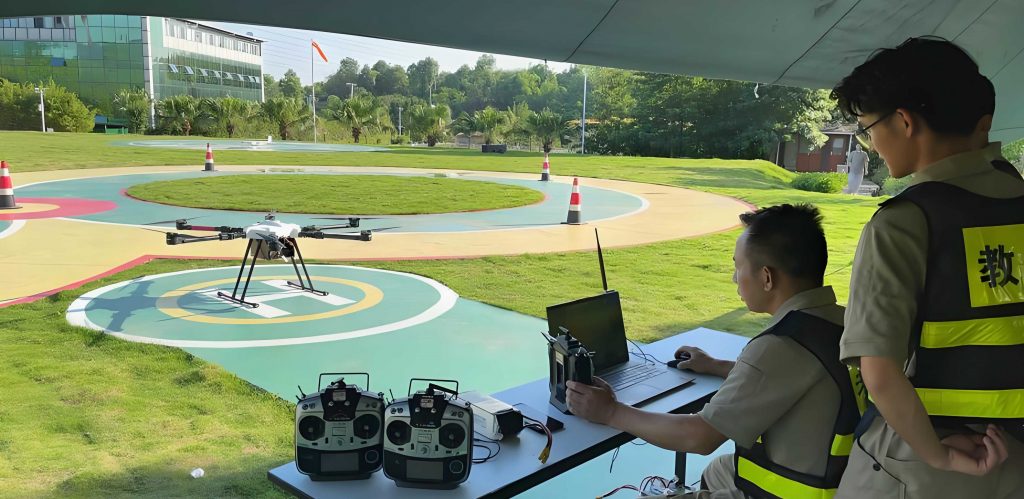
Core Components of the Proposed Drone Training Curriculum
Based on the above analysis, the curriculum must extend beyond basic flight instruction to encompass full operational workflows. The proposed modules are as follows.
1. Foundational UAV Knowledge
This module forms the essential bedrock of all subsequent drone training. Key topics include: UAV definitions and development history; classification of UAV systems (with focus on police vs. civilian types); hardware components (airframe, propulsion, sensors) and software (flight control, ground station); principles of airspace and air traffic control as they apply to low-altitude operations; and core flight maneuver proficiency.
UAV systems can be categorized for training purposes as follows:
| System Classification | Key Characteristics | Typical Traffic Police Use-Case |
|---|---|---|
| Multi-rotor | Vertical Take-Off and Landing (VTOL), high stability, hovering capability | Accident scene scanning, stationary surveillance |
| Fixed-Wing | Long endurance, high speed, large area coverage | Highway patrol, large-scale traffic monitoring |
| Hybrid VTOL | Combines VTOL with efficient forward flight | Versatile applications requiring both hover and range |
2. UAV Regulations, Laws, and Standards
A legally cognizant pilot is a safe and effective pilot. This module provides a structured reference to the complex regulatory landscape. The tables below summarize key documents that must be studied within the drone training program.
Table 1: Generic UAV Policy and Regulations
| No. | Name | Issuing Authority | Date |
|---|---|---|---|
| 1 | Operation Specification for Light and Small Unmanned Aircraft (Trial) | CAAC Flight Standards Department | 2015-12-29 |
| 2 | Air Traffic Management Measures for Civil UAS | CAAC Air Traffic Management Office | 2016-09-21 |
| 3 | Provisions on the Real-Name Registration of Civil UAS | CAAC Aircraft Airworthiness Certification Department | 2017-05-16 |
| 4 | Management Measures for Commercial Flight Activities of Civil UAS (Interim) | CAAC Transport Department | 2018-03-21 |
| 5 | Regulations on the Management of Civil UAV Pilots | CAAC Flight Standards Department | 2018-08-31 |
Table 2: Police-Specific UAV Regulations
| No. | Name | Document Code | Issuing Authority | Date |
|---|---|---|---|---|
| 1 | Interim Provisions on the Management of Police UAVs | Public Equipment Finance [2016] No. 834 | Ministry of Public Security Equipment & Finance Bureau | 2016-09-12 |
| 2 | Measures for the Training and License Management of Police UAV Pilots (Trial) | Public Police Aviation [2017] No. 20 | MPS Police Aviation Management Office | 2017-02-28 |
| 3 | Measures for the Registration of Police UAVs (Trial) | Public Police Aviation [2017] No. 21 | MPS Police Aviation Management Office | 2017-02-28 |
Table 3: Generic UAV Standards
| No. | Name | Standard No. | Type | Implementation Date |
|---|---|---|---|---|
| 1 | Civil UAS Classification and Grading | GB/T 35018-2018 | National Standard | 2018-12-01 |
| 2 | Terminology for Unmanned Aircraft Systems | GB/T 38152-2019 | National Standard | 2020-05-01 |
| 3 | General Safety Requirements for Civil Light and Small UAS | GB/T 38931-2020 | National Standard | 2021-02-01 |
| 4 | General Requirements for Flight Control and Navigation Systems of Light and Small Multi-rotor UAVs | GB/T 38997-2020 | National Standard | 2021-02-01 |
Table 4: Police and Traffic-Specific UAV Standards
| No. | Name | Standard No. | Type | Implementation Date |
|---|---|---|---|---|
| 1 | Road Traffic Accident Scene Investigation System Based on Multi-rotor UAV | GA/T 1382-2018 | Industry Standard | 2018-03-26 |
| 2 | General Technical Specifications for Road Traffic Patrol System Based on UAV | GA/T 1505-2018 | Industry Standard | 2018-10-01 |
| 3 | Standardized Paint Scheme for Police UAVs | GA 1732-2020 | Industry Standard | 2020-07-01 |
3. Generic Technical Solutions for Traffic Management Applications
This is the heart of the specialized drone training, translating technology into tactical procedures. It covers scenario overviews, contingency planning, mission execution workflows, technical key points, and after-action review protocols. Primary application scenarios include:
- Evidence Collection for Traffic Violations: This involves coordinated air-ground operations. Drones conduct aerial reconnaissance of key road sections, utilizing target vehicle tracking, image recognition, and intelligent algorithms to identify violations like illegal use of emergency lanes, illegal parking, and incorrect lane usage. The evidentiary package (images/video with metadata) is automatically uploaded to a backend system. The drone training must cover precise positioning, camera gimbal control for clear license plate capture, and data chain integrity.
- Traffic Accident Scene Investigation: Upon arrival, drones provide a rapid overhead assessment, locking down the scene perimeter. They capture wide-angle context, and high-resolution images from multiple angles (overhead, oblique) of vehicle positions, skid marks, debris, and injuries. This data is fed into specialized software to generate accurate, scale scene diagrams. Drone training focuses on systematic data capture patterns, photogrammetry basics, and evidence handling procedures.
- Routine Road Surface and Infrastructure Patrol: Drones perform automated patrols along pre-set routes, saving human resources. Equipped with high-resolution cameras and LiDAR, they use multi-modal sensing and digital modeling to detect static hazards like potholes, cracks, or damaged signage, and dynamic incidents like abandoned obstacles or fires. Drone training here emphasizes automated flight planning, sensor operation, and anomaly detection reporting.
- Traffic Emergency Response: In situations where first responders cannot immediately access the scene (e.g., mass congestion with blocked lanes, hazardous material spills), drones provide critical early situational awareness. They can carry payloads like loudspeakers for remote commands, powerful lights for night operations, or gas sensors for environmental monitoring. This segment of drone training is high-intensity, focusing on rapid deployment, decision-making under pressure, and operation of specialized payloads.
- Security for Major Events: Drones conduct automated surveillance along predefined routes during large public events, monitoring for suspicious activities, crowd density anomalies, or unauthorized vehicles. This drone training module covers coordinated operations with ground teams, long-duration mission planning, and privacy-sensitive observation protocols.
4. Standardized Operational Workflow for Police Tactics
To combat ad-hoc procedures, the drone training must instill a standardized, repeatable workflow for every mission type. This can be modeled as a phased process. Taking “Evidence Collection for Traffic Violations” as an example, the workflow is:
- Personnel & Equipment Configuration: Determine pilot, visual observer, mission commander. Select appropriate drone and payload (e.g., zoom camera).
- Pre-Mission Preparation: Check airspace restrictions, weather, NOTAMs. Conduct equipment pre-flight check (battery, propellers, sensors, communications link).
- Mission Area Definition & Takeoff: Identify target zone on map. Perform safe takeoff to a predetermined altitude.
- Mission Execution (Hover & Capture): Navigate to position. Achieve stable hover at optimal altitude and angle. Execute violation identification and evidence capture (photo/video series).
- Data Transfer & Post-Flight: Secure transmission of evidence to ground control station. Execute safe return-to-home and landing. Perform post-flight inspection and basic maintenance.
- Documentation & Archiving: Log flight data. Process, label, and archive evidentiary materials according to legal standards. File mission report.
This workflow ensures that every phase of the drone training has a concrete, procedural outcome. The efficiency and legality of the operation can be conceptualized. For instance, the probability of successful evidence admission (\(P_{adm}\)) could be modeled as a function of training adherence (\(T\)), procedural compliance (\(C\)), and technical quality (\(Q\)):
$$ P_{adm} = f(T, C, Q) = \alpha \cdot \log(T) + \beta \cdot C + \gamma \cdot \frac{Q}{Q_{max}} $$
where \(\alpha, \beta, \gamma\) are weighting coefficients representing the importance of each factor derived from legal precedent and operational analysis, and \(Q_{max}\) represents the maximum technical standard. This formula, taught in the drone training, underscores that successful outcomes are systematically built.
Furthermore, mission readiness (\(R\)) after a training cycle could be expressed as an improvement over baseline skill (\(S_0\)), amplified by scenario-based training hours (\(H_s\)) and assessed through competency evaluation scores (\(E\)):
$$ R = S_0 \cdot (1 + k \cdot H_s) \cdot \frac{E}{E_{max}} $$
Here, \(k\) is a training efficacy constant specific to the curriculum. This quantitative approach helps move drone training beyond subjective assessment.
5. Analysis of Real-World Case Studies
The final module grounds the drone training in reality. It involves detailed reviews of successful (and unsuccessful) deployments from various traffic police departments. Cases are dissected to highlight best practices in workflow, decision-making, improvisation within legal bounds, and lessons learned. This peer-learning component is vital for developing tactical judgment, which cannot be acquired through theoretical study alone.
Conclusion: The Path Forward for Systematic Drone Training
This proposed curriculum framework addresses the identified gaps by systematically combining foundational knowledge, legal standards, and tactical scenario-based training into a cohesive drone training system. It is designed for adoption by police academies and regional traffic police departments to standardize and elevate their UAV operational capabilities. While challenges persist—such as a still-evolving regulatory landscape and occasional procedural non-compliance—the trajectory is clear. Traffic police agencies are actively exploring new applications, from pandemic control checkpoints to targeted safety campaigns and expressway emergency monitoring. As drone intelligence and automation advance, and as supporting regulations mature, police drones will undoubtedly become a more central pillar of high-tech traffic management. The future of drone training, therefore, lies in its continuous evolution towards greater standardization, practical realism, and holistic system integration, ensuring that human operators remain the sophisticated, ethical, and effective masters of this transformative technology.