
In the modern military landscape, the integration of advanced technologies has become paramount, and drone systems stand at the forefront of this transformation. As someone deeply involved in military education, I have observed firsthand the critical need for effective drone training programs. The proliferation of unmanned aerial vehicles (UAVs) in armed forces worldwide has underscored a pressing challenge: a shortage of skilled personnel capable of operating and maintaining these complex systems. Without proficient operators, drone equipment often remains underutilized, leading to wasted resources and diminished combat readiness. This article explores the methodologies for drone training in military academies, emphasizing innovative approaches that enhance the quality of professional education. Through my experiences, I will delve into the necessity of drone training, its applications, and the formulation of robust training frameworks, all while incorporating tables and formulas to summarize key concepts. The keyword ‘drone training’ will be frequently reiterated to highlight its centrality in modern military pedagogy.
The necessity of drone training in military academies cannot be overstated. In contemporary warfare, drones serve as force multipliers, enabling reconnaissance, surveillance, and targeted operations without risking human lives. However, the technical sophistication of drone systems demands specialized knowledge that is often lacking in traditional military curricula. From my perspective, this gap poses a significant threat to operational effectiveness. For instance, in armored and mechanized units, the absence of trained drone operators hampers the full exploitation of equipment capabilities. Therefore, instituting comprehensive drone training programs is not merely an option but a strategic imperative. Such training ensures that personnel can leverage drone technology to enhance situational awareness, precision strikes, and logistical support. To quantify the importance, consider the following formula that relates training effectiveness to mission success: $$ S = \alpha T + \beta E + \gamma R $$ where \( S \) represents mission success rate, \( T \) denotes the intensity of drone training, \( E \) signifies equipment proficiency, and \( R \) accounts for resource allocation, with \( \alpha \), \( \beta \), and \( \gamma \) as weighting coefficients. This equation underscores that without adequate drone training (\( T \)), success diminishes regardless of other factors.
To address these needs, military academies have developed structured drone training curricula. Based on my involvement, I can attest that a well-designed training program begins with establishing comprehensive course standards and talent development plans. These frameworks are tailored to the specific requirements of drone operations, balancing theoretical knowledge with practical skills. For example, a typical drone training curriculum might include modules on aerodynamics, navigation systems, data link technologies, and mission planning. The table below summarizes core components of a drone training syllabus:
| Module | Content | Duration (Hours) | Learning Outcomes |
|---|---|---|---|
| Theoretical Foundations | Principles of flight, UAV history, regulations | 40 | Understand basic drone operations and legal frameworks |
| Technical Basics | Avionics, sensor systems, communication protocols | 60 | Grasp drone hardware and software functionalities |
| Practical Training | Flight simulation, field exercises, maintenance drills | 80 | Develop hands-on piloting and troubleshooting skills |
| Advanced Applications | Swarm tactics, payload integration, cyber-security | 50 | Execute complex missions and adapt to evolving threats |
This structured approach ensures that drone training is systematic and aligned with operational demands. Moreover, the integration of continuous assessment helps refine these standards, as shown by the feedback loop formula: $$ C_{new} = C_{old} + \eta (P – A) $$ where \( C \) represents curriculum content, \( \eta \) is the learning rate, \( P \) is performance metrics, and \( A \) is actual outcomes. This iterative process enhances the relevance of drone training over time.
Another critical aspect of drone training is the development of specialized textbooks and educational materials. In my work, I have contributed to compiling resources such as “Introduction to Drone Systems,” “Battlefield Reconnaissance Techniques,” and “UAV Operation and Maintenance.” These texts serve as foundational tools for drone training, providing cadets with accessible yet in-depth knowledge. They cover topics from basic drone mechanics to advanced operational tactics, often supplemented with case studies from military exercises. For instance, a chapter on drone maintenance might include step-by-step guides for diagnosing common faults, reinforced by mathematical models for reliability: $$ R(t) = e^{-\lambda t} $$ where \( R(t) \) is the reliability function over time \( t \), and \( \lambda \) is the failure rate. By embedding such formulas, textbooks make drone training more rigorous and analytical. Additionally, the use of digital platforms allows for interactive content, further enriching the drone training experience.
Virtual training systems represent a groundbreaking innovation in drone training. Leveraging technologies like computer simulations, virtual reality (VR), and modern communications, these systems create immersive environments for practice without the risks associated with real flight. From my observations, virtual drone training platforms enable cadets to hone their skills in scenarios ranging from routine patrols to high-stakes combat missions. A typical system includes modules for flight control, payload management, and emergency procedures. For example, a simulation might replicate a reconnaissance mission where trainees must navigate drones through hostile terrain while avoiding detection. The effectiveness of such virtual drone training can be modeled using the following performance metric: $$ P_v = \frac{S_c}{T_t} \times \log(1 + E_a) $$ where \( P_v \) is virtual training performance, \( S_c \) is mission success count, \( T_t \) is total training time, and \( E_a \) is engagement accuracy. This formula highlights how virtual systems optimize learning efficiency. To illustrate the integration of virtual tools in drone training, consider the following image that depicts a typical drone course setup:
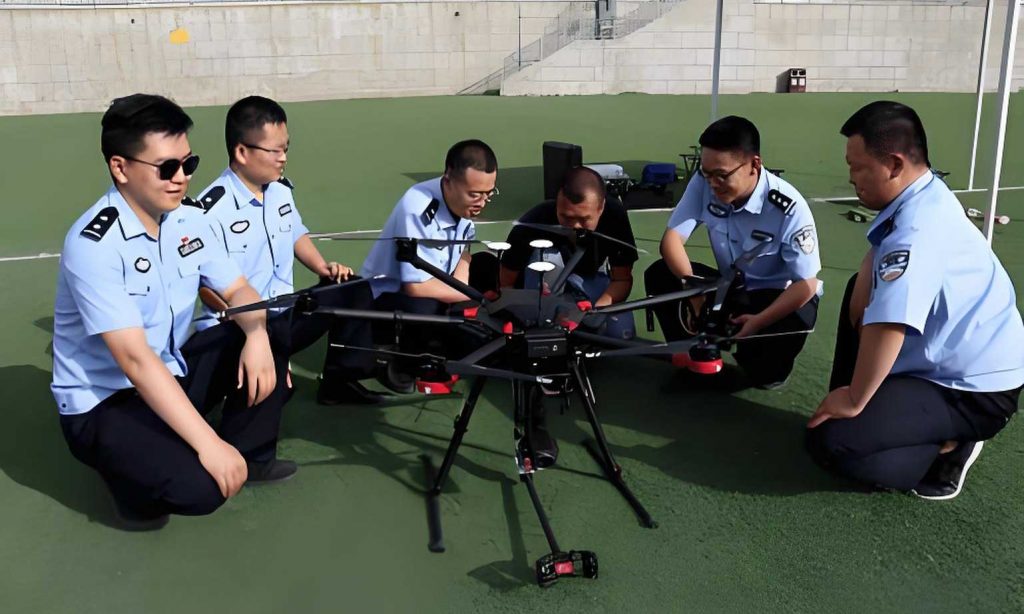
This visual aid underscores the practical implementation of drone training in military academies, showcasing how simulation environments bridge theory and practice. Furthermore, virtual drone training systems often incorporate fault injection techniques, allowing trainees to practice maintenance under simulated stress conditions. This aligns with the broader goal of drone training: to produce operators who are not only proficient but also adaptable to unforeseen challenges.
The establishment of dedicated drone operation and maintenance majors within military academies is a pivotal step in institutionalizing drone training. In my experience, creating specialized programs signals a commitment to mastering this technology. These majors typically feature well-equipped classrooms with drone simulators, repair workshops, and research labs. For instance, a drone training lab might house multiple UAV models, from small quadcopters to larger fixed-wing drones, enabling hands-on experimentation. The curriculum for such majors is designed to be interdisciplinary, blending elements of engineering, computer science, and military strategy. To evaluate the impact of these programs, we can use a cost-benefit analysis formula: $$ B = \sum_{i=1}^{n} \frac{M_i}{(1 + r)^i} – C_t $$ where \( B \) is the net benefit of drone training, \( M_i \) represents mission successes in year \( i \), \( r \) is the discount rate, and \( C_t \) is the total training cost. This demonstrates that investing in drone training yields long-term operational advantages. Additionally, the table below compares different drone training specializations offered in military academies:
| Specialization | Focus Areas | Career Pathways | Key Drone Training Components |
|---|---|---|---|
| Drone Piloting | Flight controls, mission execution, airspace management | Reconnaissance units, attack squadrons | Simulator hours, live flight drills, certification exams |
| UAV Maintenance | Hardware repair, software updates, diagnostic techniques | Logistics support, technical teams | Workshop practice, fault simulation, quality assurance protocols |
| Drone Systems Engineering | Design, integration, testing of UAV platforms | Research and development, procurement | Project-based learning, collaboration with industry, innovation labs |
Such specialized drone training ensures that graduates are prepared for diverse roles within the military, thereby enhancing overall force capability.
Building a high-caliber faculty team is essential for effective drone training. From my involvement in military education, I have seen how experienced instructors elevate the quality of drone training programs. These educators often come from backgrounds in aviation, engineering, or combat operations, bringing real-world insights into the classroom. To foster expertise, academies encourage faculty to engage in activities like factory internships, textbook authorship, and field exercises. This not only enriches their knowledge but also keeps drone training content current with technological advancements. The competency of a drone training instructor can be assessed using a weighted scoring model: $$ I_s = w_1 K + w_2 E + w_3 P $$ where \( I_s \) is the instructor score, \( K \) is knowledge depth, \( E \) is teaching experience, \( P \) is practical proficiency, and \( w_1 \), \( w_2 \), \( w_3 \) are weights summing to 1. By optimizing instructor quality, drone training becomes more impactful. Moreover, faculty-led research projects contribute to innovation in drone technology, creating a virtuous cycle where teaching and discovery reinforce each other. For example, instructors might develop new drone training simulators or refine maintenance protocols, directly benefiting cadet education.
Innovative practical training modes are the cornerstone of advanced drone training. In my view, traditional classroom instruction must be supplemented with dynamic, hands-on experiences that mirror real-world conditions. Military academies have adopted approaches such as equipment grouping contracts, where cadets are assigned specific drones for maintenance, fostering accountability and skill mastery. This method enhances drone training by providing continuous exposure to hardware. Additionally, field exercises simulate combat scenarios, requiring trainees to apply their drone training in stressful environments. The effectiveness of these practical modules can be quantified through a skill retention formula: $$ R_s = R_0 e^{-kt} + S_{\infty} (1 – e^{-kt}) $$ where \( R_s \) is retained skill level, \( R_0 \) is initial skill, \( k \) is decay constant, \( t \) is time, and \( S_{\infty} \) is asymptotic skill from repeated practice. This shows that regular practical drone training mitigates skill fade. Furthermore, collaborations with operational units allow cadets to participate in live drills, bridging the gap between academy learning and battlefield application. Such immersive drone training cultivates not only technical abilities but also decision-making and leadership qualities.
To synthesize these elements, drone training in military academies must be viewed as a holistic ecosystem. It encompasses curriculum design, resource development, virtual tools, specialized programs, faculty excellence, and practical innovation. From my perspective, the integration of these components creates a robust framework that adapts to evolving military needs. For instance, the rise of artificial intelligence (AI) in drones necessitates updates to drone training, perhaps through modules on machine learning algorithms for autonomous operations. This adaptability is captured in an evolutionary training model: $$ \frac{dT}{dt} = \gamma (D – T) + \epsilon I $$ where \( T \) represents training sophistication, \( D \) is technological demand, \( \gamma \) is the adaptation rate, \( \epsilon \) is innovation input, and \( I \) is investment. This differential equation illustrates how drone training must evolve continuously to remain effective.
In conclusion, drone training in military academies is a critical enabler of modern warfare preparedness. Through my experiences, I have highlighted the necessity of structured programs, the value of virtual and practical methods, and the importance of specialized education. By emphasizing keyword ‘drone training’ throughout, this article underscores its centrality. The use of tables and formulas, as demonstrated, helps summarize complex concepts and quantify training outcomes. As drone technology advances, so must our approaches to drone training, ensuring that military personnel are equipped to leverage these systems for national security. Ultimately, investing in comprehensive drone training is not just about mastering equipment; it is about fostering a culture of innovation and excellence that will define the future of military operations.