
The low-altitude economy is no longer a concept on the horizon; it is the airspace directly above us, buzzing with activity and potential. From my vantage point within the industry, the most palpable sign of this boom is the explosive growth in drone training facilities and the steady stream of individuals seeking to become certified pilots, or “drone飞手” as they are commonly known. On any given day at a typical training base, the scene is one of focused intensity: rows of trainees, eyes locked on monitors and controllers, guiding multi-rotor and fixed-wing drones through precise maneuvers against the backdrop of wide-open fields. The hum of motors is the soundtrack of a new professional frontier being charted. This isn’t just a hobbyist pursuit; it’s a calculated career move driven by a stark supply-demand imbalance in the workforce. Industry projections estimate a staggering shortage of nearly one million skilled operators, a gap that formal drone training programs are scrambling to fill.
The fundamental driver can be expressed as a simple yet powerful equation of market need:
$$ \text{Market Gap} = D_{\text{Industry}} – S_{\text{Certified}} $$
Where \( D_{\text{Industry}} \) represents the soaring demand for commercial drone services across sectors like agriculture, infrastructure, and logistics, and \( S_{\text{Certified}} \) is the current supply of licensed, professionally trained pilots. This gap, quantified in the hundreds of thousands, is the primary engine fueling the drone training industry’s expansion. Prospective students are not just enthusiasts; they are agricultural technicians looking to modernize crop management, construction surveyors aiming for efficiency, utility workers tasked with safer inspections, and entrepreneurs sensing a new service vertical. They arrive with the understanding that a pilot license is the non-negotiable passport to this new economy, much like a driver’s license is for the road.
Let’s delve into the structure and economics of modern drone training. The cornerstone credential is the Civil Aviation Administration of China (CAAC) drone pilot license, universally acknowledged as the industry standard for legal commercial operation. Drone training curricula are meticulously designed to bridge the gap between raw interest and professional competency. A standard course, typically spanning 15 to 25 days of intensive study, is bifurcated into theoretical knowledge and practical flight skills.
The theory component is comprehensive, covering:
- Air Regulations & Flight Management: Navigating the complex web of national and local airspace regulations, no-fly zones, and flight approval procedures.
- Aeronautical Meteorology: Understanding how wind, temperature, and precipitation affect unmanned aircraft performance and safety.
- Aircraft Knowledge: In-depth study of drone aerodynamics, propulsion systems, electronic speed controllers (ESCs), and payload capabilities.
- Navigation & Chart Reading: Interpreting aeronautical charts and utilizing GPS and other systems for mission planning.
- Emergency Procedures: Drilling protocols for communication loss, engine failure, and safe emergency landing.
The practical drone training is where theory meets the sky. Under the watchful eyes of certified instructors, students progress from basic hover and orientation exercises to advanced maneuvers like precise figure-8 patterns, loss-of-GPS navigation, and mission-specific operations such as automated grid flying for mapping. The investment in this education is significant, reflecting the value of the credential, as outlined below:
| Drone Type (License Category) | Typical Training Duration | Approximate Cost Range (USD) | Primary Industry Applications |
|---|---|---|---|
| Multi-rotor (Most Common) | 15-20 days | $1,500 – $2,200 | Aerial Photography, Close Inspection, Small-Parcel Delivery |
| Fixed-wing | 20-25 days | $2,800 – $4,000 | Large-Area Mapping, Surveying, Agricultural Monitoring |
| Vertical Take-Off & Landing (VTOL) | 20-30 days | $3,500 – $4,500+ | Long-Range Linear Inspection (Power Lines, Pipelines), Advanced Surveying |
The practical component of drone training is immersive and demanding. Trainees spend long hours on the field, mastering controller sensitivity, developing situational awareness, and learning to troubleshoot technical glitches in real-time. It’s a hands-on baptism into the realities of professional flight.
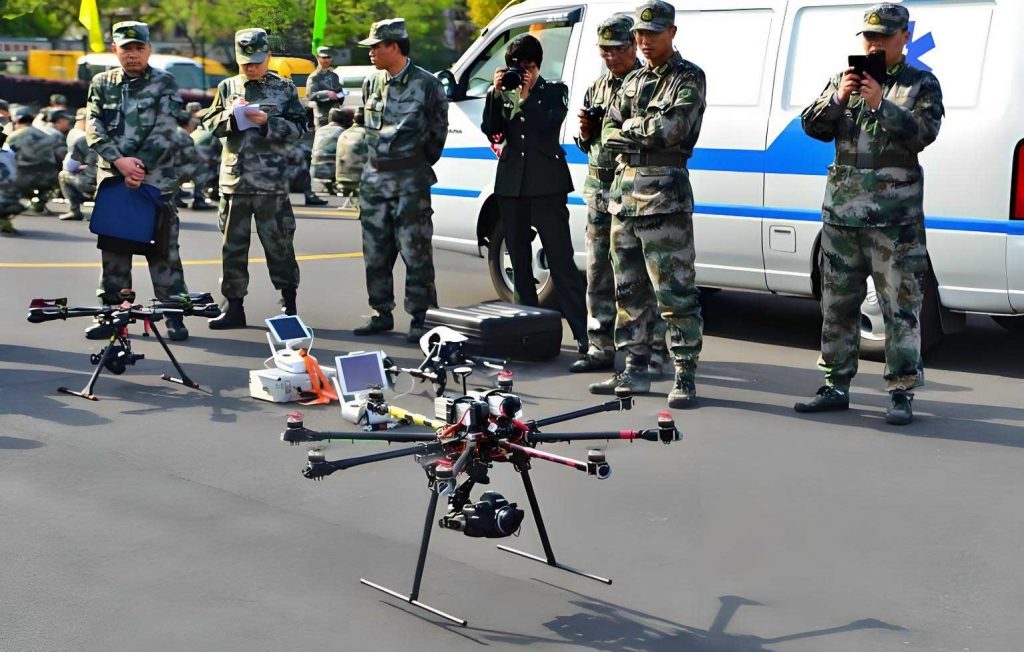
This image captures the essence of that hands-on drone training experience—a group of future aviators, grounded for now, but preparing to command the skies.
However, possessing a license, the primary goal of initial drone training, is merely the entry ticket. The employment landscape for drone pilots is sharply bifurcated, revealing a world of both high potential and intense competition. The market differentiates sharply between basic operational competency and applied, sector-specific expertise. This differentiation can be modeled as a “skill premium” in earnings:
$$ \text{Earnings Premium} = \beta_1 \cdot (\text{Licensure}) + \beta_2 \cdot (\text{Domain Expertise}) + \beta_3 \cdot (\text{Specialized Tech Skills}) $$
Here, \( \beta_1 \) is the base value of the drone pilot license. \( \beta_2 \) and \( \beta_3 \) are significantly larger multipliers representing knowledge in a vertical (e.g., agronomy, electrical engineering, construction) and proficiency with specialized technology (e.g., photogrammetry software, LiDAR, thermal analysis), respectively. This explains the wide disparity in compensation and job security.
| Role / Specialization | Typical Responsibilities | Required Skills Beyond Basic License | Average Monthly Salary Range (USD) | Market Notes |
|---|---|---|---|---|
| Agricultural Spraying Pilot | Precision application of pesticides, fertilizers; crop health monitoring. | Knowledge of crop cycles, chemical handling, mission planning for large fields. | $850 – $1,400 | Highly seasonal work; income peaks during planting/spraying seasons. |
| Power Line Inspection Pilot | Visual and thermal inspection of transmission towers and lines; defect reporting. | Understanding of electrical infrastructure, thermal imaging analysis, long-range BVLOS protocols. | $1,100 – $2,100 | High demand; often involves travel and work in challenging environments. |
| Aerial Survey & Mapping Pilot | Conducting photogrammetry flights; creating 2D/3D models and topographic maps. | Expertise in RTK/GNSS systems, photogrammetry software (e.g., Pix4D, DroneDeploy), GIS basics. | $1,400 – $2,800+ | Premium for software and data processing skills. Key for construction and mining. |
| Cinematography / Photography Pilot | Capturing dynamic aerial footage for film, TV, and real estate. | Advanced piloting for complex shots, cinematography principles, video editing skills. | Project-based, highly variable. | Portfolio-dependent; competitive with strong creative and technical demands. |
| Entry-Level / General Pilot | Assisting on various projects, basic aerial documentation. | Basic license, willingness to learn. | $300 – $850 | Highly competitive; often part-time or gig-based; high turnover. |
The data reveals a clear trend: sustainable careers are built not on drone training alone, but on “Drone+” expertise. A power utility doesn’t just need a person who can fly; it needs an inspector who can fly and intelligently interpret thermal data to identify failing components. A surveying company needs a mapper who can pilot a drone and process the raw data into an accurate, usable digital twin. This “hybrid professional” model is what the industry increasingly demands. As one seasoned pilot with seven years in the field told me, “The license got me in the door, but understanding the *why* behind each flight—the agriculture, the engineering, the data science—is what keeps me employed and advancing.” Many who enter drone training with dreams of easy money from simple flying jobs find the market saturated at that level, leading to attrition. The real opportunity lies in layering a second discipline atop piloting proficiency.
Recognizing this need for integrated skills, the ecosystem is evolving beyond standalone drone training centers. A powerful trend is the rise of industry-education integration. Universities and vocational colleges are now partnering directly with aviation research institutes and leading industry players to form “Low-Altitude Economy Industry-Education Integration Communities.” The goal is to synchronize the “four chains”: education, talent, industry, and innovation. Within these partnerships, specialized “Drone Application Technology” degree programs are being launched. These programs embed drone training within a broader curriculum of, for example, geographic information systems (GIS), smart agriculture, or infrastructure management, proactively creating the “Drone+X” graduates that employers seek.
Simultaneously, the expansion of the low-altitude economy itself is creating novel avenues for employment. One of the most promising is the “**Low-Altitude + Culture & Tourism**” model. This isn’t just about scenic drone footage. It encompasses:
- Designing and operating structured drone light shows for festivals and city events.
- Providing immersive, drone-based aerial tour experiences in natural parks or over historical sites.
- Developing tourism marketing content through advanced cinematography.
These niches require pilots to blend technical skill with creative and logistical planning, further expanding the definition of the profession. The economic potential supporting these diverse paths is monumental. Conservative forecasts project the domestic low-altitude economy to grow into a multi-trillion-dollar market within the next decade. This growth trajectory can be visualized as a compound expansion:
$$ V_t = V_0 \times (1 + r)^t $$
Where \( V_t \) is the future market value, \( V_0 \) is the current base, \( r \) is the aggressive annual growth rate fueled by technological adoption and policy support, and \( t \) is the time in years. This expanding \( V_t \) represents the ever-widening umbrella under which certified drone pilots will find opportunity.
In conclusion, the journey from novice to professional drone pilot is emblematic of a larger economic transformation. Initial drone training provides the essential, foundational license—the key to the airspace. But the map to a long-term, rewarding career is more complex. It charts a course through continuous learning, specialization, and adaptation. The most successful pilots will be those who view their initial drone training not as a final destination, but as the first flight in a lifelong journey of upskilling. They will become fluent not only in the language of aviation but also in the dialects of data analytics, environmental science, digital media, and engineering. For those willing to undertake this journey, the horizon of the low-altitude economy is not a limit, but a vast and open field of possibility.