
As I reflect on my extensive involvement in the radio frequency management sector, the rapid evolution of drone technology stands out as a transformative force. My firsthand experiences in organizing and participating in various regulatory and technical initiatives have solidified my belief that comprehensive drone training is not just beneficial but essential for safe and efficient airspace integration. This article delves into the multifaceted world of drone training, encompassing regulatory compliance, technical proficiency, and operational excellence, all viewed through the lens of my professional journey. I will employ tables and mathematical models to summarize key concepts, ensuring a thorough exploration of this critical domain.
The cornerstone of effective drone deployment lies in robust regulatory frameworks, and training is the vehicle through which these frameworks are internalized. I recall participating in simulation exercises designed to hone administrative law enforcement skills specific to radio spectrum management for drones. These drills emphasized precision in legal procedure, documentation, and equipment handling. A successful drone training program for执法人员 must integrate legal statutes with practical operation. The table below summarizes core modules in such regulatory drone training:
| Module Name | Key Focus Areas | Training Outcomes |
|---|---|---|
| Legal Foundations | Radio management laws, drone-specific decrees (e.g., Interim Measures for Radio Management of Civil Unmanned Aircraft), administrative penalty procedures. | Ability to accurately cite legal clauses, standardize legal documents, and understand enforcement boundaries. |
| Spectrum Enforcement Operations | On-site inspection protocols, signal monitoring techniques, identification of illegal transmissions, evidence collection. | Proficiency in using monitoring systems, conducting interference investigations, and executing lawful seizures. |
| Case Study & Simulation | Analysis of real-world violations, simulated enforcement scenarios, peer assessment and scoring. | Enhanced decision-making, teamwork, and adherence to the principle of lawful administration in complex situations. |
| Equipment & Technology Update | Familiarization with latest drone communication systems (direct link, relay), frequency band characteristics, and testing equipment. | Updated technical knowledge to effectively police evolving drone technologies and their radio emissions. |
The mathematical rigor behind spectrum management also forms a vital part of advanced drone training. For instance, understanding the signal-to-interference-plus-noise ratio (SINR) is crucial for evaluating communication link quality and planning frequency assignments. The SINR for a drone control link can be expressed as:
$$ \text{SINR} = \frac{P_t G_t G_r / L(d)}{N_0 B + \sum_{i} I_i} $$
Where \(P_t\) is the transmit power, \(G_t\) and \(G_r\) are antenna gains, \(L(d)\) is the path loss at distance \(d\), \(N_0\) is the noise spectral density, \(B\) is the bandwidth, and \(I_i\) represents interference from other sources. Drone training must equip personnel with the ability to apply such formulas to predict and mitigate real-world interference scenarios, ensuring reliable operations in congested spectral environments.
Moving from enforcement to industry empowerment, policy dissemination sessions represent another critical facet of drone training. I have coordinated several forums aimed at educating manufacturers and operators. These sessions translate complex regulatory texts into actionable business guidance. Key topics always include the Type Approval (TA) process for radio transmission equipment. The requirements can be summarized by a compliance function \(C(f, s)\) for a device:
$$ C(f, s) = \begin{cases} 1 & \text{if } P_{\text{emit}}(f) \leq P_{\text{limit}}(f) \text{ and } s \in S_{\text{standard}} \\ 0 & \text{otherwise} \end{cases} $$
Here, \(C=1\) indicates compliance, \(P_{\text{emit}}(f)\) is the emitted power spectral density, \(P_{\text{limit}}(f)\) is the regulatory mask, and \(s\) denotes the technical standard adherence. Drone training for enterprises demystifies this process, guiding them from design to certification. The following table outlines typical agenda items for such policy-focused drone training workshops:
| Phase | Content | Stakeholder Benefit |
|---|---|---|
| Regulatory Deep Dive | Detailed interpretation of national drone radio management policies, frequency licensing procedures (for 6+ communication systems), sales record filing workflows. | Clarity on legal obligations, streamlined application processes, avoidance of compliance pitfalls. |
| Technical Standards Review | Analysis of mandatory national standards (e.g., Safety Requirements for Civil Unmanned Aircraft Systems), radio equipment testing protocols, and certification common issues. | Informed product design and testing, reduced time-to-market, enhanced product safety and reliability. |
| Application & Case Sharing | Showcases of successful frequency licensees in logistics, emergency response, urban management; discussion on innovative low-altitude economy applications. | Inspiration for business model innovation, understanding of practical spectrum use cases, network building. |
| Q&A & Consultation | Interactive session with regulators and testing experts to address specific company concerns. | Personalized guidance, resolution of ambiguities, strengthened public-private partnership. |
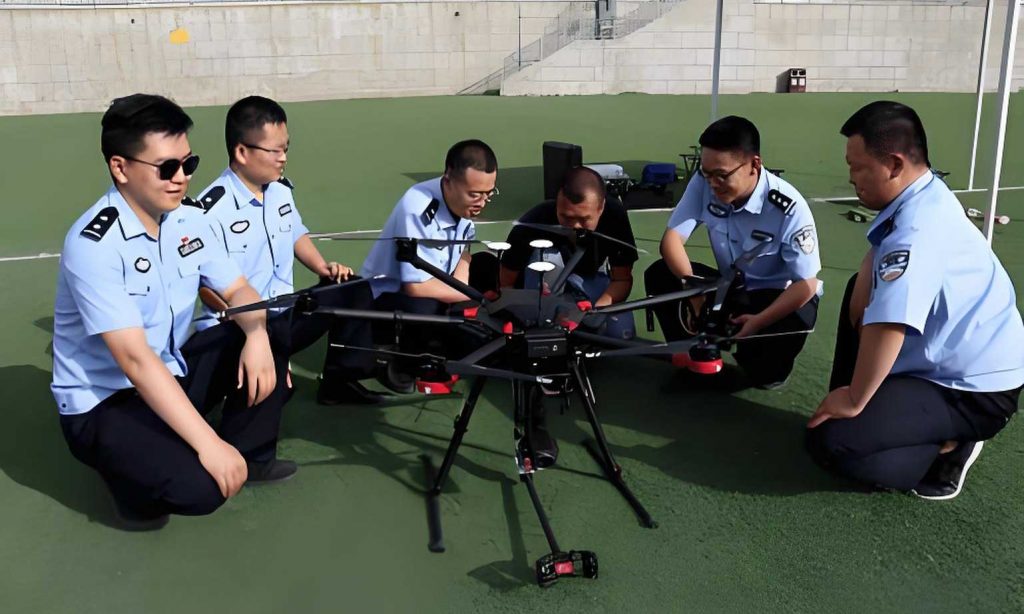
The image above captures the essence of an interactive drone training session, where theory meets practice. In my experience, the most effective drone training blends formal instruction with hands-on workshops. Technical training exchanges are paramount for pushing the boundaries of the low-altitude economy. I recently facilitated a session that brought together regulators, certification bodies, industry associations, and telecom operators. The core of such technical drone training is a deep understanding of the radio frequency (RF) chain in drones. We can model the effective isotropic radiated power (EIRP), a key regulated parameter, as:
$$ \text{EIRP} = P_{\text{out}} \times L_{\text{feed}} \times G_{\text{ant}} $$
where \(P_{\text{out}}\) is the power amplifier output, \(L_{\text{feed}}\) is the feeder loss (\(0 < L_{\text{feed}} \leq 1\)), and \(G_{\text{ant}}\) is the antenna gain relative to an isotropic radiator. Comprehensive drone training ensures engineers can design systems that optimize performance within EIRP limits. Furthermore, spectrum efficiency \(\eta\) is a critical metric discussed in training, defined for a communication link as:
$$ \eta = \frac{R_b}{B} \quad \text{(in bits/sec/Hz)} $$
where \(R_b\) is the bit rate. Training focuses on techniques like adaptive modulation and coding to maximize \(\eta\) for drone data links. The collaborative nature of these training events cannot be overstated. They foster a shared understanding of challenges like spectrum coexistence. To quantify interference potential, we often use the interference-to-noise ratio (INR) at a victim receiver:
$$ \text{INR} = \frac{P_{\text{int}}}{N_0 B} = \frac{P_{t,\text{int}} G_{t,\text{int}} G_{r,\text{vict}} / L_{\text{path,int}}}{N_0 B} $$
Joint drone training for all stakeholders enables the development of shared databases and coordination protocols to keep INR below harmful thresholds. The synergy from these sessions accelerates the development of new applications, from precision agriculture to airborne delivery networks, all underpinned by solid drone training.
The scope of drone training extends into operational safety and advanced air mobility (AAM). A significant portion of training is dedicated to risk assessment and mitigation. We employ probabilistic models to evaluate system reliability. For a drone executing a mission, the probability of successful completion \(P_{\text{success}}\) considering communication link failure can be modeled as:
$$ P_{\text{success}} = P_{\text{nav}} \times \left(1 – P_{\text{comm,fail}}\right) $$
Here, \(P_{\text{nav}}\) is the probability of navigation system success, and \(P_{\text{comm,fail}}\) is the probability of communication failure, which itself depends on factors like SINR and protocol robustness. Drone training for pilots and operators involves understanding these dependencies to plan contingencies. Furthermore, with the advent of drone swarms, training must cover multi-agent coordination. The required capacity \(C_{\text{swarm}}\) for commanding \(N\) drones can be related to bandwidth and efficiency:
$$ C_{\text{swarm}} = N \times R_{\text{cmd}} \leq B_{\text{alloc}} \times \eta_{\text{mac}} $$
where \(R_{\text{cmd}}\) is the command data rate per drone, \(B_{\text{alloc}}\) is the allocated bandwidth, and \(\eta_{\text{mac}}\) is the efficiency of the multiple access control (MAC) protocol. Specialized drone training on swarm technologies is thus emerging as a vital field. The table below categorizes advanced operational drone training programs:
| Training Tier | Target Audience | Core Technical Content | Key Performance Metrics |
|---|---|---|---|
| Professional Pilot Certification | Commercial drone operators | Flight planning, weather analysis, emergency procedures, specific payload operation (e.g., thermal cameras), local regulations. | Flight hours logged, pass rate on practical exams, incident/accident rate post-training. |
| Swarm Operations & Management | System engineers, fleet managers | Network topology, distributed control algorithms, resilient communication, collective mission planning. | Swarm cohesion under link loss, mission completion time, scalability. |
| RF Security & Counter-UAS | Security personnel, spectrum managers | Signal fingerprinting, jamming and spoofing techniques, lawful mitigation technologies, spectrum sensing. | Detection probability \(P_d\), false alarm rate \(P_{fa}\), time to neutralize threat. |
| Integration into Air Traffic Management (ATM) | Air traffic controllers, UAS service suppliers | UTM/UAM concepts, detect-and-avoid (DAA) systems, dynamic geofencing, communication with ATC (e.g., C2 links). | Conformance to flight intent, separation assurance, handover success rate. |
The iterative nature of technology demands that drone training itself be a continuous process. From my perspective, establishing a cycle of assessment, training, and re-assessment is key. We can frame the competency growth of an individual or organization through a simple learning model. Let \(K(t)\) represent the knowledge level at time \(t\). Its evolution can be described by:
$$ \frac{dK}{dt} = \alpha T(t) – \delta K(t) $$
where \(T(t)\) is the intensity of drone training at time \(t\), \(\alpha\) is the learning efficiency coefficient, and \(\delta\) is the knowledge decay rate. This differential equation highlights the need for periodic training \(T(t)\) to maintain and grow competency \(K(t)\) against obsolescence. Consequently, the most progressive organizations adopt a structured curriculum with recurrent modules. The effectiveness of a drone training program \(E\) can be evaluated as a function of multiple factors:
$$ E = f(C, P, F, R) $$
where \(C\) is curriculum relevance, \(P\) is instructor proficiency, \(F\) is hands-on facility quality, and \(R\) is the recency/frequency of training. Maximizing \(E\) requires investment in all variables. In practice, we use surveys and skill audits to measure post-training improvements in specific competencies, creating a feedback loop for enhancing the drone training itself.
Looking ahead, the future of drone training is inextricably linked to simulation and digital twins. High-fidelity simulators allow for risk-free exploration of edge cases. The physics simulated often involve complex propagation models like the Longley-Rice model for irregular terrain, which is too detailed for most analytical formulas but is embedded in training software. Furthermore, with big data from operations, predictive models can identify skill gaps and recommend personalized drone training modules. The concept of a “training passport” for drones, logging all technical and regulatory instruction received by a system and its operators, is gaining traction to standardize quality across the industry.
In conclusion, through my engagements across the spectrum of regulatory drills, policy forums, and technical exchanges, I have witnessed the transformative power of systematic drone training. It is the critical bridge between innovative technology and safe, lawful, and efficient integration into our society and economy. The formulas and tables presented herein are not mere academic exercises; they are the foundational tools imparted through rigorous drone training programs that empower individuals and organizations to harness the full potential of the low-altitude frontier. As the airspace becomes busier, the value of comprehensive, continuous, and collaborative drone training will only magnify, solidifying its role as the true backbone of sustainable drone ecosystem development.