
As I delve into the world of low-altitude economy, my attention is increasingly drawn to the burgeoning yet chaotic realm of drone training. The allure of becoming a certified drone pilot has sparked a frenzy among young aspirants, promising lucrative careers and a foothold in an emerging industry. From my vantage point, this drone training boom is a double-edged sword: while it opens doors to new opportunities, it also exposes a landscape riddled with pitfalls and deceptive practices. The very essence of drone training, meant to empower individuals with skills, is being undermined by unscrupulous actors seeking quick profits.
My exploration begins with the sheer scale of the drone training ecosystem. According to public data, over 2,600 institutions are registered as drone training providers. This number has skyrocketed in recent years, fueled by reports of a massive talent gap. For instance, it’s estimated that there is a shortage of up to 1 million drone operators. This supply-demand imbalance creates a fertile ground for drone training programs to proliferate, but not all are created equal. To illustrate the growth, consider the following table showing the projected expansion based on current trends:
| Year | Number of Registered Drone Training Institutions | Estimated Annual Enrollment in Drone Training Programs | Reported Job Placement Rate (Industry Average) |
|---|---|---|---|
| 2022 | 1,800 | 150,000 | 65% |
| 2023 | 2,200 | 220,000 | 60% |
| 2024 | 2,600 | 300,000 | 55% |
| 2025 (Forecast) | 3,000 | 400,000 | 50% (if unregulated) |
The decline in reported job placement rates is a red flag that I have observed closely. It suggests that as drone training becomes more commercialized, the quality and outcomes may be suffering. This can be modeled using a simple formula where the effective employment rate \( E \) after drone training is a function of training quality \( Q \), market demand \( D \), and institutional integrity \( I \). We can express this as:
$$ E = \frac{Q \cdot D \cdot I}{C} $$
Here, \( C \) represents competitive factors and saturation in the job market. When drone training institutions prioritize volume over quality, \( Q \) decreases, leading to a drop in \( E \). Moreover, if \( I \) is low due to fraudulent practices, the equation further deteriorates. This mathematical perspective highlights why the drone training market needs scrutiny.
In my conversations with aspiring drone pilots, I’ve heard countless stories of disillusionment. Many drone training centers advertise slogans like “employment guaranteed in 25 days,” luring individuals with the promise of a quick career transition. However, upon enrollment, students often find that the drone training curriculum is diluted, with insufficient hands-on practice. The promised job placements are vague, limited to a handful of poorly paid roles, or non-existent. Some drone training providers even embed clauses in contracts that absolve them of responsibility, trapping naive learners in financial and professional limbo. This aspect of drone training is particularly alarming, as it exploits the enthusiasm of youth.
To quantify the risks, let’s consider a cost-benefit analysis for an individual investing in drone training. Suppose the total cost of a drone training program is \( T_c \), which includes tuition, equipment, and time. The expected benefit \( B \) is the present value of future income as a drone pilot, discounted by the probability of securing a job \( P_j \) and the quality of that job \( W \). Thus:
$$ B = P_j \cdot W \cdot \sum_{t=1}^{n} \frac{I_t}{(1+r)^t} $$
where \( I_t \) is income in year \( t \), \( r \) is the discount rate, and \( n \) is the career horizon. If a drone training program misrepresents \( P_j \) or \( W \), the actual \( B \) can fall short of \( T_c \), leading to a net loss. This disparity is at the heart of the drone training crisis. The following table breaks down typical components of drone training costs versus promised benefits:
| Cost Component in Drone Training | Average Range (USD) | Advertised Benefit by Unreliable Drone Training Centers | Actual Outcome (Based on Student Reports) |
|---|---|---|---|
| Tuition Fees | $2,000 – $5,000 | High-paying job guaranteed ($50,000+ annually) | Unclear job prospects; often part-time or freelance gigs |
| Equipment and Materials | $500 – $2,000 | State-of-the-art drones provided | Outdated models or rental fees extra |
| Certification Exam Fees | $200 – $500 | Pass rate of 95%+ | Additional prep courses needed; pass rate lower |
| Time Investment (Opportunity Cost) | 3-4 weeks full-time | Rapid career switch | Delayed employment; need for further skill development |
The gap between promise and reality in drone training is stark. From my analysis, this is not merely a matter of a few bad actors but a systemic issue. The drone training industry, in its current form, lacks standardized benchmarks. Each drone training institution operates with its own curriculum, often without accreditation. This variability can be expressed through a quality index \( Q_i \) for drone training programs:
$$ Q_i = \frac{S_c + I_h + F_p}{3} $$
where \( S_c \) is curriculum standardization (0-1), \( I_h \) is instructor expertise (0-1), and \( F_p \) is facility and equipment adequacy (0-1). Most subpar drone training centers score low on \( Q_i \), yet they charge premium fees. As a result, the overall market reputation of drone training suffers, deterring potential talent.
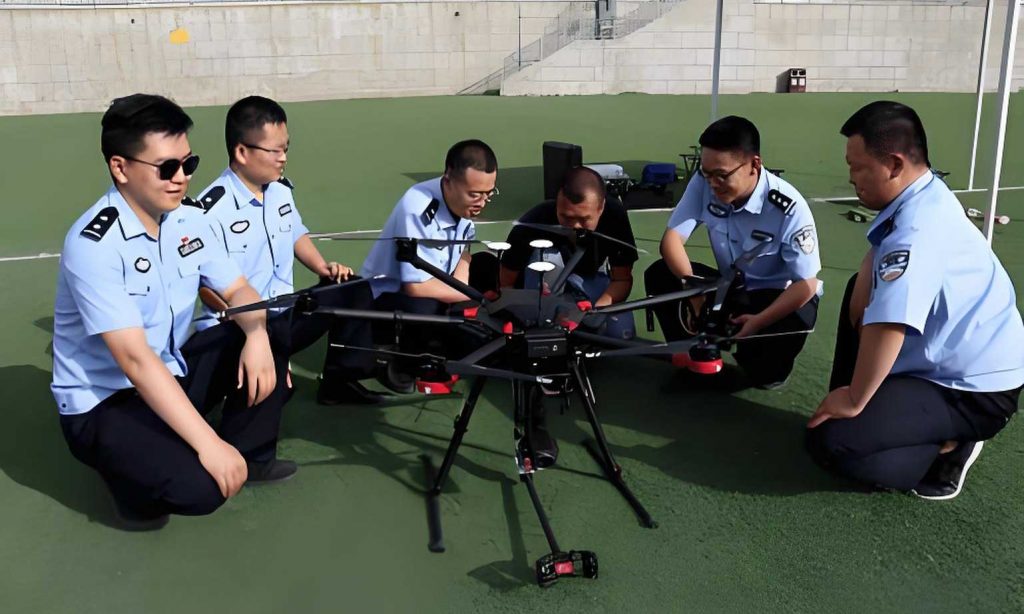
Seeing images like the one above reminds me of the potential that proper drone training holds—a structured, hands-on learning environment. However, the current market often fails to deliver this. In my opinion, the solution lies in robust regulation. Governments need to step in and establish clear guidelines for drone training providers. This includes mandatory accreditation, transparent reporting of job placement statistics, and regular audits. A dynamic exit mechanism should be implemented, whereby drone training institutions that consistently underperform or engage in deceptive practices lose their licenses. The regulatory framework can be modeled as a control system:
$$ R_{eff} = \int_{0}^{t} (C_s + M_a – V_v) \, dt $$
Here, \( R_{eff} \) is regulatory effectiveness over time \( t \), \( C_s \) is the stringency of standards for drone training, \( M_a \) is monitoring and enforcement actions, and \( V_v \) is violations by drone training entities. By maximizing \( R_{eff} \), authorities can curb the chaos in drone training.
Furthermore, industry self-discipline is crucial. Reputable drone training organizations should form consortiums to share best practices and expose malpractices. They must shift from a “quick profit” mindset to a long-term vision of skill development. This involves investing in qualified instructors, updating curricula to match industry needs, and providing genuine career support. The drone training community must police itself to restore trust. From my observations, successful drone training programs often follow a competency-based model, where skills are assessed through rigorous metrics. For example, the proficiency \( P \) of a drone pilot after training can be represented as:
$$ P = \sum_{i=1}^{n} w_i \cdot s_i $$
where \( s_i \) is the score in skill area \( i \) (e.g., flight maneuvering, safety protocols, data analysis), and \( w_i \) is the weight assigned to that skill. High-quality drone training ensures that \( P \) meets or exceeds industry thresholds.
For young individuals considering drone training, I urge caution and due diligence. The drone training path is not a guaranteed golden ticket; it requires careful evaluation. Prospective students should research drone training centers thoroughly, looking beyond flashy advertisements. Key factors include: accreditation status, instructor credentials, graduate success stories, and post-training support. It’s also wise to attend industry webinars or connect with experienced drone pilots to gauge the reality of the profession. The decision to enroll in a drone training program should be based on a rational assessment of one’s aptitude and career goals. Remember, a drone pilot license is just the beginning; continuous learning and skill refinement are essential in this dynamic field.
To aid in this evaluation, I propose a decision matrix for choosing a drone training program. Consider the following criteria and weight them according to personal priorities:
| Criteria | Weight (Assigned by Individual) | Drone Training Program A Score | Drone Training Program B Score | Weighted Score (Weight × Score) |
|---|---|---|---|---|
| Curriculum Comprehensiveness | 0.3 | 4 | 3 | 1.2 (A), 0.9 (B) |
| Instructor Qualifications | 0.25 | 5 | 4 | 1.25 (A), 1.0 (B) |
| Hands-On Flight Hours | 0.2 | 3 | 5 | 0.6 (A), 1.0 (B) |
| Job Placement Support | 0.15 | 2 | 4 | 0.3 (A), 0.6 (B) |
| Cost-Effectiveness | 0.1 | 4 | 3 | 0.4 (A), 0.3 (B) |
| Total Weighted Score | 1.0 | 3.75 (A), 3.8 (B) |
This matrix shows that even if a drone training program excels in one area, it may lag in others. A holistic approach is key when selecting drone training.
Looking beyond the immediate issues, the future of drone training is intertwined with the broader low-altitude economy. New roles such as “drone swarm flight planner” are emerging, indicating that drone-related careers will diversify. Therefore, drone training programs must evolve to cover specialized skills like fleet management, data analytics, and regulatory compliance. The drone training curriculum of tomorrow should be modular, allowing learners to stack credentials as they advance. This evolution can be described by a skills expansion function \( S_e(t) \):
$$ S_e(t) = S_0 \cdot e^{kt} + \sum_{i=1}^{m} \Delta S_i $$
where \( S_0 \) is the foundational skill set from initial drone training, \( k \) is the growth rate of new competencies, and \( \Delta S_i \) represents incremental skills gained through advanced drone training modules. As the industry matures, drone training will hopefully become more standardized and reliable.
In my reflection, I believe that the current turmoil in drone training is a growing pain of an innovative sector. However, it cannot be left unchecked. Stakeholders—including regulators, industry leaders, and educators—must collaborate to clean up the drone training market. For aspiring drone pilots, the message is clear: approach drone training with eyes wide open. Seek out programs that emphasize skill mastery over empty promises. The true value of drone training lies not in a certificate, but in the ability to navigate the skies with expertise and confidence. As I continue to monitor this space, I remain hopeful that with concerted efforts, drone training will transform into a beacon of opportunity, rather than a minefield of disappointment.
To further understand the economic impact of flawed drone training, consider the market inefficiency it creates. When substandard drone training prevails, the overall productivity of the drone workforce is hampered. We can model this using a production function for drone services output \( Y \):
$$ Y = A \cdot K^\alpha \cdot L^\beta $$
Here, \( A \) is total factor productivity, \( K \) is capital (drones and technology), and \( L \) is labor (drone pilots). The quality of labor \( L \) is directly influenced by the quality of drone training. If drone training is poor, \( L \) becomes less effective, reducing \( \beta \) and thus \( Y \). This underscores why improving drone training is not just a social issue but an economic imperative.
Moreover, the reputation damage from bad drone training experiences can have a ripple effect. Potential entrants may avoid the industry altogether, exacerbating the talent shortage. This can be represented as a negative feedback loop: low-quality drone training leads to poor job outcomes, which deters new enrollments in drone training, further shrinking the skilled labor pool. Breaking this cycle requires intervention at the drone training level.
In conclusion, my journey through the drone training landscape reveals a critical juncture. The choices made now will shape the future of low-altitude mobility and services. By advocating for transparency, accountability, and excellence in drone training, we can ensure that this exciting field reaches its full potential. Let us work towards a day when drone training is synonymous with quality and opportunity, rather than caution and regret.