
In recent years, the role of unmanned aerial vehicles (UAVs) in modern warfare has become increasingly prominent, influencing battlefield dynamics through applications such as fire calibration, reconnaissance, surveillance, and targeted strikes. As a researcher focused on military training systems, I observe that the widespread deployment of drones necessitates not only advanced hardware but also a robust, scalable, and high-quality workforce of operators. The ability to conduct effective drone training is paramount for gaining operational superiority. This paper explores the training modes for military drone operators, emphasizing a structured approach that addresses the unique demands of modern conflict. Through firsthand analysis, I propose a comprehensive framework that integrates classification, grading, phased progression, and specialization, supported by standardized and systematic methodologies. The insights drawn here aim to enhance the efficacy of drone training programs globally.
The significance of drone training cannot be overstated; it is the cornerstone of leveraging UAV capabilities in combat scenarios. As conflicts evolve, the need for skilled operators grows exponentially. For instance, reports indicate that thousands of drone pilots have been trained in short periods, highlighting the urgency for efficient training models. In this study, I delve into the characteristics and requirements of military drone training, drawing from international practices to formulate a mode that ensures operators are proficient in both flight control and mission execution. The integration of tables and mathematical models will illustrate key concepts, reinforcing the importance of iterative learning and assessment in drone training.
To begin, let us examine the training approaches employed by various military forces, which offer valuable lessons for developing a universal drone training paradigm. The United States military, for example, has established intricate systems for drone operator education, tailored to the specific needs of each branch. These systems underscore the diversity in drone training methodologies, from recruitment sources to practical instruction phases.
| Branch | Recruitment Sources | Training Duration | Key Phases | Focus Areas |
|---|---|---|---|---|
| Air Force | Experienced pilots, graduates with flight experience, non-pilot personnel | 10 months (for inexperienced) | Basic flight knowledge, simulator training, UAV parameters, application theory, practical control | Flight safety, mission completion, inter-service coordination |
| Army | Non-pilot personnel (e.g., sergeants) | 24 weeks | Ground preparation, simulator training, practical drone and radio operation | Drone tactics, reconnaissance techniques, safety rules |
| Navy | Pilots for tactical UAVs, non-pilots for small UAVs | 18 weeks (tactical), 8 weeks (payload), 6 weeks (maintenance) | Theory learning, specialized training, practical flight command | Naval operations, mission planning, emergency procedures |
From this table, it is evident that drone training varies significantly based on operational context. The Air Force emphasizes a phased approach that builds from fundamentals to advanced skills, while the Army focuses on hands-on practice for non-pilot recruits. The Navy, meanwhile, tailors training to specific drone types and roles. These variations inform the need for a flexible yet structured drone training model that can adapt to different military requirements. In my analysis, I consider these elements essential for designing a holistic training program.
The characteristics and demands of military drone training are multifaceted, driven by the diverse missions and rapid technological advancements. As I assess these factors, several key aspects emerge. First, military UAVs perform a wide range of tasks, from surveillance to strike operations, necessitating specialized drone training for each function. Second, drones vary in size and complexity—from micro to large systems—requiring graded training approaches. Third, the fast-paced development of drone technology mandates scalable training solutions to keep pace with evolving hardware. To quantify these demands, I propose a formula for training needs assessment:
$$ N_t = \sum_{i=1}^{n} (M_i \cdot C_i) $$
where \( N_t \) represents the total training need, \( M_i \) denotes the number of missions per drone type, and \( C_i \) signifies the complexity factor for each drone category. This equation highlights how drone training must be dynamically adjusted based on operational scope. Furthermore, the effectiveness of drone training can be modeled using a performance metric:
$$ E_{dt} = \frac{S_k \cdot R_p}{T_t} $$
Here, \( E_{dt} \) is the drone training effectiveness, \( S_k \) is the skill level acquired, \( R_p \) is the retention rate of training, and \( T_t \) is the total training time. Optimizing this ratio is crucial for efficient drone training programs.
Building on these insights, I now present a detailed training mode for military drone operators. This mode is founded on classification, grading, phased progression, and specialization, all underpinned by standardization. The goal is to create a replicable framework that enhances drone training outcomes across different forces.
Classification Training
In drone training, operators are broadly classified into two categories: flight operators and mission operators. Flight operators control the drone’s movement, including takeoff, landing, and navigation, using ground control stations. Mission operators, subdivided into link controllers and mission system controllers, manage communication links and payload functions such as reconnaissance or electronic warfare. This classification ensures that drone training is targeted, with each group receiving focused instruction. For instance, link controllers require expertise in maintaining data links, while mission system controllers need proficiency in sensor operation. A structured drone training program should delineate these roles clearly, as shown in the following table:
| Operator Category | Primary Responsibilities | Training Emphasis | Key Skills |
|---|---|---|---|
| Flight Operators | Control drone flight dynamics, ensure safety | Flight theory, simulator practice, actual操控 | Hand-eye coordination, emergency response |
| Mission Operators | Manage payloads and communication systems | Specialized theory, equipment实操,协同作战 | Technical proficiency, situational awareness |
This classification streamlines drone training by allowing customized curricula. In my experience, such an approach reduces training time and improves competency, as operators master specific tasks rather than generic skills.
Graded and Phased Training
Drone training must be graded according to the size and complexity of UAVs, and phased to build skills progressively. For flight operators, I propose distinct pathways for micro, small, and medium/large drones. Micro drone training, akin to model aircraft instruction, involves short, intensive courses focused on basic遥控 skills. Small drone training follows a two-phase model: Phase 1 covers civilian-grade operations (theory → practice → certification), and Phase 2 adds military-specific modules (specialized theory →实操 → certification). This phased drone training ensures a smooth transition from general to combat-ready skills.
For medium and large drones, the drone training pathway is more extensive. Operators with prior small drone experience undergo a “theory modification →实操训练 → certification” sequence. Inexperienced recruits start with foundational drone training before this sequence, as summarized below:
$$ P_{ml} = \begin{cases} B + T_m + P_c & \text{for inexperienced} \\ T_m + P_c & \text{for experienced} \end{cases} $$
where \( P_{ml} \) is the training pathway for medium/large drones, \( B \) represents basic training, \( T_m \) is theory modification, and \( P_c \) denotes practical training and certification. This formula underscores the adaptability of drone training to learner backgrounds.
Mission operators undergo similar phased training. Link controllers follow a “professional theory →实操训练 → certification” route, while mission system controllers specialize in areas like radar/electro-optics, electronic warfare, or relay communications. The drone training for these roles emphasizes hands-on practice with simulators and actual equipment. To illustrate, consider the training time allocation across phases:
| Drone Type | Phase 1: Theory | Phase 2: Simulator | Phase 3: Practical | Total |
|---|---|---|---|---|
| Micro Drones | 1 | 1 | 2 | 4 |
| Small Drones | 3 | 4 | 5 | 12 |
| Medium/Large Drones | 6 | 8 | 10 | 24 |
| Mission Operators | 4 | 6 | 8 | 18 |
This table demonstrates how drone training scales with complexity, ensuring adequate skill development. In my view, such phased approaches are critical for maintaining high standards in drone training, as they allow for incremental learning and assessment.
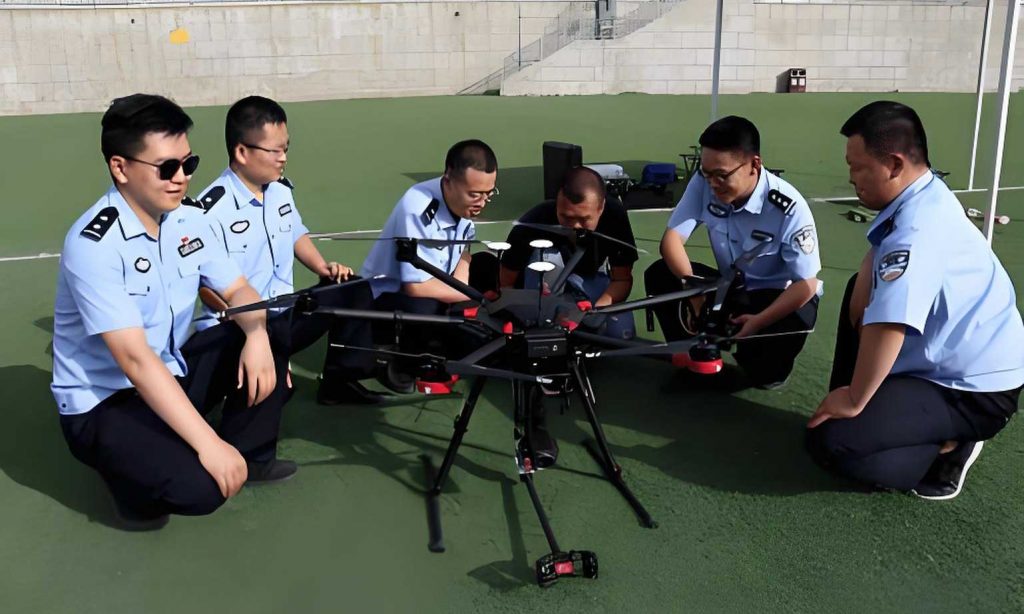
The integration of advanced training tools, as depicted, is vital for effective drone training. Simulators and realistic environments enable operators to practice without resource constraints, enhancing the efficiency of drone training programs. This aligns with the need for systematic resource allocation in drone training.
Standardized and Systematic Training
To achieve scalability and quality, drone training must be standardized and systematic. This involves developing professional instructor teams, compiling comprehensive training materials, equipping adequate training assets, and constructing suitable facilities. From my perspective, these elements form the backbone of sustainable drone training. For example, instructor teams should comprise both theoretical and practical experts, ensuring balanced drone training delivery. Training materials, including manuals and curricula, must be regularly updated to reflect technological advances. The following formula can guide resource allocation for drone training:
$$ R_a = I_t \cdot M_q + E_c \cdot F_s $$
where \( R_a \) is the resource allocation index, \( I_t \) is the instructor quality score, \( M_q \) is the material quality, \( E_c \) is equipment count, and \( F_s \) is facility suitability. Maximizing \( R_a \) is essential for robust drone training systems.
Moreover, drone training benefits from digital management systems that track progress and evaluate competencies. Such systems can model training outcomes using algorithms, for instance:
$$ C_o = \alpha \cdot \log(T_h) + \beta \cdot S_s $$
Here, \( C_o \) represents operator competency, \( T_h \) is training hours, \( S_s \) is simulator score, and \( \alpha \) and \( \beta \) are weighting factors. This highlights how data-driven approaches can optimize drone training. Additionally, policy frameworks for personnel selection and certification are crucial, as they provide legitimacy and structure to drone training initiatives.
In terms of equipment, drone training requires a mix of models, simulators, actual drones, and mission systems. The selection should match training phases: basic models for initial exposure, simulators for skill refinement, and real drones for final proficiency. Facilities must include classrooms, simulation labs, hangars, and flight fields, all designed to support immersive drone training. The synergy between these components ensures that drone training is both effective and efficient.
Future Directions in Drone Training
As drone technology evolves, so must drone training. Emerging trends such as artificial intelligence and swarm operations present new challenges for operator education. In my analysis, future drone training will incorporate more adaptive learning systems, using AI to personalize training paths based on individual performance. The integration of virtual and augmented reality could further enhance simulator-based drone training, providing realistic combat scenarios. Moreover, international collaboration in drone training standards may foster interoperability among allied forces. The continuous emphasis on drone training innovation will be key to maintaining strategic advantages.
To quantify future training needs, consider a predictive model for drone training demand:
$$ D_f = D_0 \cdot e^{rt} $$
where \( D_f \) is future demand for drone training, \( D_0 \) is current demand, \( r \) is the growth rate of drone deployment, and \( t \) is time. This exponential relationship underscores the urgency for expanding drone training capacities.
In conclusion, the proposed training mode for military drone operators, centered on classification, grading, phasing, and specialization, offers a scalable solution to meet modern warfare demands. Drone training is not merely a technical exercise but a strategic imperative, influencing battlefield outcomes. Through standardized and systematic approaches, we can cultivate high-quality operator teams that leverage UAV capabilities to their fullest. As I reflect on this research, the recurring theme is the critical role of drone training in achieving operational superiority. By embracing innovative methods and continuous improvement, military forces can ensure their drone training programs remain effective in an ever-changing landscape. The insights shared here aim to contribute to the global discourse on enhancing drone training, ultimately fostering safer and more efficient military operations.