
The exponential proliferation of unmanned aerial systems (UAS), from micro-class to large high-altitude long-endurance (HALE) platforms, has fundamentally reshaped the aerospace landscape. This growth has precipitated a critical and persistent shortfall: a severe deficit in qualified, proficient drone pilots. The operational paradigm of drone training diverges radically from traditional manned aircraft instruction. A drone pilot, situated in a ground control station (GCS), is severed from the direct sensory immersion of flight—no wide-field visual cues, no vestibular feedback, no ambient sound. Instead, they must exercise command and situational awareness through a data-link-mediated interface, characterized by limited field-of-view video, sensor data feeds, time latency, and high-volume dynamic information displays. This “keyboard and screen” cockpit, combined with the intrinsic need for crew coordination across pilot, sensor operator, and mission commander roles, elevates the cognitive and procedural demands on the operator. Consequently, established manned aircraft drone training protocols are inadequate. A specialized, rigorous, and scalable approach to drone training is not merely beneficial but essential for operational safety, efficiency, and mission success. The methodologies developed and refined by pioneering nations provide a crucial blueprint for constructing effective drone training ecosystems.
The efficacy of any drone training program hinges on recognizing the heterogeneous backgrounds of its candidates. A one-size-fits-all curriculum is inefficient and can demotivate learners with prior experience. We can broadly categorize entrants into three distinct profiles, each requiring a tailored instructional focus. The core challenge of drone training is to bridge the gap between innate human sensory-motor expectations and the mediated reality of remote piloting.
| Trainee Profile Category | Prior Experience | Core Training Challenge | Key Focus Area in Drone Training |
|---|---|---|---|
| Profile I: The Novice | No formal flight experience (manned or unmanned). | Building foundational aviation knowledge and psychomotor skills from scratch. No preconceived “feel” for flight to unlearn. | Comprehensive education starting with basic aerodynamics, aviation physiology, and fundamental stick-and-rudder (or keyboard) skills. |
| Profile II: The Certified (Non-Practicing) Aviator | Holds manned aircraft pilot qualifications but has not engaged in sustained operational flying. | Translating theoretical and basic practical knowledge from the manned domain to the unmanned, mediated control paradigm. | Adapting existing knowledge to GCS interfaces, managing sensory deprivation, and mastering data-link-centric operations. |
| Profile III: The Practicing Aviator | Actively serving as a pilot of manned aircraft. | Overcoming deeply ingrained sensory-motor habits and “muscle memory” from direct flight control. This is often the most difficult transition. | Cognitive re-mapping for remote operation, managing latency, and developing new scan patterns for electronic instrument clusters instead of out-the-window viewing. |
A modern, holistic drone training pipeline is multi-modal, integrating phased instruction across three primary domains: theoretical knowledge, simulation-based proficiency, and live flight training. This structured progression mitigates risk, controls cost, and ensures competencies are built sequentially.
1. Theoretical Knowledge Acquisition
The cornerstone of effective drone training is a robust theoretical curriculum. It moves beyond pure aerodynamics to encompass the unique, integrated systems of a UAS. Effective drone training theory modules must address the tripartite nature of the system: air vehicle, ground control, and the connecting data link.
| Knowledge Module | Core Topics | Importance in Drone Training |
|---|---|---|
| UAS-Specific Aerodynamics & Performance | Unique flight envelopes of various drone types (e.g., fixed-wing endurance, multi-rotor hover); launch and recovery physics; autonomy envelope management. | Enables pilots to predict and command vehicle behavior within its physical limits, crucial for mission planning and emergency response. |
| Ground Control Station (GCS) Architecture & Human-Machine Interface (HMI) | Data display layouts, control input devices, alert and warning systems, mission planning software integration. | Directly impacts the pilot’s situational awareness and decision-making speed. Mastery of the HMI is as critical as cockpit familiarization in a manned aircraft. |
| Payload & Sensor Theory | Electro-Optical/Infrared (EO/IR) camera operation, Synthetic Aperture Radar (SAR) fundamentals, signal intelligence (SIGINT) basics, and payload control interfaces. | Essential for mission execution. The pilot must understand sensor capabilities and limitations to effectively collect and interpret data. |
| Data Link & Communication Systems | Radio frequency (RF) theory, spectrum management, latency causes and effects, link degradation profiles, and satellite communication (SATCOM) basics. | The data link is the “umbilical cord.” Understanding its vulnerabilities is key to managing loss-of-link contingencies and maintaining control. |
| Airspace Integration & Regulatory Compliance | National Airspace System (NAS) rules, sense-and-avoid (SAA) requirements, air traffic control (ATC) communication procedures for UAV operations. | Critical for safe and legal operations, especially for beyond-visual-line-of-sight (BVLOS) missions in shared airspace. |
2. Simulation-Based Training (SBT)
Simulation is the workhorse of modern drone training. It provides a risk-free, repeatable, and cost-effective environment to develop and hone skills. High-fidelity simulators replicate the exact GCS software and hardware, allowing for immersive training on normal procedures, emergency scenarios, and full-mission rehearsals. The mathematical modeling behind a flight simulator is key to its fidelity. A simplified representation of the drone’s translational dynamics can be expressed as:
$$ \begin{aligned} \dot{u} &= -g \sin\theta + (F_x / m) \\ \dot{v} &= g \cos\theta \sin\phi + (F_y / m) \\ \dot{w} &= g \cos\theta \cos\phi – g + (F_z / m) \end{aligned} $$
Where \(u, v, w\) are velocity components in the body frame, \(\theta\) is pitch angle, \(\phi\) is roll angle, \(g\) is gravity, \(m\) is mass, and \(F_{x,y,z}\) are the forces along body axes (from thrust, aerodynamics). A high-fidelity drone training simulator solves complex versions of these equations in real-time, coupled with models for sensors, data-link latency \(\tau\), and environmental effects. The core advantages of SBT in a drone training curriculum are manifold.
| Training Element | Simulator Application | Benefit |
|---|---|---|
| Basic Vehicle Control | Practicing takeoff, landing, hover (for VTOL), navigation, and basic maneuvers. | Builds muscle memory for the specific GCS control interface without risking an airframe. |
| Emergency & Abnormal Procedure Drills | Simulating engine failure, data-link loss, flight control degradation, and sensor failures. | Allows for practiced, calm responses to high-stress, low-probability events that are dangerous to train live. |
| Mission-Specific Skill Development | Rehearsing sensor payload operation (e.g., tracking a target, mapping a grid), weapon delivery protocols, or specific intelligence collection profiles. | Enables mastery of complex operational tasks and crew coordination in a controlled setting. |
| Crew Resource Management (CRM) | Multi-station simulations involving Pilot, Sensor Operator, and Mission Commander. | Fosters communication, workload distribution, and shared situational awareness—critical for complex drone operations. |
3. Live Flight Training
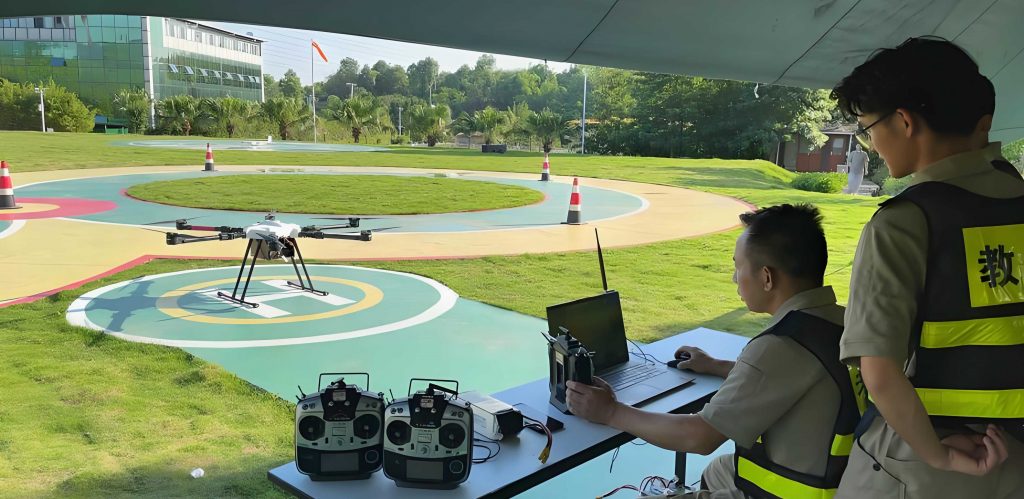
While simulation is indispensable, it cannot fully replicate the unpredictability and psychological pressure of controlling a physical asset. A phased approach to live flight drone training is essential, typically progressing from smaller, lower-cost platforms to the operational-type drone.
| Training Stage | Platform Type | Training Objectives | Rationale |
|---|---|---|---|
| Initial Live Flight | Small, Inexpensive UAS (Group 1-2) | Direct radio-control (RC) stick skills, basic visual navigation, managing actual environmental factors (wind, turbulence), and practicing manual landings. | Low financial risk, high attrition tolerance. Provides immediate kinetic feedback on control inputs in the real world. |
| Intermediate / Tactical Transition | Larger Tactical UAS (e.g., similar to Shadow, ScanEagle) | Operating via a more advanced GCS, managing mission payloads, conducting BVLOS procedures under instructor supervision, and executing full mission profiles. | Bridges the gap between simple RC models and complex HALE systems. Introduces operational concepts and more sophisticated avionics. |
| Advanced / Type-Specific Qualification | Operational Large UAS (e.g., MQ-9, Global Hawk class) | Mastering the specific GCS, avionics, and performance characteristics of the frontline platform. Conducting high-stakes operational mission training. | Final stage to achieve full mission-ready status on the designated weapons system. Conducted after core competencies are proven on lower-risk platforms. |
An innovative but less common method involves “Optionally Piloted Vehicles” (OPVs) or dual-control research aircraft. These platforms can be flown from an onboard cockpit or a remote GCS. While invaluable for research into control laws and human factors, their high cost and complexity generally preclude them from being a standard part of bulk drone training pipelines, though they offer unique insights for instructor-level training.
Drone Training Methodologies: A Quantitative and Qualitative Framework
To optimize drone training outcomes, we must move beyond descriptive methods and consider evaluative frameworks. The Kirkpatrick Model, adapted for drone training, provides a robust structure for assessment.
1. Reaction: Measuring the trainee’s engagement and perceived utility of the training. This can be quantified via post-module surveys using Likert scales.
2. Learning: Assessing the acquisition of knowledge and skills. This is where quantitative metrics from simulators are crucial. We can define a skill proficiency score \( S \) for a given task:
$$ S = \omega_1 A_c + \omega_2 (1/T_c) + \omega_3 R_s $$
Where \( A_c \) is accuracy of completion (0 to 1), \( T_c \) is time to completion, \( R_s \) is resource score (e.g., fuel remaining), and \( \omega_{1,2,3} \) are weighting factors specific to the task’s objectives. A passing threshold \( S_{min} \) is set for certification on that module.
3. Behavior: Evaluating the transfer of learning to actual job performance. This involves instructor evaluations during live flight exercises, analyzing decision logs, and assessing CRM effectiveness. Metrics like “number of protocol deviations” or “time to correctly diagnose a simulated failure” are key.
4. Results: Measuring the ultimate impact on organizational goals—reduced accident rate, increased mission success rate, lower operational costs. The accident rate metric, often cited in drone training efficacy studies, can be modeled. If \( \lambda_0 \) is the baseline accident rate before enhanced training, and training reduces error-prone behavior by a factor \( \epsilon \) (where \( 0 < \epsilon < 1 \)), the new expected accident rate \( \lambda_1 \) might be approximated as:
$$ \lambda_1 = \lambda_0 \cdot (1 – \epsilon) $$
Sustained measurement at this level proves the return on investment for comprehensive drone training programs.
Synthesizing the Path: Customized Drone Training Tracks
Returning to the three trainee profiles, we can now construct optimized drone training tracks by selectively combining the core methods. The goal is efficiency—avoiding redundant training for experienced aviators while ensuring novices build a complete foundation. The following matrix provides a prescriptive guide for curriculum design.
| Training Component | Profile I: The Novice | Profile II: Certified Aviator | Profile III: Practicing Aviator | Rationale for Allocation |
|---|---|---|---|---|
| Aviation Fundamentals (Aerodynamics, Meteorology) | Mandatory (Full Course) | Optional Refresher / Test-Out | Waived | Profile I lacks this knowledge base. Profiles II & III possess it, though Profile II may need reactivation. |
| UAS-Specific Theory (Data Link, GCS, Payloads) | Mandatory | Mandatory | Mandatory | Novel knowledge for all profiles, critical for understanding the unique system they will operate. |
| Basic Manned Aircraft Flight (in a Cessna-type aircraft) | Highly Recommended | Optional / Already Completed | Waived / Counterproductive | Gives Profile I an irreplaceable kinesthetic sense of flight. For Profile III, it reinforces the very habits they must overcome. |
| Generic UAS Simulator (Basic GCS Familiarization) | Mandatory (Extended Hours) | Mandatory (Moderate Hours) | Mandatory (Focus on Interface Transition) | All need to adapt to remote piloting. Novices need more time to build basic control skills. Practicing aviators need focused work on overcoming manned aircraft reflexes. |
| Live Flight on Small UAS | Mandatory (Core Skill Builder) | Mandatory (Essential Transition) | Highly Recommended (Habit-Breaking Environment) | The low-risk, high-feedback environment is crucial for all to connect simulator skills to reality. Especially jarring and thus useful for Profile III. |
| Type-Specific Simulator (e.g., MQ-9 Sim) | Mandatory (After prerequisites) | Mandatory (After prerequisites) | Mandatory (After prerequisites) | The final common path for all to learn the specific operational system. Entry requires passing scores on previous stages. |
| Live Flight on Operational UAS | Mandatory (Supervised, Graduated) | Mandatory (Supervised, Graduated) | Mandatory (Supervised, Graduated) | The ultimate qualification event. All profiles, having converged in competency through their tailored paths, undergo this final evaluation. |
This structured, profile-sensitive approach ensures that drone training resources are allocated effectively. It acknowledges that while the endpoint—a fully qualified drone pilot—is the same, the optimal journey to that endpoint differs based on the traveler’s starting point. The mathematical proficiency score \( S \) and the Kirkpatrick levels provide continuous feedback loops to validate that each tailored path is achieving its intended objectives, ensuring that no trainee is left behind due to an inappropriate curriculum, and no training hour is wasted on redundant instruction.
The relentless advancement of autonomous functions will inevitably change the role of the drone pilot, shifting it further towards mission command and supervisory control. However, this evolution does not diminish the need for foundational drone training; it redefines its pinnacle. The principles outlined here—theoretical depth, simulated proficiency, phased live training, and customized learning tracks—will remain the bedrock upon which safe and effective human-UAS teaming is built. Investing in sophisticated, analytically-driven drone training programs is the imperative strategy for unlocking the full potential of unmanned systems while safeguarding personnel, assets, and the airspace we share.