
The rapid proliferation of Unmanned Aerial Systems (UAS), commonly known as drones, has ushered in a transformative era for numerous industries, from precision agriculture and infrastructure inspection to cinematography and emergency services. This technological surge has created an unprecedented market demand. However, this very growth is paradoxically constrained by a critical bottleneck: a severe shortage of sufficiently skilled and certified professionals. The gap between technological capability and human expertise poses a significant risk to the sustainable development of the entire sector. It was within this context of both immense opportunity and pressing challenge that our institution recognized a pivotal mission: to become a cornerstone in the ecosystem of professional drone training and aviation technology education.
Our commitment materialized significantly on January 16, 2017, when our institution successfully obtained the coveted Civil Unmanned Aircraft System Pilot Training Organization qualification. This authorization, granted following a rigorous audit by the nationally recognized and Civil Aviation Administration of China-sanctioned aviation association, represents far more than a mere administrative milestone. It signifies a profound validation of our educational philosophy, infrastructure, and pedagogical readiness. It marks a decisive step in our strategic journey towards excellence, formally establishing our capacity to deliver standardized, high-fidelity drone training programs that meet the exacting requirements of the national civil aviation authority.
The path to this achievement was one of deliberate planning and concerted effort. Anticipating the industry’s needs, we initiated a comprehensive project in 2016 dedicated to advancing our drone application technology program. The goal was to deeply align our curriculum with real-world industry requirements, thereby enhancing the program’s capacity to serve societal and economic needs. Special funding was allocated to build and certify a professional drone training center. Under meticulous guidance, a dedicated team from our College of Mechanical and Electrical Engineering embarked on a multifaceted preparation process. This involved our instructors obtaining certified flight instructor credentials, developing comprehensive training manuals and detailed syllabi, procuring a fleet of training drones and related simulation equipment, and navigating the complex process of securing authorized flight airspace. Through determined effort, we systematically overcame numerous logistical and regulatory hurdles, completing the construction and certification process as planned.
This achievement positioned us uniquely within the national landscape. As of that pivotal date in early 2017, only 180 institutions across the country held this specific training qualification. Within our provincial region, we were among just four, and notably, we distinguished ourselves as the first higher vocational college to secure this drone training authority. This pioneering status underscored our role as an early adopter and leader in formalizing vocational drone training at the tertiary education level.
The core of our drone training philosophy is built on a structured, competency-based framework. We categorize training into distinct tiers, each with escalating theoretical and practical demands, as summarized in the table below.
| Training Tier | Primary Focus | Theoretical Components | Minimum Flight Proficiency | Typical Authorization |
|---|---|---|---|---|
| Visual Line of Sight (VLOS) | Basic flight control, safety protocols, regulations. | Airspace Classification, Meteorology, Radio Communication. | 20+ hours (Simulator & Live Flight). | Operations within pilot’s visual range. |
| Beyond Visual Line of Sight (BVLOS)/Extended | Advanced navigation, contingency planning, system management. | Advanced Navigation Systems, Risk Assessment, Human Factors. | 40+ hours with specific BVLOS missions. | Operations using extended or automated flight paths. |
| Instructor Certification | Pedagogical skills, evaluation, curriculum delivery. | Instructional Methodology, Assessment Design. | Demonstrated mastery plus supervised teaching hours. |
Parallel to our advancements in drone training, we have been deeply engaged in the broader discourse on aviation maintenance education. In late December 2016, our institution had the privilege of hosting the inaugural working conference of the National Flight Vehicle Maintenance Technology Professional Teaching Guidance Committee. This committee, operating under the national aviation industry vocational education steering body, convened experts from leading vocational colleges, research institutes, and aerospace enterprises across the country. The agenda was centered on critical issues such as the development of national professional teaching standards, curriculum innovation, textbook modernization, and the organization of skills competitions.
The convergence of these two streams—drone training and traditional aviation maintenance—is not coincidental but strategic. We perceive modern aviation technology education as an integrated ecosystem. The principles of aerodynamics, propulsion, avionics, and maintenance are foundational to both manned and unmanned aircraft. Our unique position allows us to create a synergistic educational model. For instance, students in aircraft maintenance programs gain exposure to drone-specific avionics and composite material repair, while drone training participants develop a deeper appreciation for the rigorous safety and maintenance cultures inherent in aviation. This holistic approach is crystallized in our curriculum design principle, which can be modeled as a function of integrated knowledge:
$$ C = \int (K_a(t) + K_d(t) + K_s(t)) \, dt $$
Where \( C \) represents the comprehensive competency of a graduate, \( K_a(t) \) is the knowledge of traditional aeronautics acquired over time \( t \), \( K_d(t) \) is the specialized knowledge from drone training, and \( K_s(t) \) is the systems integration and safety knowledge. The integral signifies the continuous, cumulative nature of this learning process.
The discussions at the national committee meeting strongly affirmed the necessity for faster textbook updates and unified teaching standards. This directly informs our drone training material development. We constantly revise our content to reflect the latest regulatory changes (e.g., new air traffic management frameworks like UTM – Unmanned Traffic Management), technological breakthroughs in sense-and-avoid systems, and evolving data security protocols. The goal is to set a benchmark for vocational education that other specializations can emulate.
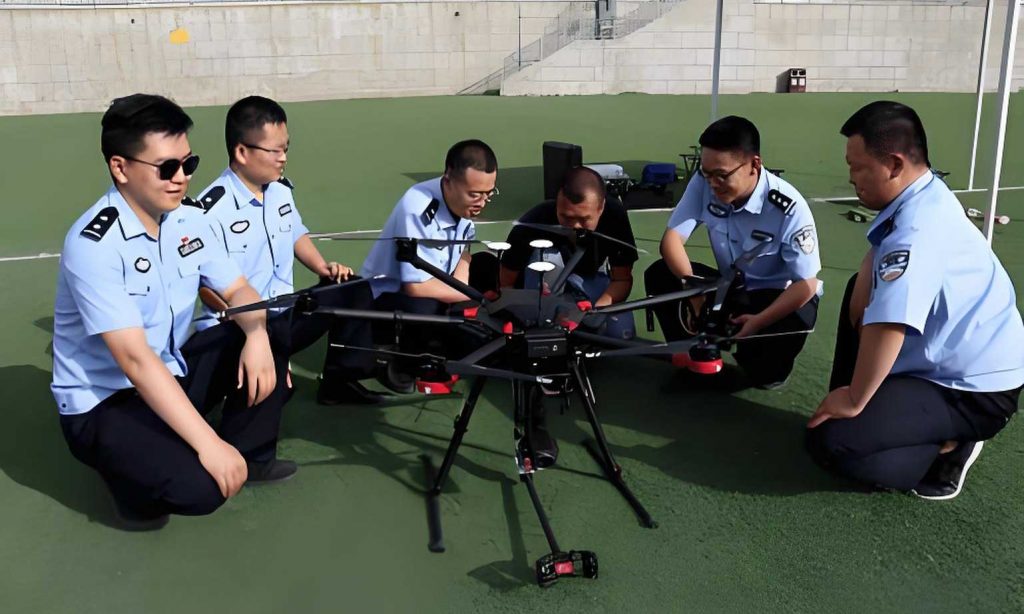
Practical skill formation is the cornerstone of effective drone training. Our training progression follows a meticulously designed curve, moving from controlled simulation to complex real-world mission execution. The relationship between training hours (both simulated, \( S \), and actual flight, \( F \)) and operational readiness score (\( R \), on a scale of 0-100) can be analyzed through a logistic growth model, reflecting the initially steep learning curve followed by refinement:
$$ R(S, F) = \frac{100}{1 + e^{-k(\alpha S + \beta F – \theta)}} $$
Here, \( k \) is a learning rate constant, \( \alpha \) and \( \beta \) are weighting coefficients for simulator and live flight effectiveness respectively (typically \( \beta > \alpha \)), and \( \theta \) is a threshold parameter. This model helps us optimize the training mix.
A critical component of our drone training curriculum is the deep technical education surrounding drone subsystems. We move beyond simple piloting to impart engineering-level understanding. Key modules include:
1. Aerodynamics and Flight Performance: Students learn to calculate basic performance metrics. For example, the approximate hover time \( T_h \) of a multi-rotor drone can be estimated using:
$$ T_h = \frac{C_b \cdot m_b}{P \cdot \eta} $$
where \( C_b \) is the battery capacity (in Ah), \( m_b \) is the battery voltage multiplier, \( P \) is the average power draw during hover (in Watts), and \( \eta \) is the power system efficiency. This calculation is vital for mission planning.
2. Flight Control Systems & Data Links: Training covers the PID (Proportional-Integral-Derivative) control algorithms that stabilize drones. The general form of a discrete-time PID controller for a single axis (like pitch) is explained:
$$ u(t) = K_p e(t) + K_i \sum_{i=0}^{t} e(i) \Delta t + K_d \frac{e(t) – e(t-1)}{\Delta t} $$
Here, \( u(t) \) is the control signal (e.g., motor speed adjustment), \( e(t) \) is the error (difference between desired and actual attitude), and \( K_p, K_i, K_d \) are tuning constants. Understanding this demystifies flight behavior.
3. Mission Planning and Data Analysis: For a photogrammetry mission, the ground sample distance (GSD), which determines image resolution, is a key planning parameter:
$$ GSD = \frac{H \cdot s}{f} $$
where \( H \) is flight altitude, \( s \) is the sensor pixel size, and \( f \) is the lens focal length. Trainees use this to plan flight paths for mapping or inspection, ensuring data quality meets client specifications.
The safety culture ingrained in traditional aviation is non-negotiable in our drone training program. We employ systematic risk assessment models. A simplified risk score \( R_s \) for a planned operation can be conceptualized as:
$$ R_s = \sum (P_i \cdot S_i) $$
where \( P_i \) is the probability of a specific hazard (e.g., GPS loss, motor failure, bird strike), and \( S_i \) is the severity of its consequence. Mitigation strategies are then developed to reduce each \( P_i \) or \( S_i \) to an acceptable level before flight authorization is granted. This procedural rigor is what distinguishes professional drone training from recreational flying.
Looking forward, the trajectory of drone training is inextricably linked to technological advancements. Our curriculum is evolving to include emerging topics such as:
- Swarm Operations: Coordinated flight of multiple drones, requiring understanding of distributed algorithms and communication protocols.
- Advanced Sense-and-Avoid (SAA): Integration of LiDAR, radar, and computer vision for autonomous obstacle navigation.
- UAV Traffic Management (UTM) Integration: Interfacing with digital platforms for airspace deconfliction and dynamic flight authorization.
- Beyond-Visual-Line-of-Sight (BVLOS) Operational Procedures: Deep dives into long-range communication, procedural contingencies, and regulatory compliance for expansive operations.
The role of the professional teaching guidance committee remains crucial in this evolution. By providing a platform for national collaboration, it enables the harmonization of standards, ensuring that graduates from different institutions possess a consistent, high-quality skill set. This, in turn, elevates the entire industry. Our involvement allows us to contribute our on-the-ground insights from running a premier drone training center while also absorbing best practices from industry and academia nationwide.
In conclusion, our dual focus on pioneering certified drone training and actively shaping the future of aviation maintenance education represents a coherent and powerful strategy. We are not merely teaching students to operate drones; we are cultivating a new generation of aviation technologists who understand unmanned systems as integral components of the broader aerospace domain. They are trained with the precision, safety mindset, and systemic understanding worthy of the aviation industry. The certification obtained in early 2017 was not an endpoint, but a launchpad. It committed us to an ongoing journey of curriculum refinement, technological investment, and pedagogical innovation. By bridging the gap between high market demand and skilled personnel shortage, we contribute directly to the responsible and explosive growth of the drone industry. Our mission aligns with greater national goals of technological self-reliance and manufacturing excellence, aiming to develop the “master craftsmen” necessary to navigate and lead in the era of advanced aerial mobility and smart manufacturing. Through this integrated approach to education, we strive to ensure that our drone training programs remain at the forefront, producing professionals who are not just operators, but innovators and stewards of the skies.