
In this study, we conducted field comparison experiments and farmer questionnaire surveys to systematically evaluate the application effects of multi-rotor crop spraying drones in corn pest control. The results demonstrate that, compared to traditional manual spraying, the use of spraying UAVs increased pesticide utilization from 35% to 75%, improved pest control effectiveness by 30%, reduced pesticide usage by 30%, saved costs by 15 yuan per mu (1 mu = 1/15 hectare), and achieved annual pesticide cost savings of 4500 to 6000 yuan. This research provides empirical support for the promotion of spraying UAVs in the Huang-Huai-Hai region, highlighting the transformative potential of this technology in modern agriculture.
Corn is a vital food crop, but it is frequently affected by pests and diseases, which compromise yield and quality. Traditional control methods, such as manual spraying, are inefficient, complex to operate, and often lead to pesticide waste and environmental pollution. With advancements in agricultural technology, crop spraying drones have emerged as a promising solution for corn pest control, aligning with national policies that advocate for modern agricultural machinery. In major corn-producing areas, annual losses due to pests can reach up to 15%, underscoring the urgency of adopting innovative technologies like spraying UAVs to enhance productivity and sustainability.
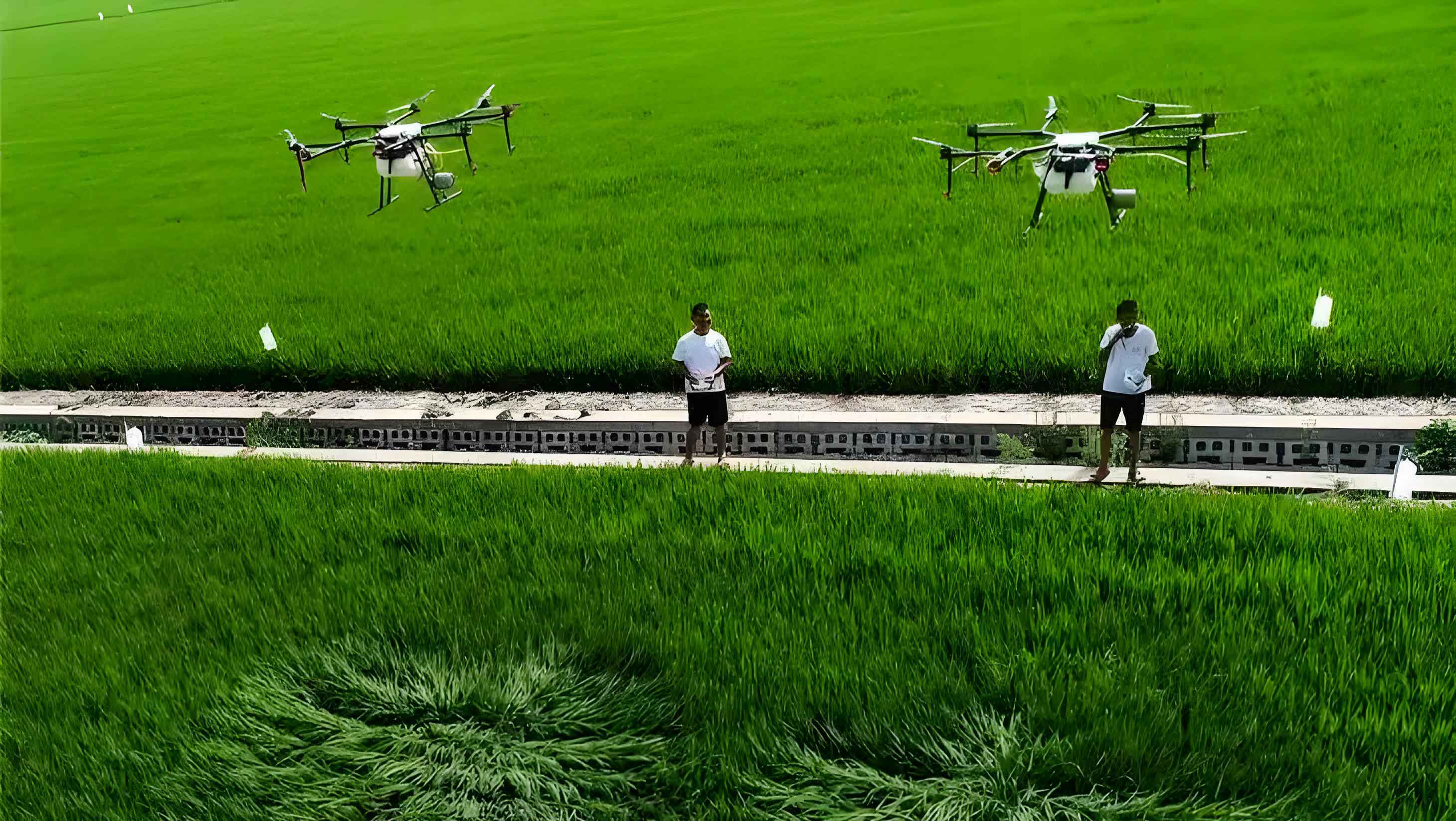
Advantages of Spraying UAV in Corn Pest Control
Efficiency and Precision Spraying
In our field experiments, we observed that traditional manual pesticide spraying allows one person to cover at most 5 mu per day. For large-scale farms, this inefficiency necessitates extensive labor, often resulting in uneven coverage. In contrast, the deployment of a multi-rotor crop spraying drone, such as a common six-rotor model, enables hourly coverage of 80 to 100 mu. Assuming an 8-hour workday, the daily operational area can reach 640 to 800 mu, representing a significant efficiency gain. The high-precision GPS navigation and intelligent spraying systems of these spraying UAVs allow for real-time adjustments based on crop growth, terrain, and pest distribution, ensuring uniform application and minimizing overspray or missed areas. Measurements using a laser particle size analyzer showed a droplet size DV50 of 120 μm and a droplet density of 25 droplets/cm², which enhances pesticide adhesion and absorption. The precision of crop spraying drones reduces resource waste and improves overall efficacy, as summarized in Table 1.
| Parameter | Traditional Manual Spraying | Spraying UAV |
|---|---|---|
| Daily Coverage per Person (mu) | 5 | 640–800 |
| Pesticide Utilization Rate (%) | 35 | 75 |
| Droplet Density (droplets/cm²) | 10–15 | 25 |
| Uniformity of Coverage | Low | High |
The efficiency of crop spraying drones can be quantified using the following formula for operational throughput: $$ \text{Throughput} = \text{Flight Speed} \times \text{Spray Width} \times \text{Operational Time} $$ where flight speed is typically 5 m/s, spray width ranges from 4 to 7 m, and operational time is up to 8 hours daily. This results in a substantial increase in area covered, making spraying UAVs indispensable for large-scale farming.
Reduction in Pesticide Costs and Resource Savings
Our analysis revealed that traditional spraying methods have a pesticide utilization rate of only 10% to 15%, leading to significant waste and environmental contamination. For instance, in a typical corn farm, manual spraying requires approximately 1.5 L of pesticide per mu, with annual costs ranging from 13,500 to 18,000 yuan for a 300-mu area. By adopting a crop spraying drone, pesticide usage is reduced to 1 L per mu, yielding annual savings of 4500 to 6000 yuan. Extrapolating to a regional scale, such as a 50,000-mu corn planting area, the widespread use of spraying UAVs could save up to 750 million yuan annually. We developed economic models, including Net Present Value (NPV) and Payback Period (PBP), to assess the financial viability. Assuming an initial investment of 100,000 yuan for a spraying UAV, an annual coverage of 3000 mu, revenue of 60,000 yuan, and operating costs of 20,000 yuan, the net annual profit is 40,000 yuan. The PBP is calculated as: $$ \text{PBP} = \frac{\text{Initial Investment}}{\text{Annual Net Cash Flow}} = \frac{100,000}{40,000} = 2.5 \text{ years} $$ Additionally, the NPV formula accounts for the time value of money: $$ \text{NPV} = \sum_{t=1}^{n} \frac{R_t}{(1+i)^t} – C_0 $$ where \( R_t \) is the net cash flow in year \( t \), \( i \) is the discount rate (assumed as 5% based on agricultural benchmarks), \( C_0 \) is the initial cost, and \( n \) is the project lifespan (e.g., 5 years). Our calculations show a positive NPV, indicating the economic attractiveness of crop spraying drones. Table 2 summarizes the cost-benefit analysis.
| Metric | Value |
|---|---|
| Initial Investment (yuan) | 100,000 |
| Annual Coverage (mu) | 3000 |
| Annual Revenue (yuan) | 60,000 |
| Annual Operating Costs (yuan) | 20,000 |
| Annual Net Profit (yuan) | 40,000 |
| Payback Period (years) | 2.5 |
| NPV (5-year, 5% discount) | Positive |
Safety and Environmental Protection
The use of crop spraying drones enhances operator safety by minimizing direct contact with pesticides, thereby reducing poisoning risks. In our field assessments, we noted that spraying UAVs decrease pesticide usage by 30%, which subsequently lowers pesticide residues in soil by 25%. This contributes to environmental conservation and aligns with sustainable agricultural practices. The precision of spraying UAVs ensures that pesticides are targeted only where needed, mitigating off-target effects and protecting non-target organisms. The environmental benefit can be expressed through a reduction factor: $$ \text{Environmental Impact Reduction} = \frac{\text{Traditional Pesticide Use} – \text{UAV Pesticide Use}}{\text{Traditional Pesticide Use}} \times 100\% = 30\% $$ This highlights the role of crop spraying drones in promoting eco-friendly farming.
Application Technologies of Crop Spraying Drones
Pesticide Selection
In our experiments, the choice of pesticide formulation significantly influenced spraying efficacy. Traditional emulsion formulations achieved only 60% coverage, whereas switching to suspension formulations increased coverage to 85%. This improvement is attributed to better compatibility with the spraying systems of crop spraying drones, enhancing adhesion and penetration on crop surfaces. We recommend selecting formulations that optimize droplet formation and reduce drift, as summarized in Table 3.
| Formulation Type | Coverage Rate (%) | Adhesion Quality |
|---|---|---|
| Emulsion | 60 | Moderate |
| Suspension | 85 | High |
Operational Parameter Settings
Optimizing operational parameters is crucial for the effectiveness of spraying UAVs. Based on wind tunnel tests and field trials, we determined that the ideal flight height for corn fields is 2 to 3 m, ensuring uniform droplet distribution and minimizing drift. For specific pest scenarios, such as aphids in the seedling stage, parameters include a flight height of 2 m, speed of 5 m/s, spray volume of 1 L/mu, spray pressure of 1.5 MPa, droplet size of 80–120 μm, and spray width of 4–6 m, achieving over 90% control efficiency. For later stages, like corn rust, spray volume is increased to 1.5 L/mu, pressure to 2 MPa, and spray width to 5–7 m, improving control from 70% to 85%. The relationship between parameters and efficacy can be modeled using: $$ \text{Control Efficiency} = k \times \frac{\text{Spray Volume} \times \text{Droplet Density}}{\text{Flight Speed}} $$ where \( k \) is a crop-specific constant. Table 4 outlines key parameters for different growth stages.
| Growth Stage | Pest | Flight Height (m) | Flight Speed (m/s) | Spray Volume (L/mu) | Spray Pressure (MPa) | Droplet Size (μm) | Spray Width (m) | Control Efficiency (%) |
|---|---|---|---|---|---|---|---|---|
| Seedling | Aphids | 2 | 5 | 1 | 1.5 | 80–120 | 4–6 | 90 |
| Mid to Late | Rust | 2–3 | 4–6 | 1.5 | 2 | 80–120 | 5–7 | 85 |
Spraying Time Selection
Our comparative experiments, conducted with three replicates and analyzed using statistical methods, showed that spraying during early morning (06:00–08:00) or evening (17:00–19:00) results in pesticide adhesion rates of 80%, whereas midday spraying (12:00–14:00) under high temperatures reduces adhesion to 60% due to evaporation. We recommend spraying during low-wind conditions in the morning or evening to increase adhesion by 15–20%, significantly enhancing control effectiveness. The adhesion rate can be expressed as: $$ \text{Adhesion Rate} = A – B \times \text{Temperature} $$ where \( A \) and \( B \) are empirical constants, emphasizing the importance of timing in spraying UAV operations.
Summary of Successful Experiences and Key Technologies
Through the implementation of crop spraying drones, we achieved high-efficiency pest control in corn fields. The use of advanced models enabled hourly coverage of 80–100 mu, coupled with GPS and intelligent systems that reduced pesticide usage from 1.5 L/mu to 1 L/mu, yielding annual savings of 4500–6000 yuan and raising pesticide utilization by 40%. Pest control effectiveness exceeded 90%, and by optimizing spraying paths, heights, and pressures, along with strategic timing, adhesion rates improved by 15–20%. These successes underscore the potential of spraying UAVs to revolutionize agricultural practices.
Challenges and Strategies
Promotion and Support Issues
In our surveys, we found that approximately 70% of farmers in remote areas remain hesitant to adopt crop spraying drones, primarily due to high costs. A single spraying UAV costs 30,000 to 50,000 yuan, while annual net income from corn farming is only 20,000 to 30,000 yuan, creating a significant financial barrier. Existing subsidy programs cover only 10–15% of costs, insufficient to incentivize adoption. To address this, we propose increasing subsidies to 30–40%, which would reduce the out-of-pocket cost for a 40,000-yuan drone to 24,000–28,000 yuan, making it more accessible. Additionally, collaboration with agricultural extension services to provide training can overcome technical apprehensions.
Technical Stability Problems
Our field tests highlighted stability issues with spraying UAVs in complex terrains and adverse weather. Battery life is limited to 30–40 minutes, requiring frequent replacements and reducing efficiency in large-scale operations. For example, in a 500-mu corn field, battery limitations extended a planned one-day task to two days, delaying critical pest control. To mitigate this, we advocate for research into improved battery technologies, such as new cell designs that extend flight time to 60–80 minutes, potentially boosting efficiency by 30%. Enhancements in flight control systems are also needed to improve adaptability and anti-interference capabilities.
Policy and Technical Solutions
We recommend that governments amplify subsidies for crop spraying drones, aligning with smart agriculture initiatives to raise coverage from 10–15% to 30–40%. This policy shift, combined with regular training programs, can address the “fear of use” among farmers. Technologically, investments in R&D should focus on optimizing UAV flight systems for better terrain handling and developing advanced batteries. For instance, prototype batteries with extended endurance have shown promise in pilot projects, increasing operational efficiency. Further refinements in spraying systems will enhance precision and pesticide utilization, solidifying the role of spraying UAVs in agriculture.
Conclusion
In this study, we empirically analyzed the application of multi-rotor crop spraying drones in corn pest control, establishing a parameter system tailored to regional conditions and evaluating economic and environmental benefits. Our findings confirm that spraying UAVs excel in improving efficiency, reducing costs, and minimizing environmental impact. Looking ahead, we aim for a 60% adoption rate of crop spraying drones by 2025, driven by technological advancements and policy support. Future developments should focus on extending battery life, stabilizing flight controls, and enhancing intelligent systems to meet diverse crop needs. Over the next five years, we anticipate significant improvements in coverage, pesticide utilization, and control efficacy, fostering a shift toward green, efficient, and sustainable agriculture. This progress will contribute to national food security and ecological conservation, underscoring the transformative potential of spraying UAVs in global farming practices.
Through continuous innovation, crop spraying drones and spraying UAVs will play an increasingly vital role in addressing agricultural challenges, ensuring that farmers can achieve higher yields with fewer resources. Our research provides a foundation for future studies and practical implementations, emphasizing the importance of integrating technology with traditional knowledge for holistic agricultural development.