
In modern agriculture, the adoption of advanced technologies such as crop spraying drones has revolutionized pest and weed management practices. As a researcher focused on precision agriculture, I have conducted an in-depth study to evaluate the droplet characteristics and weed control efficacy of different nozzles used with spraying UAVs in corn fields. This investigation aims to address the challenges of pesticide drift, uneven coverage, and variable efficacy that often plague aerial applications. The widespread use of crop spraying drones offers benefits like reduced labor costs and increased efficiency, but optimizing their performance requires a thorough understanding of nozzle types and their impact on spray dynamics. Through this research, we seek to provide actionable insights for farmers and agronomists to enhance the effectiveness of spraying UAV operations while minimizing environmental impacts.
The global agricultural sector is increasingly relying on spraying UAVs to achieve sustainable crop production. These crop spraying drones enable precise application of agrochemicals, which is critical for managing weeds in major crops like corn. However, the performance of a spraying UAV heavily depends on nozzle selection, as it influences droplet size, distribution, and drift potential. In this study, we examined six different nozzle types attached to a commercial crop spraying drone, assessing their雾滴特征和对玉米田杂草的防控效果. Our findings highlight the trade-offs between droplet size, coverage, and control efficacy, underscoring the need for tailored nozzle choices in specific field conditions.
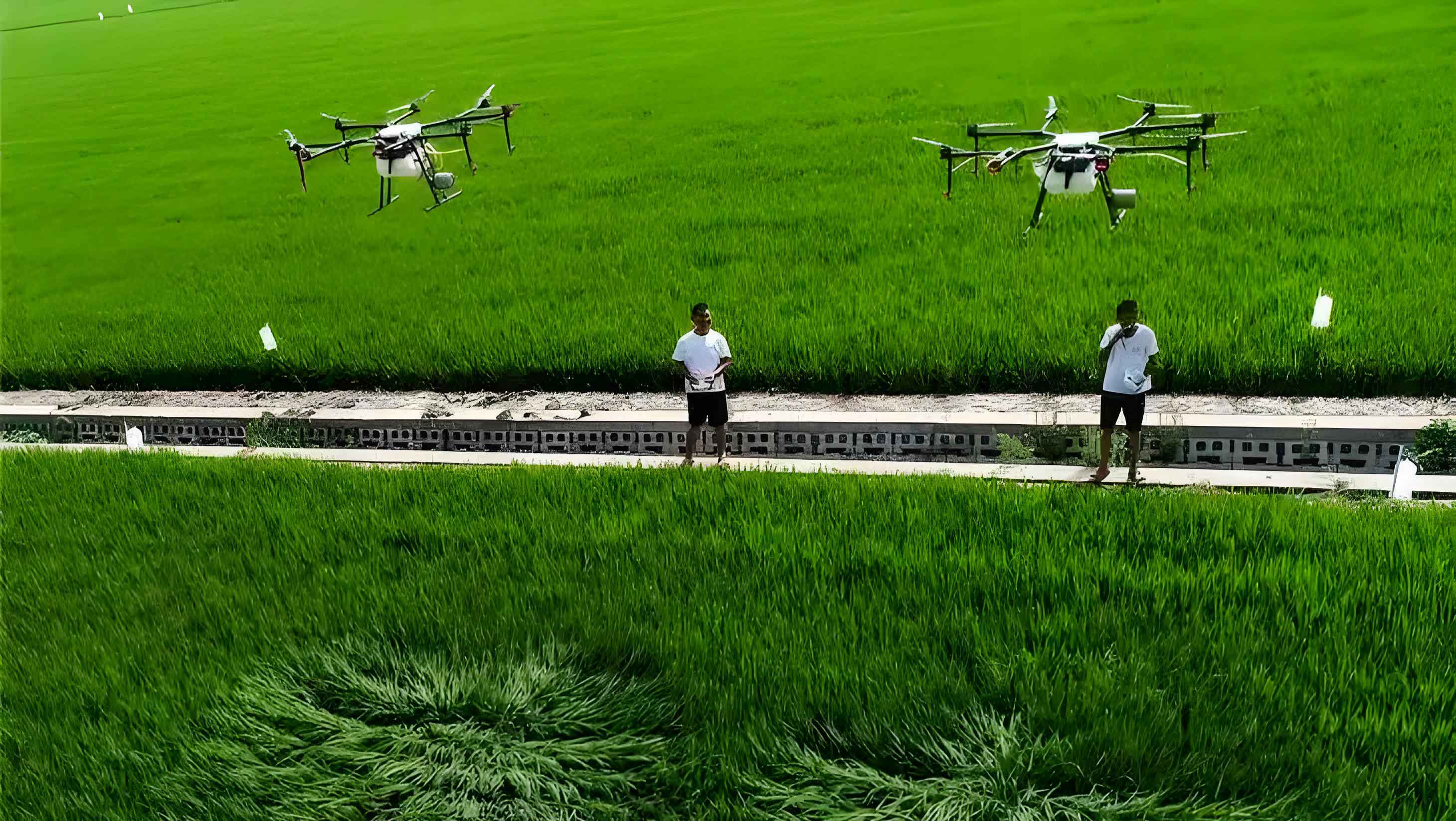
To set the context, crop spraying drones have become integral to precision agriculture due to their ability to cover large areas quickly with minimal water usage. A typical spraying UAV can reduce pesticide volume by over 20% and water consumption by more than 90% compared to conventional methods. Despite these advantages, issues like droplet drift and inconsistent deposition persist, often leading to reduced weed control and potential damage to non-target areas. Our research focuses on comparing nozzles from renowned manufacturers, evaluating parameters such as droplet diameter, density, and coverage uniformity. By integrating empirical data with theoretical models, we aim to establish guidelines for optimizing crop spraying drone operations in corn production systems.
The methodology for this study involved a randomized field experiment in a typical corn-growing region. We utilized a widely available crop spraying drone model, equipped with various nozzles, to apply a common herbicide formulation. The spraying UAV was operated under consistent environmental conditions to minimize external variables. Data collection included measurements of droplet size using laser diffraction, density via sampling cards, and coverage through tracer agents. Weed control efficacy was assessed at multiple intervals post-application, calculating both population reduction and biomass suppression. This comprehensive approach allows for a holistic evaluation of how nozzle design affects the performance of a crop spraying drone in real-world scenarios.
In the following sections, we delve into the detailed results, supported by tables and mathematical formulations. For instance, the average droplet size for each nozzle can be represented using the formula for mean diameter: $$ D_{avg} = \frac{\sum_{i=1}^{n} D_i}{n} $$ where \( D_i \) is the diameter of individual droplets and \( n \) is the total number of measurements. Similarly, control efficacy is computed as: $$ \text{Efficacy} = \left( \frac{C – T}{C} \right) \times 100\% $$ where \( C \) is the control group value and \( T \) is the treatment group value. These equations help standardize our analysis and facilitate comparisons across different spraying UAV setups.
| Nozzle Type | Minimum Droplet Size (μm) | Maximum Droplet Size (μm) | Average Droplet Size (μm) |
|---|---|---|---|
| Type A | 114 | 221 | 134 |
| Type B | 119 | 357 | 199 |
| Type C | 126 | 4997 | 385 |
| Type D | 141 | 3526 | 293 |
| Type E | 122 | 5388 | 211 |
| Type F | 101 | 704 | 179 |
Our analysis revealed significant variations in droplet size across nozzle types, which directly influence drift and deposition patterns. For example, nozzles producing larger droplets, such as Type C and Type D, exhibited lower drift distances but higher uniformity issues. This is critical for spraying UAV applications, as larger droplets are less prone to wind displacement but may not cover the target area evenly. The relationship between droplet size and drift can be modeled using the Stokes’ law approximation for settling velocity: $$ v = \frac{2}{9} \frac{(\rho_p – \rho_f) g r^2}{\mu} $$ where \( v \) is the terminal velocity, \( \rho_p \) and \( \rho_f \) are particle and fluid densities, \( g \) is gravity, \( r \) is droplet radius, and \( \mu \) is dynamic viscosity. This formula underscores why larger droplets from certain crop spraying drone nozzles reduce drift, enhancing targeted application.
| Nozzle Type | Coverage at 4m (%) | Coverage at 6m (%) | Coverage at 8m (%) | Coverage at 10m (%) | Coverage at 12m (%) | Total Coverage (%) | Drift Distance (m) |
|---|---|---|---|---|---|---|---|
| Type A | 2.73 | 0.23 | 0.18 | 0.08 | 0.14 | 3.36 | 24 |
| Type B | 1.17 | 0.83 | 0.26 | 0.11 | 0.00 | 2.37 | 11 |
| Type C | 7.59 | 0.73 | 0.12 | 0.09 | 0.00 | 8.53 | 11 |
| Type D | 5.08 | 3.61 | 0.72 | 0.15 | 0.00 | 9.56 | 11 |
| Type E | 3.37 | 0.92 | 0.67 | 0.24 | 0.18 | 5.38 | 24 |
| Type F | 10.81 | 2.26 | 1.27 | 1.43 | 0.92 | 16.69 | 33 |
Coverage uniformity is another vital aspect of spraying UAV performance. We observed that nozzles with higher coverage concentrations at closer distances, like Type B and Type C, resulted in shorter drift distances, making them suitable for applications in sensitive environments. In contrast, nozzles like Type F showed extensive drift, up to 33 meters, which could lead to off-target effects. The coverage efficiency can be quantified using the coefficient of variation (CV): $$ CV = \frac{\sigma}{\mu} \times 100\% $$ where \( \sigma \) is the standard deviation of coverage values and \( \mu \) is the mean coverage. A lower CV indicates more uniform deposition, which is desirable for crop spraying drones to ensure consistent weed control across the field.
Droplet density measurements further elucidate the deposition patterns. For instance, Type F nozzle had the highest droplet density near the application point, but this decreased rapidly with distance, contributing to its poor drift control. The density data can be analyzed using spatial distribution models, such as the Gaussian plume model for aerosol dispersion: $$ C(x,y,z) = \frac{Q}{2\pi u \sigma_y \sigma_z} \exp\left(-\frac{y^2}{2\sigma_y^2}\right) \exp\left(-\frac{z^2}{2\sigma_z^2}\right) $$ where \( C \) is concentration, \( Q \) is emission rate, \( u \) is wind speed, and \( \sigma_y \), \( \sigma_z \) are dispersion parameters. This model helps predict how droplet density varies with distance from the spraying UAV, aiding in nozzle selection for minimal environmental impact.
| Nozzle Type | Density at 4m (droplets/cm²) | Density at 6m (droplets/cm²) | Density at 8m (droplets/cm²) | Density at 10m (droplets/cm²) | Density at 12m (droplets/cm²) | Density at 14m (droplets/cm²) | Density at 22m (droplets/cm²) | Density at 24m (droplets/cm²) |
|---|---|---|---|---|---|---|---|---|
| Type A | 15.1 | 1.26 | 2.07 | 0.84 | 0.70 | 0.31 | 2.53 | 0.49 |
| Type B | 14.09 | 4.16 | 2.82 | 1.42 | 1.57 | 0.84 | 0.60 | 0.81 |
| Type C | 5.22 | 1.39 | 0.40 | 0.92 | 0.00 | 0.00 | 0.00 | 0.00 |
| Type D | 2.88 | 3.01 | 1.84 | 0.45 | 0.00 | 0.00 | 0.00 | 0.00 |
| Type E | 2.58 | 1.61 | 0.50 | 0.92 | 0.00 | 0.00 | 0.00 | 0.00 |
| Type F | 130.84 | 45.26 | 40.75 | 44.18 | 23.06 | 28.52 | 12.73 | 10.49 |
Weed control efficacy was a primary focus, with assessments conducted at 15 and 30 days after application. The results demonstrated that nozzles producing larger droplets, such as Type B, Type C, and Type D, achieved superior control of broadleaf weeds like苘麻 and龙葵, with efficacy exceeding 90% in many cases. This aligns with the concept that larger droplets from a crop spraying drone penetrate the canopy more effectively, reducing wash-off and enhancing herbicide absorption. The overall efficacy can be expressed as a function of droplet size and density: $$ E = f(D_{avg}, \rho) $$ where \( E \) is efficacy, \( D_{avg} \) is average droplet size, and \( \rho \) is droplet density. Our data suggests that an optimal balance exists for spraying UAVs, where moderate droplet size and high density yield the best results.
| Nozzle Type | Efficacy on Grass Weeds (%) | Efficacy on Broadleaf Weeds (%) | Efficacy on Other Weeds (%) | Total Efficacy (%) |
|---|---|---|---|---|
| Type A | 83.33 | 98.33 | 90.28 | 88.42 |
| Type B | 88.75 | 100.00 | 87.20 | 91.29 |
| Type C | 90.23 | 100.00 | 88.39 | 94.83 |
| Type D | 90.47 | 100.00 | 92.64 | 94.02 |
| Type E | 80.72 | 100.00 | 91.72 | 87.16 |
| Type F | 76.84 | 92.37 | 82.31 | 82.92 |
At 30 days post-application, the trends persisted, with Type C nozzle maintaining the highest efficacy, followed by Type D and Type B. This longevity is crucial for sustainable weed management using spraying UAVs, as it reduces the need for multiple applications. The decline in efficacy over time can be modeled using a first-order decay equation: $$ E(t) = E_0 e^{-kt} $$ where \( E(t) \) is efficacy at time \( t \), \( E_0 \) is initial efficacy, and \( k \) is the decay constant. Our data indicates that nozzles with better initial deposition, such as those on high-performing crop spraying drones, exhibit slower efficacy decay, emphasizing the importance of nozzle selection for long-term control.
| Nozzle Type | Efficacy on Grass Weeds (%) | Efficacy on Broadleaf Weeds (%) | Efficacy on Other Weeds (%) | Total Efficacy (%) | Biomass Reduction Efficacy (%) |
|---|---|---|---|---|---|
| Type A | 78.90 | 95.23 | 80.73 | 84.73 | 87.64 |
| Type B | 80.02 | 96.52 | 86.76 | 86.49 | 90.98 |
| Type C | 80.85 | 100.00 | 90.49 | 90.73 | 94.16 |
| Type D | 82.83 | 98.76 | 89.05 | 86.98 | 91.82 |
| Type E | 76.38 | 96.68 | 82.34 | 80.82 | 86.60 |
| Type F | 68.46 | 80.83 | 72.98 | 70.83 | 81.61 |
Discussion of these results highlights the critical role of nozzle design in spraying UAV operations. Nozzles that generate larger droplets, such as Type B, Type C, and Type D, minimize drift and provide adequate control for most weeds, making them ideal for crop spraying drones in corn fields. However, their lower uniformity might require adjustments in flight patterns or application rates. Conversely, nozzles like Type A and Type E offer finer droplets and better uniformity but are prone to drift, necessitating careful weather monitoring. The worst performer, Type F, with its small droplets and high drift, underscores the risks of improper nozzle selection, which could compromise the entire spraying UAV mission.
From a practical perspective, farmers using crop spraying drones should prioritize nozzles that balance droplet size and drift control. For instance, in windy conditions, opting for larger droplet nozzles can mitigate off-target movement. Additionally, integrating real-time sensors on spraying UAVs could dynamically adjust nozzle settings based on environmental factors, further optimizing efficacy. The economic implications are also significant; by choosing the right nozzle, users of crop spraying drones can reduce chemical costs and minimize crop damage, enhancing overall profitability.
In conclusion, our study demonstrates that nozzle type profoundly influences the performance of crop spraying drones in weed management. We recommend that operators of spraying UAVs conduct pre-season trials to identify the best nozzle for their specific conditions, considering factors like weed spectrum and field topography. Future research should explore advanced nozzle technologies and their integration with AI-driven spraying UAV systems to achieve even greater precision. As agriculture continues to evolve, the role of crop spraying drones will expand, and optimizing their components, like nozzles, will be key to sustainable food production.
Overall, the adoption of spraying UAVs represents a paradigm shift in agricultural practices. By leveraging data-driven insights from studies like this, we can harness the full potential of crop spraying drones to address global challenges such as food security and environmental conservation. The continuous improvement in spraying UAV technology, coupled with rigorous testing, will ensure that these tools remain at the forefront of modern agriculture.