
In modern agriculture, the use of crop spraying drones has revolutionized pest management strategies, particularly for invasive species like the rice leaf roller (Cnaphalocrocis medinalis). This pest, a migratory lepidopteran, causes significant yield losses by rolling and feeding on rice leaves, thereby reducing photosynthetic efficiency. Traditional methods such as manual spraying often lead to uneven pesticide distribution, low utilization rates, and increased labor costs, which can exacerbate pesticide resistance and environmental contamination. In contrast, spraying UAVs offer precision, efficiency, and adaptability, making them ideal for large-scale applications. This study investigates how key parameters of a crop spraying drone—specifically, spraying volume and application height—affect the control efficacy against Cnaphalocrocis medinalis. By conducting field experiments with a widely used spraying UAV model, we aim to optimize these parameters for enhanced pest management while maintaining operational efficiency.
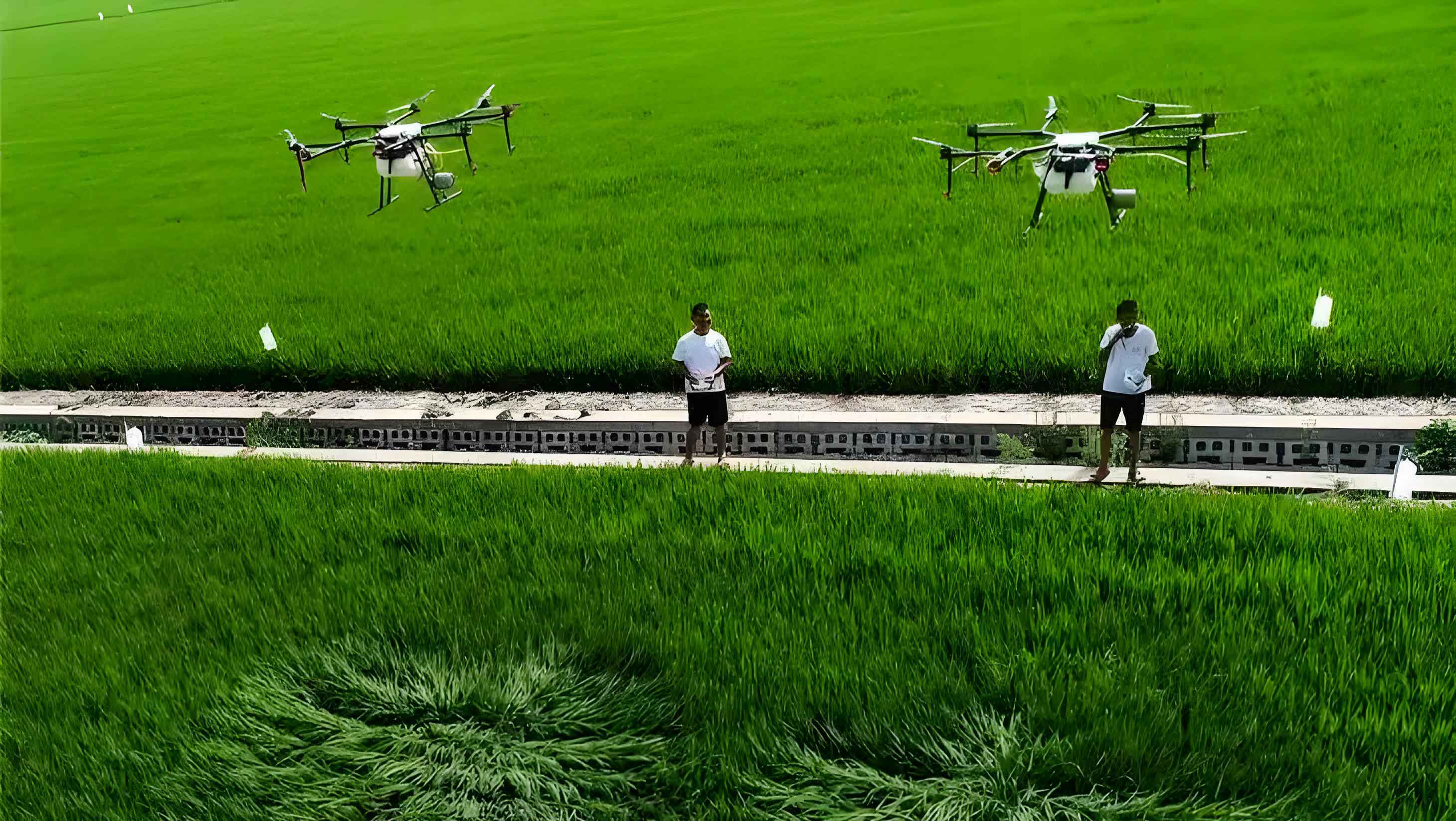
The rice leaf roller is a pervasive threat in many rice-growing regions, with larvae causing direct damage by constructing leaf rolls that impair plant growth. Chemical control remains the primary method, but its effectiveness depends heavily on application techniques. Crop spraying drones, such as the model used in this study, enable uniform pesticide deposition and reduce human exposure to chemicals. However, the interplay between spraying volume and height can influence droplet distribution, coverage, and ultimately, pest control outcomes. Previous research has highlighted that higher spraying volumes improve droplet density and deposition, but this must be balanced against operational costs. Similarly, application height affects the downward airflow generated by the spraying UAV, which can enhance penetration into the crop canopy. This paper systematically evaluates these factors through a dual-factor experimental design, employing statistical analyses to derive actionable insights for farmers and agronomists.
Our methodology involved a randomized block design with multiple replications to ensure robustness. The experiments were conducted in a controlled field environment, focusing on the rice jointing stage—a critical period for pest intervention. We utilized a commercial crop spraying drone equipped with standard nozzles, maintaining a constant flight speed and spray swath across all treatments. The spraying volume was varied at three levels: 30.0 L/ha, 45.0 L/ha, and 67.5 L/ha, while the application height was set at two levels: 3 meters and 4 meters. These combinations resulted in six treatment groups, plus an untreated control. Each plot was managed uniformly to isolate the effects of the tested parameters. Data on leaf protection efficacy and pest population control were collected at 7 and 15 days post-application, using standardized sampling techniques to minimize bias.
The calculation of efficacy metrics followed established formulas. The leaf rolling rate was determined as: $$ \text{Leaf Rolling Rate (\%)} = \frac{\text{Number of Rolled Leaves}}{\text{Total Leaves Surveyed}} \times 100 $$ Leaf protection efficacy was then computed using: $$ \text{Leaf Protection Efficacy (\%)} = \frac{\text{Control Leaf Rolling Rate} – \text{Treatment Leaf Rolling Rate}}{\text{Control Leaf Rolling Rate}} \times 100 $$ Similarly, pest control efficacy was derived from: $$ \text{Pest Control Efficacy (\%)} = \frac{\text{Control Pest Count} – \text{Treatment Pest Count}}{\text{Control Pest Count}} \times 100 $$ These equations allowed for a quantitative assessment of how the crop spraying drone parameters influenced outcomes. Statistical analyses, including ANOVA, were performed to identify significant effects and interactions, with a focus on F-values and P-values to determine the relative importance of each factor.
| Treatment | Spraying Volume (L/ha) | Application Height (m) | Pesticide Dosage (mL/ha) |
|---|---|---|---|
| A1-B1 | 30.0 | 3 | 600 |
| A1-B2 | 30.0 | 4 | 600 |
| A2-B1 | 45.0 | 3 | 600 |
| A2-B2 | 45.0 | 4 | 600 |
| A3-B1 | 67.5 | 3 | 600 |
| A3-B2 | 67.5 | 4 | 600 |
| Control | N/A | N/A | 0 |
Results from the field trials demonstrated that the combination of higher spraying volume and lower application height yielded the best control efficacy. For instance, the A3-B1 treatment (67.5 L/ha at 3 m height) achieved leaf protection efficacies of 93.77% and 92.58% at 7 and 15 days, respectively, and pest control efficacies of 94.76% and 94.10%. These values were significantly higher than those in treatments with lower spraying volumes, underscoring the critical role of droplet deposition. The spraying UAV’s ability to deliver adequate pesticide coverage was evident in these outcomes, as increased volume likely enhanced the penetration and retention of droplets on the rice canopy. In contrast, variations in application height had a minimal impact, suggesting that the downward airflow from the crop spraying drone was sufficient to ensure deposition even at 4 meters, though slightly better results were observed at 3 meters.
| Treatment | Days After Application | Leaf Rolling Rate (%) | Leaf Protection Efficacy (%) | Pest Count (×10^4/ha) | Pest Control Efficacy (%) |
|---|---|---|---|---|---|
| A1-B1 | 7 | 0.14 | 79.73 | 4.57 | 81.12 |
| 15 | 0.48 | 70.08 | 10.60 | 69.70 | |
| A1-B2 | 7 | 0.25 | 63.91 | 8.30 | 65.73 |
| 15 | 0.60 | 62.35 | 13.21 | 62.25 | |
| A2-B1 | 7 | 0.10 | 85.41 | 3.52 | 85.48 |
| 15 | 0.26 | 83.40 | 5.20 | 85.15 | |
| A2-B2 | 7 | 0.12 | 82.63 | 3.53 | 85.43 |
| 15 | 0.25 | 84.01 | 5.02 | 85.67 | |
| A3-B1 | 7 | 0.04 | 93.77 | 1.27 | 94.76 |
| 15 | 0.12 | 92.58 | 2.07 | 94.10 | |
| A3-B2 | 7 | 0.06 | 91.64 | 2.12 | 91.24 |
| 15 | 0.13 | 91.90 | 2.86 | 91.81 | |
| Control | 7 | 0.71 | N/A | 24.23 | N/A |
| 15 | 1.59 | N/A | 34.99 | N/A |
Statistical analysis through ANOVA revealed that spraying volume had a highly significant effect on both leaf protection and pest control efficacies (P < 0.01), whereas application height and its interaction with volume were not statistically significant (P > 0.05). The F-values for spraying volume consistently exceeded those for height, confirming its dominance in influencing outcomes. For example, in leaf protection efficacy at 7 days, the F-value for volume was 10.489 compared to 2.874 for height. This aligns with the principle that higher volumes from a spraying UAV increase the number of droplets per unit area, improving the probability of contact with the pest. The non-significance of height suggests that modern crop spraying drones can maintain effective deposition across a range of altitudes, though lower heights might slightly optimize airflow dynamics.
| Source | Days After Application | Sum of Squares | Degrees of Freedom | Mean Square | F-value | P-value |
|---|---|---|---|---|---|---|
| Spraying Volume | 7 | 1397.812 | 2 | 698.906 | 10.489 | 0.002 |
| 15 | 2112.154 | 2 | 1056.077 | 12.219 | 0.001 | |
| Application Height | 7 | 191.492 | 1 | 191.492 | 2.874 | 0.116 |
| 15 | 30.524 | 1 | 30.524 | 0.353 | 0.563 | |
| Interaction | 7 | 149.523 | 2 | 74.762 | 1.122 | 0.358 |
| 15 | 60.596 | 2 | 30.298 | 0.351 | 0.711 |
The implications of these findings are substantial for optimizing crop spraying drone operations. While the highest spraying volume (67.5 L/ha) delivered superior control, it may reduce operational efficiency due to increased refill frequency and time. Thus, a balanced approach is recommended: using 45.0 L/ha at 3 meters height for optimal efficiency with efficacies above 85%, or 67.5 L/ha at 3 meters for maximum control. This flexibility allows farmers to tailor spraying UAV applications based on pest pressure and resource availability. Moreover, the consistency of results across time intervals highlights the durability of treatments, which is crucial for managing pests like the rice leaf roller that have multiple generations per season.
In discussion, our results corroborate earlier studies on crop spraying drones, where increased spraying volume enhanced droplet deposition and pest mortality. For instance, research on similar spraying UAV models showed that higher volumes improve canopy penetration, which is critical for targeting leaf-rolling larvae. The minimal effect of application height observed here may be attributed to the advanced rotor design of modern crop spraying drones, which generates sufficient downwash to disperse droplets effectively even at higher altitudes. However, we caution that extreme heights could lead to drift, and future work should incorporate environmental factors like wind speed. Additionally, the use of adjuvants or modified nozzles could further optimize these parameters, offering avenues for innovation in spraying UAV technology.
From a practical perspective, the adoption of crop spraying drones in integrated pest management programs can significantly reduce pesticide use and environmental impact. By fine-tuning parameters such as spraying volume and height, farmers can achieve precise application, minimizing off-target effects and resistance development. Our study provides a framework for such optimizations, emphasizing the role of empirical data in decision-making. For example, the regression relationship between spraying volume and efficacy can be modeled as: $$ \text{Efficacy} = \alpha \cdot \ln(\text{Volume}) + \beta $$ where $\alpha$ and $\beta$ are constants derived from experimental data. This logarithmic fit reflects the diminishing returns at very high volumes, guiding economic assessments.
| Source | Days After Application | Sum of Squares | Degrees of Freedom | Mean Square | F-value | P-value |
|---|---|---|---|---|---|---|
| Spraying Volume | 7 | 1251.293 | 2 | 625.646 | 11.467 | 0.002 |
| 15 | 2325.054 | 2 | 1162.527 | 18.148 | 0.002 | |
| Application Height | 7 | 156.586 | 1 | 156.586 | 2.870 | 0.116 |
| 15 | 42.412 | 1 | 42.412 | 0.662 | 0.432 | |
| Interaction | 7 | 161.488 | 2 | 80.744 | 1.480 | 0.266 |
| 15 | 49.073 | 2 | 24.536 | 0.383 | 0.690 |
In conclusion, this study underscores the importance of spraying volume as a key determinant in the efficacy of crop spraying drones against the rice leaf roller. While application height had negligible effects, the synergy between volume and drone technology enables sustainable pest control. We recommend further investigations into variable-rate applications and real-time monitoring to enhance the precision of spraying UAVs. As agriculture moves towards digitalization, the integration of data-driven参数优化 will be pivotal in maximizing the benefits of crop spraying drones for global food security.