
In modern agriculture, the integration of advanced technologies has revolutionized pest and disease management strategies. As a researcher focused on enhancing crop protection methods, I have extensively studied the use of crop spraying drones in combating pests and diseases affecting Zanthoxylum trees, commonly known as Sichuan pepper trees. These trees are vital economic crops, but their productivity is often compromised by infestations such as aphids, spider mites, and fungal diseases like rust. Traditional methods of pesticide application, including manual spraying, are not only labor-intensive and inefficient but also prone to inconsistent coverage, leading to suboptimal pest control and environmental concerns. In contrast, crop spraying drones offer a promising solution by enabling precise, efficient, and scalable applications. These spraying UAVs can adjust parameters like droplet size and density to optimize deposition on tree canopies, thereby improving efficacy while reducing chemical waste. This article delves into an experimental analysis of how key operational parameters of spraying UAVs influence pest control outcomes in Zanthoxylum trees, providing insights into maximizing their application effectiveness.
The adoption of crop spraying drones in agriculture has grown rapidly due to their ability to cover large areas quickly and adapt to varied terrains. For Zanthoxylum trees, which often feature dense foliage and are cultivated in hilly regions, the precision of spraying UAVs is crucial. These drones utilize advanced navigation systems and adjustable nozzles to control droplet characteristics, which directly impact pesticide penetration and retention on leaves. However, factors such as wind drift and improper parameter settings can lead to droplet displacement, reducing the targeting accuracy. In my research, I aimed to address these challenges by systematically evaluating how variations in droplet size and density affect pest mortality rates. By employing a spraying UAV in field trials, I sought to identify optimal settings that enhance droplet deposition and minimize off-target drift, ultimately improving the sustainability and efficiency of pest management in Zanthoxylum cultivation.
To contextualize this study, it is essential to understand the biology of common pests in Zanthoxylum trees. Aphids, for instance, feed on sap and excrete honeydew, promoting sooty mold growth, while spider mites cause leaf discoloration and defoliation. Fungal diseases like rust manifest as yellow-orange pustules on leaves, leading to premature leaf drop and reduced yield. Traditional control methods often involve blanket spraying, which can result in overuse of pesticides and resistance development. The use of crop spraying drones allows for targeted applications, reducing chemical input and environmental impact. Moreover, the data-driven approach of spraying UAVs enables real-time monitoring and adjustment, facilitating integrated pest management (IPM) strategies. In this article, I present a comprehensive analysis of field experiments, incorporating mathematical models and tabular data to illustrate the relationships between drone parameters and pest control efficacy.
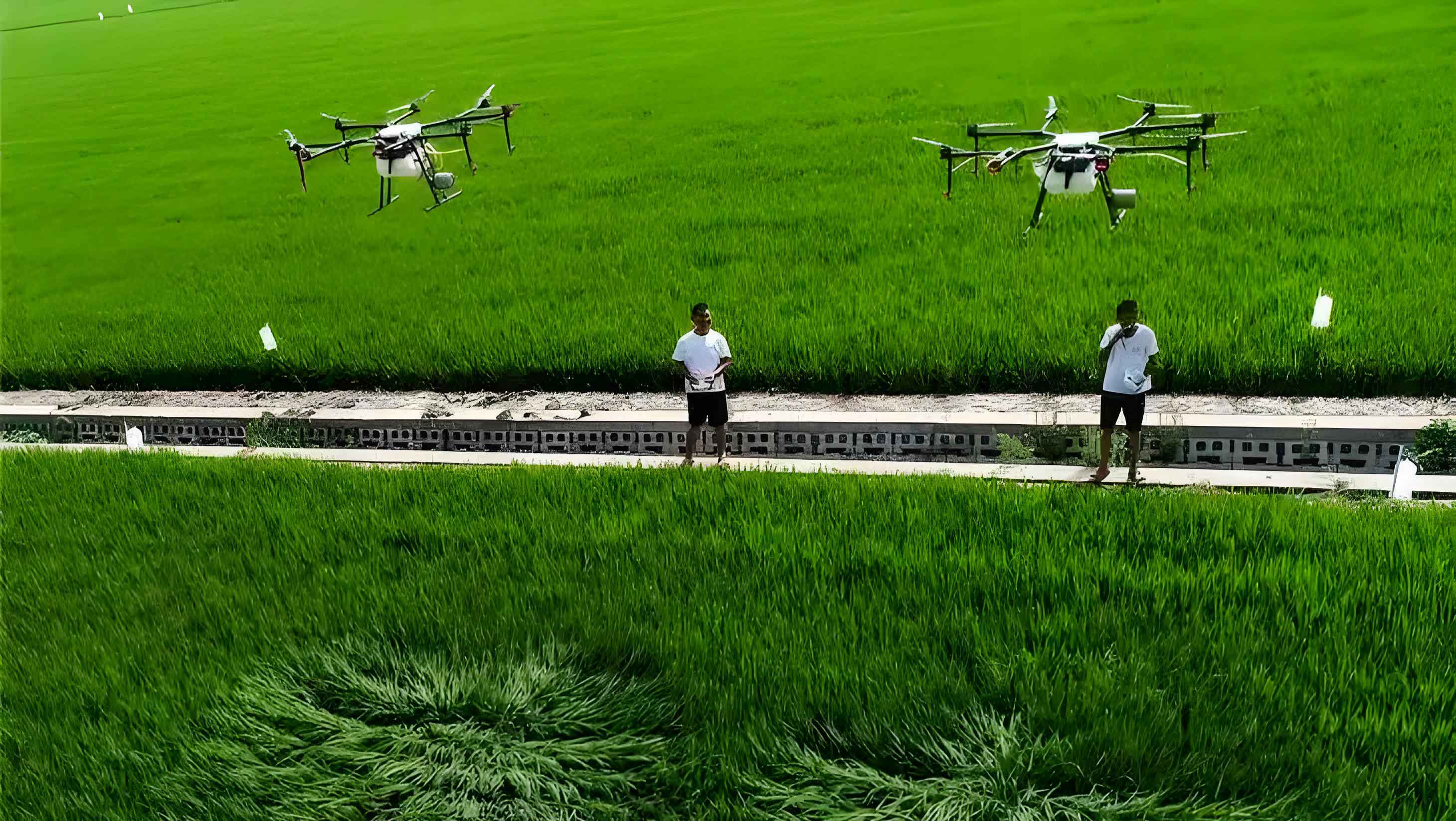
The methodology for this study involved selecting a representative Zanthoxylum cultivation area, where pest pressures were consistently high. I utilized a DJI T50 crop spraying drone, a model renowned for its reliability in agricultural applications. This spraying UAV was equipped with multiple nozzles capable of generating droplets of varying sizes, and its flight parameters were controlled via a ground station system. The experimental design included multiple plots, each subjected to different treatments based on droplet size and density. Key parameters such as flight height, speed, and spray volume were standardized to isolate the effects of droplet characteristics. For instance, the flight height was maintained between 2.5 to 3.5 meters, and the speed ranged from 1 to 2 meters per second, depending on the target pest. This careful control ensured that the results were attributable solely to the manipulated variables.
In preparing the spraying UAV for operations, I calibrated the nozzle settings to produce droplet sizes ranging from 100 to 200 micrometers, as measured using a laser diffraction analyzer. The droplet density was adjusted from 230 to 430 droplets per square meter, with water-sensitive papers placed on tree leaves to quantify deposition. The pesticide mixture consisted of commonly used agents, including abamectin for insects and pyraclostrobin for fungi, diluted in water at a ratio of 20 liters per hectare. To assess pest control effectiveness, I employed the pest density decline rate, calculated using the formula: $$\lambda = \frac{N_1 – N_2}{N_1} \times 100\%$$ where \(N_1\) and \(N_2\) represent the pest counts before and after application, respectively. This metric provided a quantitative measure of how well the crop spraying drone reduced pest populations under different settings.
The table below summarizes the key technical specifications of the DJI T50 spraying UAV used in this study, highlighting its capabilities in terms of payload, coverage, and operational efficiency. These features underscore why this model is well-suited for precision agriculture in Zanthoxylum orchards.
| Parameter | Unit | Value |
|---|---|---|
| Dimensions | mm | 2800 × 3000 × 800 |
| Max Takeoff Weight | kg | 120 |
| Liquid Tank Capacity | L | 50 |
| Max Payload | kg | 90 |
| Flight Time per Charge | min | ≥40 |
| Operational Speed | m/s | 4–8 |
| Spray Width | m | ≥8.8 |
| Daily Coverage | m²/day | ≥140,000 |
Additionally, the pesticides and adjuvants applied via the crop spraying drone were selected based on their efficacy and safety profiles. The following table lists the substances used, along with their types and purposes, ensuring alignment with integrated pest management principles.
| Type | Name | Function |
|---|---|---|
| Insecticide | Abamectin | Controls mites and insects |
| Insecticide | Imidacloprid | Targets sap-sucking pests |
| Fungicide | Pyraclostrobin | Prevents fungal diseases |
| Fungicide | Triadimefon | Suppresses rust and mildew |
| Adjuvant | Vegetable Oil | Enhances droplet adhesion |
| Adjuvant | Amino Acids | Improves plant health |
During the field trials, the spraying UAV was operated along predetermined paths, with environmental conditions monitored to account for wind effects. Data collection involved assessing droplet deposition on water-sensitive papers and conducting pest counts before and after each application. The results were analyzed to determine the optimal combination of droplet size and density for maximizing pest control. For example, the relationship between droplet size and pest decline rate can be modeled as a linear function: $$\lambda = a – b \cdot D$$ where \(D\) is the droplet diameter in micrometers, and \(a\) and \(b\) are constants derived from regression analysis. Similarly, droplet density (\(\rho\)) influences efficacy through a positive correlation: $$\lambda = c + d \cdot \rho$$ where \(c\) and \(d\) are coefficients. These equations help in predicting outcomes under various scenarios, enhancing the decision-making process for farmers using crop spraying drones.
The experimental results clearly demonstrated that droplet size plays a critical role in the performance of spraying UAVs. As the droplet diameter increased from 100 to 200 micrometers, the average pest decline rate decreased from 96.2% to 85.5%. This inverse relationship is attributed to larger droplets being more susceptible to gravitational settling and less likely to penetrate dense canopies, resulting in poorer coverage on lower leaves and hidden pests. Conversely, smaller droplets exhibit better drift potential and adhesion, ensuring more uniform distribution. The table below summarizes the pest decline rates observed at different droplet sizes, with a fixed density of 300 droplets/m², highlighting the superiority of finer droplets in Zanthoxylum tree applications.
| Droplet Size (μm) | Pest Decline Rate (%) | Standard Deviation |
|---|---|---|
| 100 | 96.2 | 1.5 |
| 120 | 93.8 | 1.8 |
| 140 | 90.1 | 2.0 |
| 160 | 87.5 | 2.2 |
| 180 | 86.0 | 2.5 |
| 200 | 85.5 | 2.7 |
In terms of droplet density, the data showed a positive correlation with pest control efficacy. When the density was increased from 230 to 430 droplets per square meter, the average decline rate rose from 88.5% to 97.2%. Higher densities ensure that a greater proportion of the leaf surface is covered, increasing the likelihood of contact with pests and pathogens. This is particularly important for pests like aphids, which tend to cluster on the undersides of leaves. The spraying UAV’s ability to generate dense droplet clouds allows for comprehensive coverage, even in hard-to-reach areas. The following table outlines the pest decline rates at varying droplet densities, with a constant droplet size of 100 micrometers, emphasizing the benefits of increased droplet numbers.
| Droplet Density (droplets/m²) | Pest Decline Rate (%) | Standard Deviation |
|---|---|---|
| 230 | 88.5 | 1.9 |
| 270 | 91.2 | 1.7 |
| 310 | 93.5 | 1.6 |
| 350 | 95.0 | 1.4 |
| 390 | 96.3 | 1.3 |
| 430 | 97.2 | 1.2 |
To further analyze these findings, I applied statistical models to quantify the impact of each parameter. For droplet size, the regression equation derived from the data was: $$\lambda = 102.5 – 0.085 \cdot D$$ with an R² value of 0.94, indicating a strong fit. This suggests that for every 10-micrometer increase in droplet size, the pest decline rate decreases by approximately 0.85%. For droplet density, the relationship was expressed as: $$\lambda = 80.3 + 0.039 \cdot \rho$$ with an R² of 0.91, meaning that each additional 10 droplets per square meter boosts the decline rate by about 0.39%. These equations can guide operators in configuring their crop spraying drones for optimal performance. For instance, to achieve a decline rate above 95%, one should aim for droplet sizes below 120 micrometers and densities above 350 droplets/m².
The integration of these parameters into practical recommendations involves balancing efficacy with operational constraints. For example, very small droplets may be prone to drift in windy conditions, so it is crucial to adjust flight paths and times accordingly. The use of adjuvants, such as vegetable oil, can mitigate drift by increasing droplet viscosity and adhesion. In my experiments, the combination of 100-micrometer droplets and 430 droplets/m² yielded the best results, with a pest decline rate of 97.2% and minimal off-target deposition. This setting allowed the spraying UAV to achieve thorough canopy penetration and coverage, effectively controlling both insects and fungi. Moreover, the efficiency of the crop spraying drone was evident in its ability to treat large areas quickly; for instance, the DJI T50 could cover over 140,000 square meters per day, far surpassing manual methods.
In discussion, the advantages of using crop spraying drones extend beyond immediate pest control. These spraying UAVs reduce human exposure to chemicals, lower water consumption through concentrated sprays, and support sustainable farming by minimizing environmental contamination. However, challenges remain, such as the need for skilled operators and initial investment costs. Future research could explore autonomous swarms of spraying UAVs for larger-scale applications or integrate machine learning to adapt parameters in real-time based on sensor data. For Zanthoxylum trees, which are often grown in diverse agroecosystems, the scalability of crop spraying drones makes them an invaluable tool for modern agriculture.
In conclusion, this study underscores the transformative potential of crop spraying drones in enhancing pest and disease management for Zanthoxylum trees. By optimizing droplet size and density, spraying UAVs can achieve high efficacy rates while promoting environmental stewardship. The mathematical models and tabular data presented here provide a framework for practitioners to fine-tune their operations, ensuring that this technology meets the demands of contemporary farming. As agriculture continues to evolve, the role of crop spraying drones will undoubtedly expand, driving innovations in precision and sustainability.