
In modern agriculture, the integration of advanced technologies has revolutionized crop protection practices. As a researcher in this field, I have observed that traditional ground-based spraying methods often face limitations due to terrain constraints and inefficiencies. The advent of crop spraying drones, or spraying UAVs, has addressed these issues by offering high operational efficiency, adaptability to diverse landscapes, and minimal crop damage. However, conventional drone spraying still suffers from significant droplet drift, leading to uneven deposition, reduced pesticide utilization, and environmental concerns. Electrostatic spraying technology, when combined with spraying UAVs, enhances droplet adhesion and deposition on crop surfaces, including hard-to-reach areas like leaf undersides, thereby improving pesticide efficiency. This article systematically reviews the principles, system components, challenges, and future directions of electrostatic spraying for crop spraying drones, incorporating tables and formulas to summarize key aspects.
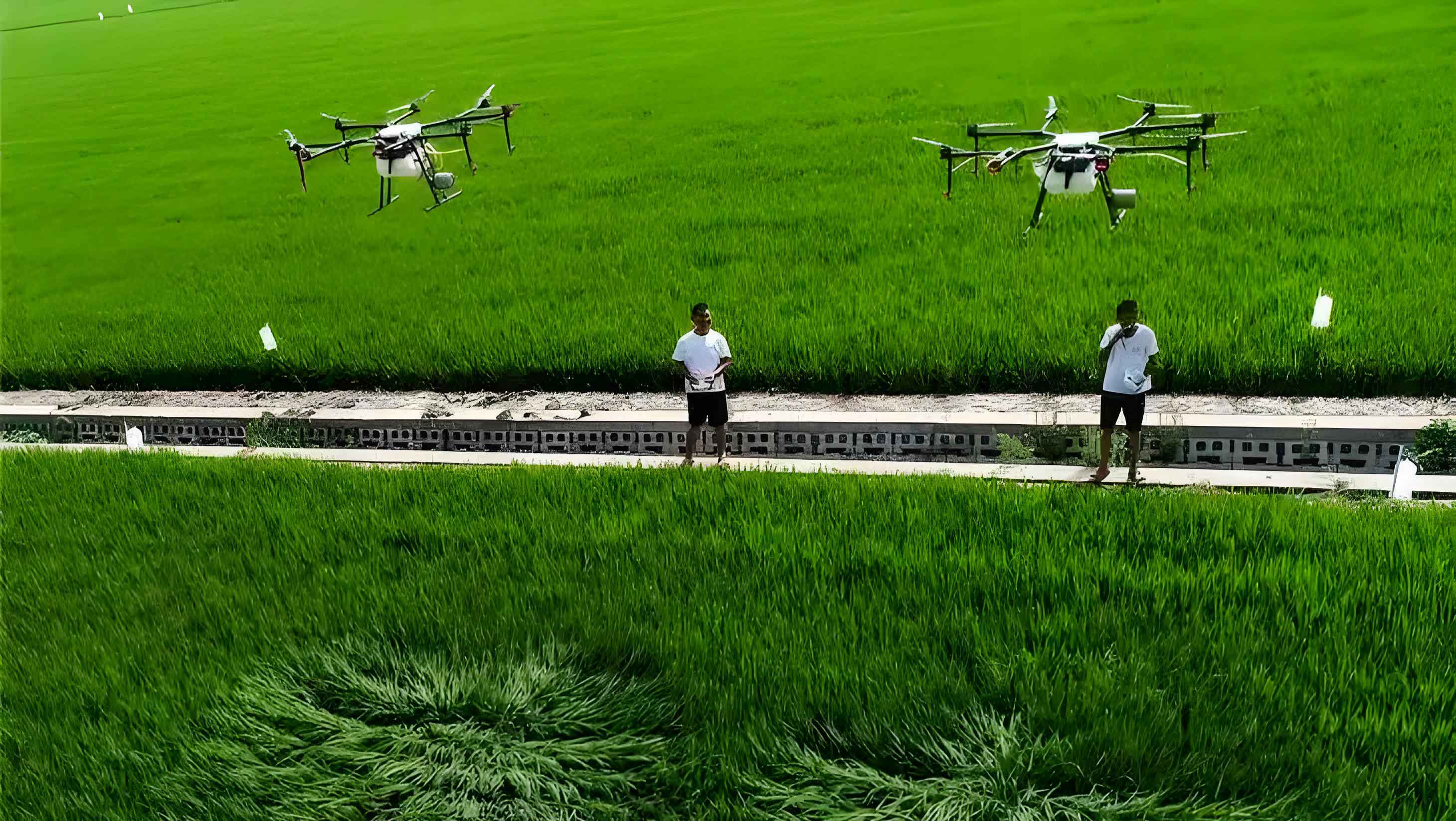
The fundamental principle of electrostatic spraying involves charging liquid droplets using a high-voltage electrostatic field, which directs them toward target crops through electrostatic forces. The charge-to-mass ratio (q/m) is a critical parameter, defined as the amount of charge carried per unit mass of the droplet. It can be expressed as: $$ \frac{q}{m} = f(V, A, L) $$ where \( V \) is the electrostatic voltage, \( A \) represents the atomization method, and \( L \) denotes the liquid properties. Optimizing this ratio is essential for effective spraying. The process includes droplet charging, electric field-driven motion, and electrostatic adsorption. Charging methods include induction, corona, and contact charging, with induction being widely used for its safety and versatility. The electric field guides droplets via Coulomb forces, maintaining directionality even in windy conditions. Adsorption occurs when charged droplets induce opposite charges on crop surfaces, enhancing adhesion. For instance, the force of adsorption \( F_a \) can be modeled as: $$ F_a = k \frac{q^2}{r^2} $$ where \( k \) is a constant, \( q \) is the charge, and \( r \) is the distance to the surface.
The system components of a spraying UAV for electrostatic spraying are multifaceted, as summarized in Table 1. Each part plays a vital role in ensuring efficient and precise application.
| Component | Description | Key Features |
|---|---|---|
| UAV Platform | Carrier for the spraying system, typically multi-rotor for stability and maneuverability. | High payload capacity, long endurance, adjustable flight parameters (e.g., height, speed). |
| Electrostatic Generation Device | Generates high voltage for charging droplets, includes DC-DC converters and electrodes. | Lightweight, efficient power conversion, optimized electrode design (e.g., ring or needle electrodes). |
| Atomization Device | Breaks liquid into charged droplets; types include centrifugal, pressure, and pneumatic atomizers. | Centrifugal atomizers are common for uniform droplets; integrated charging mechanisms. |
| Control System | Coordinates operations using flight control, spray control, and monitoring units. | Real-time parameter adjustment, GPS and IMU for precision, smart decision-making for variable rate application. |
| Liquid Supply System | Stores and delivers pesticide liquid, includes tanks, pumps, pipes, and filters. | Corrosion-resistant materials, balanced design to minimize UAV instability, ensures continuous flow. |
In the UAV platform, factors like flight height and speed significantly influence spray coverage. For example, the deposition efficiency \( \eta_d \) can be approximated as: $$ \eta_d = \frac{C_d}{C_a} $$ where \( C_d \) is the deposited concentration and \( C_a \) is the applied concentration. The electrostatic generation device must maintain a stable voltage, often ranging from 5 kV to 20 kV, to achieve optimal charging. The atomization device’s performance depends on the atomizer type; centrifugal atomizers, for instance, produce droplets with sizes following a Rosin-Rammler distribution: $$ P(d) = 1 – \exp\left[-\left(\frac{d}{d_{63.2}}\right)^n\right] $$ where \( P(d) \) is the fraction of droplets smaller than diameter \( d \), \( d_{63.2} \) is the characteristic size, and \( n \) is the spread parameter. The control system integrates sensors to monitor parameters like voltage and flow rate, enabling adaptive spraying based on environmental conditions.
Despite the advantages, electrostatic spraying for spraying UAVs faces several technical bottlenecks, as outlined in Table 2. These challenges hinder widespread adoption and require focused research.
| Bottleneck | Description | Impact |
|---|---|---|
| Droplet Charging Instability | Charge leakage or neutralization in high-humidity or high-conductivity conditions reduces droplet charge. | Diminished electrostatic effects, lower deposition efficiency, and increased drift. |
| Liquid Property Effects | Conductivity, surface tension, and viscosity affect atomization and charging; lack of standardized formulations. | Poor droplet formation, uneven coverage, and reduced adhesion on target surfaces. |
| Platform Energy and Load Issues | Additional weight from electrostatic components reduces UAV endurance and increases energy consumption. | Frequent battery or tank replacements, lower operational efficiency for large areas. |
| Insufficient Target Characteristic Studies | Variations in crop surface properties (e.g., roughness, conductivity) across species and growth stages are poorly understood. | Inconsistent droplet deposition, especially on complex surfaces like leaf backs, limiting adaptability. |
For instance, the charge decay rate \( \lambda \) in droplets can be modeled as: $$ \lambda = \alpha \sigma $$ where \( \alpha \) is a constant and \( \sigma \) is the liquid conductivity. High conductivity accelerates charge loss, undermining the benefits of electrostatic spraying. Similarly, the energy consumption \( E \) of a spraying UAV can be expressed as: $$ E = P_t t + P_s $$ where \( P_t \) is the thrust power, \( t \) is time, and \( P_s \) is the spray system power. The added load from electrostatic devices increases \( P_s \), necessitating lightweight designs.
To address these bottlenecks, future research directions should focus on innovations in charging efficiency, system design, and liquid formulations. Table 3 summarizes potential development areas for crop spraying drones.
| Direction | Approaches | Expected Outcomes |
|---|---|---|
| Charging Efficiency and Stability | Develop multi-needle array electrodes, nano-coated electrodes, and pulse or AC voltage techniques. | Higher and more uniform charge-to-mass ratios, reduced energy use, longer system lifespan. |
| Liquid Adaptation and Formula Optimization | Study relationships between liquid properties and charging; create low-surface-tension, moderate-conductivity formulations. | Improved droplet charging and deposition, customized solutions for different pesticides. |
| System Lightweighting and Energy Saving | Use composite materials, integrate efficient power modules, and explore solar-assisted power systems. | Enhanced UAV endurance, reduced operational costs, broader application in large-scale farming. |
| Target Characteristic and Deposition Mechanism Research | Build databases of crop surface properties; employ high-speed imaging and electric field simulations. | Better understanding of deposition dynamics, optimized spraying parameters for various crops. |
In charging efficiency, novel electrode designs could improve the charge distribution. For example, the electric field strength \( E \) around an electrode can be calculated as: $$ E = \frac{V}{d} $$ where \( V \) is voltage and \( d \) is distance. Optimizing this for multiple electrodes can enhance uniformity. For liquid adaptation, the relationship between surface tension \( \gamma \) and droplet size \( d \) can be described by: $$ d \propto \gamma^{0.5} $$ Lowering \( \gamma \) through additives reduces droplet size, improving coverage. In system lightweighting, the mass reduction \( \Delta m \) can be estimated as: $$ \Delta m = \rho \Delta V $$ where \( \rho \) is density and \( \Delta V \) is volume change, highlighting the benefits of lightweight materials. For target characteristics, studies could model deposition on rough surfaces using fractal dimensions, aiding in precision agriculture.
In conclusion, the integration of electrostatic spraying with crop spraying drones represents a significant advancement in agricultural technology, offering superior droplet deposition and reduced pesticide usage. However, challenges such as charging stability, energy constraints, and target adaptability remain. Future efforts should prioritize enhancing charging mechanisms, optimizing liquid formulations, and reducing system weight to achieve more precise and efficient spraying UAV operations. By addressing these areas, we can propel this technology toward broader adoption, contributing to sustainable farming practices and environmental protection. The continuous evolution of spraying UAVs will undoubtedly play a pivotal role in the future of crop protection, making electrostatic spraying an indispensable tool for modern agriculture.