
In recent years, the increasing challenges of weed infestations in wheat fields have prompted the exploration of innovative agricultural technologies. As a researcher focused on precision agriculture, I have investigated the use of crop spraying drones for pre-emergence herbicide applications to control grass weeds, particularly in winter wheat cultivation. The adoption of spraying UAVs has revolutionized farming practices by enhancing efficiency and reducing labor demands. This study evaluates the efficacy of various herbicide combinations applied via crop spraying drones for weed suppression, with an emphasis on reducing weed density and improving crop yields. The integration of drone technology in agriculture, especially for tasks like herbicide application, represents a significant advancement in sustainable farming. By leveraging the capabilities of spraying UAVs, farmers can achieve more uniform coverage and timely interventions, which are critical for successful weed management.
The problem of weed resistance and the limitations of post-emergence treatments have led to a growing interest in pre-emergence or “closed” herbicide applications. In this context, I designed a field experiment to assess the performance of different herbicide mixtures applied using a crop spraying drone. The primary objective was to determine the effectiveness of these treatments in reducing the population of grass weeds, such as Japanese foxtail, which are prevalent in wheat fields. The use of a spraying UAV allows for precise application, even in large-scale farming operations, where manual methods are often impractical. This approach not only addresses weed control but also aligns with the broader goals of reducing chemical usage and minimizing environmental impact. Through this research, I aim to provide actionable insights for farmers and agronomists on integrating drone-based herbicide applications into their weed management strategies.
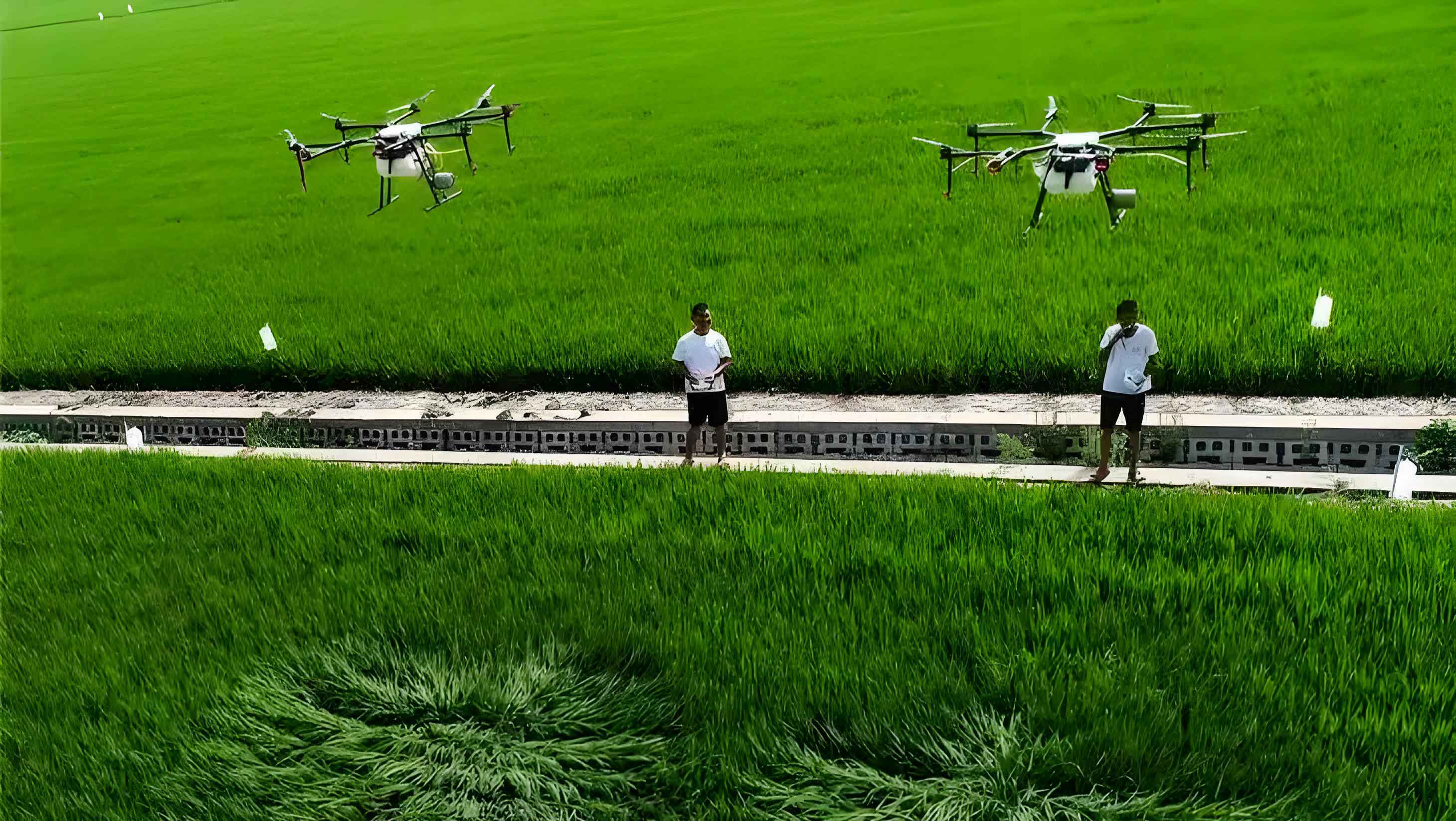
The experimental setup involved a randomized block design in a wheat field with a history of high weed pressure. I selected four distinct treatments, including a control, to compare the effects of herbicide combinations on weed density. The crop spraying drone used in this study was a DJI T30 model, which is widely recognized for its reliability in agricultural applications. Key parameters for the spraying UAV operation included a flight speed of 2.50 m/s, a swath width of 3.50 m, and an altitude of 1.50 m. These settings were optimized to ensure even distribution of herbicides, with a water volume of 5 L per 667 m². The application was conducted immediately after seedbed preparation, taking advantage of favorable weather conditions to maximize herbicide efficacy. This method highlights the potential of crop spraying drones to perform closed treatments efficiently, even in challenging field environments.
To quantify the impact of the treatments, I collected data on weed counts at multiple time points after application. The formula for calculating the weed control efficacy, denoted as η, is given by:
$$ \eta = \frac{X_{CK} – X_i}{X_{CK}} \times 100\% $$
where \( X_{CK} \) represents the weed count in the control plot, and \( X_i \) is the weed count in the treated plot. This metric allows for a straightforward comparison of the effectiveness of each herbicide combination. The use of a crop spraying drone ensured consistent application across all plots, reducing variability and enhancing the reliability of the results. The data were analyzed to assess both grass and broadleaf weed suppression, providing a comprehensive view of the treatment effects. The integration of spraying UAV technology in this experiment underscores its value in precision agriculture, where accurate data collection is essential for informed decision-making.
| Treatment | Herbicide Combination | Dosage per 667 m² | Application Method |
|---|---|---|---|
| Treatment 1 | Dicloxazone + Isoproturon | 30 mL + 120 mL | Spraying UAV |
| Treatment 2 | Dicloxazone + Fluthiacet | 30 mL + 20 mL | Spraying UAV |
| Treatment 3 | Propachlor + Fluthiacet | 100 mL + 20 mL | Spraying UAV |
| Treatment 4 (Control) | No herbicide | N/A | N/A |
The results from the weed surveys conducted at 62 and 90 days after application revealed significant differences among the treatments. Treatment 1, which combined dicloxazone and isoproturon, showed the highest efficacy in reducing grass weed density. The use of a crop spraying drone for this treatment ensured that the herbicides were distributed evenly, leading to consistent weed suppression across the plot. Similarly, Treatment 3, involving propachlor and fluthiacet, also demonstrated substantial control, though slightly lower than Treatment 1. The data underscore the importance of herbicide selection and application timing when using spraying UAVs for closed treatments. The ability of crop spraying drones to cover large areas quickly makes them ideal for such applications, particularly in regions where labor shortages are a concern.
Further analysis involved calculating the mean weed control efficacy for each treatment over time. The formula for the average efficacy, \( \bar{\eta} \), across multiple survey points is:
$$ \bar{\eta} = \frac{1}{n} \sum_{j=1}^{n} \eta_j $$
where \( n \) is the number of survey points, and \( \eta_j \) is the efficacy at each point. This approach helps in understanding the overall performance of the treatments and the role of the spraying UAV in achieving uniform results. For instance, Treatment 1 maintained an efficacy above 70% throughout the study, highlighting its reliability. The use of a crop spraying drone not only improved the accuracy of the application but also reduced the risk of human error, which is common in traditional methods. These findings emphasize the potential of spraying UAVs to enhance weed management practices in wheat cultivation, particularly for pre-emergence treatments.
| Treatment | Survey Point | Grass Weed Count (62 days) | Efficacy (%) | Grass Weed Count (90 days) | Efficacy (%) |
|---|---|---|---|---|---|
| Treatment 1 | Point 1 | 339 | 62.21 | 867 | 78.88 |
| Point 2 | 153 | 83.55 | 782 | 81.75 | |
| Point 3 | 120 | 80.58 | 906 | 79.41 | |
| Overall | — | 612 | 74.97 | 2555 | 80.03 |
| Treatment 2 | Point 1 | 567 | 36.79 | 3317 | 19.22 |
| Point 2 | 501 | 46.13 | 2976 | 30.55 | |
| Point 3 | 451 | 27.02 | 3402 | 22.70 | |
| Overall | — | 1519 | 37.87 | 9695 | 24.21 |
| Treatment 3 | Point 1 | 360 | 59.87 | 1302 | 68.29 |
| Point 2 | 207 | 77.74 | 1278 | 70.18 | |
| Point 3 | 231 | 62.62 | 1389 | 68.44 | |
| Overall | — | 798 | 67.36 | 3969 | 68.97 |
| Treatment 4 (Control) | Point 1 | 897 | — | 4106 | — |
| Point 2 | 930 | — | 4285 | — | |
| Point 3 | 618 | — | 4401 | — | |
| Overall | — | 2445 | — | 12792 | — |
In addition to grass weeds, I evaluated the impact on broadleaf weeds, as their control is equally important for overall crop health. The efficacy for broadleaf weeds was calculated using the same formula, and the results indicated that Treatment 1 also performed well in this regard. The use of a crop spraying drone allowed for targeted application, which is crucial for managing diverse weed species. The data suggest that the combination of dicloxazone and isoproturon, when applied via a spraying UAV, provides broad-spectrum control. This is particularly beneficial in integrated weed management systems, where multiple weed types are present. The versatility of crop spraying drones in handling different herbicide formulations further enhances their utility in modern agriculture.
The discussion of these findings centers on the advantages of using crop spraying drones for closed herbicide treatments. Unlike conventional methods, spraying UAVs offer precise control over application rates and coverage, which can lead to improved herbicide efficacy and reduced environmental impact. For example, the consistent performance of Treatment 1 can be attributed to the even distribution achieved by the drone, minimizing gaps where weeds could emerge. Moreover, the ability of spraying UAVs to operate in various field conditions, such as after rainfall or on uneven terrain, makes them a reliable tool for timely applications. This is critical for closed treatments, as delays can compromise effectiveness. The integration of drone technology also facilitates data collection, as seen in this study, where multiple survey points were easily monitored.
To further illustrate the statistical significance of the results, I considered the standard deviation of efficacy across survey points. The formula for the standard deviation, \( \sigma \), is:
$$ \sigma = \sqrt{\frac{1}{n} \sum_{j=1}^{n} (\eta_j – \bar{\eta})^2} $$
This metric helps assess the variability in weed control within each treatment. For instance, Treatment 1 showed lower variability compared to Treatment 2, indicating more consistent performance when applied with a crop spraying drone. This consistency is a key benefit of using spraying UAVs, as it reduces the likelihood of patchy weed control. The data reinforce the idea that drone-based applications can enhance the reliability of herbicide treatments, especially in large-scale farming operations. As weed resistance continues to evolve, the precision offered by crop spraying drones will become increasingly important for sustainable weed management.
Looking ahead, the potential for combining closed treatments with post-emergence applications using spraying UAVs warrants further investigation. In this study, the focus was solely on pre-emergence effects, but integrating both approaches could lead to more comprehensive weed control. For example, after a closed treatment with a crop spraying drone, follow-up applications could target escaped weeds, further reducing the weed seed bank. This strategy aligns with the principles of integrated pest management and leverages the strengths of spraying UAVs for multiple interventions. Additionally, future research could explore the economic benefits of drone-based herbicide applications, such as cost savings from reduced herbicide use and labor. The scalability of crop spraying drones makes them suitable for a wide range of farm sizes, from smallholders to large commercial enterprises.
In conclusion, this study demonstrates the effectiveness of using crop spraying drones for closed herbicide treatments in wheat fields. The results show that specific herbicide combinations, such as dicloxazone with isoproturon, can achieve high levels of weed control when applied via a spraying UAV. The precision and efficiency of drone technology not only improve herbicide performance but also contribute to more sustainable farming practices. As agriculture continues to embrace digital tools, the role of spraying UAVs in weed management is likely to expand, offering new opportunities for enhancing crop productivity. I recommend that farmers and agronomists consider integrating crop spraying drones into their weed control programs, particularly for pre-emergence applications in challenging environments. This approach represents a forward-thinking solution to the persistent problem of weed infestations in wheat cultivation.
The broader implications of this research extend beyond weed control to include environmental stewardship and resource optimization. By using crop spraying drones, farmers can minimize herbicide drift and runoff, reducing the impact on non-target organisms and water sources. The data-driven approach enabled by spraying UAVs also supports better decision-making, as real-time monitoring and adjustments are possible. For instance, if weed pressure varies across a field, the drone can be programmed to apply herbicides only where needed, conserving chemicals and reducing costs. This level of precision is unattainable with traditional methods, highlighting the transformative potential of drone technology in agriculture. As I continue to explore this field, I plan to investigate the long-term effects of drone-based herbicide applications on soil health and crop yields, further solidifying the case for widespread adoption.
Ultimately, the success of crop spraying drones in weed management depends on continued innovation and education. Training programs for farmers on the use of spraying UAVs will be essential to maximize their benefits. Additionally, collaborations between researchers, technology providers, and agricultural extensions can drive the development of optimized herbicide formulations and application protocols. The findings from this study contribute to this growing body of knowledge, providing a foundation for future advancements. As weed challenges evolve, so too must our approaches, and crop spraying drones offer a promising path forward. By embracing this technology, the agricultural sector can achieve more resilient and productive farming systems, ensuring food security for generations to come.