
The rapid advancement of drone technology has revolutionized agricultural crop protection by providing efficient and convenient solutions. Crop spraying drones, also known as spraying UAVs, have gained widespread adoption in plant protection due to their superior spraying effectiveness, high operational efficiency, advanced automation, compact size, lightweight design, and the ability to separate human operators from the application process. These spraying UAVs address the limitations of ground-based equipment by enabling uniform pesticide distribution, significantly improving pesticide utilization rates. In particular, low-altitude and low-volume spraying technology has achieved groundbreaking progress in recent years. Compared to manned aerial spraying methods like agricultural gliders or helicopters, crop spraying drones offer reduced operational costs, enhanced safety, increased productivity, and higher efficiency, making them more cost-effective and practical for diverse agricultural settings.
Low-altitude and low-volume spraying involves operations at heights typically ranging from 1 to 4 meters above crops, using highly concentrated spray liquids with low dilution ratios. By reducing droplet size, this technology improves penetration and coverage, minimizes drift in low-altitude conditions, and ensures even distribution of droplets across plant surfaces for optimal results. The droplet diameter, represented as the Volume Median Diameter (VMD), falls between 150 and 250 micrometers. When implemented using crop spraying drones, this approach is termed low-altitude and low-volume spraying technology for spraying UAVs. The workflow for this technology can be summarized in a table outlining key stages.
| Work Stage | Tasks |
|---|---|
| Pre-execution Preparation | System self-check, ground control station initiates one-click startup, automatic warm-up |
| Takeoff | Automatic takeoff after ground control station approval |
| Climb and Entry | Ascend to operational height, reach 20 m altitude, auto-cruise into the work area |
| Spraying Operation | Automatic activation of spraying system, route-based flight, real-time monitoring of spraying |
| Return for Refill | Automatic return and landing, manual refilling, route re-planning, automatic takeoff |
| Resume Spraying | Continuation from breakpoints, automatic spraying system re-engagement, repeat operations |
| Return and Landing | Automatic return, landing, and shutdown via ground control station |
| Recovery | Completion of automatic landing process |
The advantages of crop spraying drones in low-altitude and low-volume spraying are multifaceted. In terms of equipment technology, these spraying UAVs can take off and land from ordinary sites without needing dedicated airports or hangars. Their small size, light weight, tight turning radius, and ability to hover, reverse direction, and perform vertical maneuvers allow for ultra-low-altitude operations with high climb rates. This flexibility makes crop spraying drones ideal for complex terrains with significant elevation variations and scattered, small-scale fields, reducing labor intensity and safety risks. For spraying effectiveness, the slow flight speeds of spraying UAVs facilitate better droplet adhesion to crop surfaces, generating updrafts that direct pesticide droplets to the undersides of leaves. In hover mode, crop spraying drones can target individual plants, and their drift buffer zones are comparable to ground machinery but much smaller than fixed-wing aerial spraying, as detailed in the following table.
| Plant Protection Equipment | Drift Buffer Distance (m) |
|---|---|
| Ground-Based Machinery | 10–30 |
| Fixed-Wing Aerial Spraying | 500–3,000 |
| Crop Spraying Drones | 15–50 |
Cost and safety benefits are also prominent. Crop spraying drones eliminate the need for specialized infrastructure, lowering operational expenses. As unmanned systems, they remove the risks associated with human pilots during aerial missions, enhancing safety. Moreover, the high efficiency and superior coverage of spraying UAVs lead to savings in pesticide usage, water consumption, and labor costs. The economic impact can be modeled using a simple formula for cost efficiency: $$ CE = \frac{A}{C} $$ where \( CE \) represents cost efficiency, \( A \) is the area covered per unit time, and \( C \) is the total cost including pesticides, water, and labor. For crop spraying drones, this ratio is optimized due to reduced input requirements.
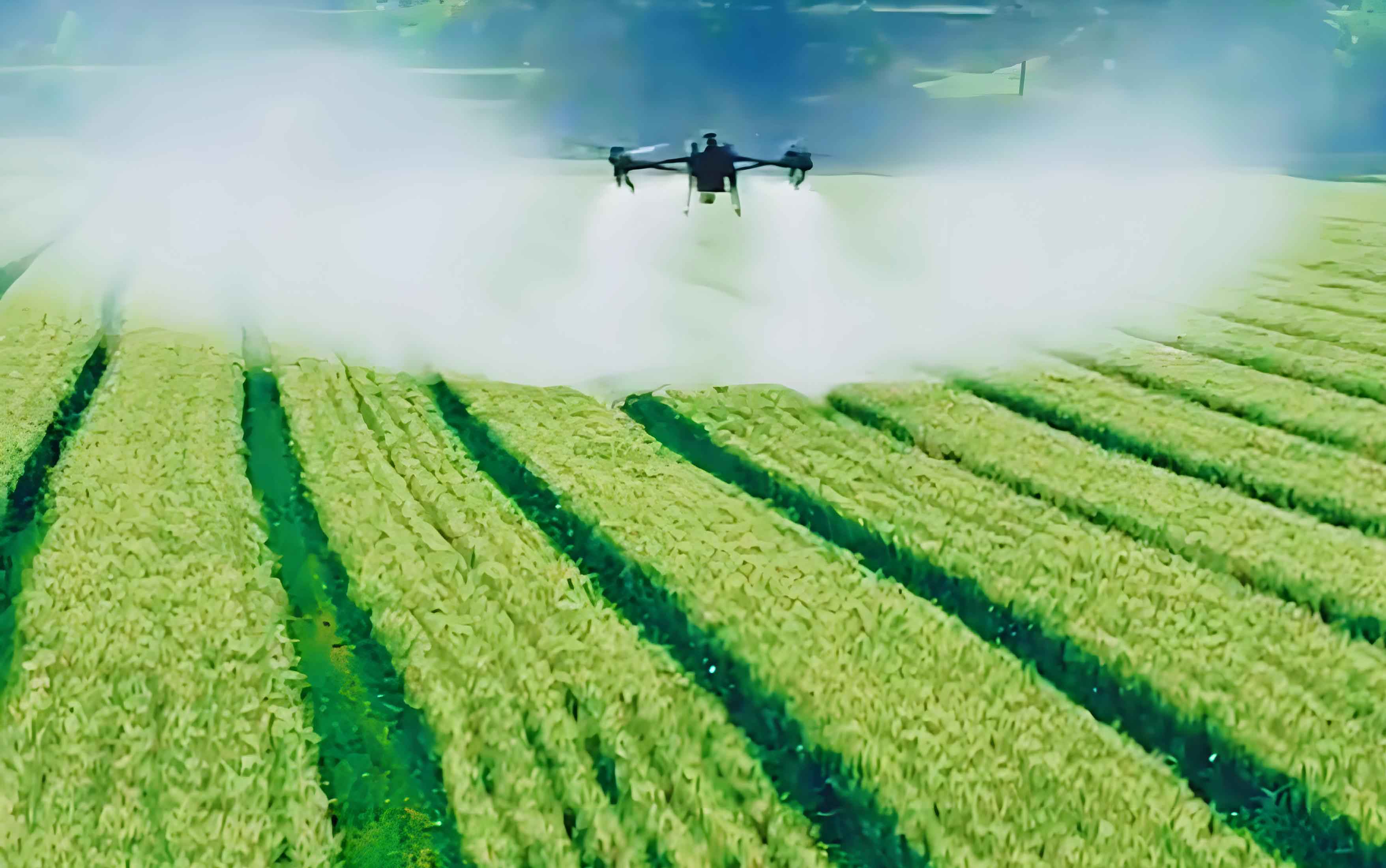
In recent years, low-altitude and low-volume spraying with crop spraying drones has developed rapidly, becoming integral to agricultural production for crops such as rice, wheat, corn, cotton, and sugarcane. This technology has significantly improved the efficiency of pest and disease control, with comprehensive operational standards and technical systems now in place. For instance, spraying UAVs have demonstrated effective control against rice sheath blight and rice leaf rollers, achieving an overall control rate of approximately 83.56%. Various models of crop spraying drones, like the DJI T60 and others, are widely used. The DJI T60, for example, can handle a maximum spray takeoff weight of 112 kg with a standard configuration, carrying 50 liters of liquid for low-altitude and low-volume spraying. Compared to traditional methods, this spraying UAV reduces pesticide use by at least 30% through finer droplets and uniform application.
Analyzing the effectiveness of spraying UAV technology reveals its performance against different pests and diseases. For cotton aphids, control efficacy exceeds 90%, while for common rice pests like rice leaf rollers, it ranges from 80% to 90%. Similarly, for whiteflies and tobacco aphids, efficacy is between 80% and 90%. Against corn borers, control efficacy is slightly lower at around 83.45%, whereas for wheat aphids and fusarium head blight, it varies more widely from 55% to 85%, depending on specific conditions. This variability underscores the importance of optimizing operational parameters for crop spraying drones.
The flight speed of crop spraying drones significantly influences control efficacy. In studies where spraying UAVs were operated at speeds of 1.0 m/s, 1.5 m/s, 2.0 m/s, 2.5 m/s, and 3.0 m/s at a constant height of 6.5 meters, the control effects were measured for different pesticides. Results indicate that a speed of 2.0 m/s yields the best efficacy, while 3.0 m/s performs the poorest, demonstrating an inverse relationship between speed and effectiveness beyond an optimal point. The data can be summarized in the following table.
| Pesticide Name | 1.0 m/s | 1.5 m/s | 2.0 m/s | 2.5 m/s | 3.0 m/s |
|---|---|---|---|---|---|
| 1.2% Nicotine · Matrine Soluble Liquid | (88.9 ± 1.6)% | (89.8 ± 1.5)% | (93.9 ± 1.5)% | (66.9 ± 1.7)% | (42.1 ± 2.5)% |
| 1.5% Matrine Soluble Liquid | (88.5 ± 2.0)% | (89.6 ± 1.8)% | (93.3 ± 1.6)% | (66.8 ± 2.0)% | (39.6 ± 2.7)% |
| 25% Abamectin · Chlorbenzuron Suspension | (88.1 ± 2.2)% | (88.0 ± 1.9)% | (92.6 ± 1.8)% | (62.9 ± 2.1)% | (37.6 ± 3.1)% |
Wind speed is another critical factor affecting the performance of spraying UAVs, influencing both coverage and uniformity. Experiments with single-rotor drones at a fixed height of 7 meters and wind speeds from 0 to 3 m/s, tested at flight speeds of 10 m/s, 12 m/s, and 15 m/s, show that optimal conditions with low wind speeds meet standard spraying requirements, whereas higher winds degrade performance. The relationship can be expressed using a drift model formula: $$ D = k \cdot v^2 $$ where \( D \) is drift potential, \( k \) is a constant based on droplet size and environmental factors, and \( v \) is wind speed. The following table illustrates how wind speed impacts spraying outcomes for crop spraying drones.
| Flight Height (m) | Flight Speed (m/s) | Temperature (°C) | Humidity (%) | Wind Speed (m/s) | Droplet Density (drops/cm²) | Droplet Diameter (μm) | Swath Width (m) | Spray Type | Qualified |
|---|---|---|---|---|---|---|---|---|---|
| 7 | 10 | 33 | 70 | 2.5 | 20 | 260 | 11 | Constant Volume | No |
| 7 | 10 | 31 | 71 | 1.0 | 28 | 305 | 12 | Constant Volume | Yes |
| 7 | 12 | 29 | 81 | 3.0 | 17 | 248 | 9 | Constant Volume | No |
| 7 | 12 | 27 | 90 | 0 | 27 | 289 | 9 | Constant Volume | Yes |
| 7 | 15 | 27 | 80 | 2.0 | 8 | 220 | 0 | Low Volume | No |
To optimize low-altitude and low-volume spraying technology for crop spraying drones, several strategies are essential. First, developing dedicated pesticides and spray adjuvants tailored to the parameters of spraying UAVs is crucial. Current practices often use conventional pesticides designed for ground application, which may not achieve optimal results in low-altitude spraying. Specialized formulations could enhance droplet adhesion and penetration, improving overall efficacy. The effectiveness of such formulations can be described by a deposition efficiency formula: $$ \eta = \frac{D_a}{D_t} $$ where \( \eta \) is deposition efficiency, \( D_a \) is the actual deposited amount, and \( D_t \) is the total sprayed amount. For crop spraying drones, optimizing \( \eta \) requires compatible chemicals.
Second, multi-drone coordination technology can exponentially increase spraying efficiency. By deploying multiple crop spraying drones in a synchronized manner, large areas can be covered rapidly. This requires robust wireless networks for real-time communication and data exchange among spraying UAVs, ensuring coordinated flight paths and avoiding collisions. With advancements in internet and big data technologies, multi-drone systems are becoming more feasible, enabling scalable operations for crop spraying drones. The coordination can be modeled using a swarm efficiency equation: $$ SE = n \cdot e^{-c \cdot d} $$ where \( SE \) is swarm efficiency, \( n \) is the number of drones, \( c \) is a coordination constant, and \( d \) is the average distance between drones.
Third, precision application technology is key to maximizing the benefits of spraying UAVs. This involves using high-precision nozzles, sensitive sensors, and accurate control systems to enhance the responsiveness of crop spraying drones. Developing new testing devices and monitoring frameworks allows for rapid assessment of spraying quality and effects, facilitating real-time adjustments and evaluations. For instance, droplet distribution uniformity can be quantified using a coefficient of variation formula: $$ CV = \frac{\sigma}{\mu} \times 100\% $$ where \( CV \) is the coefficient of variation, \( \sigma \) is the standard deviation of droplet densities, and \( \mu \) is the mean droplet density. Lower \( CV \) values indicate more uniform spraying, a goal for precision in spraying UAVs.
In conclusion, low-altitude and low-volume spraying technology with crop spraying drones enables rapid coverage of extensive farmland, executing precise and repetitive tasks that boost pesticide application and pest control efficiency. These spraying UAVs reduce resource waste through controlled use of inputs, lower operational costs, and minimize safety risks. However, ongoing technical refinements and upgrades are necessary to address existing limitations and further enhance performance. As crop spraying drones evolve, they promise to play an increasingly vital role in sustainable agriculture, driven by innovations in dedicated chemicals, multi-drone systems, and precision technologies for spraying UAVs.