
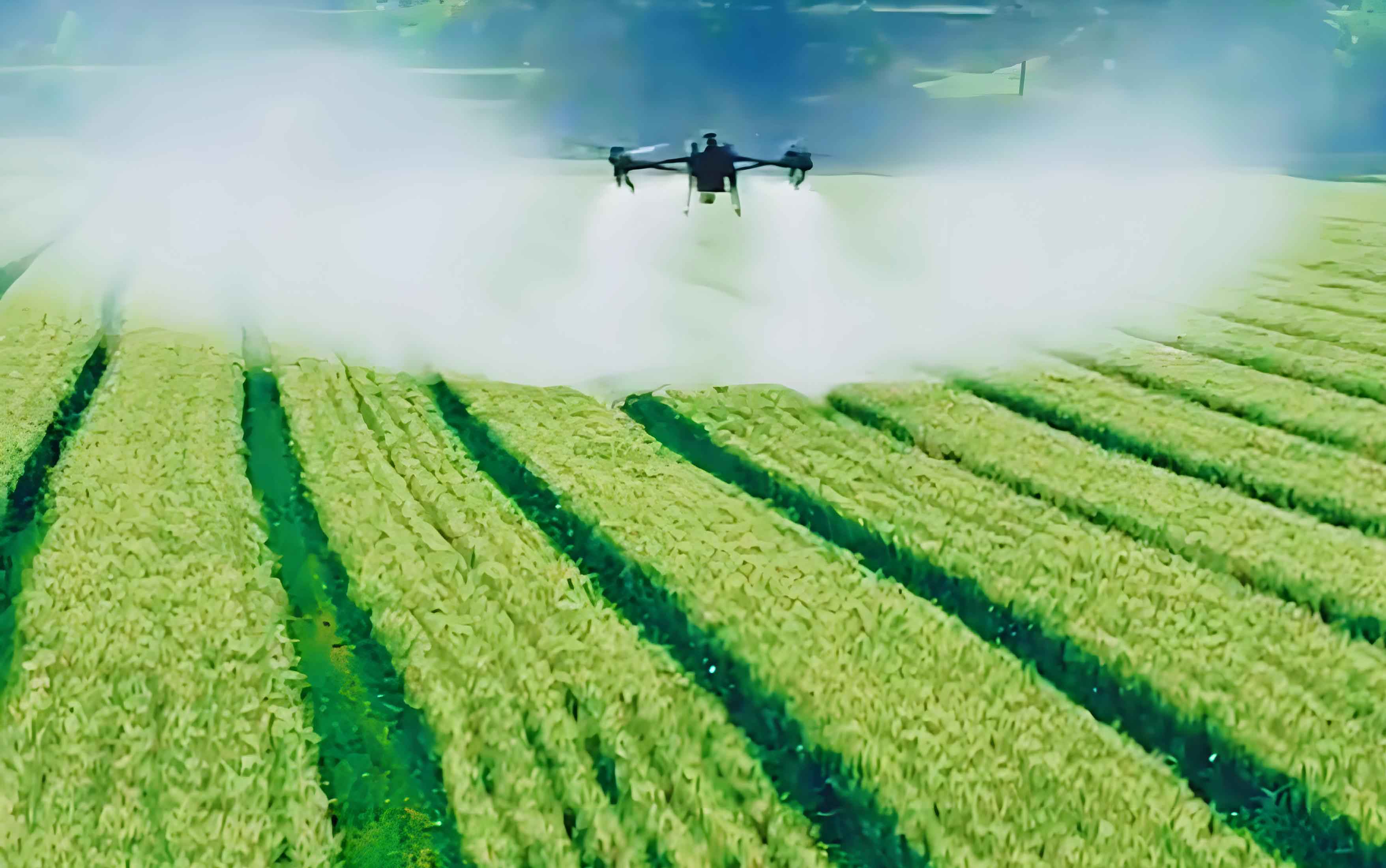
In modern agriculture, crop spraying drones, also known as spraying UAVs, have become essential tools for precise pesticide and fertilizer application. These unmanned aerial vehicles offer flexibility and efficiency, especially in regions where large-scale aircraft operations are impractical. However, the operational environment for crop spraying drones is highly complex, with factors such as motor dynamic characteristics, body vibrations, and mechanical friction introducing significant disturbances. These disturbances can lead to deviations in flight paths, resulting in issues like over-spraying or under-spraying, and even catastrophic failures. To address these challenges, we propose an anti-disturbance back-stepping robust control method that enhances the stability and precision of crop spraying drones during spraying operations. This method integrates an extended state observer to estimate disturbances and a back-stepping control law to regulate flight commands, ensuring accurate trajectory tracking.
The mathematical model of a crop spraying drone must account for various disturbances to accurately represent real-world conditions. The dynamics of the spraying UAV can be described by a set of nonlinear equations that include terms for motor currents, voltages, and external perturbations. Let the state variables be defined as follows: $x_1 = \omega$ represents the angular position (pitch, roll, and yaw angles), $x_2 = \dot{\omega}$ denotes the angular velocity, and $x_3 = i$ signifies the motor current. The system model under disturbances is given by:
$$ \begin{align*}
\dot{x}_1 &= x_2 + d_1 \\
\dot{x}_2 &= -A^{-1}B x_2 + A^{-1}K_T x_3 + d_2 \\
\dot{x}_3 &= -C^{-1}D x_3 + C^{-1}u + d_3
\end{align*} $$
Here, $A$, $B$, $C$, and $D$ are coefficient matrices related to the drone’s inertia and motor parameters, $K_T$ is the torque coefficient vector, $u$ is the motor input voltage, and $d_1$, $d_2$, $d_3$ represent disturbances in angular position, angular acceleration, and motor current, respectively. These disturbances arise from factors like motor nonlinearities, aerodynamic vibrations, and friction, which are common in spraying UAV operations. To mitigate their effects, we design an extended state observer (ESO) to estimate these disturbances in real-time. The ESO for each disturbance is formulated as:
$$ \begin{align*}
\dot{\hat{x}}_1 &= \hat{x}_2 + \hat{d}_1 – 2r \tilde{x}_1 \\
\dot{\hat{d}}_1 &= -r^2 \tilde{x}_1 + (x_1 – x_{1c}) \\
\dot{\hat{x}}_2 &= -A^{-1}B \hat{x}_2 + A^{-1}K_T \hat{x}_3 + \hat{d}_2 – 2p \tilde{x}_2 \\
\dot{\hat{d}}_2 &= -p^2 \tilde{x}_2 + (x_2 – x_{2c}) \\
\dot{\hat{x}}_3 &= -C^{-1}D \hat{x}_3 + C^{-1}u + \hat{d}_3 – 2q \tilde{x}_3 \\
\dot{\hat{d}}_3 &= -q^2 \tilde{x}_3 + (x_3 – x_{3c})
\end{align*} $$
In these equations, $\hat{x}_i$ and $\hat{d}_i$ are the estimated states and disturbances, $\tilde{x}_i = \hat{x}_i – x_i$ is the estimation error, and $r$, $p$, $q$ are positive observer gains. The ESO provides accurate estimates of the disturbances, enabling the control system to compensate for them effectively. For instance, in simulations, the maximum estimation errors for $d_1$, $d_2$, and $d_3$ were found to be 0.03°/s, 0.03°/s², and 0.04 A/s, respectively, demonstrating high precision.
The core of our approach lies in the back-stepping robust control law, which is designed recursively to ensure stability and tracking performance. We define tracking errors for each state variable: $e_1 = x_1 – x_{1c}$ for angular position, $e_2 = x_2 – x_{2c}$ for angular velocity, and $e_3 = x_3 – x_{3c}$ for motor current, where $x_{1c}$, $x_{2c}$, and $x_{3c}$ are the desired commands. Using Lyapunov stability theory, we derive virtual control laws step by step. First, the virtual angular velocity command is designed as:
$$ x_{2c} = -k_1 e_1 – \hat{d}_1 + \dot{x}_{1c} $$
where $k_1$ is a positive definite matrix. This ensures that the angular position error converges to zero. Next, the virtual motor current command is given by:
$$ x_{3c} = K_T^{-1} A \left( -k_2 e_2 + A^{-1}B x_2 – \hat{d}_2 + \dot{x}_{2c} \right) $$
with $k_2$ as another positive definite matrix. Finally, the actual motor voltage command is computed as:
$$ u = C \left( -k_3 e_3 + C^{-1}D x_3 – \hat{d}_3 + \dot{x}_{3c} \right) $$
where $k_3$ is a positive definite matrix. The stability of the entire system is proven by constructing a composite Lyapunov function $W = V_1 + V_2 + V_3$, where each $V_i$ corresponds to the error dynamics of the $i$-th step. The derivative $\dot{W}$ is shown to be negative semi-definite, guaranteeing global asymptotic stability. This control law enables the crop spraying drone to maintain precise flight paths even under significant disturbances, as verified in both simulations and field tests.
To validate the effectiveness of our anti-disturbance back-stepping robust control method, we conducted extensive simulations in MATLAB. The desired flight commands for the spraying UAV were set as a function of time $t$ (in seconds):
$$ x_{1c} = \begin{bmatrix} 3t – 6\cos(t) \\ e^{0.25t} – 10\cos(t) \\ 5\cos(t) + t + e^{0.25t} \end{bmatrix} $$
External disturbances were modeled as nonlinear functions to simulate real-world conditions:
$$ \begin{align*}
d_1 &= \begin{bmatrix} 0.3t + 0.2\cos(t) \\ 0.3t + 0.2\cos(t) \\ 0.3t + 0.2\cos(t) \end{bmatrix} \\
d_2 &= \begin{bmatrix} e^{0.05t} + 0.2\sin(t) \\ e^{0.05t} + 0.2\sin(t) \\ e^{0.05t} + 0.2\sin(t) \end{bmatrix} \\
d_3 &= \begin{bmatrix} 0.1t + e^{0.03t} + 0.1\sin(t) \\ 0.1t + e^{0.03t} + 0.1\sin(t) \\ 0.1t + e^{0.03t} + 0.1\sin(t) \end{bmatrix}
\end{align*} $$
The control parameters were tuned as follows: $r = 5$, $p = 3$, $q = 6$, and $k_1 = \text{diag}(3, 5, 7)$, $k_2 = \text{diag}(6, 4, 3)$, $k_3 = \text{diag}(8, 4, 6)$. We compared our method with existing approaches, such as adaptive fuzzy active disturbance rejection (AFADR) control and joint observation with feedforward compensation (JOFFC) control. The results demonstrated that our method achieved superior tracking performance. For example, the maximum errors in pitch, roll, and yaw angles were only 0.4°, 0.6°, and 0.5°, respectively, whereas AFADR and JOFFC resulted in errors up to 9.2°. The table below summarizes the simulation results for tracking errors under different control methods.
| Control Method | Max Pitch Error (°) | Max Roll Error (°) | Max Yaw Error (°) |
|---|---|---|---|
| AFADR | 6.2 | 8.3 | 9.2 |
| JOFFC | 3.5 | 3.8 | 4.4 |
| Proposed ADBSR | 0.4 | 0.6 | 0.5 |
Furthermore, field tests were conducted using a C50 crop spraying drone with a payload capacity of 50 kg. The tests involved spraying nitrogen fertilizer over a 100 m × 18 m rice field, with the drone flying at a height of 2.5 m and a speed of 1.5 m/s. The effective spraying radius was set to 1.8 m. We implanted our control method into the drone’s onboard controller and recorded the flight trajectory using high-precision positioning modules. The results showed that our method significantly reduced areas of over-spraying and under-spraying compared to other methods. Specifically, the over-sprayed and under-sprayed areas accounted for only 0.23% and 0.27% of the total area, respectively, and the total operation time was minimized to 676 seconds. The table below provides a detailed comparison of the test results.
| Control Method | Over-spray Area (m²) | Over-spray Percentage (%) | Under-spray Area (m²) | Under-spray Percentage (%) | Flight Time (s) |
|---|---|---|---|---|---|
| AFADR | 64.08 | 3.56 | 67.14 | 3.73 | 695 |
| JOFFC | 33.12 | 1.84 | 35.10 | 1.95 | 684 |
| Proposed ADBSR | 4.14 | 0.23 | 4.86 | 0.27 | 676 |
The effectiveness of our control method can be attributed to the accurate disturbance estimation by the ESO and the robust feedback provided by the back-stepping law. For instance, the ESO estimates were used to compute the control commands in real-time, allowing the spraying UAV to adjust its motors dynamically. The motor voltage command $u$ is derived based on the current error $e_3$ and the estimated disturbance $\hat{d}_3$, ensuring that the drone compensates for uncertainties without requiring precise model knowledge. This is particularly important for crop spraying drones, which often operate in varying environmental conditions. The Lyapunov stability analysis confirms that the system remains stable under the proposed control law, with the composite function $W$ satisfying $\dot{W} \leq 0$.
In conclusion, our anti-disturbance back-stepping robust control method offers a reliable solution for enhancing the performance of crop spraying drones in agricultural spraying operations. By integrating an extended state observer and a recursive control design, we achieve precise trajectory tracking and minimize spraying errors. Future work will focus on extending this approach to multi-drone systems, where coordination and formation control are essential for large-scale agricultural applications. The use of spraying UAVs equipped with such advanced control strategies promises to revolutionize precision agriculture by improving efficiency and reducing environmental impact.
The mathematical formulations and experimental validations highlight the robustness of our method. For example, the dynamics of the crop spraying drone can be further analyzed using state-space representations. Consider the system matrix $A_s$ and input matrix $B_s$ for the linearized model:
$$ \begin{align*}
A_s &= \begin{bmatrix}
0 & I & 0 \\
0 & -A^{-1}B & A^{-1}K_T \\
0 & 0 & -C^{-1}D
\end{bmatrix}, \\
B_s &= \begin{bmatrix}
0 \\ 0 \\ C^{-1}
\end{bmatrix}
\end{align*} $$
where $I$ is the identity matrix. The control input $u$ is designed to ensure that the closed-loop system eigenvalues lie in the left-half plane, guaranteeing stability. Additionally, the disturbance estimation errors converge exponentially due to the ESO design, as shown by the error dynamics $\dot{\tilde{d}}_i = – \alpha_i \tilde{d}_i + \text{higher-order terms}$, where $\alpha_i$ are positive constants. This theoretical foundation supports the practical success of our method in real-world spraying UAV applications.
Overall, the integration of advanced control theories with agricultural machinery like crop spraying drones paves the way for smarter and more sustainable farming practices. Our approach not only addresses current challenges but also provides a framework for future innovations in autonomous agricultural systems.