
In recent decades, the rapid advancement of unmanned aerial vehicle (UAV) technology has revolutionized various sectors, including agriculture, where crop spraying drones have emerged as a pivotal tool. As a researcher in this field, I have observed how these spraying UAVs enhance precision farming by enabling targeted pesticide application, fertilizer distribution, and crop monitoring. This article delves into the development journey of crop spraying drones, analyzes their current advantages and limitations, and proposes pathways for future growth, incorporating quantitative insights through tables and formulas to underscore key points.
The concept of crop spraying drones, or spraying UAVs, refers to unmanned aircraft specifically designed for plant protection tasks. These systems are equipped with advanced sensors and spraying mechanisms to perform precise operations, reducing resource waste and environmental impact. With global agriculture facing challenges such as labor shortages and the need for sustainable practices, the adoption of crop spraying drones has surged. For instance, in many regions, spraying UAVs have demonstrated the ability to cover large areas efficiently, with applications expanding beyond traditional crop spraying to include seeding, monitoring, and even pollination in some experimental setups.
Historical Development of Crop Spraying Drones
The evolution of crop spraying drones spans over a century, marked by technological milestones that have shaped their current capabilities. We can categorize this development into three distinct phases: the initial emergence, technological accumulation, and large-scale application. Each phase contributed to refining the performance and reliability of spraying UAVs, driven by innovations in aerodynamics, materials science, and automation.
In the early stages, during the 20th century, the idea of using aircraft for agricultural purposes took root. For example, initial experiments involved manned aircraft for pest control, but these were limited by high costs and operational complexities. The breakthrough came with the introduction of the first dedicated crop spraying drone by Yamaha in the 1980s, which laid the groundwork for future advancements. This period was characterized by rudimentary designs and low adoption rates due to technical constraints.
The technological accumulation phase, from the early 2000s to around 2014, saw significant progress in battery technology, navigation systems, and lightweight materials. During this time, research initiatives, such as those funded under national high-tech programs, accelerated the development of spraying UAVs. We witnessed the transition from fuel-powered to electric-powered models, which improved safety and reduced operational costs. The efficiency of crop spraying drones began to gain recognition, with early adopters reporting substantial savings in time and chemicals.
Since 2014, the large-scale application phase has unfolded, driven by policy support and market demand. Governments worldwide have introduced subsidies and regulations to promote the use of spraying UAVs in agriculture. For instance, initiatives aimed at reducing pesticide usage have aligned perfectly with the capabilities of crop spraying drones, leading to widespread adoption. The market for spraying UAVs has expanded rapidly, with thousands of units deployed annually, and the ecosystem has matured to include training, maintenance, and insurance services.
| Phase | Time Period | Key Innovations | Impact on Spraying UAV Efficiency |
|---|---|---|---|
| Emergence | 20th Century | First UAV prototypes, basic spraying mechanisms | Low efficiency, high operational risks |
| Technological Accumulation | 2000s-2014 | Electric propulsion, GPS navigation, lightweight designs | Moderate improvements in accuracy and speed |
| Large-Scale Application | 2014-Present | AI integration, advanced sensors, swarm technology | High efficiency, reduced costs, widespread adoption |
To quantify the progress, we can model the operational efficiency of a crop spraying drone over time. Let $E(t)$ represent the efficiency in hectares per hour, which can be expressed as a function of technological advancements $A(t)$ and regulatory support $R(t)$:
$$E(t) = k \cdot A(t) \cdot R(t) + C$$
where $k$ is a constant factor, and $C$ accounts for baseline performance. For example, in the early phases, $A(t)$ was low, resulting in $E(t) \approx 1-2$ hectares/hour, whereas in the current phase, $A(t)$ has increased significantly, leading to $E(t) \geq 5$ hectares/hour for modern spraying UAVs.
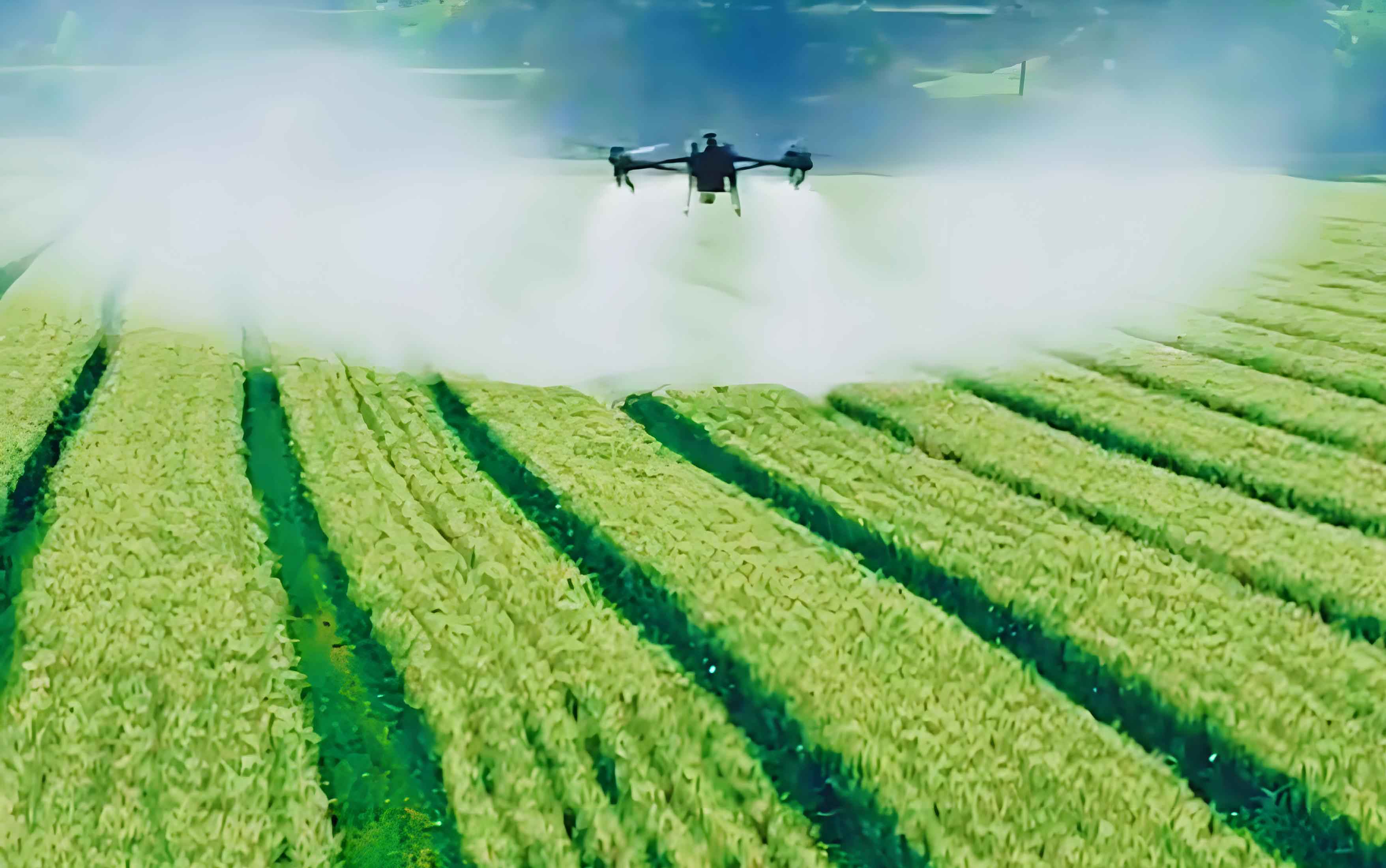
Advantages and Limitations of Crop Spraying Drones in Modern Agriculture
As an advocate for precision agriculture, I have extensively studied the benefits and challenges of deploying crop spraying drones. The advantages are multifaceted, ranging from operational efficiency to environmental sustainability, while the limitations highlight areas requiring further innovation.
Advantages of Spraying UAVs
One of the most significant advantages of crop spraying drones is their high operational efficiency. Compared to traditional methods, spraying UAVs can cover large areas quickly, with typical models achieving spraying rates of 5-10 hectares per hour. This is due to their ability to fly at optimized speeds and altitudes, ensuring uniform coverage. Moreover, crop spraying drones are highly adaptable, capable of operating in diverse terrains such as hills, wetlands, and dense forests, where ground-based equipment would struggle.
Another key benefit is the reduction in chemical usage and water consumption. Spraying UAVs employ advanced atomization techniques that create fine droplets, enhancing adhesion to plant surfaces. This results in a more effective application, with studies showing that crop spraying drones can reduce pesticide use by 30-50% and water usage by up to 90% compared to conventional methods. The efficiency can be modeled using the formula for deposition efficiency $D_e$:
$$D_e = \frac{M_d}{M_a} \times 100\%$$
where $M_d$ is the mass of pesticide deposited on target plants, and $M_a$ is the mass applied. For spraying UAVs, $D_e$ often exceeds 80%, whereas for traditional sprayers, it may be below 50%.
Additionally, crop spraying drones address labor shortages in rural areas. With simplified controls and autonomous features, operators can manage multiple spraying UAVs with minimal training. This democratizes access to advanced farming techniques, empowering smallholders to improve productivity. The operational cost savings can be substantial, as illustrated in the table below, which compares traditional and drone-based spraying methods.
| Aspect | Traditional Methods | Crop Spraying Drones |
|---|---|---|
| Spraying Efficiency (hectares/hour) | 0.5-1 | 5-10 |
| Pesticide Usage Reduction | 0% | 30-50% |
| Water Consumption (liters/hectare) | 100-200 | 10-20 |
| Labor Requirements (persons/operation) | 2-3 | 1 |
| Adaptability to Difficult Terrain | Low | High |
Limitations of Spraying UAVs
Despite their advantages, crop spraying drones face several technical and infrastructural challenges. Battery life remains a critical issue; most spraying UAVs rely on lithium-ion batteries that provide limited flight times of 8-20 minutes per charge. This necessitates frequent battery swaps and recharging, which can interrupt operations and increase downtime. The energy capacity $E_b$ of a typical battery can be described as:
$$E_b = P \cdot t$$
where $P$ is the power consumption in watts, and $t$ is time in hours. For a crop spraying drone with $P = 500$W, $E_b$ might be around 150-200 Wh, limiting continuous operation.
Navigation and positioning inaccuracies also pose problems. While GPS and vision-based systems are commonly used, errors can lead to uneven spraying or missed areas. Environmental factors such as wind, rain, and temperature extremes further constrain the usability of spraying UAVs. For instance, wind speeds above 5 m/s can cause spray drift, reducing effectiveness. The drift loss $L_d$ can be estimated as:
$$L_d = k_w \cdot v^2$$
where $k_w$ is a wind-dependent constant, and $v$ is wind velocity. This highlights the need for improved stability in crop spraying drones.
Moreover, the lack of standardized pesticides formulated for drone application hinders optimal performance. Most available chemicals are designed for high-volume spraying, not the concentrated solutions used in spraying UAVs. This mismatch can lead to clogging, poor coverage, or even crop damage. The industry also grapples with inconsistent product quality and inadequate after-sales support, which erodes user confidence.
Regulatory frameworks for spraying UAVs are still evolving, leading to safety concerns such as unauthorized flights. Additionally, the supporting ecosystem—including repair services, insurance, and trained operators—is underdeveloped, creating bottlenecks in widespread adoption. For example, the shortage of skilled pilots for crop spraying drones limits scalability, as effective operation requires knowledge of both agronomy and UAV technology.
Pathways for Enhancing Crop Spraying Drone Technology
Based on my analysis, several strategies can address the current limitations and unlock the full potential of crop spraying drones. First, technological innovations should focus on improving battery energy density and exploring alternative power sources, such as hydrogen fuel cells, to extend flight times. The relationship between battery capacity and operational time $T_op$ can be optimized by minimizing the weight-to-power ratio:
$$T_op = \frac{E_b}{P} \cdot \eta$$
where $\eta$ is the efficiency factor. Research into lightweight composite materials could also enhance payload capacity, allowing spraying UAVs to carry more chemicals per flight.
Second, advancing navigation systems through the integration of real-time kinematics (RTK) and artificial intelligence can boost accuracy. For instance, machine learning algorithms can process sensor data to adjust flight paths dynamically, minimizing errors. The precision of a spraying UAV can be quantified by the positioning error $\sigma_p$, which should be reduced to below 0.1 meters for optimal coverage.
Third, developing specialized formulations for drone-applied pesticides is crucial. Collaborative efforts between chemical companies and UAV manufacturers can yield solutions with appropriate viscosity and atomization properties. This aligns with the broader trend of “low-altitude economy,” which promotes the integration of UAVs into various industries, including agriculture. The low-altitude sector is poised to drive innovations in crop spraying drones, expanding their applications to tasks like crop health monitoring and data analytics.
Furthermore, establishing industry standards and regulations will foster a safer and more reliable market for spraying UAVs. This includes certification processes for operators, maintenance protocols, and insurance products tailored to crop spraying drones. By creating a cohesive ecosystem, we can mitigate risks and build trust among farmers.
| Area of Improvement | Proposed Measures | Expected Impact on Spraying UAV Performance |
|---|---|---|
| Battery Technology | Invest in solid-state batteries and fast-charging systems | Increase flight time by 50-100% |
| Navigation Accuracy | Incorporate multi-sensor fusion and AI-based path planning | Reduce spraying errors to less than 5% |
| Chemical Formulations | Develop low-volume, high-efficacy pesticides for drones | Enhance deposition efficiency by 20-30% |
| Regulatory Framework | Implement standardized training and flight permits | Decrease incidents of misuse by 80% |
| Support Services | Expand repair networks and insurance options | Improve user satisfaction and adoption rates |
Conclusion
Reflecting on the journey of crop spraying drones, it is evident that these spraying UAVs have transformed agricultural practices by offering unparalleled efficiency and sustainability. From their humble beginnings to becoming integral tools in modern farming, crop spraying drones exemplify the synergy between technology and ecology. However, challenges such as limited endurance, regulatory gaps, and supply chain issues must be overcome to realize their full potential.
Looking ahead, the convergence of low-altitude economic policies and technological breakthroughs will likely accelerate the evolution of crop spraying drones. With continued innovation in areas like autonomous swarming and eco-friendly formulations, spraying UAVs could soon become the standard for precision agriculture worldwide. As we move forward, it is imperative to foster collaboration among stakeholders to ensure that crop spraying drones not only boost productivity but also contribute to a greener, more resilient food system. The future of agriculture hinges on our ability to harness the power of spraying UAVs responsibly and effectively.