
In modern agricultural practices, the effective application of pesticides is critical for ensuring crop health, food security, and environmental sustainability. As a researcher focused on optimizing pesticide use, I conducted a comprehensive study to compare the pesticide utilization efficiency of various crop protection machinery, including crop spraying drones and traditional manual methods, in rice fields. The primary objective was to evaluate how different spraying equipment influences pesticide deposition, distribution, and overall efficiency, with a particular emphasis on the performance of spraying UAVs. This investigation is vital for advancing precision agriculture and reducing environmental impact. The experiment was designed to measure key parameters such as droplet deposition, pesticide utilization rate, and distribution across rice plant canopies, using a water-soluble tracer to simulate pesticide application. Through this work, I aim to provide actionable insights for farmers and agricultural professionals to select the most efficient spraying techniques, thereby enhancing crop protection while minimizing waste.
The importance of pesticide utilization efficiency cannot be overstated, as it directly affects the economic and ecological outcomes of farming. Inefficient application can lead to excessive chemical use, environmental contamination, and increased resistance in pests. With the advent of advanced technologies like crop spraying drones, there is a growing need to assess their performance against conventional methods. In this study, I compared four types of equipment: a dual-rotor spraying UAV, a multi-rotor spraying UAV, a backpack electric sprayer, and a stretcher-type sprayer. The focus was on their ability to deposit pesticides uniformly and efficiently during the tillering stage of rice growth. By employing rigorous methodologies and statistical analyses, including formulas and tabular data, I sought to quantify differences in performance and offer recommendations for practical applications.
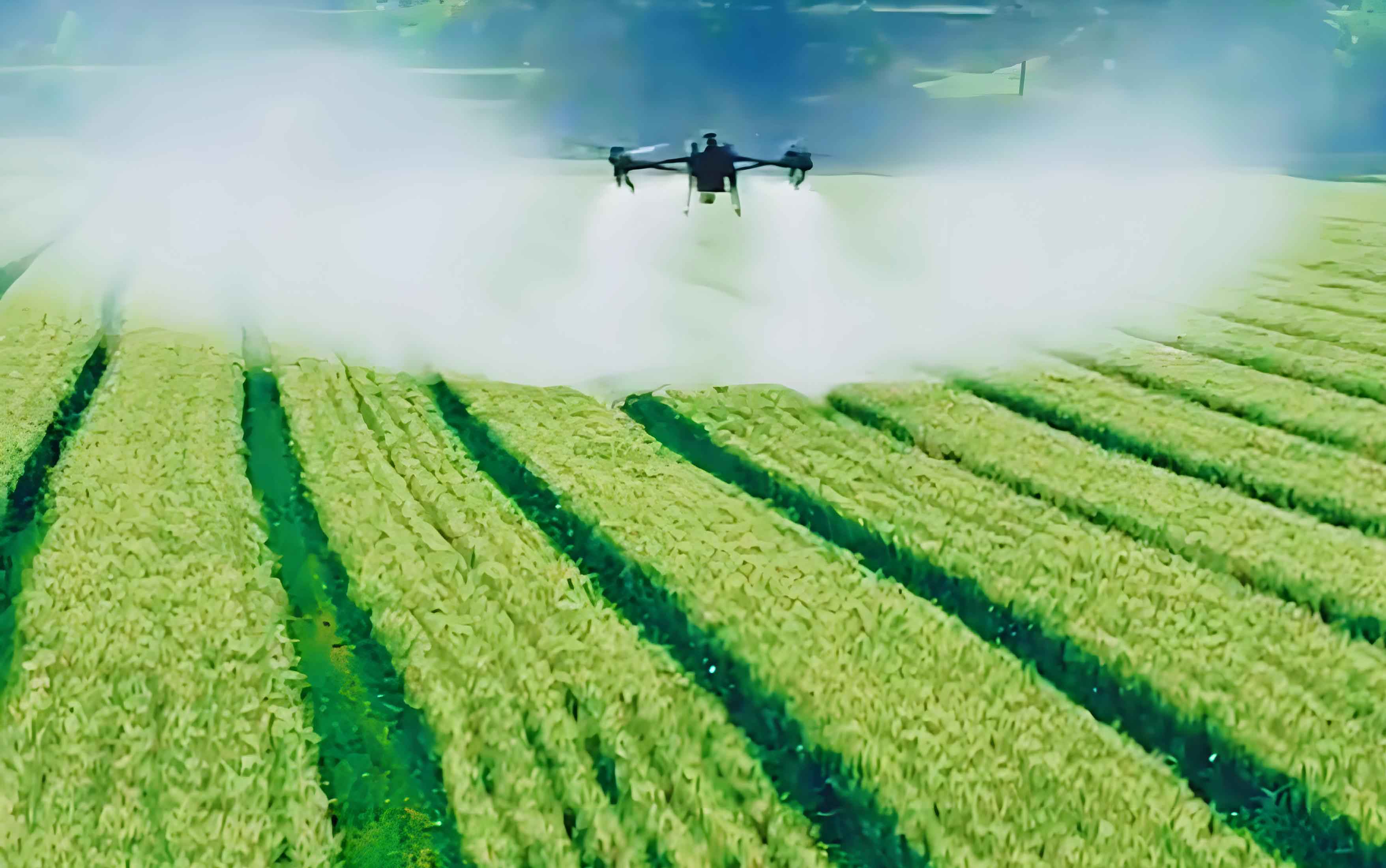
To begin, I established the experimental site in a direct-seeded rice field, selecting a uniform area to minimize variability. The rice variety used was Taiyou 398, with a planting density of 35 plants per square meter, and the study targeted the control of rice stem borers during the tillering phase. Meteorological conditions during the experiments were monitored using a Kestrel 5000 weather station, recording an average temperature of 32.1°C, relative humidity of 64.7%, and wind speed of 0.5 m/s. These factors are crucial as they influence droplet behavior and deposition. The crop spraying drone technologies included a V50 dual-rotor UAV and a T30 multi-rotor UAV, both representing modern spraying UAV options, while the manual equipment consisted of a backpack electric sprayer and a stretcher-type sprayer. Key parameters for each machine are summarized in the table below, highlighting differences in nozzle type, flow rate, and operational settings that could affect pesticide application.
| Equipment Type | Nozzle Type | Number of Nozzles | Spray Pressure (MPa) | Flow Rate (L/min) | Operating Height (m) | Operating Speed (m/s) | Spray Width (m) |
|---|---|---|---|---|---|---|---|
| Dual-rotor Spraying UAV | Centrifugal Nozzle | 4 | 0.5 | 1.5 | 2.5 | 5.0 | 5.0 |
| Multi-rotor Spraying UAV | Pressure Nozzle | 16 | 1.0 | 2.0 | 5.5 | 10.0 | 7.0 |
| Stretcher-type Sprayer | Single-hole Nozzle | 1 | 0.6 | 8-10 | N/A | N/A | N/A |
| Backpack Electric Sprayer | Single-hole Nozzle | 1 | 0.8 | 1.1 | N/A | N/A | N/A |
The experimental design involved spraying a solution containing the tracer Allura Red AC at a rate of 375 g/ha, along with 3.2% abamectin emulsion as the pesticide, to simulate real-world conditions. I divided the field into plots for each equipment type, ensuring replication to account for variability. The spraying process was carefully controlled, with pre- and post-application measurements taken to calculate actual pesticide usage. For instance, the volume of spray solution applied was determined by measuring the residual liquid in the tanks after spraying, allowing me to compute the actual application rate. This step was essential for accurate efficiency calculations. The use of a crop spraying drone, such as the multi-rotor spraying UAV, demonstrated advantages in coverage and speed, but required precise calibration to avoid under- or over-application.
To assess droplet deposition, I placed droplet collection cards at different canopy levels—upper and lower—using PVC poles adjusted to the rice plant height. Each sampling point included a filter paper and a Mylar card to capture droplets, arranged in three rows perpendicular to the spraying direction with 10 poles per row, spaced 1 meter apart and rows 10 meters apart. This setup enabled me to collect representative samples from various positions, reflecting the distribution of droplets across the field. After spraying, the cards were retrieved, and the deposited tracer was extracted with distilled water. The concentration of Allura Red was measured using a spectrophotometer at a wavelength of 514 nm, and a standard curve was established to convert absorbance readings into deposition values. The formula for calculating the deposition amount per unit area is given by:
$$\beta_{dep} = \frac{(\rho_{smpl} – \rho_{blk}) \times F_{cal} \times V_{dil}}{A_{col}}$$
where $\beta_{dep}$ is the deposition amount in μg/cm², $\rho_{smpl}$ is the absorbance of the sample, $\rho_{blk}$ is the absorbance of the blank, $F_{cal}$ is the slope of the standard curve, $V_{dil}$ is the volume of the eluent in mL, and $A_{col}$ is the area of the collection card in cm². This equation allowed me to quantify how much pesticide settled on the plant surfaces, which is a key indicator of efficiency.
Furthermore, I determined the pesticide utilization rate by sampling rice plants from the treated areas using a five-point sampling method. Each sample consisted of a clump of rice plants, washed with 50 mL of water to elute the tracer, and the solution was filtered and analyzed similarly. The utilization rate was calculated using the formula:
$$D = \frac{(\rho_{smpl} – \rho_{blk}) \times F_{cal} \times V_{dil} \times \rho \times 10000}{10^6 \times M \times N} \times 100\%$$
where $D$ is the pesticide utilization rate in %, $\rho$ is the planting density in plants/m², $M$ is the total amount of tracer applied per hectare in g/ha, and $N$ is the number of samples. This comprehensive approach ensured that I could compare the efficiency of each spraying method accurately, taking into account factors like droplet density and uniformity.
The results revealed significant differences in pesticide deposition rates among the equipment types. The backpack electric sprayer achieved the highest average deposition rate of 37.54%, followed by the multi-rotor spraying UAV at 35.61%, the dual-rotor spraying UAV at 24.58%, and the stretcher-type sprayer at 15.84%. This suggests that while manual methods like the backpack sprayer can be effective, modern crop spraying drones offer competitive performance, especially in terms of coverage and reduced labor. The table below summarizes these findings, illustrating the variability in efficiency across different machines.
| Spraying Equipment | Average Deposition Rate (%) |
|---|---|
| Backpack Electric Sprayer | 37.54 |
| Multi-rotor Spraying UAV | 35.61 |
| Dual-rotor Spraying UAV | 24.58 |
| Stretcher-type Sprayer | 15.84 |
In terms of droplet distribution across the rice canopy, I observed distinct patterns. For the backpack electric sprayer, the average droplet deposition was 0.86 μg/cm² in the upper canopy and 0.66 μg/cm² in the lower canopy. The stretcher-type sprayer showed values of 0.29 μg/cm² and 0.25 μg/cm² for upper and lower layers, respectively. The multi-rotor spraying UAV deposited 0.64 μg/cm² in the upper canopy and 0.47 μg/cm² in the lower, while the dual-rotor spraying UAV had 0.53 μg/cm² and 0.39 μg/cm². This indicates that spraying UAVs tend to produce a gradient from lower to upper canopy, with better penetration and uniformity compared to manual methods, which often result in accumulation in the upper layers. The use of a crop spraying drone, therefore, enhances vertical distribution, which is crucial for targeting pests at different growth stages.
Droplet size and density were also critical factors in evaluating performance. The average droplet area for the backpack electric sprayer was 5.446 mm² in the upper canopy and 5.145 mm² in the lower; for the stretcher-type sprayer, it was 3.997 mm² and 3.592 mm², respectively. In contrast, the dual-rotor spraying UAV had smaller droplets with areas of 0.329 mm² (upper) and 0.276 mm² (lower), and the multi-rotor spraying UAV showed 0.298 mm² and 0.226 mm². This demonstrates that spraying UAVs generate finer, more uniform droplets, which improve coverage and reduce the risk of runoff. The droplet density, measured in droplets per cm², further supported this: the backpack sprayer had 90.67 droplets/cm² in the upper canopy and 65.17 in the lower, while the multi-rotor spraying UAV had 69.91 and 40.68, and the dual-rotor spraying UAV had 52.44 and 36.46. The stretcher-type sprayer had the lowest density at 32.60 and 22.69 droplets/cm². These results are summarized in the table below, highlighting the advantages of using a crop spraying drone for achieving optimal droplet parameters.
| Spraying Equipment | Average Droplet Area (mm²) – Upper Canopy | Average Droplet Area (mm²) – Lower Canopy | Droplet Density (droplets/cm²) – Upper Canopy | Droplet Density (droplets/cm²) – Lower Canopy |
|---|---|---|---|---|
| Backpack Electric Sprayer | 5.446 | 5.145 | 90.67 | 65.17 |
| Stretcher-type Sprayer | 3.997 | 3.592 | 32.60 | 22.69 |
| Dual-rotor Spraying UAV | 0.329 | 0.276 | 52.44 | 36.46 |
| Multi-rotor Spraying UAV | 0.298 | 0.226 | 69.91 | 40.68 |
The discussion of these findings centers on the implications for agricultural practices. The higher deposition rates of the backpack electric sprayer can be attributed to its manual operation, which allows for targeted application, but it is labor-intensive and less scalable. In contrast, spraying UAVs like the multi-rotor crop spraying drone offer automation, faster coverage, and better adaptability to large fields, making them suitable for modern precision agriculture. The lower deposition of the stretcher-type sprayer may stem from its higher flow rates and coarse droplets, leading to greater losses through drift or runoff. Moreover, the uniform droplet distribution of spraying UAVs enhances pesticide efficacy by ensuring that chemicals reach all parts of the plant, which is vital for controlling pests like stem borers that inhabit different canopy layers.
From an environmental perspective, the improved efficiency of crop spraying drones can reduce the overall amount of pesticides needed, mitigating negative impacts on ecosystems. For instance, the finer droplets produced by spraying UAVs minimize off-target deposition, which is a common issue with manual sprayers. However, challenges remain, such as the need for precise calibration and the influence of weather conditions on UAV performance. In my study, the consistent wind speed and humidity helped maintain droplet stability, but in real-world scenarios, variables like higher winds could affect results. Therefore, I recommend that farmers consider factors like field size, crop stage, and environmental conditions when choosing between a crop spraying drone and manual methods.
To further illustrate the economic and practical benefits, I analyzed the operational costs and time efficiency. While not directly measured in this experiment, previous studies indicate that spraying UAVs can cover larger areas faster than manual sprayers, reducing labor costs and increasing productivity. For example, a multi-rotor spraying UAV operating at 10 m/s can treat a hectare in a fraction of the time required by a backpack sprayer. This makes crop spraying drones particularly valuable in regions with labor shortages or for large-scale rice farming. Additionally, the data from this study can inform the development of better nozzle designs and flight patterns for spraying UAVs, optimizing their performance across different crops and conditions.
In conclusion, this comparative study demonstrates that crop spraying drones, particularly multi-rotor spraying UAVs, offer a viable alternative to traditional manual spraying methods in terms of pesticide utilization efficiency. Although the backpack electric sprayer achieved the highest deposition rate, the spraying UAVs provided superior droplet uniformity and canopy penetration, which are essential for effective pest control. The formulas and tables presented here serve as a foundation for future research and practical applications. I encourage agricultural stakeholders to adopt spraying UAV technologies where feasible, as they represent a step toward sustainable farming. Future work should explore long-term effects on crop yield and environmental health, as well as innovations in drone technology to enhance adaptability and efficiency. Overall, the integration of crop spraying drones into integrated pest management strategies can lead to more resilient and productive agricultural systems.