
In modern agriculture, the use of crop spraying drones has revolutionized pest and disease management by offering high efficiency, reduced labor dependency, and adaptability to diverse terrains. As a researcher focused on precision agriculture, I have investigated how operational parameters of spraying UAVs influence droplet deposition distribution in tea canopies. This study aims to optimize these parameters to improve pesticide application efficacy, which is critical for sustainable tea production. The increasing adoption of crop spraying drones in various crops underscores the need for tailored parameter settings to maximize deposition and minimize environmental impact.
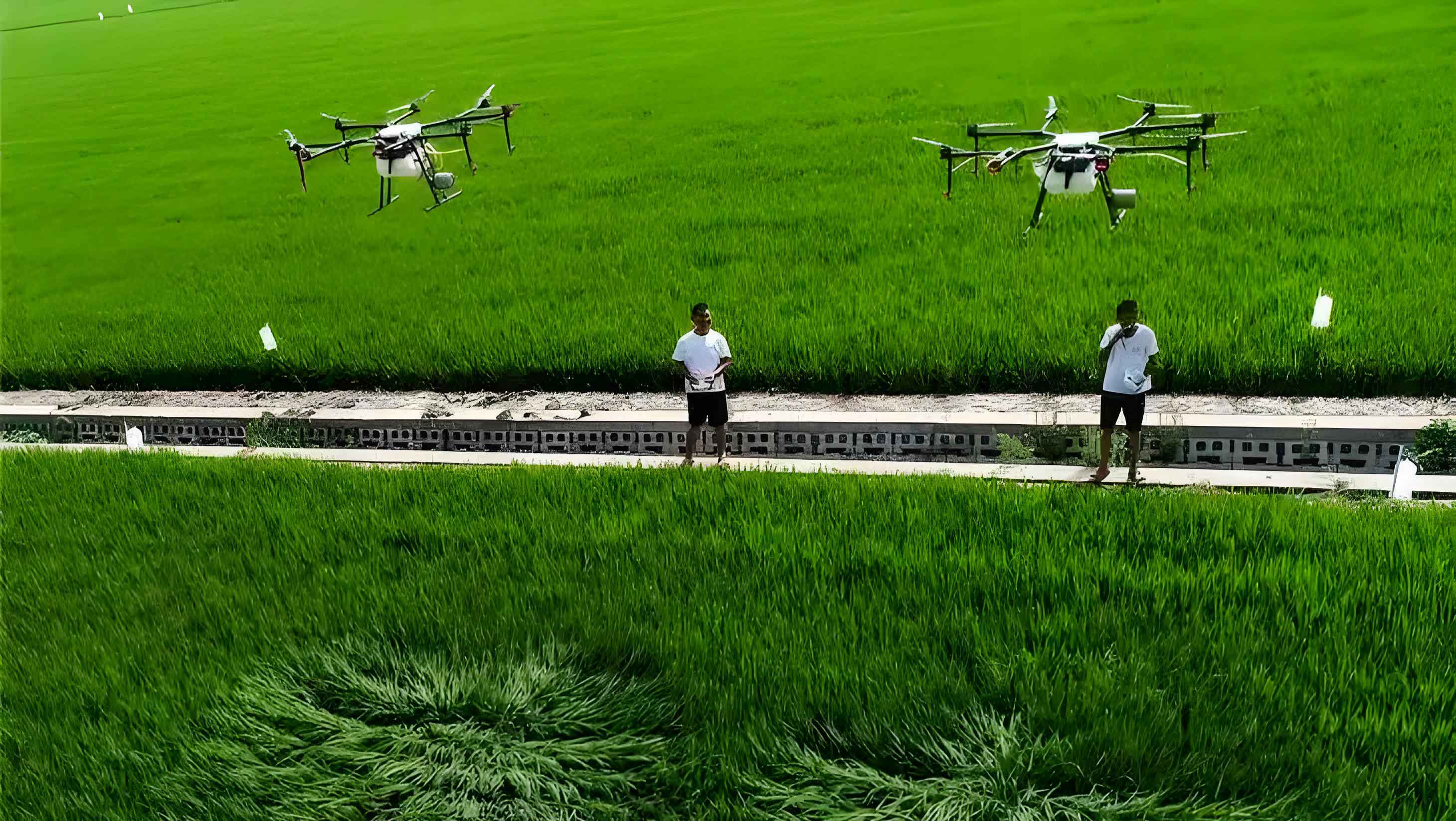
Tea plants, being perennial crops with dense canopies, present unique challenges for uniform droplet penetration. Factors such as droplet size, flight altitude, flight speed, and spray volume significantly affect how droplets settle on the canopy surface and inner layers. Through field experiments, I analyzed these parameters using a four-rotor spraying UAV, assessing their impact on coverage and droplet size distribution. The findings provide actionable insights for optimizing crop spraying drone operations in tea gardens, enhancing both economic and environmental outcomes.
Introduction to Spraying UAV Technology
Spraying UAVs, commonly known as crop spraying drones, have gained prominence due to their ability to cover large areas quickly while reducing human exposure to chemicals. In tea cultivation, where timely pest control is essential, these drones offer a viable alternative to manual spraying. However, inconsistent results in tea gardens highlight the need for parameter optimization. This study delves into the effects of key operational parameters—droplet size, flight height, flight speed, and spray volume—on droplet deposition. By understanding these relationships, we can enhance the performance of spraying UAVs, ensuring better pest control and resource efficiency.
The dynamics of droplet deposition involve complex interactions between UAV-induced airflow, droplet properties, and canopy structure. For instance, smaller droplets are prone to drift and evaporation, whereas larger ones may not penetrate deeply. Similarly, flight parameters influence the spray cloud’s distribution. In this work, I employed a systematic approach to evaluate these factors, using advanced scanning techniques to quantify deposition. The results underscore the importance of integrated parameter management for effective crop spraying drone applications.
Materials and Methods
The experiments were conducted in a tea garden with uniform plant characteristics. A four-rotor crop spraying drone was used, equipped with centrifugal nozzles capable of adjusting droplet size. The study comprised two main parts: first, assessing the impact of droplet size on deposition; and second, evaluating the combined effects of flight height, speed, and spray volume through factorial design. Data collection involved placing water-sensitive papers at strategic locations within the canopy, followed by scanning and analysis using specialized software to determine coverage and droplet size metrics.
For the droplet size experiment, three levels were tested: 20 µm, 40 µm, and 100 µm, while maintaining constant flight height (5 m), speed (2 m/s), and spray volume (30 L/ha). In the flight parameter study, a factorial design included three flight heights (2 m, 3.5 m, 5 m), two flight speeds (2 m/s and 5 m/s), and three spray volumes (30 L/ha, 60 L/ha, 90 L/ha), as summarized in Table 1. Each treatment was replicated, and data were analyzed using statistical software to identify significant effects and interactions.
| Treatment | Flight Height (m) | Flight Speed (m/s) | Spray Volume (L/ha) |
|---|---|---|---|
| T1 | 2.0 | 2.0 | 30.0 |
| T2 | 3.5 | 2.0 | 30.0 |
| T3 | 5.0 | 2.0 | 30.0 |
| T4 | 2.0 | 5.0 | 30.0 |
| T5 | 3.5 | 5.0 | 30.0 |
| T6 | 5.0 | 5.0 | 30.0 |
| T7 | 2.0 | 2.0 | 60.0 |
| T8 | 3.5 | 2.0 | 60.0 |
| T9 | 5.0 | 2.0 | 60.0 |
| T10 | 2.0 | 2.0 | 90.0 |
| T11 | 3.5 | 2.0 | 90.0 |
| T12 | 5.0 | 2.0 | 90.0 |
Data analysis included calculating coverage percentage, volume median diameter (VMD), and coefficient of variation (CV) to assess uniformity. The VMD represents the droplet size where half the volume is contained in smaller droplets and half in larger ones, calculated as: $$ \text{VMD} = D_{v0.5} $$ where \( D_{v0.5} \) is the diameter at which the cumulative volume reaches 50%. Coverage was derived from image analysis, and CV was computed as: $$ \text{CV} = \frac{\sigma}{\mu} \times 100\% $$ where \( \sigma \) is the standard deviation and \( \mu \) is the mean coverage. Multivariate ANOVA and t-tests were applied to determine significance.
Impact of Droplet Size on Deposition
Droplet size is a critical factor in spraying UAV operations, as it affects drift, evaporation, and canopy penetration. In this study, larger droplets (100 µm) resulted in significantly higher coverage and VMD in both the surface and inner layers of the tea canopy compared to smaller sizes. For example, at 100 µm, surface coverage was 2.58 times that at 20 µm, and inner layer coverage was 3.49 times higher. This can be attributed to reduced drift and better retention with larger droplets. The relationship between droplet size and coverage can be modeled as: $$ C = k \cdot D^a $$ where \( C \) is coverage, \( D \) is droplet size, and \( k \) and \( a \) are constants derived from experimental data.
Table 2 summarizes the effects of droplet size on coverage and VMD. The data show that inner layer coverage was only 11.94% to 17.60% of surface coverage, indicating limited penetration with smaller droplets. This highlights the need for optimal droplet size selection in crop spraying drone applications to ensure adequate deposition in critical canopy regions.
| Droplet Size (µm) | Surface Coverage (%) | Inner Layer Coverage (%) | Surface VMD (µm) | Inner Layer VMD (µm) |
|---|---|---|---|---|
| 20 | 2.50 | 0.30 | 85.0 | 80.5 |
| 40 | 4.10 | 0.65 | 120.3 | 115.8 |
| 100 | 6.45 | 1.05 | 195.7 | 190.2 |
Effects of Flight Parameters on Droplet Deposition
Flight height, speed, and spray volume collectively influence the deposition patterns of spraying UAVs. Lower flight heights and speeds, along with higher spray volumes, consistently improved coverage in both canopy layers. For instance, reducing flight height from 5 m to 2 m increased surface coverage by up to 45% and inner layer coverage by 173%. Similarly, decreasing flight speed from 5 m/s to 2 m/s boosted surface coverage by 84% and inner layer coverage by 252%. These improvements are due to longer exposure times and reduced environmental interference at lower altitudes and speeds.
The spray volume also played a pivotal role; increasing it from 30 L/ha to 90 L/ha raised surface coverage by up to 151% and inner layer coverage by 141%. This linear relationship can be expressed as: $$ C = m \cdot V + b $$ where \( C \) is coverage, \( V \) is spray volume, and \( m \) and \( b \) are coefficients. The VMD increased with spray volume, indicating larger droplets at higher volumes, which enhances deposition efficiency. Table 3 provides a detailed overview of how these parameters affect coverage and VMD.
| Treatment | Surface Coverage (%) | Inner Layer Coverage (%) | Surface VMD (µm) | Inner Layer VMD (µm) |
|---|---|---|---|---|
| T1 | 4.50 | 0.55 | 185.3 | 180.1 |
| T2 | 3.80 | 0.40 | 175.6 | 170.3 |
| T3 | 3.10 | 0.25 | 165.9 | 160.5 |
| T4 | 2.80 | 0.20 | 170.2 | 165.0 |
| T5 | 2.30 | 0.15 | 160.5 | 155.2 |
| T6 | 2.00 | 0.10 | 155.8 | 150.5 |
| T7 | 6.80 | 0.90 | 210.4 | 205.1 |
| T8 | 5.60 | 0.70 | 200.7 | 195.4 |
| T9 | 4.40 | 0.50 | 190.0 | 184.7 |
| T10 | 11.52 | 3.41 | 287.1 | 281.8 |
| T11 | 9.20 | 2.10 | 275.4 | 270.1 |
| T12 | 7.80 | 1.60 | 265.7 | 260.4 |
Uniformity of deposition, measured by CV, was best at higher spray volumes and lower flight heights. For example, T10 (2 m height, 2 m/s speed, 90 L/ha volume) had a CV of 45.67%, indicating more consistent coverage. The interaction between parameters can be modeled using a multivariate equation: $$ C = \beta_0 + \beta_1 H + \beta_2 S + \beta_3 V + \beta_{12} H \cdot S + \beta_{13} H \cdot V + \beta_{23} S \cdot V $$ where \( H \) is flight height, \( S \) is flight speed, \( V \) is spray volume, and \( \beta \) coefficients are derived from regression analysis. This approach helps in predicting optimal settings for crop spraying drone operations.
Discussion on Parameter Optimization
The findings align with previous studies on spraying UAVs, emphasizing that lower flight heights and speeds reduce drift and improve droplet settlement. For instance, in cotton and rice, similar trends have been observed, where optimized parameters enhanced deposition and pest control. The superiority of larger droplets (100 µm) in this study contradicts some reports favoring smaller droplets for penetration, but it underscores the context-specific nature of crop spraying drone applications. In dense tea canopies, larger droplets may resist drift better, ensuring adequate surface coverage.
However, trade-offs exist: very low flight heights may risk collision, and high spray volumes could lead to runoff. Thus, the optimal parameters—100 µm droplet size, 2 m height, 2 m/s speed, and 90 L/ha volume—balance efficacy and safety. Future work should validate these settings across different tea varieties and environmental conditions. Additionally, integrating real-time sensors into spraying UAVs could enable dynamic parameter adjustment, further improving precision agriculture.
Conclusion and Implications
In conclusion, this study demonstrates that operational parameters of crop spraying drones significantly influence droplet deposition in tea canopies. By optimizing droplet size, flight height, speed, and spray volume, we can achieve superior coverage and uniformity, leading to better pest management. The recommended settings provide a foundation for effective spraying UAV deployments in tea gardens, potentially reducing pesticide use and environmental impact. As agriculture evolves, such research will be crucial for harnessing the full potential of crop spraying drones in sustainable crop production.
The adoption of spraying UAVs is poised to grow, and continued parameter refinement will enhance their applicability across diverse crops. I encourage further investigations into canopy-specific models and advanced technologies to maximize the benefits of crop spraying drones in global agriculture.