
In recent years, the integration of maize and soybean in strip intercropping has gained significant attention due to its potential to enhance land use efficiency and ensure food security. However, this cropping system presents unique challenges in pest management, particularly for pests like Spodoptera exigua, which can cause substantial damage to both crops. Traditional ground-based spraying methods often struggle with uneven coverage and limited penetration in dense canopies, especially when crops are at different growth stages. To address these issues, we explored the use of crop spraying drones, specifically focusing on their operational parameters to improve pesticide deposition and efficacy. This study evaluates two types of spraying UAVs—equipped with different nozzle systems—under varying heights and spray volumes to assess droplet distribution, control effectiveness against S. exigua, and crop safety. Our findings aim to provide actionable insights for optimizing crop spraying drone applications in complex agricultural landscapes.
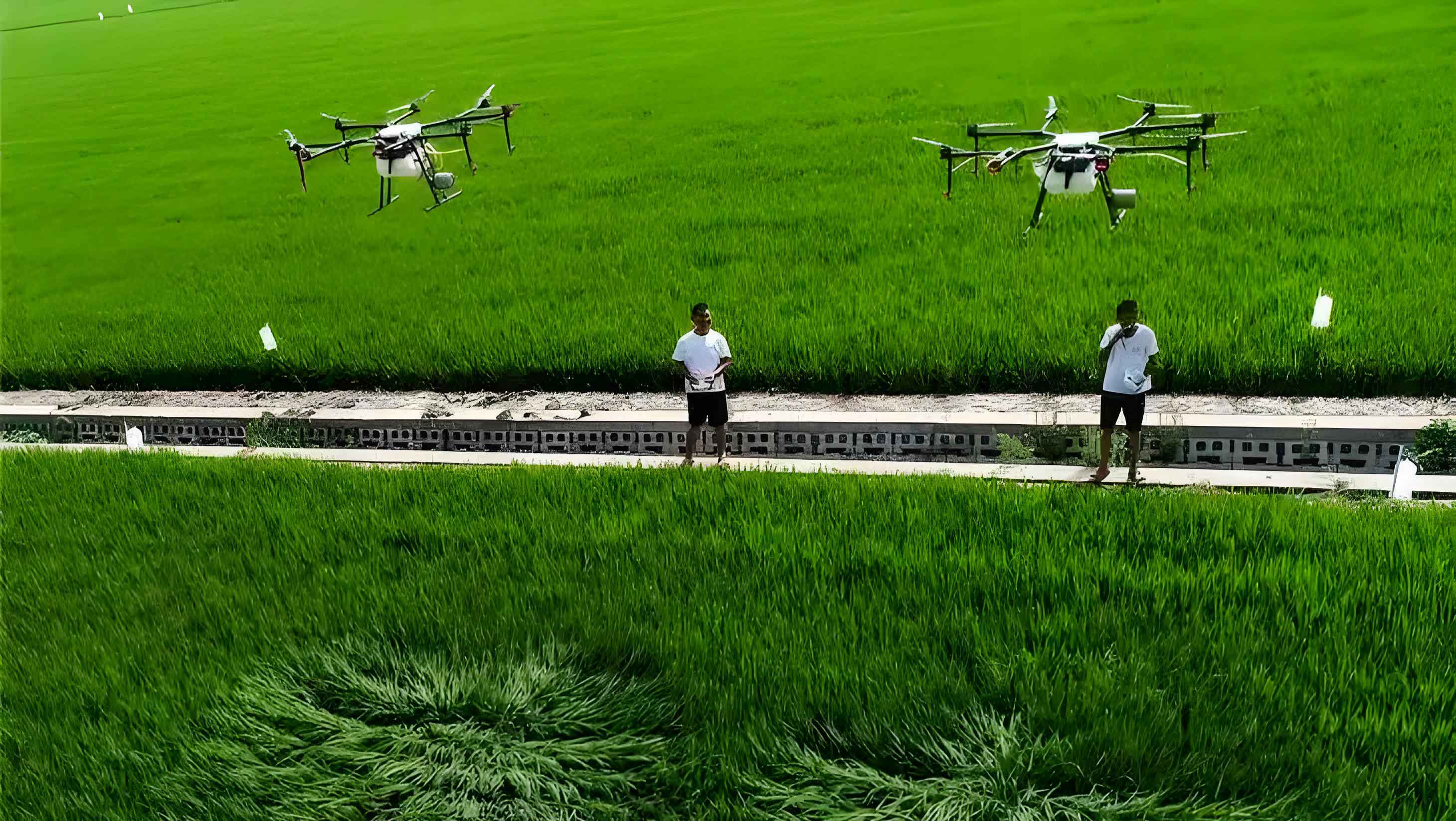
The experiment was conducted in a field with a typical maize-soybean intercropping pattern, where maize rows alternated with soybean strips. We selected two commercial spraying UAV models: one featuring a常温双峰弥雾 system (producing finer droplets) and another with dual atomization centrifugal nozzles. Both crop spraying drones were tested under different operational heights (1.5 m and 2.5 m above the maize canopy) and spray volumes (30 L/ha and 45 L/ha). The pesticide mixture included a combination of insecticides and a tracer dye for droplet analysis. We measured droplet deposition density and coverage on soybean leaves at upper, middle, and lower canopy layers, as well as on both adaxial and abaxial surfaces. Additionally, we assessed the control efficacy against S. exigua over 7 days and monitored crop safety for maize plants. Key formulas used in our analysis included the droplet deposition number, defined as the total number of droplets per unit area, and coverage percentage, calculated as the ratio of droplet-covered pixels to total pixels in scanned images. For instance, the droplet deposition number (N) is given by:
$$ N = \frac{\text{Total number of droplets}}{\text{Area of sampling paper}} $$
and the coverage (C) by:
$$ C = \frac{\text{Pixels covered by droplets}}{\text{Total pixels in image}} \times 100\% $$
Control efficacy was evaluated using standard formulas for insect population reduction, incorporating pre- and post-treatment counts. All data were analyzed statistically to determine significant differences among treatments.
Our results demonstrated that the crop spraying drone with the finer droplet atomization system achieved superior deposition in the lower canopy and on leaf undersides. For example, at an operational height of 2.5 m and spray volume of 45 L/ha, this spraying UAV recorded deposition numbers of up to 64.7 droplets/cm² on the upper canopy and 81.9 droplets/cm² on the lower leaf surfaces, with coverage values of 2.4% and 3.1%, respectively. In contrast, the other spraying UAV showed higher coverage on adaxial surfaces at a lower height of 1.5 m, reaching up to 7.7%. These differences highlight the importance of nozzle type and operational parameters in optimizing droplet distribution. The following table summarizes the droplet deposition numbers across different treatments and canopy layers:
| Treatment | Spraying UAV Type | Operational Height (m) | Spray Volume (L/ha) | Deposition Upper (droplets/cm²) | Deposition Middle (droplets/cm²) | Deposition Lower (droplets/cm²) |
|---|---|---|---|---|---|---|
| T1 | Fine Droplet UAV | 2.5 | 45 | 64.7 | 55.2 | 81.9 |
| T2 | Fine Droplet UAV | 1.5 | 45 | 11.5 | 13.2 | 9.9 |
| T3 | Fine Droplet UAV | 2.5 | 30 | 42.1 | 38.7 | 50.3 |
| T4 | Dual Nozzle UAV | 2.5 | 45 | 27.0 | 22.4 | 15.8 |
| T5 | Dual Nozzle UAV | 1.5 | 45 | 25.8 | 24.1 | 28.5 |
| T6 | Dual Nozzle UAV | 2.5 | 30 | 18.9 | 16.3 | 12.4 |
Control efficacy against S. exigua was high across all treatments, with most crop spraying drone applications achieving over 92% reduction in larval populations after 7 days. The fine droplet spraying UAV at 2.5 m height and 45 L/ha spray volume yielded the best results, with efficacy reaching 99.8%. This can be attributed to better canopy penetration and deposition on hidden pest habitats. The efficacy over time followed a logarithmic growth pattern, which we modeled using the equation:
$$ E(t) = E_{\text{max}} \left(1 – e^{-kt}\right) $$
where \( E(t) \) is the efficacy at time \( t \), \( E_{\text{max}} \) is the maximum efficacy, and \( k \) is a rate constant. For instance, in the optimal treatment, \( k \) was estimated at 0.35 per day, indicating rapid pest suppression. The table below details the control efficacy across different days post-application:
| Treatment | Spraying UAV Type | Efficacy at 1 Day (%) | Efficacy at 3 Days (%) | Efficacy at 7 Days (%) |
|---|---|---|---|---|
| T1 | Fine Droplet UAV | 78.1 | 95.2 | 99.8 |
| T2 | Fine Droplet UAV | 80.5 | 87.6 | 94.3 |
| T3 | Fine Droplet UAV | 85.4 | 96.8 | 98.9 |
| T4 | Dual Nozzle UAV | 92.7 | 97.1 | 99.1 |
| T5 | Dual Nozzle UAV | 88.3 | 95.9 | 97.5 |
| T6 | Dual Nozzle UAV | 96.3 | 98.4 | 99.5 |
Crop safety assessments revealed that most treatments did not cause significant phytotoxicity in maize plants. However, reductions in spray volume or environmental factors like wind drift led to minor leaf yellowing in some cases, classified as level 2 toxicity on a standard scale. This underscores the need for careful parameter selection to minimize off-target effects. The relationship between spray volume and phytotoxicity risk can be expressed as:
$$ P = \alpha \cdot \frac{1}{V} + \beta $$
where \( P \) represents phytotoxicity score, \( V \) is spray volume, and \( \alpha \), \( \beta \) are constants derived from regression analysis. In our data, \( \alpha \) was approximately 0.15 for the fine droplet spraying UAV, indicating that lower volumes increase risk slightly.
Discussion of these results emphasizes that operational height and spray volume are critical factors influencing the performance of crop spraying drones. The fine droplet system excelled in deposition uniformity and penetration, making it suitable for dense canopies, while the dual nozzle UAV performed better in coverage at lower heights. We also observed that wind speed during operations could alter droplet trajectories, affecting deposition. To quantify this, we used a drift potential model:
$$ D = \gamma \cdot H \cdot U^2 $$
where \( D \) is drift potential, \( H \) is operational height, \( U \) is wind speed, and \( \gamma \) is a drone-specific coefficient. For the spraying UAVs tested, \( \gamma \) ranged from 0.02 to 0.05, suggesting that heights above 2 m in windy conditions may increase drift. Thus, we recommend operating crop spraying drones at calibrated heights and volumes based on canopy structure and environmental factors.
In conclusion, this study demonstrates that crop spraying drones can effectively manage S. exigua in maize-soybean intercropping systems when parameters are optimized. The fine droplet spraying UAV at 2.5 m height and 45 L/ha spray volume provided the best balance of deposition, efficacy, and safety. Future work should explore real-time adjustments using sensors to further enhance the precision of spraying UAV applications. By integrating these insights, farmers can achieve sustainable pest control while minimizing environmental impact.