
In recent years, the application of crop spraying drones in agriculture has gained significant attention due to their efficiency, precision, and ability to reduce labor costs. Traditional methods of foliar fertilizer application, such as manual backpack sprayers, are labor-intensive and time-consuming, especially in hilly regions where crops like Acanthopanax trifoliatus are cultivated. This study explores the feasibility of using a spraying UAV to apply foliar fertilizers to Acanthopanax trifoliatus, with the aim of optimizing key operational parameters to enhance spray quality, crop yield, and leaf quality. The parameters investigated include spray concentration, flight speed, and operating height, which are critical factors influencing the deposition and effectiveness of foliar treatments.
The use of spraying UAVs offers several advantages over conventional methods, including higher coverage efficiency, reduced water consumption, and improved uniformity of application. However, the application of foliar fertilizers via drones requires careful consideration of concentration levels to avoid leaf burn while maximizing nutrient uptake. This research employs an orthogonal experimental design to systematically evaluate the effects of these parameters and identify the optimal combination for practical use in Acanthopanax trifoliatus cultivation.
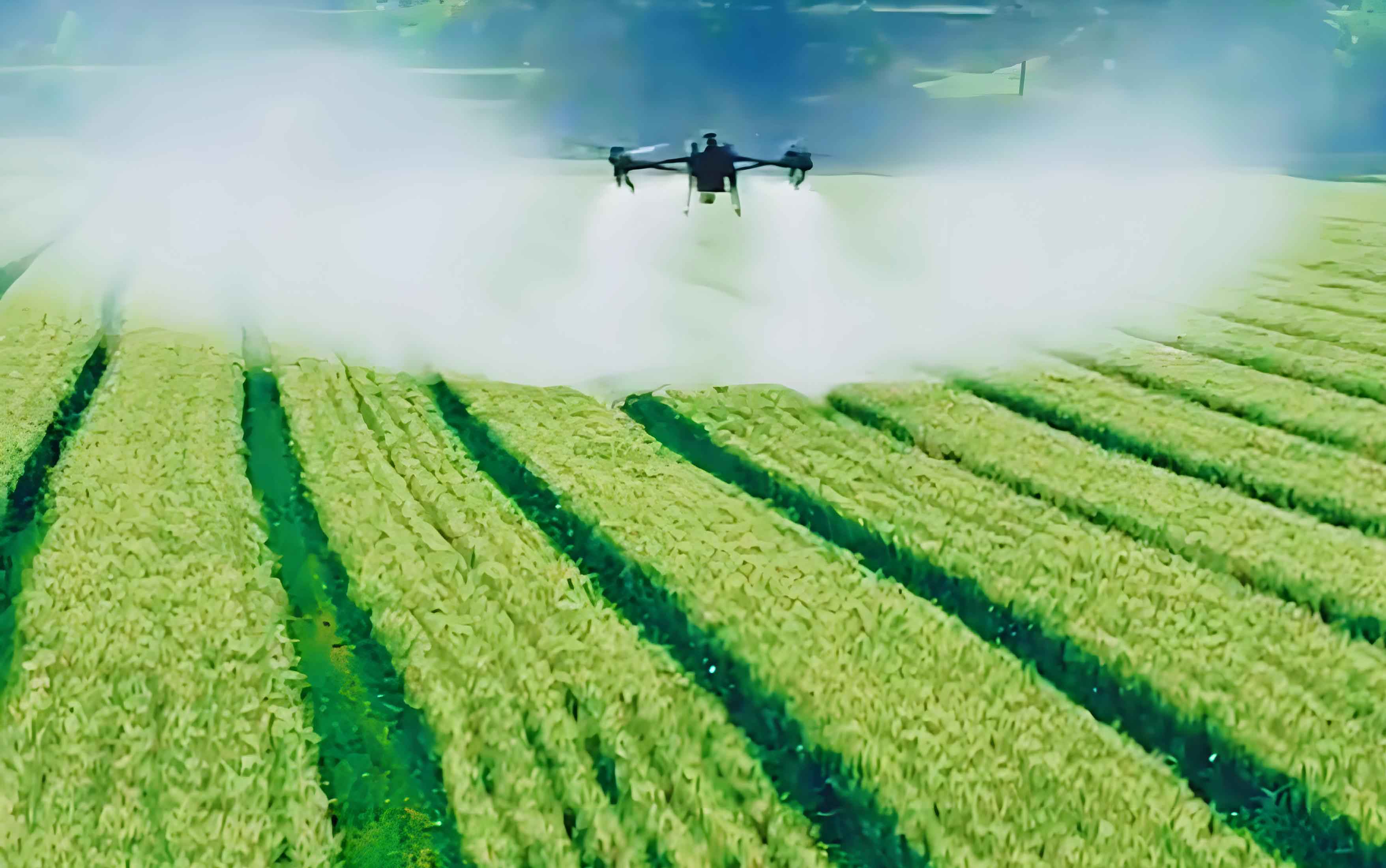
Foliar fertilization is a widely adopted technique in modern agriculture due to its rapid nutrient absorption and high utilization efficiency. It is particularly beneficial for crops like Acanthopanax trifoliatus, which is valued for its medicinal properties and is commonly processed into tea products. Enhancing yield and leaf quality, such as chlorophyll content, is essential for improving the economic value of this crop. The integration of crop spraying drones into foliar application processes can revolutionize farming practices by addressing challenges related to labor shortages and uneven application.
This paper presents a comprehensive analysis of the spray quality, crop yield, and leaf quality under varying operational parameters of a crop spraying drone. The findings aim to provide a scientific basis for the widespread adoption of UAV-based foliar fertilization in similar agricultural contexts, contributing to sustainable and precision agriculture.
Materials and Methods
The experiment was conducted using a quadcopter crop spraying drone, specifically the XAG P20-2019 model, equipped with centrifugal nozzles. The drone was operated under different settings of spray concentration, flight speed, and operating height to assess their impact on Acanthopanax trifoliatus. The foliar fertilizer used was a bio-enzyme-based product, and the recommended concentration for traditional spraying was diluted at a ratio of 600:1 (water to fertilizer).
To determine the safe and effective concentration range for UAV application, a preliminary concentration screening test was performed. Five concentration levels were tested: 1x, 3x, 5x, 8x, and 10x the recommended concentration. The assessment was based on the occurrence of leaf burn, characterized by yellowing, curling, and softening of leaves. Concentrations that did not cause burn symptoms were selected for further orthogonal experiments.
The orthogonal experimental design followed an L9(3^4) matrix, with three factors at three levels each:
– Spray concentration (A): 1x, 3x, and 5x the recommended concentration.
– Flight speed (B): 1.0 m/s, 1.5 m/s, and 2.0 m/s.
– Operating height (C): 1.0 m, 2.0 m, and 2.5 m.
A blank column was included to account for experimental error. Each treatment combination was replicated three times to ensure reliability.
The experimental field was located in a flat area with uniform crop growth. Acanthopanax trifoliatus plants were cultivated in ridges, with a plant height of 35–45 cm. The spraying UAV was operated at a constant flow rate of 40 L/ha, and the droplet size was preset to a volume median diameter of 200 μm. Water-sensitive papers were placed at sampling points to capture droplet deposition patterns, which were analyzed using image analysis software to determine droplet density and deposition amount.
Crop yield was measured by harvesting leaves from designated sampling areas and calculating the yield per hectare based on plant density and leaf count. Leaf quality was assessed by measuring chlorophyll content using spectrophotometry. The relative changes in yield and chlorophyll content compared to a control group (sprayed with water) were calculated to evaluate the treatment effects.
Statistical analyses, including range analysis and ANOVA, were performed to determine the significance of each factor and identify the optimal parameter combination. The correlation between droplet deposition density and amount was also examined using Pearson’s correlation coefficient.
Results
Spray Quality Analysis
The spray quality, characterized by droplet deposition density and deposition amount, varied significantly across different treatments. The droplet deposition density ranged from 53.8 to 195.4 droplets/cm², with the highest value observed in Treatment 1 (spray concentration: 5x, flight speed: 1.0 m/s, operating height: 2.0 m) and the lowest in Treatment 3 (spray concentration: 5x, flight speed: 2.0 m/s, operating height: 2.5 m). Similarly, the droplet deposition amount ranged from 0.1 to 0.3 μg/cm², following a similar pattern to deposition density.
A strong positive correlation was found between droplet deposition density and deposition amount, with a Pearson correlation coefficient of r = 0.810 (p < 0.001). This indicates that higher droplet density generally leads to greater deposition, which is crucial for effective foliar fertilization.
The range analysis revealed that flight speed had the greatest influence on spray quality, followed by operating height and spray concentration. The optimal combination for maximizing spray quality was A1B1C1, corresponding to a spray concentration of 5x the recommended level, flight speed of 1.0 m/s, and operating height of 2.0 m.
| Treatment | Spray Concentration (A) | Flight Speed (B) (m/s) | Operating Height (C) (m) | Droplet Density (droplets/cm²) | Droplet Deposition (μg/cm²) |
|---|---|---|---|---|---|
| 1 | 5x | 1.0 | 2.0 | 188.2 | 0.269 |
| 2 | 5x | 1.5 | 1.0 | 145.6 | 0.198 |
| 3 | 5x | 2.0 | 2.5 | 71.9 | 0.100 |
| 4 | 3x | 1.0 | 1.0 | 162.3 | 0.221 |
| 5 | 3x | 1.5 | 2.5 | 85.4 | 0.115 |
| 6 | 3x | 2.0 | 2.0 | 99.4 | 0.134 |
| 7 | 1x | 1.0 | 2.5 | 128.1 | 0.178 |
| 8 | 1x | 1.5 | 2.0 | 132.5 | 0.185 |
| 9 | 1x | 2.0 | 1.0 | 94.0 | 0.130 |
The ANOVA results confirmed that flight speed and operating height had significant effects on spray quality (p < 0.05), while spray concentration did not show statistical significance. This underscores the importance of optimizing flight parameters when using a spraying UAV for foliar applications.
Effects on Crop Yield and Leaf Quality
The application of foliar fertilizer via crop spraying drone significantly influenced the yield of Acanthopanax trifoliatus. The highest yield increase of 27.46% was observed in Treatment 1, compared to the control group. In contrast, Treatment 9 (spray concentration: 1x, flight speed: 2.0 m/s, operating height: 1.0 m) showed the smallest increase of 3.15%. The yield improvement was positively correlated with higher spray concentrations and lower flight speeds.
Leaf quality, measured as chlorophyll content, also exhibited notable variations. The maximum increase in chlorophyll content (33.23%) was recorded in Treatment 1, while the minimum increase (6.05%) occurred in Treatment 9. The results indicate that higher spray concentrations and optimal flight parameters enhance photosynthetic efficiency and leaf health.
The range analysis for yield and chlorophyll content highlighted spray concentration as the most influential factor, followed by flight speed and operating height. The optimal parameter combination for both yield and leaf quality was A1B1C1, consistent with the spray quality results.
| Treatment | Spray Concentration (A) | Flight Speed (B) (m/s) | Operating Height (C) (m) | Yield Increase (%) | Chlorophyll Increase (%) |
|---|---|---|---|---|---|
| 1 | 5x | 1.0 | 2.0 | 27.46 | 33.23 |
| 2 | 5x | 1.5 | 1.0 | 21.10 | 25.18 |
| 3 | 5x | 2.0 | 2.5 | 15.05 | 18.21 |
| 4 | 3x | 1.0 | 1.0 | 18.34 | 22.45 |
| 5 | 3x | 1.5 | 2.5 | 9.87 | 12.56 |
| 6 | 3x | 2.0 | 2.0 | 13.78 | 16.89 |
| 7 | 1x | 1.0 | 2.5 | 11.23 | 14.32 |
| 8 | 1x | 1.5 | 2.0 | 8.95 | 10.67 |
| 9 | 1x | 2.0 | 1.0 | 3.15 | 6.05 |
The ANOVA for yield and chlorophyll content confirmed that all three factors had significant effects (p < 0.05), with spray concentration being the most critical. This emphasizes the need for careful selection of fertilizer concentration when using a crop spraying drone to avoid under- or over-application.
Mathematical Modeling and Optimization
To further analyze the relationships between parameters and outcomes, mathematical models were developed. The droplet deposition density (D_d) can be expressed as a function of spray concentration (C), flight speed (V), and operating height (H):
$$D_d = k_1 \cdot C^{a} \cdot V^{b} \cdot H^{c}$$
where \(k_1\), \(a\), \(b\), and \(c\) are constants determined through regression analysis. Similarly, the yield increase (Y_i) and chlorophyll increase (Chl_i) can be modeled as:
$$Y_i = k_2 \cdot C^{d} \cdot V^{e} \cdot H^{f}$$
$$Chl_i = k_3 \cdot C^{g} \cdot V^{h} \cdot H^{i}$$
Based on the experimental data, the optimal values for the constants were estimated, and the models were used to predict performance under untested conditions. For instance, the droplet deposition density was maximized when C=5x, V=1.0 m/s, and H=2.0 m, yielding:
$$D_d = 188.212 \text{ droplets/cm}^2$$
These models provide a practical tool for farmers and operators to optimize spraying UAV parameters for specific crops and environmental conditions.
Discussion
The results demonstrate that the use of a crop spraying drone for foliar fertilizer application is not only feasible but also highly effective in enhancing crop yield and quality. The optimal parameters identified—spray concentration of 5x the recommended level, flight speed of 1.0 m/s, and operating height of 2.0 m—resulted in superior spray quality, yield increase, and chlorophyll content improvement. This alignment across multiple metrics underscores the robustness of the findings.
The significance of flight speed and operating height on spray quality can be attributed to the aerodynamic effects of the spraying UAV. Lower flight speeds and moderate operating heights facilitate better droplet penetration and deposition on the crop canopy, reducing drift and evaporation losses. Conversely, higher flight speeds lead to reduced deposition due to increased airflow disturbance and shorter exposure time.
Spray concentration emerged as the most critical factor for yield and leaf quality, highlighting the importance of nutrient dosage in foliar fertilization. The absence of leaf burn at concentrations up to 5x the recommended level indicates that spraying UAVs can safely apply higher concentrations than traditional methods, potentially due to the finer droplet size and uniform distribution. However, concentrations beyond 5x may risk phytotoxicity, as observed in the preliminary screening.
The strong correlation between droplet deposition density and amount suggests that monitoring deposition patterns can serve as a proxy for fertilization efficacy. This is particularly useful for real-time adjustment of spraying UAV operations to achieve desired outcomes.
Compared to conventional spraying methods, the crop spraying drone offers substantial benefits in terms of efficiency and resource utilization. For example, the drone completed the spraying tasks in a fraction of the time required for manual application, with consistent results across replications. This efficiency is crucial for large-scale farming operations and regions facing labor shortages.
Future research should focus on the long-term effects of UAV-based foliar fertilization on soil health and crop resilience, as well as the integration of smart technologies for autonomous parameter adjustment based on real-time sensor data.
Conclusion
This study successfully optimized the parameters for foliar fertilizer application on Acanthopanax trifoliatus using a crop spraying drone. The findings confirm that spray concentration, flight speed, and operating height significantly influence spray quality, crop yield, and leaf quality. The optimal combination—spray concentration of 5x the recommended level, flight speed of 1.0 m/s, and operating height of 2.0 m—achieved the best results, with a 27.46% increase in yield and a 33.23% increase in chlorophyll content compared to the control.
The use of a spraying UAV for foliar fertilization is a viable and efficient alternative to traditional methods, offering precision, scalability, and reduced environmental impact. The mathematical models derived from the data provide a foundation for further optimization and adoption in other crops and contexts. As agriculture continues to evolve towards precision and sustainability, crop spraying drones will play an increasingly vital role in enhancing productivity and resource efficiency.
We recommend that farmers and agricultural practitioners consider integrating spraying UAVs into their foliar fertilization practices, adhering to the optimized parameters outlined in this study. Continued innovation and research in UAV technology will further unlock its potential to transform modern agriculture.