
In recent years, the demand for efficient and flexible emergency inspection systems has grown significantly, driven by the need for rapid response in disaster management, infrastructure monitoring, and public safety. As a researcher in this field, I have focused on developing an integrated system that leverages multi-rotor drones and a mobile shelter to enhance inspection capabilities. Multi-rotor drones are particularly suitable for such tasks due to their maneuverability, stability, and ability to operate in diverse environments. This paper presents a comprehensive design of an emergency inspection system, including the shelter structure, task allocation algorithms, and experimental validation. The system aims to address limitations in existing technologies, such as limited compatibility and high complexity, by employing a modular approach and advanced optimization techniques.
The core of this system is a mobile shelter that serves as a base for storing, maintaining, and deploying multiple multi-rotor drones. This shelter, constructed from a standard 20GP container, incorporates a dual-layer landing platform mechanism that allows two drones to operate simultaneously. By integrating hardware and software components, the system enables autonomous takeoff, mission execution, and return of drones, thereby improving efficiency in emergency scenarios. In this work, I detail the system architecture, workflow, and algorithmic framework, emphasizing the use of ant colony optimization for task allocation and path planning. Simulation and real-world experiments demonstrate the system’s effectiveness in reducing inspection time and optimizing resource utilization.
The system architecture is designed with modularity in mind, combining hardware elements like the shelter, drones, and control systems with software components for flight planning and communication. Key hardware includes multi-rotor drones equipped with Pixhawk flight controllers and onboard computers (e.g., NUC), which interface with the QGroundControl (QGC) software for mission management. The shelter features a programmable logic controller (PLC) that manages the landing platforms’ movement, ensuring safe deployment and retrieval of drones. The workflow begins with mission planning in QGC, where inspection points are defined and uploaded to the drones. Upon receiving commands, the PLC extends the landing platforms, allowing the multi-rotor drones to take off autonomously. During flight, the onboard computer communicates with the flight controller via MAVROS in a ROS environment, sending control commands and monitoring status. After completing the inspection, the drones return to the shelter, and the PLC retracts the platforms, securing the drones for charging and maintenance.
To illustrate the system components, Table 1 summarizes the key elements and their functions. This modular design ensures scalability and adaptability to various emergency scenarios, making it ideal for rapid deployment.
| Component | Function |
|---|---|
| Multi-rotor Drones | Execute inspection tasks, equipped with sensors and communication modules |
| Mobile Shelter | Provides storage, charging, and protection for drones; includes landing platforms |
| Onboard Computer (NUC) | Processes data, runs algorithms, and interfaces with flight controllers |
| QGroundControl (QGC) | Ground station software for mission planning and monitoring |
| PLC | Controls shelter mechanisms, such as platform extension and retraction |
| Ant Colony Algorithm | Optimizes task allocation and path planning for multiple drones |
The workflow can be modeled as a sequence of states and transitions. Let \( S \) represent the system state, which includes drone status, platform position, and mission progress. The transition from takeoff to mission execution is governed by:
$$ S_{t+1} = f(S_t, U_t) $$
where \( U_t \) denotes the control input at time \( t \), such as commands from the onboard computer. This ensures a deterministic process, minimizing human intervention and enhancing reliability for multi-rotor drone operations.
The mobile shelter’s structural design is critical for supporting the multi-rotor drones in harsh environments. Based on a 20GP container, the shelter incorporates a dual-layer landing platform that uses a scissor-lift mechanism for vertical movement and a sliding mechanism for horizontal extension. This allows the upper and lower platforms to be deployed independently, enabling simultaneous operation of two multi-rotor drones. The scissor-lift is hydraulically driven and controlled by the PLC, which receives signals for lifting and lowering. For instance, when deploying the upper platform, the sliding forks extend, the scissor-lift raises to the upper level, and electric actuators push the platform into position. Similarly, the lower platform is engaged by lifting it from its resting position and securing it with pins. This design ensures compact storage and rapid deployment, which is essential for emergency responses where time is critical.
An automatic centering module is integrated into the landing platforms to ensure precise positioning and locking of the multi-rotor drones upon landing. This module consists of横向 and longitudinal arms that converge toward the center, guiding the drone’s landing gear to a designated spot. Once centered, locking plates secure the gear, preventing movement during platform retraction. The centering process can be described using a coordinate system where the platform center is at \( (0, 0) \). The displacement \( d \) of a drone’s landing gear is minimized by the centering force \( F_c \), given by:
$$ F_c = -k \cdot d $$
where \( k \) is a stiffness constant. This ensures that the multi-rotor drone is stabilized quickly, reducing the risk of damage and improving operational safety.
The platform deployment and retraction sequences are optimized for efficiency. For the upper platform, the steps include: (1) extending the sliding forks, (2) raising the scissor-lift to the upper level, (3) activating electric actuators to push the platform outward, and (4) locking it in place. The lower platform follows a similar process but involves lifting from a pinned position. The total time for deployment \( T_d \) can be estimated as:
$$ T_d = \sum_{i=1}^{n} t_i $$
where \( t_i \) represents the time for each step, and \( n \) is the number of steps. In practice, this design allows the shelter to ready multi-rotor drones for flight within minutes, making it highly responsive.
Task allocation is a fundamental aspect of maximizing the efficiency of multi-rotor drone fleets in inspection missions. In this system, the problem involves assigning multiple inspection points to two drones such that the total flight distance is minimized, and the workload is balanced. Let \( T = \{T_1, T_2, \dots, T_n\} \) be the set of \( n \) inspection points, and let \( m \) denote the number of multi-rotor drones (here, \( m = 2 \)). The objective is to find paths for each drone that start and end at the shelter location, visiting each point exactly once. The decision variable \( x_{ij}^k \) is defined as:
$$ x_{ij}^k = \begin{cases}
1 & \text{if drone } k \text{ travels from point } i \text{ to point } j \\
0 & \text{otherwise}
\end{cases} $$
The total flight distance \( L \) to be minimized is:
$$ L = \sum_{k=1}^{m} \left( \sum_{i=0}^{n} \sum_{j=0}^{n} D_{ij} \cdot x_{ij}^k + D_{0k} + D_{k0} \right) $$
where \( D_{ij} \) is the distance between points \( i \) and \( j \), \( D_{0k} \) is the distance from the shelter to the first point of drone \( k \), and \( D_{k0} \) is the distance from the last point back to the shelter. To ensure fairness, the difference in total distance between any two multi-rotor drones should not exceed 50 units, expressed as:
$$ |D_{k_1} – D_{k_2}| \leq 50 $$
for drones \( k_1 \) and \( k_2 \), where \( D_k = \sum_{i=1}^{n} \sum_{j=1}^{n} d_{ij} x_{ij}^k \). Additionally, constraints ensure that each point is visited exactly once:
$$ \sum_{k=1}^{m} \sum_{j=1}^{n} x_{ij}^k = 1 \quad \forall i \in T $$
and that the path is continuous for each multi-rotor drone:
$$ \sum_{j=1}^{n} x_{ij}^k = \sum_{j=1}^{n} x_{ji}^k \quad \forall i \in T, k \in \{1, 2\} $$
The ant colony optimization (ACO) algorithm is employed to solve this task allocation problem, mimicking the behavior of ants seeking food sources. In this analogy, inspection points represent food sources, and multi-rotor drones represent ants. The algorithm iteratively improves solutions by updating pheromone trails based on path quality. The probability \( P_{ij}^k \) of drone \( k \) moving from point \( i \) to point \( j \) is given by:
$$ P_{ij}^k = \frac{[\tau_{ij}(t)]^\alpha \cdot [\eta_{ij}(t)]^\beta}{\sum_{s \in \text{allow}_k} [\tau_{is}(t)]^\alpha \cdot [\eta_{is}(t)]^\beta} $$
where \( \tau_{ij}(t) \) is the pheromone level at time \( t \), \( \eta_{ij}(t) = 1 / D_{ij} \) is the heuristic desirability, \( \alpha \) and \( \beta \) are parameters controlling the influence of pheromones and heuristic information, and \( \text{allow}_k \) is the set of allowable points for drone \( k \). The pheromone update rule includes evaporation and deposition:
$$ \tau_{ij}(t+1) = (1 – \rho) \cdot \tau_{ij}(t) + \Delta \tau_{ij} $$
where \( \rho \) is the evaporation rate, and \( \Delta \tau_{ij} = \sum_{k=1}^{m} \frac{Q}{L_k} \) if drone \( k \) uses path \( (i,j) \), with \( Q \) being a constant and \( L_k \) the path length of drone \( k \). To further optimize paths, the 2-opt algorithm is applied as a local search technique, which swaps pairs of points in a path to reduce distance. For a path \( v \) with points \( v_1, v_2, \dots, v_n \), the original length \( L_{\text{before}} \) is computed as:
$$ L_{\text{before}} = \sum_{i=1}^{n-1} D(v_i, v_{i+1}) + D(v_1, v_{\text{start}}) + D(v_n, v_{\text{end}}) $$
After applying 2-opt, the new length \( L_{\text{after}} \) is calculated similarly, and if \( L_{\text{after}} < L_{\text{before}} \), the swap is accepted. This hybrid approach enhances the global search capability of ACO, making it suitable for multi-rotor drone task allocation.
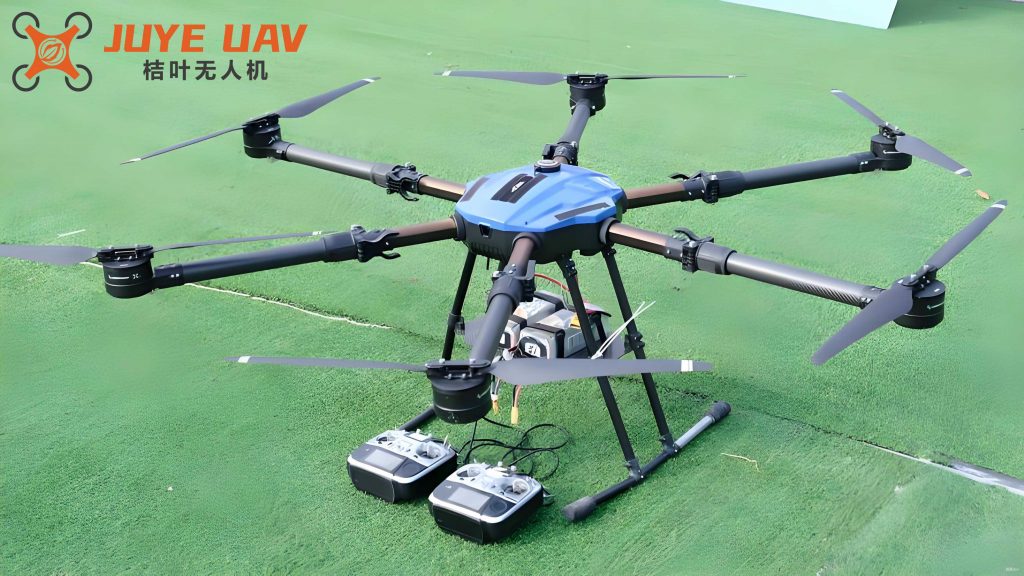
For simulation and experimental analysis, I set up a scenario with 2 multi-rotor drones, 12 inspection points, and a shelter at the origin. The coordinates of the points are stored in a matrix, and the ACO parameters are configured as shown in Table 2. The algorithm was run for 400 iterations to ensure convergence, and the results were validated through both software simulation and physical tests using hexacopter drones equipped with Pixhawk controllers and QGC for trajectory visualization.
| Parameter | Value |
|---|---|
| Number of Ants (\( m \)) | 2 |
| \( \alpha \) (Pheromone Influence) | 1 |
| \( \beta \) (Heuristic Influence) | 5 |
| \( \rho \) (Evaporation Rate) | 0.1 |
| \( Q \) (Pheromone Constant) | 50 |
| Maximum Iterations | 400 |
The inspection points were assigned to the two multi-rotor drones as detailed in Table 3, resulting in balanced paths with total distances of 283.3 m and 297.1 m, respectively. The convergence plot of the ACO algorithm showed a rapid decrease in path length during early iterations, stabilizing after about 200 iterations, indicating effective optimization. The paths were collision-free and covered all points efficiently, demonstrating the practicality of the approach for real-world applications.
| Drone ID | Assigned Path | Flight Distance (m) |
|---|---|---|
| k1 | T5 → T3 → T4 → T1 → T7 → T11 | 283.3 |
| k2 | T9 → T2 → T6 → T10 → T12 → T8 | 297.1 |
In physical tests, the multi-rotor drones successfully followed the planned trajectories, with QGC displaying real-time flight paths. The system’s reliability was confirmed through multiple trials, where all components functioned as intended, and the drones returned to the shelter without issues. The use of multi-rotor drones in this context highlights their versatility in adaptive mission planning, and the integration with the shelter ensures sustained operation over extended periods.
In conclusion, this work presents a robust emergency inspection system centered around multi-rotor drones and a mobile shelter. The design incorporates innovative mechanisms for drone management and employs advanced algorithms for task allocation and path optimization. The ant colony algorithm, combined with 2-opt local search, proves effective in minimizing flight distances and balancing workloads between multiple multi-rotor drones. Experimental results validate the system’s performance, showing significant improvements in inspection efficiency and response time. Future research could explore dynamic environments, more complex constraints, and the integration of additional sensors to enhance the capabilities of multi-rotor drone fleets in emergency scenarios.