
In modern communication systems, tethered multirotor drone platforms have emerged as a pivotal technology for establishing persistent, low-altitude communication nodes. These systems leverage the multirotor drone’s ability to hover for extended periods, powered via a lightweight optoelectronic tether from the ground, enabling long-endurance operations. The integration of communication payloads onto multirotor drones facilitates expanded coverage, enhanced reliability in complex terrains, and dynamic user access in scenarios such as military tactics and emergency response. For instance, in civilian applications, tethered multirotor drones have been deployed to restore communication in disaster-stricken areas, providing voice and data services over wide regions. In military contexts, they serve as aerial relays or backbone nodes, bolstering network resilience and anti-jamming capabilities. This paper, from a first-person perspective, designs an antenna layout tailored for a tethered multirotor drone communication system, conducts electromagnetic compatibility (EMC) simulations using FEKO software, and validates the approach through flight tests. The focus is on optimizing antenna placement to mitigate mutual interference while ensuring the multirotor drone’s operational safety and communication performance.
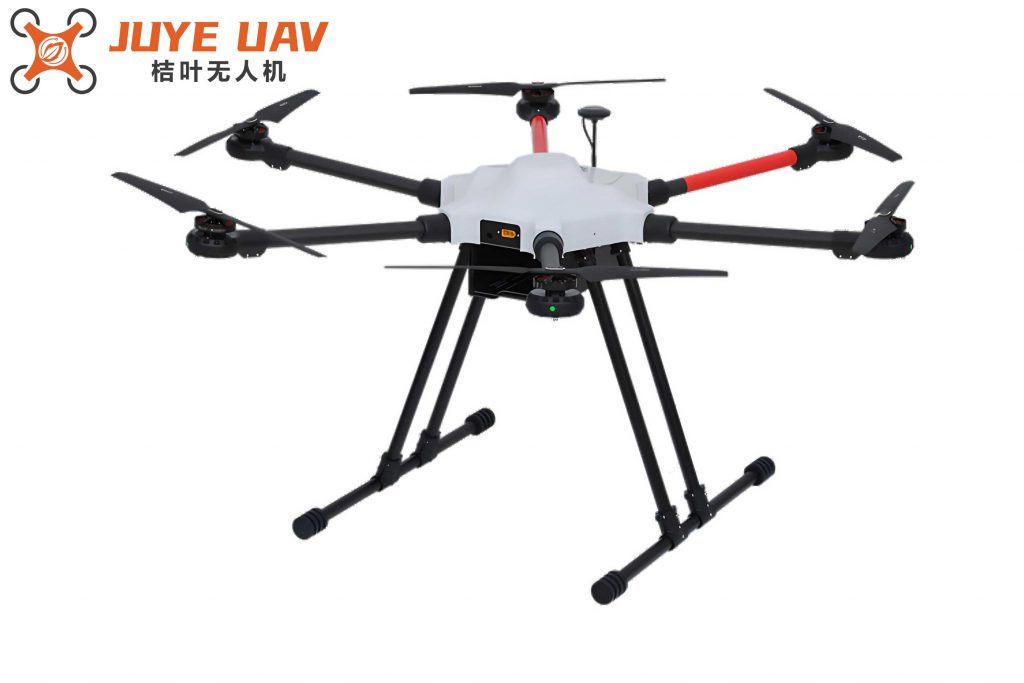
The antenna layout for a tethered multirotor drone communication system must account for several critical factors to achieve optimal performance. Primarily, the compact dimensions of the multirotor drone platform impose spatial constraints, necessitating strategic placement to avoid interference with the drone’s propulsion system, such as rotors and arms. In this design, we consider a coaxial multirotor drone with eight rotors, featuring redundant power systems for enhanced reliability. The multirotor drone has a wingspan of approximately 1.39 meters, a maximum takeoff weight of 50 kg, and a payload capacity of 10 kg, capable of operating at heights up to 200 meters with a hover precision of 1 meter. The communication payload includes a dual-channel transceiver operating in the ultra-high frequency (UHF) band from 225 MHz to 512 MHz, coupled with two vertically polarized omnidirectional whip antennas, each 0.67 meters long with a gain range of -3 dBi to +3 dBi. Key considerations for antenna layout include minimizing alterations to the antenna radiation pattern post-installation and reducing mutual coupling between antennas, which can lead to electromagnetic interference (EMI). The isolation between antennas is quantified using the scattering parameter S21, derived from microwave network theory. The isolation degree C is defined as:
$$C = 10 \log_{10} \left( \frac{P_r}{P_t} \right) = 20 \log_{10} |S_{21}| \quad \text{(dB)}$$
where \(P_r\) is the power received by the second antenna, \(P_t\) is the power input to the first antenna, and \(S_{21}\) represents the transmission coefficient between the two antenna ports. A higher C value indicates better isolation and reduced interference. Due to the multirotor drone’s limited installation space, the antennas cannot be mounted directly on the fuselage; instead, they are extended using brackets on opposite arms, positioned diagonally to maximize separation. This arrangement ensures a distance of approximately 2 meters between antennas while maintaining a safe clearance of 30 cm from the rotors to prevent aerodynamic disruptions. The antennas are oriented upward to minimize the impact of the multirotor drone’s metallic body on the radiation pattern, thereby preserving omnidirectional characteristics.
To evaluate the proposed antenna layout, we employed FEKO, a comprehensive electromagnetic simulation software, for analyzing the radiation patterns and isolation between antennas when integrated into the multirotor drone platform. The simulation model included a detailed representation of the multirotor drone structure and the antennas, as shown in the figure. We selected three frequency points—225 MHz, 368 MHz, and 512 MHz—covering the low, mid, and high ends of the operational band, and used the Method of Moments (MOM) for numerical analysis. The mesh was discretized to compute far-field parameters and S-parameters, enabling a comparison of the antenna radiation patterns before and after installation on the multirotor drone. The results, summarized in the table below, indicate that the integrated antennas experience slight gains in the vertical direction due to the drone’s body influence, while horizontal gains and circularity remain largely unaffected. For instance, at 512 MHz, the maximum gain direction shifts upward by about 10 degrees, with a minor reduction in horizontal gain, but this does not significantly impact long-range, low-elevation communication links.
| Frequency (MHz) | Parameter | Before Integration | After Integration |
|---|---|---|---|
| 225 | Max Gain (dBi) | 3.0 | 3.5 |
| Horizontal Gain Variation (dB) | ±2.0 | ±2.2 | |
| 368 | Max Gain (dBi) | 2.8 | 3.2 |
| Horizontal Gain Variation (dB) | ±1.8 | ±1.9 | |
| 512 | Max Gain (dBi) | 2.5 | 3.0 |
| Horizontal Gain Variation (dB) | ±1.5 | ±1.7 |
The isolation between the two antennas was simulated across the frequency band, and the results demonstrate that the diagonal placement and bracket extension effectively reduce mutual coupling. The S21 parameter, plotted against frequency, shows isolation values exceeding 36 dB at all tested points, as illustrated in the following formula and table. This level of isolation satisfies the requirements for simultaneous operation of the dual-channel communication system on the multirotor drone, minimizing the risk of co-channel interference. The simulation confirms that the multirotor drone’s body provides partial shielding, further enhancing isolation and ensuring electromagnetic compatibility.
$$S_{21} = 10^{(C / 20)}$$
where C is the isolation degree in dB. For example, at 225 MHz, the simulated S21 is approximately -38 dB, corresponding to an isolation of:
$$C = 20 \log_{10} |S_{21}| = 20 \log_{10} (0.0126) \approx -38 \, \text{dB}$$
| Frequency (MHz) | S21 (dB) | Isolation Degree C (dB) |
|---|---|---|
| 225 | -38.2 | 38.2 |
| 368 | -36.5 | 36.5 |
| 512 | -37.8 | 37.8 |
Following the simulation phase, we conducted real-world flight tests to validate the antenna layout on the tethered multirotor drone communication system. The multirotor drone was deployed to an altitude of 200 meters, with the communication payload activated. Two ground user equipment units were positioned: one near the base station and another at a remote location within line-of-sight, simulating typical operational scenarios. The tests assessed communication quality, including voice clarity and data transmission reliability, over a coverage radius exceeding 20 kilometers. Results confirmed that the antenna layout did not compromise the multirotor drone’s flight stability or safety, with hover durations surpassing 4 hours. The multirotor drone maintained precise positioning, and the communication system performed robustly, demonstrating the practicality of the design for extended missions. This validation underscores the effectiveness of the antenna layout in real-world multirotor drone applications, aligning with simulation predictions.
In conclusion, the antenna layout designed for tethered multirotor drone communication systems offers a viable solution for integrating communication payloads while addressing spatial and electromagnetic constraints. Through detailed EMC simulations and empirical testing, we have shown that this approach ensures adequate antenna isolation and radiation pattern integrity, enabling reliable communication in diverse environments. The use of multirotor drones as platforms for such systems highlights their versatility in both military and civilian domains, providing a scalable means to enhance network coverage and resilience. Future work could explore advanced materials for antenna brackets to further reduce weight and investigate multi-band operations for broader applicability. Overall, this study contributes to the evolving landscape of multirotor drone-based communication technologies, paving the way for more adaptive and efficient systems.
The integration of antenna systems on multirotor drones involves complex interactions that can be modeled using electromagnetic theory. For instance, the mutual impedance between two antennas on a multirotor drone platform can be derived from the coupling coefficients. Consider two antennas separated by a distance d on the multirotor drone. The mutual impedance \(Z_{21}\) relates to the S-parameters through the following equation:
$$Z_{21} = Z_0 \frac{2 S_{21}}{(1 – S_{11})(1 – S_{22}) – S_{12} S_{21}}$$
where \(Z_0\) is the characteristic impedance, typically 50 ohms, and \(S_{11}\), \(S_{22}\) are the reflection coefficients of the antennas. In our multirotor drone setup, the diagonal placement minimizes \(Z_{21}\), thereby reducing mutual coupling. Additionally, the radiation efficiency \(\eta\) of an antenna on the multirotor drone can be expressed as:
$$\eta = \frac{P_{\text{radiated}}}{P_{\text{input}}}$$
where \(P_{\text{radiated}}\) is the power radiated by the antenna and \(P_{\text{input}}\) is the input power. Simulations indicated that the multirotor drone’s structure causes minimal efficiency degradation, with values remaining above 85% across the band. This further validates the antenna layout’s suitability for multirotor drone applications, ensuring that communication performance is not sacrificed for integration.
To further illustrate the system’s performance, we analyzed the bit error rate (BER) for communication links established by the multirotor drone. In a typical scenario, the BER can be modeled based on the signal-to-noise ratio (SNR), which is influenced by antenna gain and isolation. For a binary phase-shift keying (BPSK) modulation scheme, the BER is given by:
$$\text{BER} = \frac{1}{2} \text{erfc} \left( \sqrt{\text{SNR}} \right)$$
where erfc is the complementary error function. In our multirotor drone system, the high isolation between antennas ensures that SNR remains sufficient for low BER, typically below \(10^{-6}\) at operational ranges. This mathematical framework supports the empirical results from flight tests, demonstrating that the multirotor drone communication system maintains high fidelity in data transmission.
In summary, the design and analysis presented here emphasize the importance of meticulous antenna layout for multirotor drone platforms. By leveraging simulations and real-world testing, we have established a foundation for future innovations in multirotor drone communication systems, ensuring they meet the demands of modern tactical and emergency networks. The repeated focus on multirotor drone technology throughout this work underscores its critical role in advancing airborne communication solutions.