
In modern military operations, transport helicopters are indispensable for their ability to perform vertical replenishment without terrain restrictions. They play critical roles in naval anti-submarine warfare, amphibious landings, special operations, battlefield rescue, and unimpeded transport. However, the current hoisting process in helicopter vertical replenishment, which includes lifting, transport, and unloading, heavily relies on manual labor. The helicopter’s downwash airflow often necessitates multiple ground crew members to complete the task, leading to prolonged operation times and reduced efficiency. To address these challenges, we have developed an autonomous hoisting system centered around a tethered quadcopter. This system aims to automate the lifting process, enhancing safety and efficiency by minimizing human intervention and withstanding environmental disturbances like strong downwash.
Our autonomous hoisting system comprises three main components: a storage device, a tethered quadcopter, and a docking mechanism. The storage device is mounted on the helicopter’s cabin floor and manages the deployment and retraction of the tether. The tethered quadcopter, connected to the tether’s end, carries the upper docking part and autonomously navigates to the lower docking part attached to the cargo. The docking mechanism ensures secure connection and release during hoisting and unloading. This paper details the design and analysis of these components, with a focus on the quadcopter’s structural and dynamic performance, validated through static simulations under extreme conditions.
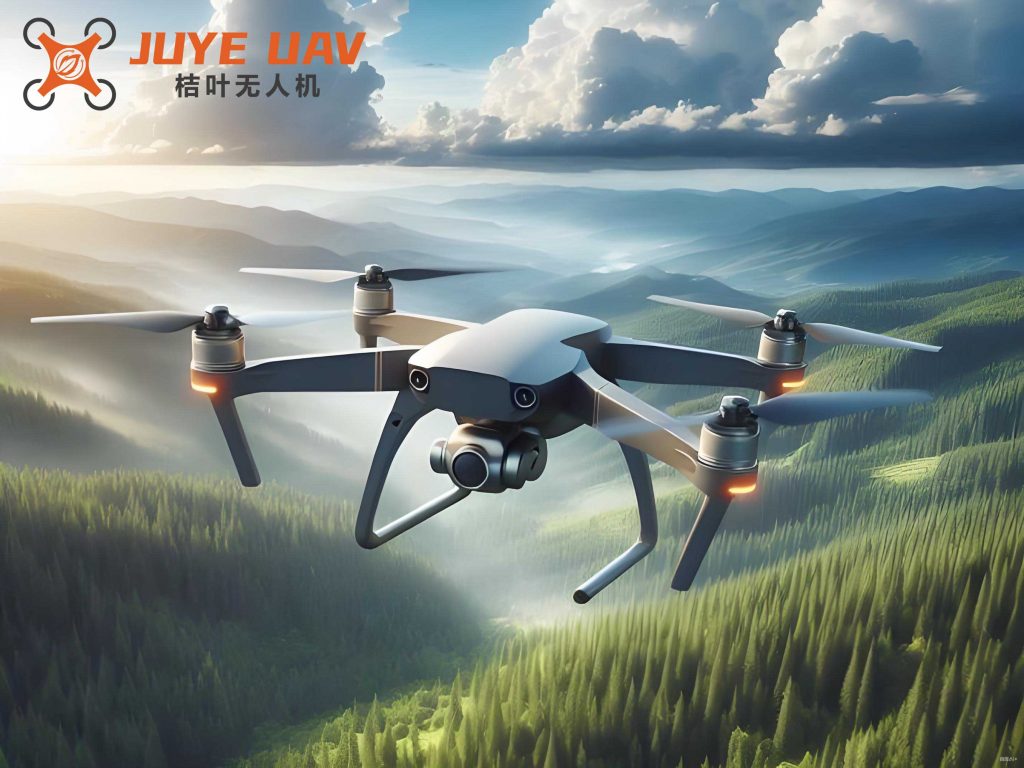
The tethered quadcopter is a pivotal element in our system, designed for compactness, lightweight, and high maneuverability. We adopted an X-layout configuration for the quadcopter, which offers a balance between size reduction and stability. The quadcopter’s frame dimensions were derived based on rotor parameters. For instance, the rotor radius \( r_p \) is 165.1 mm, and the maximum radius \( r_{\text{max}} \) is calculated as:
$$ r_{\text{max}} = 1.05 r_p \text{ to } 1.2 r_p $$
Using \( r_{\text{max}} = 194.45 \) mm, the frame radius \( R \) for a quadcopter with \( n = 4 \) arms and arm angle \( \theta = 90^\circ \) is:
$$ R = \frac{r_{\text{max}}}{\sin(\theta/2)} = \frac{r_{\text{max}}}{\sin(45^\circ)} \approx 275 \text{ mm} $$
We selected a arm length of 150 mm to accommodate electronic components while ensuring robustness. The quadcopter incorporates a morphing mechanism using a hollow threaded screw and sliding slots, allowing the arms to fold and reduce storage space. This morphing capability is crucial for efficient stowage in the helicopter’s limited belly space. The overall mass of the quadcopter, constructed from carbon fiber Hexcel AS4C, is approximately 4.79 kg, including a T14*3 screw and an 86-series through-type screw motor.
To withstand the helicopter’s downwash, equivalent to level 6 winds (10.8–13.8 m/s), we analyzed the quadcopter’s forward flight speed \( v \) using aerodynamic principles. The formula for \( v \) in terms of pitch angle \( \theta \) is:
$$ v(\theta) = \sqrt{\frac{2 M g \tan \theta}{\rho s [C_1 (1 – \cos^3 \theta) + C_2 (1 – \sin^3 \theta)]}} $$
where \( M \) is the total mass (4.79 kg), \( g = 9.8 \, \text{m/s}^2 \), \( \rho = 1.29 \, \text{kg/m}^3 \) (air density), \( s = 0.04 \, \text{m}^2 \) (cross-sectional area), and drag coefficients \( C_1 = 3 \), \( C_2 = 1.5 \). For a pitch angle of \( 20^\circ \), the calculated speed is 18.42 m/s, confirming the quadcopter’s ability to counteract downwash effects. This robustness is essential for reliable operation in challenging conditions, and the quadcopter’s design prioritizes repeated use of high-performance components to maintain stability.
| Parameter | Value | Description |
|---|---|---|
| Rotor Radius (\( r_p \)) | 165.1 mm | Radius of the propeller |
| Max Radius (\( r_{\text{max}} \)) | 194.45 mm | Calculated maximum radius |
| Frame Radius (\( R \)) | 275 mm | Radius of the quadcopter frame |
| Arm Length | 150 mm | Length of each quadcopter arm |
| Mass | 4.79 kg | Total mass including components |
| Pitch Angle (\( \theta \)) | 20° | Angle for wind resistance calculation |
| Forward Speed (\( v \)) | 18.42 m/s | Calculated speed to withstand downwash |
The docking mechanism is designed for high strength and reliability, consisting of an upper (passive) and lower (active) part. The upper part is attached to the quadcopter, while the lower part is fixed to the cargo. The mechanism uses a guide disk with cam slots and guide beams to convert rotational motion into linear movement for locking and unlocking. This design ensures quick and secure docking, even under dynamic conditions such as ship motion due to waves. The docking process involves the quadcopter aligning with the lower part, guided by conical surfaces, and then engaging the lock via motor-driven actions. This system allows for both attachment and detachment, facilitating full automation of hoisting and unloading cycles.
For the storage device, we implemented a compact electric hoist system with guide wheels to manage the tether. The quadcopter is secured in the stowed position using magnetic plates on its central hub and electromagnets in the storage unit, preventing movement during flight. This setup minimizes spatial requirements and ensures quick deployment when needed. The entire system is engineered for integration into the helicopter’s cabin, with considerations for weight distribution and accessibility.
To validate the structural integrity of the docking mechanism, we conducted static simulations using ANSYS Workbench, focusing on the docking latch—a critical component under maximum load during transport. Assuming a cargo mass of 1,000 kg, we applied forces and constraints to the latch model made of AISI 4340 steel. The mesh was refined to 0.5 mm triangular elements for accuracy. The analysis yielded stress and deformation results, with the maximum stress calculated as:
$$ \sigma_{\text{max}} = 608.39 \, \text{MPa} $$
Given the tensile strength of normalized AISI 4340 steel is 1,110 MPa, the safety factor \( SF \) is:
$$ SF = \frac{1110}{608.39} \approx 1.824 $$
This indicates sufficient safety margins, confirming the latch’s reliability under extreme hoisting conditions. The deformation was minimal, ensuring operational stability. Our approach emphasizes the use of finite element analysis to optimize components for weight and strength, crucial for the quadcopter-based system’s overall performance.
| Parameter | Value | Unit |
|---|---|---|
| Max Stress (\( \sigma_{\text{max}} \)) | 608.39 | MPa |
| Tensile Strength | 1110 | MPa |
| Safety Factor (\( SF \)) | 1.824 | Dimensionless |
| Max Deformation | Minimal (as per cloud diagram) | mm |
In conclusion, our autonomous hoisting system leveraging a tethered quadcopter addresses key limitations in helicopter vertical replenishment. The design integrates morphing capabilities, robust docking, and efficient storage, with static analysis verifying structural adequacy. Future work will involve dynamic testing and optimization for various operational scenarios. This innovation highlights the potential of quadcopter technology in enhancing military logistics, reducing human risk, and improving efficiency. The repeated application of quadcopter principles in this system underscores its versatility and reliability in autonomous operations.
Throughout this research, we have focused on maximizing the quadcopter’s performance through aerodynamic and structural optimizations. The formulas and tables provided summarize critical aspects, enabling replication and further development. By automating the hoisting process, our system not only mitigates the hazards of downwash but also sets a foundation for advanced autonomous systems in aviation. The quadcopter’s role as a versatile platform continues to inspire innovations in logistics and transportation, and we are committed to refining this technology for broader applications.