
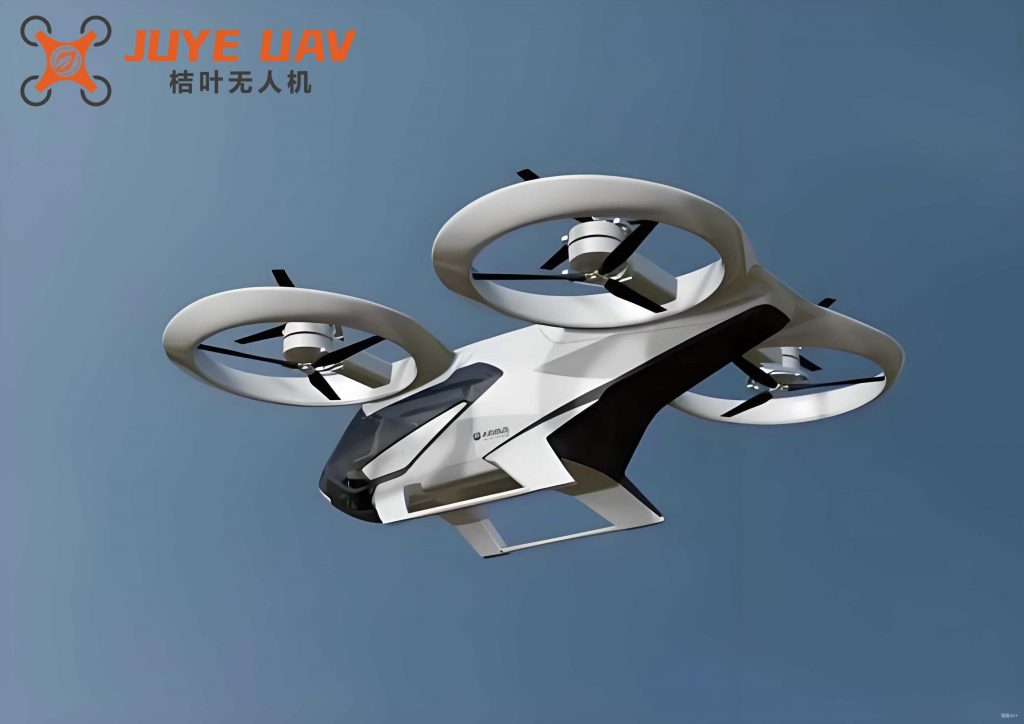
In recent years, quadcopter unmanned aerial vehicles (UAVs) have gained significant attention due to their capabilities in vertical take-off and landing, hovering, and agile maneuvering. These features make quadcopters ideal for applications such as environmental monitoring, security patrols, and disaster rescue operations. However, when a quadcopter is tasked with transporting a suspended payload via a cable, the system becomes highly coupled, nonlinear, and underactuated, posing substantial challenges for control design. External disturbances and performance constraints on the payload’s position further complicate the trajectory tracking problem. In this work, we address these issues by proposing a novel fixed-time sliding mode control strategy that ensures rapid convergence and adherence to specified output constraints.
The dynamics of a quadcopter with a suspended payload can be represented by a set of nonlinear equations. Let $m_Q$ and $m_L$ denote the masses of the quadcopter and payload, respectively, with total mass $m = m_Q + m_L$. The position dynamics of the payload are given by:
$$ \dot{p}_l = v_l $$
$$ \dot{v}_l = \frac{1}{m} \left[ u_{pa} + c_f + c_a – m_T g o_3 – m_Q l (q \times \dot{q} \times q) + \Delta_v \right] $$
where $p_l \in \mathbb{R}^3$ and $v_l \in \mathbb{R}^3$ are the payload position and velocity, $u_{pa}$ is the control input, $c_f$ and $c_a$ are coupling terms, $g$ is gravity, $l$ is the cable length, $q \in \mathbb{R}^3$ is the unit vector from the quadcopter to the payload, and $\Delta_v$ represents unknown disturbances. The swing dynamics and quadcopter attitude dynamics are similarly derived, with angular velocities $\omega$ and $\Omega$ for the payload and quadcopter, respectively. The rotation matrix $R$ from the inertial frame to the body frame satisfies $\dot{R} = R \skew{\Omega}$, where $\skew{\cdot}$ denotes the skew-symmetric operator.
To handle unknown nonlinear disturbances, we design a fixed-time disturbance observer. Let $\Delta_j$ represent the disturbance for subsystem $j \in \{v, \omega, \Omega\}$. The observer is formulated as:
$$ \dot{\hat{\Delta}}_j = c_1 \text{Sig}^{\alpha_1}(e_e) + c_2 \text{Sig}^{\alpha_2}(e_e) + c_3 e_e $$
where $e_e = \Lambda_j + \Delta_j – \hat{\Delta}_j$, $\alpha_1 = 1 – 1/\alpha_3$, $\alpha_2 = 1 + 1/\alpha_3$, $\alpha_3 > 1$, and $c_1, c_2, c_3 > 0$ are design parameters. This observer guarantees that the estimation error converges to zero within a fixed time $T_1$, independent of initial conditions.
For output constraints, we define barrier functions to ensure the payload position $p_l$ remains within prescribed bounds. Let $e_p = p_l – p_{ld}$ be the tracking error, where $p_{ld}$ is the desired trajectory. The constraint functions are given by $\Theta(t) = -\sigma_p e^{-\epsilon t} + \delta$ and $\bar{\Theta}(t) = \sigma_p e^{-\epsilon t} + \bar{\delta}$, with $0 < \delta, \bar{\delta} < 1$, $\epsilon > 0$, and $\sigma_p > 0$. The barrier Lyapunov function (BLF) is constructed as:
$$ \zeta_{pi} = \frac{(e_{pi} – \Theta_i)(\bar{\Theta}_i – e_{pi})}{(\bar{\Theta}_i – \Theta_i)^2} $$
for each channel $i \in \{1,2,3\$. This BLF ensures that $e_{pi}$ remains within $\Theta_i < e_{pi} < \bar{\Theta}_i$ for all time, provided the initial conditions satisfy the constraints.
We propose a nonsingular terminal sliding mode surface for the payload position subsystem:
$$ s_p = \zeta_p + \lambda_1 H(\zeta_p) + \lambda_2 \text{Sig}^{\chi}(\zeta_p) = 0 $$
where $\lambda_1, \lambda_2 > 0$, $0 < \chi = 1 – 1/\alpha_3 < 1$, and $H(\zeta_p)$ is a switching function to avoid singularity. The control law $u_{pa}$ is designed as:
$$ u_{pa} = m_T \left[ -F^{-1} (Q + \hat{O}_v + \dot{F}^{-1} \zeta_p + \dot{F}^{-1} F \zeta_p) – y_1 s_p – y_2 \text{Sig}^{\alpha_1}(s_p) – y_3 \text{Sig}^{\alpha_2}(s_p) \right] $$
with $y_1, y_2, y_3 > 0$ being control gains, and $\hat{O}_v$ is the estimated disturbance from the observer. This ensures that the sliding surface $s_p = 0$ is reached in fixed time $T_2$, and the tracking error $e_p$ converges to zero with prescribed performance.
Similar sliding mode surfaces and control laws are derived for the swing and attitude subsystems. For the swing dynamics, the surface is:
$$ s_q = e_\omega + \lambda_3 H(e_q) + \lambda_4 \text{Sig}^{\chi}(e_q) = 0 $$
and for the quadcopter attitude:
$$ s_R = e_\Omega + \lambda_5 H(e_R) + \lambda_6 \text{Sig}^{\chi}(e_R) = 0 $$
The control inputs $u_{qa}$ and $u_\Omega$ are designed analogously, incorporating disturbance estimates and fixed-time convergence terms.
To validate the proposed control strategy, we conduct numerical simulations with the following parameters:
| Parameter | Value | Description |
|---|---|---|
| $m_Q$ | 2 kg | Quadcopter mass |
| $m_L$ | 0.6 kg | Payload mass |
| $l$ | 0.6 m | Cable length |
| $g$ | 9.8 m/s² | Gravity |
| $J$ | diag{0.03, 0.03, 0.055} kg·m² | Inertia matrix |
The desired trajectory for the payload is $p_{ld} = [0.2\sin t + 1.4, 0.2\cos t + 1.2, 0.1t + 0.2]^\top$. External disturbances are set as $\Delta_v = 0.1 + 0.2\sin t$, $\Delta_\omega = 0.2 + 0.2\cos t$, and $\Delta_\Omega = 0.1 + 0.2(\sin t + \cos t)$. The constraint parameters are $\sigma_p = 2.0$, $\delta = \bar{\delta} = 0.05$, and $\epsilon = 0.175$.
Simulation results demonstrate that the proposed controller achieves rapid convergence and maintains the payload position within the specified constraints. The tracking errors for all channels converge to zero in fixed time, and the sliding surfaces reach zero as designed. The disturbance observer accurately estimates unknown perturbations within a fixed time frame. Comparative analysis with a backstepping sliding mode control approach from literature shows superior performance in terms of convergence speed and accuracy.
Performance metrics such as Integral Squared Error (ISE) and Integral Absolute Error (IAE) are used for quantitative evaluation:
| Channel | ISE (Proposed) | IAE (Proposed) | ISE (Comparative) | IAE (Comparative) |
|---|---|---|---|---|
| $p_1$ | 0.7820 | 1.0923 | 0.8594 | 6.2228 |
| $p_2$ | 0.7822 | 1.1271 | 0.9691 | 7.6414 |
| $p_3$ | 0.7865 | 1.1054 | 1.6915 | 8.9651 |
The results confirm that our method reduces both ISE and IAE values significantly, highlighting its effectiveness in handling disturbances and constraints for quadcopter systems.
In conclusion, we have developed a fixed-time sliding mode control scheme for a quadcopter with a suspended payload, incorporating a disturbance observer and output constraints. The proposed controller ensures fixed-time convergence of tracking errors while maintaining the payload position within predefined bounds. Future work will focus on extending this approach to multi-quadcopter systems and real-world implementation challenges.