
In recent years, quadrotor unmanned aerial vehicles (UAVs) have garnered significant attention due to their versatility in applications such as surveillance, payload transportation, and mapping. However, the inherent underactuation, strong coupling, and nonlinear dynamics of quadrotor systems, compounded by time-varying external disturbances, pose substantial challenges for control design. Traditional control strategies, including sliding mode control, backstepping control, and active disturbance rejection control, often focus on steady-state performance but lack mechanisms for enforcing transient performance constraints, particularly overshoot limitations. Overshoot constraints are critical in real-world scenarios, such as navigating narrow passages or carrying suspended loads, where excessive deviations can lead to collisions or instability. To address this, we propose a novel prescribed performance control approach based on an asymmetric time-varying barrier Lyapunov function (BLF) for quadrotor UAVs, enabling quantitative overshoot constraints while ensuring robustness against disturbances.
Our work introduces a tubular prescribed performance boundary that imposes continuous asymmetric constraints on the system output, allowing for precise regulation of overshoot. By integrating a radial basis function (RBF) neural network for disturbance estimation and an adaptive backstepping control framework, we achieve uniform ultimate boundedness of all closed-loop signals. Simulation results demonstrate the effectiveness of our method in constraining overshoot and enhancing tracking performance compared to conventional approaches. This paper is structured as follows: Section 1 describes the quadrotor dynamics and preliminaries; Section 2 details the novel BLF and controller design; Section 3 provides stability analysis; Section 4 presents simulation results; and Section 5 concludes the work.
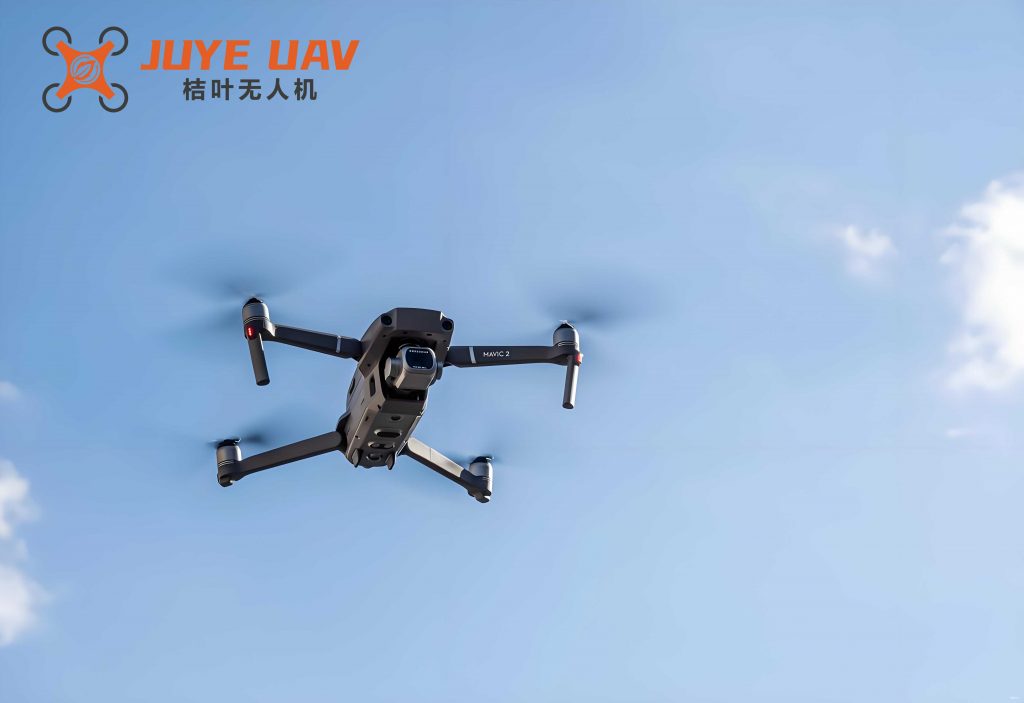
The dynamics of a quadrotor UAV are derived under the assumption of a rigid and symmetric body, with the center of mass coinciding with the geometric center. We define an inertial frame \( (O_eX_eY_eZ_e) \) and a body frame \( (O_bX_bY_bZ_b) \). The equations of motion are given by:
$$ \begin{aligned}
\ddot{x} &= u_1 (\cos\phi \sin\theta \cos\psi + \sin\phi \sin\psi) – \frac{k_1 \dot{x}}{m} + d_x(t), \\
\ddot{y} &= u_1 (\sin\phi \sin\theta \cos\psi + \cos\phi \sin\psi) – \frac{k_2 \dot{y}}{m} + d_y(t), \\
\ddot{z} &= u_1 \cos\phi \cos\psi – g – \frac{k_3 \dot{z}}{m} + d_z(t), \\
\ddot{\phi} &= u_2 – \frac{l k_4 \dot{\phi}}{I_1} + d_\phi(t), \\
\ddot{\theta} &= u_3 – \frac{l k_5 \dot{\theta}}{I_2} + d_\theta(t), \\
\ddot{\psi} &= u_4 – \frac{l k_6 \dot{\psi}}{I_3} + d_\psi(t),
\end{aligned} $$
where \( [x, y, z] \) and \( [\phi, \theta, \psi] \) represent the position and orientation states, respectively; \( m \) is the mass; \( l \) is the arm length; \( g \) is gravity; \( k_j \) (for \( j = 1, \dots, 6 \)) are drag coefficients; \( I_1, I_2, I_3 \) are moments of inertia; and \( d_p(t) \) (for \( p = x, y, z, \phi, \theta, \psi \)) are time-varying disturbances. The control inputs \( u_i \) (for \( i = 1, \dots, 4 \)) are defined as:
$$ \begin{aligned}
u_1 &= \frac{F_1 + F_2 + F_3 + F_4}{m}, \\
u_2 &= \frac{l(F_1 + F_2 + F_3 + F_4)}{I_1}, \\
u_3 &= \frac{l(-F_1 + F_2 + F_3 – F_4)}{I_2}, \\
u_4 &= \frac{C(F_1 – F_2 + F_3 – F_4)}{I_3},
\end{aligned} $$
with \( F_i \) denoting rotor thrusts and \( C \) a constant. We define state variables for the position subsystem as \( [x_1, x_2, x_3, x_4, x_5, x_6]^T = [x, \dot{x}, y, \dot{y}, z, \dot{z}]^T \) and for the attitude subsystem as \( [x_7, x_8, x_9, x_{10}, x_{11}, x_{12}]^T = [\theta, \dot{\theta}, \psi, \dot{\psi}, \phi, \dot{\phi}]^T \). The system can be simplified into:
$$ \begin{aligned}
\dot{x}_1 &= x_2, \quad \dot{x}_2 = u_{1x} – K_x x_2 + d_x(t), \\
\dot{x}_3 &= x_4, \quad \dot{x}_4 = u_{1y} – K_y x_4 + d_y(t), \\
\dot{x}_5 &= x_6, \quad \dot{x}_6 = u_{1z} – g – K_z x_6 + d_z(t), \\
\dot{x}_7 &= x_8, \quad \dot{x}_8 = u_2 – K_\phi x_8 + d_\phi(t), \\
\dot{x}_9 &= x_{10}, \quad \dot{x}_{10} = u_3 – K_\theta x_{10} + d_\theta(t), \\
\dot{x}_{11} &= x_{12}, \quad \dot{x}_{12} = u_4 – K_\psi x_{12} + d_\psi(t),
\end{aligned} $$
where \( u_{1x} = u_1 (\cos\phi \sin\theta \cos\psi + \sin\phi \sin\psi) \), \( u_{1y} = u_1 (\sin\phi \sin\theta \cos\psi + \cos\phi \sin\psi) \), \( u_{1z} = u_1 \cos\phi \cos\psi \), and \( K_p \) (for \( p = x, y, z, \phi, \theta, \psi \)) are simplified coefficients. We make the following assumptions:
Assumption 1: The disturbances \( d_p(t) \) are bounded, i.e., \( |d_p(t)| \leq D_{pm} \), where \( D_{pm} \) is a known positive constant.
Assumption 2: The desired trajectories \( p_d \) and their derivatives \( \dot{p}_d \) (for \( p = x, y, z, \phi, \theta, \psi \)) are bounded.
Key lemmas include:
Lemma 1: For a system with a continuously differentiable Lyapunov function \( V(x) \) satisfying \( \kappa_1(\|x\|) \leq V(x) \leq \kappa_2(\|x\|) \) and \( \dot{V}(x) \leq -\gamma V(x) + \rho \), where \( \kappa_1, \kappa_2 \) are class \( \mathcal{K}_\infty \) functions and \( \gamma, \rho > 0 \), the system solution is uniformly ultimately bounded.
Lemma 2: A barrier Lyapunov function \( V(x) \) defined on an open set \( D \) containing the origin is positive definite, continuously differentiable in \( D \), and approaches infinity as \( x \) approaches the boundary of \( D \). If \( V(x) \leq b \) for some \( b > 0 \) and initial conditions, then \( x \) remains in \( D \).
We propose a novel asymmetric time-varying BLF to address overshoot constraints continuously. Traditional BLFs, such as the logarithmic or tangent types, often impose symmetric constraints or involve discontinuous switching functions. Our BLF is defined as:
$$ V = \frac{1}{2} \ln^2\left( \frac{\Theta}{1 – \Theta} \right), \quad \Theta = \frac{e_{1i} – B}{\Delta B}, $$
where \( e_{1i} \) is the tracking error for state \( i \), \( \Delta B = \bar{B} – B \), with \( \bar{B} \) and \( B \) being the time-varying upper and lower bounds, respectively. The tubular prescribed performance boundary \( \text{tub}(\bar{B}, B) \) is designed as:
$$ \text{tub}(\bar{B}, B) = \begin{bmatrix} \frac{1 + \text{sigz}(e(0))}{2} & \frac{-1 + \text{sigz}(e(0))}{2} \\ \frac{-1 + \text{sigz}(e(0))}{2} & \frac{1 + \text{sigz}(e(0))}{2} \end{bmatrix} \begin{bmatrix} q_a \\ q_b \end{bmatrix}, $$
with
$$ q_a = (B_{a0} – B_{a\infty}) e^{-c_1 t} + B_{a\infty}, \quad q_b = (B_{b0} – B_{b\infty}) e^{-c_2 t} + B_{b\infty}, $$
and \( \text{sigz}(\cdot) \) being the sign function. This boundary ensures that the overshoot \( \sigma \) satisfies \( \sigma \leq \frac{1}{|e(0)|} \max\{|B_{a\infty}|, |B_{b\infty}|\} \), providing quantitative constraint.
For disturbance estimation, we employ an RBF neural network:
$$ d_p(x_p) = W_p^{*T} h_p(x_p) + \varepsilon_p(x_p), $$
where \( x_p = [p, \dot{p}, e_p, \dot{e}_p]^T \), \( h_p(x_p) \) is the Gaussian basis function, \( W_p^* \) is the ideal weight vector, and \( \varepsilon_p \) is the approximation error. The estimate is \( \hat{d}_p = \hat{W}_p^T h_p(x_p) \), with adaptive law designed later.
The controller design follows a backstepping approach for the position subsystem and a sliding mode control for the attitude subsystem. For the position subsystem (e.g., X-direction), define the error \( e_{1x} = x_1 – x_{1d} \). The novel BLF is:
$$ V_{x1} = \frac{1}{2} \ln^2\left( \frac{\Theta_x}{1 – \Theta_x} \right), \quad \Theta_x = \frac{e_{1x} – B_x}{\Delta B_x}. $$
Differentiating \( V_{x1} \):
$$ \dot{V}_{x1} = \ln\left( \frac{\Theta_x}{1 – \Theta_x} \right) \left[ \partial_x (\dot{e}_{1x} – \vartheta_x) \right], $$
where \( \partial_x = \frac{1}{\Theta_x(1 – \Theta_x) \Delta B_x} \) and \( \vartheta_x = \frac{\partial_x}{\Delta B_x} (-\dot{B}_x \bar{B}_x + B_x \dot{\bar{B}}_x – \Delta \dot{B}_x e_{1x}) \). Define \( e_{2x} = x_2 – \alpha_x \), with virtual control law:
$$ \alpha_x = \dot{x}_{1d} – \frac{1}{\partial_x} \left[ \gamma_{1x} \ln\left( \frac{\Theta_x}{1 – \Theta_x} \right) + \vartheta_x \right], $$
where \( \gamma_{1x} > 0 \). Then, \( \dot{V}_{x1} = -\gamma_{1x} \ln^2\left( \frac{\Theta_x}{1 – \Theta_x} \right) + \partial_x \ln\left( \frac{\Theta_x}{1 – \Theta_x} \right) e_{2x} \). Next, consider \( \dot{e}_{2x} = u_{1x} – K_x x_2 + d_x – \dot{\alpha}_x \). The Lyapunov function \( V_{x2} = V_{x1} + \frac{1}{2} e_{2x}^2 \) yields:
$$ \dot{V}_{x2} = -\gamma_{1x} V_{x1} + e_{2x} \left[ \partial_x \ln\left( \frac{\Theta_x}{1 – \Theta_x} \right) + u_{1x} – K_x x_2 + d_x – \dot{\alpha}_x \right]. $$
Design the control law:
$$ u_{1x} = K_x x_2 – \hat{d}_x + \dot{\alpha}_x – \partial_x \ln\left( \frac{\Theta_x}{1 – \Theta_x} \right) – \gamma_{2x} e_{2x}, $$
with \( \gamma_{2x} > \frac{\gamma_{1x} + 1}{2} \). The neural network adaptive law is:
$$ \dot{\hat{W}}_x = \gamma_{3x} e_{2x} h_x – 2 \gamma_{1x} \hat{W}_x, $$
where \( \gamma_{3x} > 0 \). Similarly, for Y and Z directions:
$$ \begin{aligned}
u_{1y} &= K_y x_4 – \hat{d}_y + \dot{\alpha}_y – \partial_y \ln\left( \frac{\Theta_y}{1 – \Theta_y} \right) – \gamma_{2y} e_{2y}, \\
u_{1z} &= K_z x_6 – \hat{d}_z + \dot{\alpha}_z + g – \partial_z \ln\left( \frac{\Theta_z}{1 – \Theta_z} \right) – \gamma_{2z} e_{2z},
\end{aligned} $$
with corresponding adaptive laws. The desired attitudes \( \theta_d \) and \( \psi_d \) are computed from \( u_{1x}, u_{1y}, u_{1z} \) and given \( \phi_d \):
$$ \begin{bmatrix} \theta_d \\ \psi_d \\ u_1 \end{bmatrix} = \begin{bmatrix} \arcsin\left( \frac{\cos\phi_d (u_{1x} \cos\phi_d + u_{1y} \sin\phi_d)}{u_{1z}} \right) \\ \arctan\left( \frac{\cos\phi_d (u_{1x} \sin\phi_d + u_{1y} \cos\phi_d)}{u_{1z}} \right) \\ \frac{u_{1z}}{\cos\phi_d \cos\psi_d} \end{bmatrix}. $$
For the attitude subsystem, we use a backstepping sliding mode control. Define sliding surfaces \( s_k = \lambda_k e_{1k} + e_{2k} \) for \( k = \phi, \theta, \psi \), where \( e_{2k} = x_{2k} – \alpha_{k1} \), \( \alpha_{k1} = -c_{k1} e_{1k} + \dot{k}_d \), and \( \lambda_k, c_{k1} > 0 \). The control laws are:
$$ \begin{aligned}
u_2 &= K_\phi x_8 + \dot{\alpha}_{\phi 1} – \lambda_\phi (e_{2\phi} – c_{\phi 1} e_{1\phi}) – \left[ h_\phi s_\phi + \eta_\phi \text{sgn}(s_\phi) \right], \\
u_3 &= K_\theta x_{10} + \dot{\alpha}_{\theta 1} – \lambda_\theta (e_{2\theta} – c_{\theta 1} e_{1\theta}) – \left[ h_\theta s_\theta + \eta_\theta \text{sgn}(s_\theta) \right], \\
u_4 &= K_\psi x_{12} + \dot{\alpha}_{\psi 1} – \lambda_\psi (e_{2\psi} – c_{\psi 1} e_{1\psi}) – \left[ h_\psi s_\psi + \eta_\psi \text{sgn}(s_\psi) \right],
\end{aligned} $$
with \( \eta_k > D_{pm} \) and \( h_k > 0 \). A finite-time differentiator is used to compute derivatives of \( \theta_d \) and \( \psi_d \):
$$ \begin{aligned}
\dot{x}_{a1} &= x_{a2}, \\
\dot{x}_{a2} &= x_{a3}, \\
\dot{x}_{a3} &= -2 \cdot 3^{5/4} \left( x_{a1} – v(t) + (\omega x_{a2})^{9/7} \right)^{1/3} – 4 (\omega^2 x_{a3})^{3/5},
\end{aligned} $$
where \( v(t) \) is the input signal, \( \omega = 0.04 \), and outputs are \( y_{a1} = x_{a2} \), \( y_{a2} = x_{a3} \). Control inputs are saturated to \( |u_i| \leq u_{i \text{max}} \) for \( i = 2, 3, 4 \), and the total thrust \( u_1^* = m u_1 \) is limited to \( |u_1^*| \leq u_{1 \text{max}} \).
Stability analysis is conducted using the Lyapunov function \( V_s = V_p + V_a \), where \( V_p \) and \( V_a \) correspond to position and attitude subsystems, respectively. For the position subsystem, \( V_p = \sum_{i=x,y,z} \left[ \frac{1}{2} \ln^2\left( \frac{\Theta_i}{1 – \Theta_i} \right) + \frac{1}{2} e_{2i}^2 + \frac{1}{2 \gamma_{3i}} \tilde{W}_i^T \tilde{W}_i \right] \), and for the attitude subsystem, \( V_a = \sum_{k=\phi,\theta,\psi} \left( \frac{1}{2} e_{2k}^2 + s_k^2 \right) \). Differentiating \( V_s \) and substituting the control laws yields:
$$ \dot{V}_s \leq -\gamma_{1 \text{min}} V_s + \rho_{\text{max}}, $$
where \( \gamma_{1 \text{min}} = \min(\gamma_{1x}, \gamma_{1y}, \gamma_{1z}) \) and \( \rho_{\text{max}} \) is a bounded term. By Lemma 1, all signals are uniformly ultimately bounded, and the tracking errors remain within the prescribed bounds \( (B_i, \bar{B}_i) \).
Simulations validate the proposed method. The quadrotor parameters are listed in Table 1.
| Parameter | Value | Parameter | Value | Parameter | Value | Parameter | Value |
|---|---|---|---|---|---|---|---|
| \( m \) (kg) | 1.79 | \( I_2 \) (kg·m²) | 0.03 | \( k_1 \) (N·s/m) | 0.01 | \( k_4 \) (N·s/rad) | 0.012 |
| \( g \) (m/s²) | 9.8 | \( I_3 \) (kg·m²) | 0.04 | \( k_2 \) (N·s/m) | 0.01 | \( k_5 \) (N·s/rad) | 0.012 |
| \( I_1 \) (kg·m²) | 0.03 | \( l \) (m) | 0.2 | \( k_3 \) (N·s/m) | 0.01 | \( k_6 \) (N·s/rad) | 0.012 |
In the first scenario, the quadrotor tracks a spiral trajectory under time-varying disturbances. The desired trajectory is \( [x_d, y_d, z_d, \phi_d]^T = [4 \sin(0.5t), 4 \cos(0.5t), 4 + 0.5t, \pi/6]^T \), with initial conditions \( [x(0), y(0), z(0)]^T = [1, 5, 5]^T \) and \( [\phi(0), \theta(0), \psi(0)]^T = [0, 0, 0]^T \). Disturbances are \( d_i(t) = 0.1 \sin(t) \) for \( i = x, y, z, \phi, \theta, \psi \). The tubular boundary parameters are \( B_{a0j} = 3 \), \( B_{b0j} = 0.6 \), \( B_{a\infty j} = 0.01 \), \( B_{b\infty j} = -0.01 \), \( c_{1j} = 3 \), \( c_{2j} = 3 \) for \( j = x, y, z \). The RBF network has a 4-5-1 structure with centers \( c_j = [-1, -0.5, 0, 0.5, 1] \) and width \( b_j = 3 \). Controller gains are listed in Table 2.
| Parameter | Value | Parameter | Value | Parameter | Value | Parameter | Value |
|---|---|---|---|---|---|---|---|
| \( \gamma_{1x} \) | 6 | \( c_{\phi 1} \) | 11 | \( \lambda_\theta \) | 17 | \( \eta_\psi \) | 1.6 |
| \( \gamma_{1y} \) | 3 | \( c_{\theta 1} \) | 10 | \( \lambda_\psi \) | 15 | \( h_\phi \) | 20 |
| \( \gamma_{1z} \) | 3 | \( c_{\psi 1} \) | 10 | \( \eta_\phi \) | 1 | \( h_\theta \) | 30 |
| \( \gamma_{1j} \) | 10 | \( \lambda_\phi \) | 16 | \( \eta_\theta \) | 1 | \( h_\psi \) | 32 |
Results show that the proposed controller constrains overshoot effectively, with errors remaining within the tubular boundaries. The quadrotor achieves smooth tracking with minimal deviation. In a second scenario, a complex “double cloverleaf” trajectory is tracked under multi-source disturbances: \( d_x(t) \) includes constant, periodic, and divergent components, while other disturbances are \( d_i(t) = 0.1 \sin(t) \). Comparisons with traditional tangent BLF (TBLF), sliding mode control (SMC), and novel finite-time SMC (NSMC) methods demonstrate the superiority of our approach in overshoot reduction and robustness. The tubular boundaries ensure quantitative overshoot limits, and the control inputs exhibit lower fluctuations compared to other methods.
In conclusion, we have developed a prescribed performance control strategy for quadrotor UAVs that enforces quantitative overshoot constraints using a novel asymmetric time-varying barrier Lyapunov function. The tubular prescribed performance boundary provides continuous asymmetric constraints, enhancing transient performance. Integrated with neural network disturbance estimation and adaptive backstepping control, the method ensures uniform ultimate boundedness and effective tracking. Simulations confirm its advantages over existing techniques, making it suitable for applications requiring precise overshoot control. Future work will explore real-time implementation and extension to multi-quadrotor systems.