
In modern emergency response scenarios, particularly in power grid restoration and disaster relief operations, effective illumination is critical for safety and efficiency. Traditional emergency lighting systems often face limitations due to their bulky design, fixed illumination angles, and short battery life, which hinder their deployment in challenging environments like mountainous terrains or post-typhoon sites. To address these issues, I have developed a tethered lighting system utilizing multi-rotor unmanned aerial vehicles (UAVs), specifically designed as a lighting UAV or lighting drone. This system integrates advanced technologies such as high power-to-weight ratio motors, high-voltage power conversion, tethered composite fiber-optic cables, aerodynamic rotor platform design, and remote signal transmission. By combining conventional emergency lights with tethered multi-rotor UAVs and enhancing them, this lighting UAV solution overcomes the drawbacks of traditional methods, significantly reducing safety risks during nighttime operations and accelerating power restoration efforts.
The core of this lighting drone system comprises an aerial lighting module and a ground-based power supply unit. The aerial component includes a modular quick-release mount, an automatic tracking and adjustment mechanism for illumination, and high-power LED searchlights. A high-definition camera is attached to the modular mount, while the LED arrays are mounted on the tracking system, all carried by the multi-rotor UAV. The ground system consists of a power source, such as a 220 V AC supply or diesel generator, a transformer that converts AC to 400 V DC, and a lightweight tethered composite fiber-optic cable that transmits power and data over distances up to 100 meters. This cable not only delivers electricity to the lighting UAV but also facilitates real-time video transmission from the aerial unit to the ground control center, ensuring adaptive illumination based on environmental needs.
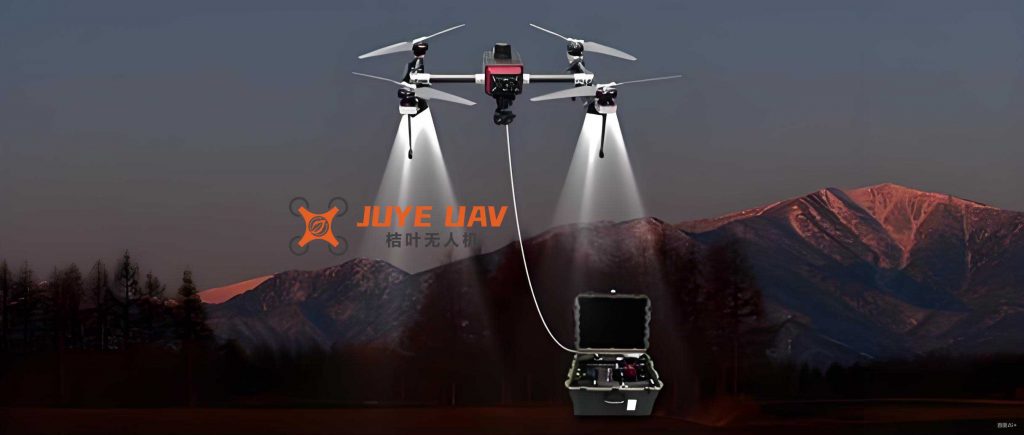
The aerial lighting system of this lighting drone is engineered for durability and flexibility. The modular quick-release mount is fabricated using computer-aided 3D modeling and fused deposition modeling (FDM) printing, which allows for complex geometries with high thermal stability and chemical resistance. This ensures a strong weight-to-strength ratio, critical for maintaining stability during flight. The automatic tracking system employs intelligent following and distance recognition technologies to adjust illumination angles and brightness dynamically. For instance, it can focus light on specific work areas while minimizing glare for personnel, thereby enhancing safety. The high-power LED searchlights feature a design with a transparent plate, front cover, mounting clip, LED modules, and rear housing. The LEDs are installed on the rear housing, and the front cover includes openings for light emission, covered by a textured transparent plate that diffuses light evenly. Heat dissipation slots on the cover and housing prevent overheating, ensuring consistent performance. An onboard voltage reducer is connected between the LED lights and the tethered cable, stepping down the input from 400 V DC to 48 V DC for the LEDs and providing a power interface for the UAV. This reducer includes heat dissipation holes to manage thermal loads, as illustrated in the design schematics.
To quantify the performance of the lighting UAV, consider the following table summarizing key parameters of the aerial lighting components:
| Component | Parameter | Value | Description |
|---|---|---|---|
| Modular Mount | Material Strength | High | FDM-printed with thermal stability |
| LED Searchlight | Power Consumption | Up to 500 W | Adjustable brightness |
| Tracking System | Adjustment Range | 0-180 degrees | Automatic angle and distance tracking |
| Onboard Reducer | Efficiency | >95% | Converts 400 V DC to 48 V DC |
The ground-based power supply system for the lighting drone is designed for reliability and portability. It includes a power generation unit, a transformer, and the tethered composite fiber-optic cable. The transformer utilizes pulse-width modulation (PWM) technology to convert input AC voltage to a stable 400 V DC output. The process involves input filtering to suppress noise, rectification to DC, and an input buffer circuit to handle voltage and current surges. Protection mechanisms, such as over-voltage and under-voltage safeguards, ensure safe operation. The main control circuit monitors input and output parameters, adjusting the inverter switches to maintain stability. The tethered cable, made of aluminum alloy, is lightweight yet robust, reducing the load on the UAV while providing high electrical conductivity. Additionally, it incorporates optical fibers for data transmission, allowing the aerial unit to relay video and sensor data to the ground with minimal latency. This dual functionality enhances the lighting drone’s operational range and altitude capabilities.
The power conversion efficiency in the ground system can be modeled using the formula for electrical power: $$ P = V \times I $$ where \( P \) is power in watts, \( V \) is voltage in volts, and \( I \) is current in amperes. For instance, with an input of 220 V AC and an output of 400 V DC, the transformer’s efficiency \( \eta \) is given by: $$ \eta = \frac{P_{\text{output}}}{P_{\text{input}}} \times 100\% $$ Typically, this system achieves efficiencies above 90%, minimizing energy loss. The use of high-voltage DC transmission reduces current flow, as per Ohm’s law: $$ I = \frac{P}{V} $$ which decreases power dissipation \( P_{\text{loss}} = I^2 R \) in the cable, where \( R \) is the resistance. This allows for a thinner, lighter cable, further optimizing the lighting UAV’s performance.
Operational procedures for the lighting drone system are straightforward but require strict adherence to safety protocols. First, the ground power unit is disconnected from the aerial end, and the input is connected to a 220 V AC source. After securing the connection and switching on the circuit breaker, the power unit is activated to test no-load output, with voltage adjusted to 400 V and current set to maximum. The output is then turned off, and the ground-to-air interface is connected securely. The UAV is powered by a backup battery for initial checks, ensuring self-diagnosis is complete. Cables are inspected for tangles to prevent in-flight hazards. Once the power output is enabled, indicated by a “voltage stable” light, the lighting drone is ready for takeoff. Safety measures include pre-use inspections for cable damage, verification of input voltage, and monitoring for fault indicators. The UAV must always have a backup battery to prevent crashes due to power failures, and operators should avoid prolonged full-load operation to maintain system integrity.
The advantages of this lighting UAV are evident in its application. For example, in post-typhoon scenarios, the lighting drone can be deployed rapidly to illuminate large areas from above, adapting angles to avoid shadows and glare. The high-voltage transmission reduces energy loss, and the lightweight cable extends flight duration. Compared to traditional systems, this lighting drone offers superior mobility, as shown in the table below:
| Aspect | Traditional Lighting | Lighting UAV System |
|---|---|---|
| Weight | Bulky (>50 kg) | Lightweight (<10 kg) |
| Illumination Angle | Fixed | Adjustable (0-180°) |
| Operational Time | Limited by batteries | Continuous via tether |
| Transport | Difficult in rough terrain | Easy deployment |
In conclusion, the tethered lighting system based on multi-rotor UAVs represents a significant advancement in emergency illumination. This lighting drone addresses the inefficiencies of conventional methods by providing flexible, high-intensity lighting from optimal altitudes, supported by a robust power supply. The integration of aerodynamic design, efficient power conversion, and real-time data transmission ensures that the system can operate continuously in diverse conditions, from mountainous regions to disaster zones. By reducing safety risks and enhancing operational speed, this lighting UAV not only facilitates quicker power restoration but also sets a new standard for future emergency response technologies. As I continue to refine this system, focus will be on improving energy efficiency and expanding adaptability for broader applications, solidifying the role of lighting drones in modern infrastructure resilience.