
As an enthusiast and researcher in unmanned aerial systems, I have witnessed the rapid integration of lighting UAV technology into various sectors, revolutionizing how we approach illumination in dynamic environments. The concept of using drones for lighting purposes, often referred to as lighting drones or lighting UAVs, has expanded beyond traditional methods, offering unprecedented flexibility and efficiency. In this article, I will delve into the technical aspects, mathematical models, and practical applications of lighting UAVs, drawing from real-world implementations and theoretical frameworks. The core idea revolves around autonomous drones equipped with high-intensity lights, controlled via smartphone applications, which can be summoned on-demand to provide illumination for pedestrians, vehicles, and even creative projects like photography. This innovation not only enhances safety but also opens up new possibilities in urban planning and emergency response.
One of the fundamental components of a lighting drone is its navigation system, which relies heavily on GPS and real-time kinematic (RTK) satellite technology. These systems enable precise positioning, with accuracies ranging from 10 to 20 millimeters, allowing the lighting UAV to maintain a stable hover or follow a moving user. The integration of sensors ensures that the drone can adapt to environmental changes, such as wind or obstacles, while providing consistent illumination. For instance, when a user moves, the lighting drone recalculates its position continuously, using algorithms that minimize latency. This dynamic repositioning is crucial for applications like nighttime walking or vehicle guidance, where reliable lighting is essential. The mathematical representation of this positioning accuracy can be expressed using the following formula for error minimization: $$ \epsilon = \sqrt{(\Delta x)^2 + (\Delta y)^2 + (\Delta z)^2} $$ where $\epsilon$ is the total positioning error, and $\Delta x$, $\Delta y$, and $\Delta z$ represent the deviations in the three-dimensional space. By reducing $\epsilon$, lighting UAVs can achieve higher reliability in providing illumination exactly where needed.
In terms of performance, lighting drones are designed with varying specifications to cater to different needs. For example, some models are optimized for pedestrian use, with lower speeds and shorter ranges, while others are built for vehicular applications, requiring higher speeds and extended coverage. The following table summarizes key parameters for two common types of lighting UAVs, highlighting their differences in speed, endurance, and lighting capacity. This comparison helps in selecting the appropriate lighting drone based on the application requirements, whether it’s for urban infrastructure or remote area lighting.
| Parameter | Pedestrian-Focused Lighting UAV | Vehicle-Focused Lighting UAV |
|---|---|---|
| Maximum Speed (km/h) | 55 | 96 |
| Endurance (minutes) | 25-30 | Not specified, but optimized for longer missions |
| Range (km) | 2.4 | Dependent on speed and payload |
| Lighting Power (W) | 200 | 200 (with multiple lamps for broader coverage) |
| Primary Application | Illuminating pathways for walkers | Providing high-intensity light for roads |
The energy consumption of a lighting UAV is a critical factor, as it directly impacts operational duration and efficiency. Using the power rating of the lighting system, we can model the energy usage over time. For a typical lighting drone with a 200W LED lamp, the energy consumed during a flight session can be calculated as: $$ E = P \times t $$ where $E$ is the energy in watt-hours, $P$ is the power in watts, and $t$ is the time in hours. For instance, if a lighting UAV operates for 30 minutes (0.5 hours), the energy consumption would be $E = 200 \times 0.5 = 100$ watt-hours. This simple formula helps in planning battery requirements and optimizing flight schedules for sustained lighting services. Moreover, advancements in battery technology have enabled longer endurance for lighting drones, making them viable for extended missions in areas without fixed lighting infrastructure.
Another fascinating aspect of lighting UAV technology is its application in creative fields, such as photography and cinematography. By attaching high-power LED lights to drones, artists can achieve unique lighting effects that were previously impossible with ground-based equipment. The lighting drone can be positioned at various angles and altitudes, creating dramatic shadows and highlights in nighttime scenes. The intensity of light falling on a subject can be described by the inverse-square law: $$ I = \frac{P}{4\pi r^2} $$ where $I$ is the illuminance in lux, $P$ is the luminous flux in lumens, and $r$ is the distance from the light source to the subject. This principle allows photographers to manipulate the lighting drone’s distance to control the brightness and contrast in their shots, resulting in stunning visual compositions. The flexibility of lighting UAVs in such scenarios underscores their versatility beyond utilitarian purposes.
In urban environments, lighting drones offer a scalable solution for temporary or emergency illumination. For example, during public events or construction projects, these UAVs can be deployed to light up specific areas without the need for permanent installations. The coordination of multiple lighting drones can form a networked system, where each unit communicates with others to avoid collisions and optimize coverage. This can be modeled using swarm algorithms, where the total illuminated area $A_{\text{total}}$ for $n$ drones is given by: $$ A_{\text{total}} = \sum_{i=1}^{n} \pi r_i^2 $$ assuming each lighting drone covers a circular area with radius $r_i$. By adjusting the number and positioning of drones, urban planners can achieve desired lighting levels while minimizing energy usage. The following table illustrates how different configurations of lighting UAVs affect the total coverage area, assuming each drone has an effective illumination radius of 10 meters.
| Number of Lighting Drones | Total Coverage Area (m²) | Estimated Power Consumption (W) |
|---|---|---|
| 1 | 314 | 200 |
| 3 | 942 | 600 |
| 5 | 1570 | 1000 |
| 10 | 3140 | 2000 |
The integration of lighting UAVs into smart city frameworks is another area I find promising. With the rise of IoT devices, lighting drones can be part of a larger ecosystem that includes sensors and data analytics. For instance, a lighting drone equipped with environmental sensors can not only provide illumination but also monitor air quality or traffic conditions in real-time. The data collected can be processed using machine learning algorithms to optimize drone paths and lighting patterns. A basic model for path optimization might involve minimizing the total distance traveled while maximizing illumination coverage, which can be expressed as: $$ \min \sum_{i=1}^{n} d_i \quad \text{subject to} \quad \sum_{j=1}^{m} I_j \geq I_{\text{min}} $$ where $d_i$ is the distance traveled by the $i$-th lighting drone, and $I_j$ is the illuminance at point $j$, with $I_{\text{min}}$ being the minimum required light level. This approach ensures efficient operation of lighting UAV fleets in complex urban settings.
From a safety perspective, lighting drones must adhere to strict regulations to prevent accidents. This includes geofencing to restrict flight zones and fail-safe mechanisms for battery failures or signal loss. The probability of a lighting UAV encountering a critical failure can be estimated using reliability engineering principles. For example, if each component has a failure rate $\lambda$, the overall system reliability $R(t)$ over time $t$ can be modeled as: $$ R(t) = e^{-\lambda t} $$ for a simple exponential distribution. By improving component quality and incorporating redundancies, manufacturers can enhance the reliability of lighting drones, making them safer for public use. Additionally, the use of lighting UAVs in emergency scenarios, such as search and rescue operations, highlights their life-saving potential when traditional lighting is unavailable.
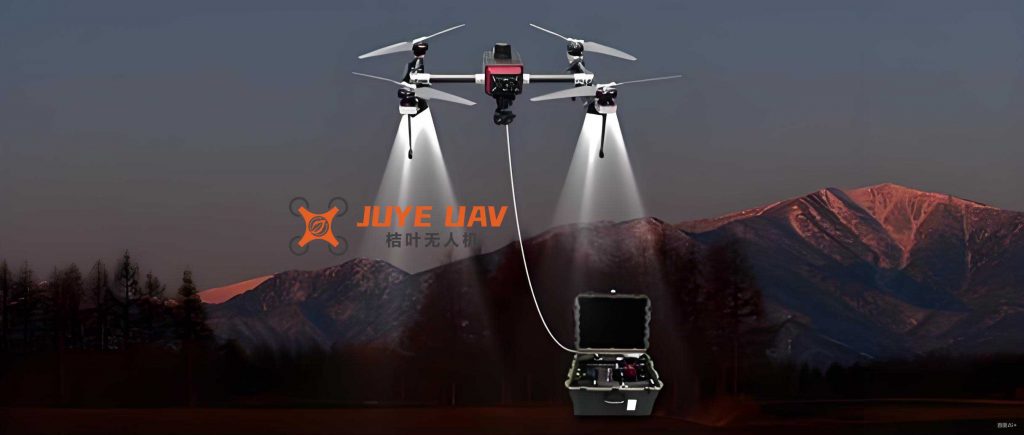
The economic aspects of deploying lighting UAVs are equally important. Initial costs include the drone itself, lighting equipment, and control systems, while operational costs involve energy, maintenance, and software updates. A cost-benefit analysis can help organizations decide whether to invest in lighting drone technology. For a typical deployment, the total cost of ownership (TCO) over a period $T$ can be calculated as: $$ \text{TCO} = C_{\text{initial}} + \sum_{t=1}^{T} \frac{C_{\text{operational}}}{(1 + r)^t} $$ where $C_{\text{initial}}$ is the upfront cost, $C_{\text{operational}}$ is the annual operational cost, and $r$ is the discount rate. Compared to installing fixed streetlights, lighting UAVs may offer lower TCO in temporary or remote applications due to their mobility and reduced infrastructure needs. This financial flexibility makes lighting drones an attractive option for municipalities and private entities alike.
In creative industries, the use of lighting drones has spawned innovative projects that blend technology and art. For example, by mounting programmable LED arrays on drones, artists can create dynamic light shows in the night sky, synchronized to music or other media. The color and intensity of the lights can be controlled in real-time, allowing for intricate patterns and effects. The luminous efficacy $\eta$ of these LEDs, defined as the ratio of luminous flux to electrical power, plays a key role in achieving bright displays without excessive power draw: $$ \eta = \frac{\Phi}{P} $$ where $\Phi$ is the luminous flux in lumens and $P$ is the power in watts. High-efficacy LEDs enable lighting UAVs to produce vivid illumination while conserving battery life, extending their usability in prolonged performances.
Looking ahead, the future of lighting UAV technology seems boundless, with potential advancements in AI-driven autonomy and renewable energy integration. For instance, solar-powered lighting drones could operate indefinitely in sunny regions, reducing their environmental impact. The power generated by solar panels on a drone can be estimated as: $$ P_{\text{solar}} = A \times \eta_{\text{panel}} \times I_{\text{solar}} $$ where $A$ is the panel area, $\eta_{\text{panel}}$ is the efficiency, and $I_{\text{solar}}$ is the solar irradiance. Combining this with energy storage systems could make lighting drones fully self-sufficient, ideal for off-grid applications. Moreover, as AI algorithms improve, lighting UAVs might predict user movements and preemptively adjust their positions, further enhancing the user experience.
In conclusion, lighting drones represent a transformative technology with diverse applications from urban lighting to artistic expression. The mathematical models and tables presented here illustrate the technical depth and scalability of lighting UAV systems. As I continue to explore this field, I am excited by the potential for lighting drones to create safer, more efficient, and creatively enriched environments. The ongoing innovation in lighting UAV design and implementation promises to expand their role in our daily lives, making them an indispensable tool for the future.