
In recent years, the rapid advancement of drone technology has significantly enhanced payload capacity, flight stability, and endurance, providing robust support for integrating lighting systems. Concurrently, progress in lighting technologies, such as improved LED efficiency and smart control systems, has made drone-based illumination more effective. The combination of drone flexibility with advanced lighting and control technologies offers innovative solutions across various scenarios. Although current systems have limitations, ongoing improvements promise to expand their applications, injecting new vitality into economic and social development. In this paper, I explore the design, performance, and applications of lighting UAV systems, emphasizing their potential through detailed analysis, formulas, and tables.
The research background of lighting drones stems from the growing need for nighttime operations in fields like emergency response and construction. Traditional drones possess capabilities like vertical take-off, hovering, and rapid transit, with substantial load-bearing capacity for auxiliary equipment. However, low visibility at night compromises safety and restricts applications. As urbanization accelerates and nighttime activities increase, the demand for efficient illumination has risen. Integrating drones with high-efficiency lighting technologies addresses these challenges, showcasing unique advantages. Supported by national strategies such as 3D modeling and low-altitude economy, the applications of lighting drones are set to broaden. Tethered lighting drones, for instance, provide continuous illumination via ground power in emergencies but are limited by cable length. To overcome this, I developed a wireless remote-controlled lighting drone system that combines self-powered lighting with drone landing gear, enhancing visibility and safety for nighttime flights.
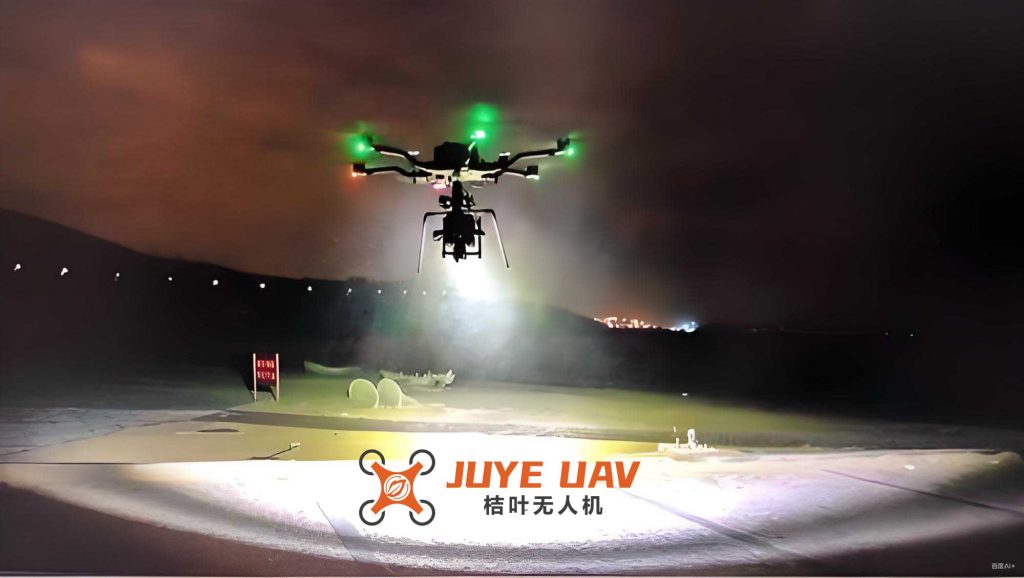
The design principles of a lighting UAV involve several key aspects: mounting structure, lighting selection, battery configuration, and control system development. For the mounting structure, I focused on materials, attachment points, and fixation methods to minimize weight and maintain flight stability. Using carbon fiber similar to drone landing gear, I adopted a combination of two main and four auxiliary lights mounted symmetrically to preserve the center of gravity. The main spotlights are attached with adjustable clamps on the outer sides of the landing gear, avoiding obstruction of cameras and sensors, and include steering servos. Four position lights are installed at the corners, powered via cables inside hollow landing gear tubes. This design ensures balance and durability, critical for a reliable lighting drone system.
Lighting selection for a lighting UAV requires high brightness and long endurance to meet diverse nighttime needs. LED technology, with its energy efficiency, compact size, and low heat emission, is ideal. I chose main spotlights with dual-mode white LEDs (flood and focus) for adjustable intensity and coverage, while position lights use red or white LEDs for navigation and decorative effects. The luminous efficacy of LEDs can be modeled using the formula: $$\Phi = \eta \times P$$ where \(\Phi\) is the luminous flux in lumens, \(\eta\) is the efficacy in lumens per watt, and \(P\) is the power in watts. For instance, with \(\eta = 150 \, \text{lm/W}\) and \(P = 5 \, \text{W}\), the output is \(750 \, \text{lm}\), sufficient for most scenarios. This optimization ensures that the lighting drone delivers consistent performance.
Battery configuration is crucial for a wireless lighting drone to achieve extended operation without tethering. I selected rechargeable lithium batteries integrated into the main lights, powering the entire system. The battery capacity is chosen based on drone payload; for example, with a DJI M200 drone, a 3000 mAh battery supports over 4 hours of illumination at 5 W. The endurance can be calculated as: $$t = \frac{C \times V}{P \times 1000}$$ where \(t\) is time in hours, \(C\) is capacity in mAh, \(V\) is voltage (e.g., 3.7 V for lithium cells), and \(P\) is power in watts. With \(C = 3000\), \(V = 3.7\), and \(P = 5\), \(t \approx 2.22\) hours, but parallel configurations or higher voltages can extend this. Testing showed a slight reduction in drone endurance due to added weight, but it remains acceptable, and future improvements in power management can enhance it further for lighting UAV applications.
Control system development for the lighting drone incorporates wireless modules for remote operation, mode switching, and self-diagnostics. I designed a system using 2.4 GHz frequency-hopping technology, with code for signal transmission and reception to control actions like servo rotation. The servo angle \(\theta\) can be adjusted based on input signals, following: $$\theta = k \cdot \Delta s$$ where \(k\) is a gain factor and \(\Delta s\) is the signal difference. This allows precise directional control and integration with smart devices. The control logic ensures multi-channel, interference-free operation, enabling features like automated fault detection. Such intelligent control is a hallmark of advanced lighting drone systems, facilitating adaptability in various environments.
Performance evaluation of the lighting UAV involved simulation and practical tests to assess flight stability and illumination effectiveness. I compared flight parameters with and without the lighting load, as summarized in Table 1. The results indicate minor changes in speed and attitude angles, confirming minimal impact on flight performance. The symmetrical mounting maintained stability during maneuvers, with no significant shaking or imbalance. Electrical, optical, and safety tests confirmed that the lighting drone meets design specifications, excelling in coverage, brightness, durability, and controllability.
| Condition | Average Speed (m/s) | Yaw Angle Range (°) | Pitch Angle Range (°) | Roll Angle Range (°) |
|---|---|---|---|---|
| Without Lighting Load | 10.0 | ±0.2 | ±0.5 | ±0.3 |
| With Lighting Load | 9.8 | ±0.3 | ±0.7 | ±0.4 |
Advantages of the lighting drone include high efficiency, with remote control up to 100 meters enabling rapid deployment and uniform illumination for tasks like inspections. Flexibility allows adjustable height and angle for wide coverage, while adaptability permits operation in complex terrains. Safety is enhanced by reducing human exposure to hazards, and convenience comes from the lightweight design (0.6 kg) and easy attachment as a standard accessory. These benefits make lighting UAV systems versatile for numerous applications.
However, limitations exist, such as reduced endurance and payload constraints. The added weight shortens flight time, restricting use in prolonged missions. Operator skill requirements pose challenges, as trained personnel are needed for effective control. Environmental factors like bad weather or electromagnetic interference can disrupt operations. To quantify endurance impact, consider the drone’s power consumption model: $$E_{\text{total}} = E_{\text{flight}} + E_{\text{lighting}}$$ where \(E_{\text{flight}}\) is flight energy and \(E_{\text{lighting}}\) is lighting energy. With increased load, \(E_{\text{flight}}\) rises, reducing overall endurance. Addressing these issues through better batteries and training is essential for broader lighting drone adoption.
Efficacy analysis reveals significant economic and social benefits. For operators, the lighting UAV improves safety, lowering accident risks and associated costs. For users, it enhances nighttime工作效率, reducing rework and accidents, thus saving resources. Socially, it raises public awareness of drone technology, spurring industry growth and innovation. The lighting drone market is poised for expansion, with standards likely to emerge, fostering healthy development. As I reflect on this, the potential of lighting UAV systems to transform nighttime operations is immense, driven by continuous innovation.
In conclusion, the lighting drone represents a cutting-edge solution with promising prospects. Through iterative design and testing, I have demonstrated its feasibility and superiority. Future work should focus on enhancing battery life, reducing weight, and integrating AI for smarter control. As technology evolves, lighting UAV systems will undoubtedly play a pivotal role in diverse fields, offering efficient, flexible, and safe illumination solutions. The journey of refining these systems is ongoing, and I am excited to contribute to this dynamic field.