
In recent years, the integration of deep learning into unmanned aerial vehicle (UAV) systems has revolutionized their capabilities, particularly in night vision lighting applications. As a researcher in this field, I have focused on enhancing the adaptive performance of lighting UAV systems through advanced neural networks. The primary challenge lies in the dynamic and complex nature of nighttime environments, where traditional lighting systems often fall short in providing adequate illumination for tasks such as search and rescue, surveillance, and cinematography. By leveraging deep learning, we can develop intelligent lighting drone systems that automatically adjust to varying conditions, thereby improving safety, efficiency, and user experience. This article delves into the design, implementation, and optimization of such systems, emphasizing the use of convolutional neural networks (CNNs) for real-time image analysis and lighting control. Throughout this discussion, I will explore key aspects including the foundational principles of deep learning, the specific requirements of night vision lighting for drones, and the practical implementation of models that enhance illumination quality. The goal is to provide a comprehensive framework for developing smarter lighting UAV solutions that can operate effectively in diverse scenarios.
Deep learning, a subset of machine learning, involves the use of multi-layered neural networks to model complex patterns in data. In the context of lighting drone systems, these networks can process visual inputs from onboard cameras to make informed decisions about lighting adjustments. The core of deep learning lies in its ability to learn hierarchical representations from raw data, which is particularly beneficial for handling the variability in night-time imagery. For instance, CNNs excel at extracting spatial features from images, making them ideal for analyzing environmental lighting conditions. A typical CNN consists of convolutional layers, pooling layers, and fully connected layers, each contributing to feature extraction and classification. The training process involves optimizing parameters through backpropagation, using loss functions such as cross-entropy or mean squared error. To illustrate the diversity of neural network architectures applicable to lighting UAV systems, consider the following table summarizing common types and their uses:
| Neural Network Type | Description | Typical Applications |
|---|---|---|
| Feedforward Neural Network (FNN) | Data flows in one direction without cycles; simple structure suitable for basic classification. | Simple pattern recognition in lighting conditions. |
| Convolutional Neural Network (CNN) | Uses convolutional layers to capture spatial hierarchies in data, ideal for image processing. | Real-time analysis of night vision imagery for lighting adjustments in drones. |
| Recurrent Neural Network (RNN) | Includes feedback connections, allowing it to handle sequential data like time series. | Predicting lighting trends over time in dynamic environments. |
| Long Short-Term Memory (LSTM) | A variant of RNN that mitigates vanishing gradient problems, suitable for long sequences. | Managing lighting patterns during extended drone missions. |
In practice, the choice of network depends on the specific requirements of the lighting UAV application. For example, CNNs are often preferred due to their efficiency in image-related tasks, which is critical for processing video feeds from drones in real-time. The training of these models requires substantial datasets comprising various night-time scenarios, such as urban areas with high light pollution or remote regions with minimal ambient light. Data augmentation techniques, like rotation and brightness adjustment, can enhance model robustness. Moreover, optimization algorithms like Adam or SGD are employed to minimize the loss function, expressed mathematically as: $$ L(\theta) = \frac{1}{N} \sum_{i=1}^{N} \ell(y_i, f(x_i; \theta)) + \lambda R(\theta) $$ where \( L(\theta) \) is the total loss, \( \ell \) is the per-sample loss, \( y_i \) is the true label, \( f(x_i; \theta) \) is the model prediction, \( N \) is the number of samples, \( \lambda \) is the regularization parameter, and \( R(\theta) \) is the regularization term to prevent overfitting. This foundational knowledge enables us to tailor deep learning models for the unique demands of lighting drone systems, ensuring they can adapt to unpredictable night environments.
The effectiveness of a lighting UAV system hinges on a thorough understanding of its operational requirements, which vary widely based on mission objectives and environmental factors. Night vision lighting for drones must address issues such as illumination intensity, coverage area, color temperature, and energy efficiency. For instance, in search and rescue operations, a lighting drone needs high-intensity beams to penetrate darkness and cover large areas, whereas in cinematic applications, adjustable color temperatures are crucial for achieving desired visual effects. Additionally, factors like weather conditions (e.g., fog or rain) and terrain (e.g., forests or urban landscapes) impose further constraints on lighting design. To systematically analyze these needs, I have categorized common scenarios and their corresponding lighting requirements in the table below:
| Mission Type | Lighting Requirements | Key Parameters |
|---|---|---|
| Search and Rescue | High-intensity illumination for broad coverage and object detection. | Luminance (measured in lux), beam angle, and power consumption. |
| Surveillance and Reconnaissance | Steady, low-glare lighting to avoid detection and maintain visibility. | Uniformity of light distribution, duration, and minimal light pollution. |
| Border Patrol | Wide-area lighting adaptable to diverse terrains and conditions. | Coverage radius, adaptability to obstacles, and integration with sensors. |
| Film Production | Adjustable brightness and color temperature for artistic control. | Color rendering index (CRI), dimming capability, and stability. |
From a user perspective, the diversity of operators—ranging from emergency responders to filmmakers—necessitates intuitive interfaces and customizable settings. For example, a rescue team might prioritize quick activation of maximum lighting, while a cinematographer may require fine-tuned adjustments via a mobile app. Environmental diversity also plays a critical role; urban settings often involve challenges like light pollution and reflections, whereas rural areas may demand robust lighting that compensates for the absence of ambient light. The lighting UAV system must therefore incorporate sensors to monitor real-time conditions, such as ambient light levels and obstacles, and use deep learning to dynamically adjust parameters. Mathematically, the optimal lighting output can be modeled as a function of environmental inputs: $$ I_{\text{opt}} = g(E, S, U) $$ where \( I_{\text{opt}} \) is the ideal illumination, \( E \) represents environmental factors (e.g., weather, terrain), \( S \) denotes system constraints (e.g., battery life), and \( U \) signifies user preferences. By integrating these elements, a lighting drone can achieve a balance between performance and efficiency, ensuring reliable operation across various night-time scenarios.
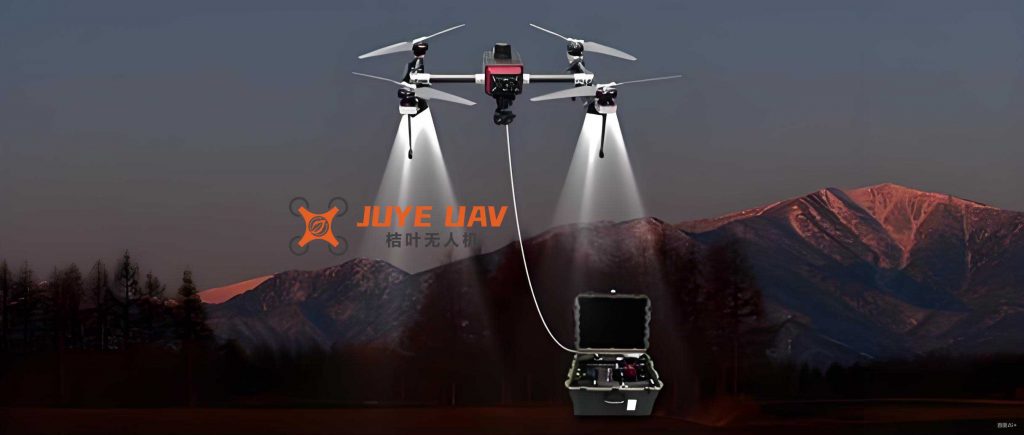
Implementing a deep learning-based lighting UAV system involves careful model selection, training, and optimization to handle the intricacies of night vision. In my work, I have predominantly used CNNs due to their proficiency in image analysis, which is essential for processing video feeds from drone cameras. The design philosophy centers on creating a model that can rapidly assess lighting conditions and output control signals for adjustable LEDs or other light sources. This requires a network architecture that includes multiple convolutional layers for feature extraction, followed by fully connected layers for decision-making. For instance, a typical CNN for a lighting drone might consist of input layers accepting image data, hidden layers applying filters to detect patterns like shadows or bright spots, and output layers generating commands for brightness and color temperature adjustments. The training process involves supervised learning, where labeled datasets—comprising images paired with optimal lighting settings—are used to minimize a loss function. One common loss function for regression tasks in lighting control is the mean squared error: $$ L = \frac{1}{N} \sum_{i=1}^{N} (y_i – \hat{y}_i)^2 $$ where \( y_i \) is the desired lighting parameter, \( \hat{y}_i \) is the model’s prediction, and \( N \) is the number of training samples. To enhance generalization, techniques like dropout and data augmentation are employed, preventing overfitting to specific scenarios.
Optimizing the model for real-time performance on resource-constrained drones is crucial. This often involves model pruning, quantization, and the use of efficient architectures like MobileNets, which reduce computational load without significant accuracy loss. Additionally, transfer learning can accelerate development by leveraging pre-trained models on large datasets (e.g., ImageNet) and fine-tuning them for night vision tasks. The optimization process includes hyperparameter tuning, such as adjusting learning rates and batch sizes, to achieve fast convergence. For example, the Adam optimizer is frequently used due to its adaptive learning rate properties, updating parameters as follows: $$ \theta_{t+1} = \theta_t – \frac{\eta}{\sqrt{\hat{v}_t} + \epsilon} \hat{m}_t $$ where \( \theta_t \) represents the parameters at time \( t \), \( \eta \) is the learning rate, \( \hat{m}_t \) and \( \hat{v}_t \) are bias-corrected estimates of the first and second moments of the gradients, and \( \epsilon \) is a small constant to prevent division by zero. In deployment, the lighting UAV system continuously captures images, processes them through the CNN, and adjusts lighting in real-time, creating a feedback loop that adapts to changing conditions. This approach not only improves illumination quality but also extends battery life by avoiding unnecessary lighting, making it a sustainable solution for various applications.
The integration of deep learning into lighting drone systems represents a significant advancement in UAV technology, enabling smarter and more efficient night-time operations. Through the use of CNNs and other neural networks, these systems can dynamically respond to environmental cues, providing optimal illumination for tasks ranging from emergency response to entertainment. Key benefits include enhanced safety through better visibility, reduced operator fatigue via automated adjustments, and broader applicability across diverse scenarios. However, challenges remain, such as ensuring robustness in extreme weather and minimizing computational demands for onboard processing. Future work could explore hybrid models combining CNNs with reinforcement learning for even greater adaptability, or the incorporation of multi-sensor data fusion for comprehensive environment perception. As deep learning techniques evolve, lighting UAV systems will continue to improve, offering more precise and energy-efficient solutions. Ultimately, this research underscores the transformative potential of AI-driven lighting in expanding the capabilities of drones, paving the way for innovations in autonomous night-time navigation and operation.
In summary, the optimization of night vision lighting for drones through deep learning involves a multi-faceted approach that addresses model design, training, and practical implementation. By focusing on real-time image analysis and adaptive control, we can develop lighting drone systems that meet the demanding requirements of modern applications. The tables and equations provided in this article illustrate the technical foundations, while the emphasis on key terms like lighting UAV and lighting drone highlights their relevance. As I continue to refine these systems, the goal remains to achieve a seamless integration of intelligence and illumination, ensuring that drones can operate effectively and safely in any night-time environment. This progress not only benefits current users but also opens up new possibilities for future advancements in aerial robotics and smart lighting technologies.