
In modern power transmission systems, nighttime operations such as emergency repairs, fault inspections, and line acceptance often require reliable and flexible illumination. Traditional ground-based searchlights face significant limitations, including poor mobility, obstruction by transmission towers, and glare from low-angle lighting. These issues pose safety risks and reduce efficiency during critical tasks. To address these challenges, we have developed a novel long-endurance lighting UAV (unmanned aerial vehicle) system that leverages virtual battery technology, high-efficiency power conversion, and advanced COB lighting. This system enables continuous, high-altitude illumination from above, eliminating shadows and providing uniform lighting over large areas. By eliminating the need for onboard batteries through a ground-based power supply, the lighting drone achieves extended operational time and enhanced payload capacity, making it ideal for transmission line maintenance in remote or difficult terrains.
The core innovation of our lighting UAV system lies in the integration of a virtual battery module, which simulates the electrical characteristics of a physical battery while drawing power from a ground source via a fluorescent photoelectric composite cable. This approach significantly reduces the weight carried by the drone, allowing it to support high-power lighting modules without compromising flight stability. The system comprises a ground power supply base station, an automatic cable reel, the lighting drone equipped with COB light arrays, and the virtual battery unit. Throughout this article, we will delve into the design principles, mathematical models, and experimental validation of each component, emphasizing the repeated application of lighting UAV and lighting drone technologies to underscore their pivotal role in revolutionizing emergency lighting for power transmission networks.
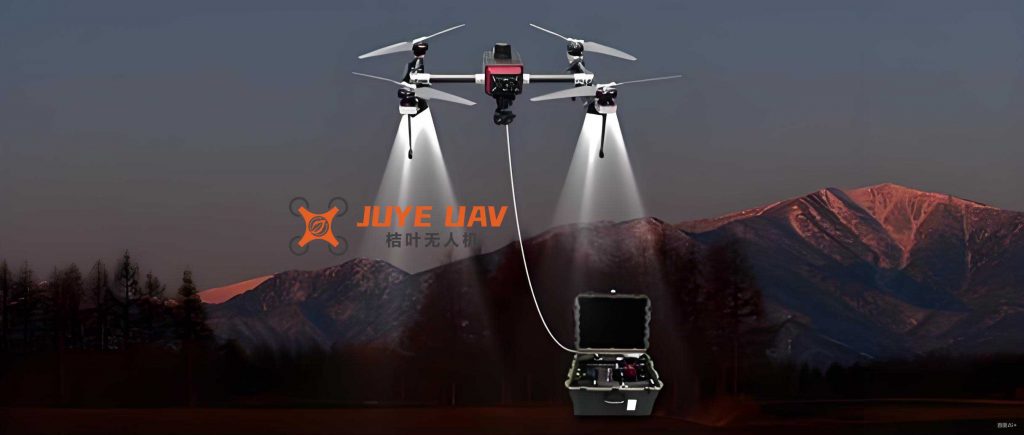
The ground power supply base station serves as the energy source for the entire lighting UAV system. It converts input AC power from generators or grid sources into high-voltage DC power, which is transmitted through the composite cable to the drone. This setup minimizes energy loss over long distances and supports the high-power demands of the COB lighting. The base station incorporates a DSP-based digital control system for real-time monitoring and protection features, such as overvoltage, overcurrent, and thermal protection. The key parameters of the DC switch power supply are summarized in Table 1, illustrating its efficiency and compatibility with various input sources.
| Parameter | Value |
|---|---|
| AC Input Voltage | 220 V |
| DC Output Voltage | 300 V |
| DC Output Current | 10 A |
| Forward Peak Voltage | 420 V |
| Output Voltage Range | 200-420 V |
| Transmission Efficiency | 99% |
The power conversion process in the base station can be modeled using a full-bridge rectifier circuit. The output voltage regulation is achieved through IGBT switches controlled by feedback mechanisms. The efficiency of this conversion is critical for minimizing energy loss and is given by the formula: $$\eta = \frac{P_{\text{output}}}{P_{\text{input}}} \times 100\%$$ where $\eta$ represents the efficiency, $P_{\text{output}}$ is the output power, and $P_{\text{input}}$ is the input power. In our tests, the average efficiency reached 99%, ensuring reliable power delivery to the lighting drone.
The fluorescent photoelectric composite cable is a lightweight, durable component that combines power conductors and communication fibers. Its outer layer is made of Kevlar reinforced with fluorescent material, making it visible at night and resistant to abrasion. The cable’s design reduces weight while maintaining high current-carrying capacity, which is essential for the lighting UAV to operate at altitudes up to 100 meters. The automatic reel system, driven by a stepper motor and PWM controller, ensures smooth cable deployment and retraction, adapting to the drone’s movement. This subsystem enhances the mobility of the lighting drone, allowing it to cover large areas without tangling or excessive tension.
For the lighting module, we utilized high-brightness COB (Chip-on-Board) LEDs arranged in a series-parallel configuration to achieve the required illuminance of over 700 lux, as per industry standards. Each COB lamp operates at a voltage range of 130–180 V and a current of 300 mA, producing approximately 600 lux. By connecting multiple lamps in series and then in parallel, the total voltage reaches 300–360 V, and the power output stabilizes at 400 W. This design ensures uniform illumination over an area of 3500–5000 m², providing adequate light for transmission tower work. The luminous efficacy can be expressed as: $$\Phi_v = \frac{P_{\text{light}}}{P_{\text{electrical}}}$$ where $\Phi_v$ is the luminous flux, $P_{\text{light}}$ is the radiant power, and $P_{\text{electrical}}$ is the electrical power input. Our COB arrays achieve a luminous flux of over 30,000 lm, making them suitable for high-altitude applications in the lighting UAV.
The virtual battery technology is the cornerstone of the long-endurance capability of our lighting drone. It replaces the conventional onboard battery with a combination of a brick DC-DC converter, equivalent resistors, and a battery management chip that emulates the voltage and current profiles of a real battery. This setup allows the drone’s flight controller to interact with the virtual battery as if it were a standard power source, while the actual power is supplied from the ground. The brick converter steps down the 300 V DC input to the drone’s operating voltage of 25.8 V, with adjustable output via trim resistors. The resistance values for voltage adjustment are calculated as: $$R_{\text{up}} = -\frac{100}{x} – 2 + \frac{U_{\text{standard}} \times (100 + x)}{1.23 \times x}$$ and $$R_{\text{down}} = \frac{100}{x} – 2$$ where $R_{\text{up}}$ is the up-adjustment resistor, $R_{\text{down}}$ is the down-adjustment resistor, $x$ is the percentage change in voltage, and $U_{\text{standard}}$ is the standard output voltage (e.g., 24 V). For instance, to increase the voltage by 20%, $R_{\text{up}} \approx 110 \Omega$, and to decrease it by 10%, $R_{\text{down}} = 8 \Omega$.
The virtual battery module weighs only 262.1 grams, significantly less than typical drone batteries, which can exceed 1 kg. This weight reduction increases the payload capacity of the lighting UAV, enabling it to carry heavier lighting arrays or additional sensors. The power handling of the brick converter is modeled using IGBT switching characteristics, with the output current calculated as: $$I_{\text{output}} = \frac{P_{\text{input}}}{V_{\text{input}}}$$ where $I_{\text{output}}$ is the output current, $P_{\text{input}}$ is the input power (600 W), and $V_{\text{input}}$ is the input voltage (300 V). This yields a current of 2.1 A, with peaks up to 3 A to account for wind resistance and other factors. The efficiency of the virtual battery unit was tested extensively, as shown in Table 2, demonstrating consistent performance under varying conditions.
| Test Number | Efficiency (%) |
|---|---|
| 1 | 99.3 |
| 2 | 99.5 |
| 3 | 99.6 |
| 4 | 99.4 |
| 5 | 99.7 |
| 6 | 99.2 |
| 7 | 99.4 |
| 8 | 99.6 |
| 9 | 99.5 |
| 10 | 99.4 |
Experimental validation of the lighting UAV system involved comprehensive tests on the ground base station, COB lighting arrays, and virtual battery. For the base station, we measured the switching accuracy and power transmission efficiency over 10 trials, as summarized in Table 3. The results confirm 100% switching accuracy and an average efficiency of 98.7%, with minor variations due to environmental factors.
| Trial | Switching Accuracy (%) | Power Transmission Efficiency (%) |
|---|---|---|
| 1 | 100 | 98.7 |
| 2 | 100 | 99.1 |
| 3 | 100 | 98.8 |
| 4 | 100 | 98.7 |
| 5 | 100 | 98.6 |
| 6 | 100 | 99.3 |
| 7 | 100 | 99.4 |
| 8 | 100 | 98.7 |
| 9 | 100 | 98.6 |
| 10 | 100 | 99.1 |
The COB lighting arrays were tested for illuminance using a light meter across 10 trials, with each trial measuring multiple points. The data, presented in Table 4, shows that all values exceed 700 lux, meeting the required standards for transmission work. The average illuminance was calculated as: $$\bar{E} = \frac{1}{n} \sum_{i=1}^{n} E_i$$ where $\bar{E}$ is the average illuminance, $n$ is the number of measurements, and $E_i$ is the illuminance at point $i$. This yielded an average of 785 lux, with a standard deviation of 10 lux, indicating consistent performance.
| Trial | Point 1 (lx) | Point 2 (lx) | Point 3 (lx) | Point 4 (lx) | Point 5 (lx) | Point 6 (lx) | Point 7 (lx) | Point 8 (lx) |
|---|---|---|---|---|---|---|---|---|
| 1 | 782 | 773 | 785 | 779 | 781 | 776 | 774 | 772 |
| 2 | 763 | 794 | 786 | 788 | 782 | 777 | 775 | 769 |
| 3 | 771 | 789 | 784 | 783 | 780 | 778 | 773 | 770 |
| 4 | 768 | 792 | 787 | 785 | 779 | 776 | 772 | 771 |
| 5 | 765 | 791 | 785 | 784 | 781 | 777 | 774 | 768 |
| 6 | 769 | 793 | 786 | 786 | 782 | 778 | 775 | 772 |
| 7 | 764 | 790 | 784 | 783 | 780 | 776 | 773 | 769 |
| 8 | 767 | 789 | 785 | 784 | 781 | 777 | 774 | 770 |
| 9 | 762 | 788 | 783 | 782 | 779 | 775 | 771 | 767 |
| 10 | 754 | 795 | 785 | 787 | 783 | 779 | 776 | 791 |
The virtual battery module underwent efficiency tests, with results plotted in a curve showing an average conversion efficiency of 99.46%. The temperature during operation remained stable between 41°C and 43°C, confirming the reliability of the lighting drone under continuous use. The power loss in the virtual battery can be described by: $$P_{\text{loss}} = I^2 R$$ where $P_{\text{loss}}$ is the power loss, $I$ is the current, and $R$ is the equivalent resistance. In our design, this loss is minimized through optimized component selection, contributing to the overall efficiency of the lighting UAV system.
In conclusion, our long-endurance lighting UAV system represents a significant advancement in emergency lighting for power transmission networks. By integrating virtual battery technology, we have eliminated the weight and limitations of onboard batteries, enabling the lighting drone to operate for up to 24 hours continuously. The ground-based power supply, with its high-efficiency conversion and automatic cable management, ensures reliable energy delivery, while the COB lighting arrays provide intense, uniform illumination from high altitudes. This system not only enhances safety during nighttime repairs but also improves operational efficiency, reducing the time required for fault resolution and power restoration. Future work will focus on scaling this technology for larger areas and integrating autonomous navigation for the lighting UAV, further solidifying its role in modern infrastructure maintenance.
The repeated emphasis on lighting UAV and lighting drone technologies throughout this research highlights their transformative potential. As power grids expand into remote regions, the demand for flexible, high-endurance lighting solutions will grow, and our system offers a scalable and efficient answer. By leveraging mathematical models and rigorous testing, we have demonstrated that virtual battery-based lighting drones can overcome the drawbacks of traditional methods, paving the way for wider adoption in various industries beyond power transmission, such as disaster response and construction.