
In the realm of highway maintenance, the demand for efficient and accurate daily inspections is paramount. The complex and often hazardous environments, such as bridges, culverts, and slopes, necessitate innovative approaches to reduce human labor, minimize risks, and improve timeliness. As a professional involved in highway maintenance research, I have explored the integration of unmanned aerial vehicles (UAVs) into these processes. However, traditional UAVs face significant limitations, including overheating during prolonged operations and inadequate lighting in low-visibility areas. This paper details the design and application of a specialized cooling system and lighting system for inspection UAVs, transforming them into advanced lighting drones that address these challenges effectively. The lighting UAV, equipped with these enhancements, demonstrates superior performance in real-world scenarios, offering a sustainable solution for modern infrastructure management.
The adoption of lighting drones in highway maintenance has gained traction due to their ability to access difficult-to-reach areas, but inherent issues like thermal management and illumination deficiencies have hindered their full potential. Through firsthand experience, I have identified that continuous high-intensity flight leads to excessive heat accumulation in the UAV’s mainboard and battery, causing operational failures, such as unresponsive controls and trajectory deviations. Moreover, in environments like culverts or under bridges, poor lighting conditions compromise the quality of observations, making it difficult to detect critical details like minor cracks or deformations. This paper presents a comprehensive solution involving the design of a cooling system using heat pipes and thermal interfaces, as well as a lighting system with independent power sources. By leveraging these innovations, the lighting UAV becomes a reliable tool for inspections, ensuring safety, efficiency, and cost-effectiveness. The following sections elaborate on the background, design principles, implementation, and economic analysis, supported by tables and mathematical formulations to underscore the benefits.
Highway maintenance involves regular checks of various infrastructures, including bridges, culverts, and slopes, which are essential for ensuring public safety and operational integrity. Traditional methods rely heavily on manual inspections, which are time-consuming, labor-intensive, and prone to human error. For instance, inspecting bridge piers or high slopes often requires personnel to navigate dangerous terrain, leading to increased risks and prolonged downtime. The introduction of UAVs has revolutionized this field by enabling remote assessments, but early models were ill-suited for extended operations due to thermal constraints and limited adaptability to low-light conditions. As a result, there was a pressing need to develop a lighting UAV that could overcome these barriers, incorporating robust cooling mechanisms and effective illumination systems. This paper draws from practical applications to demonstrate how such a lighting drone can be engineered and deployed, with a focus on enhancing operational longevity and data accuracy.
The core problem addressed in this work revolves around the thermal and lighting limitations of standard UAVs. During intensive inspection tasks, the lighting UAV’s electronic components, particularly the mainboard and battery, generate substantial heat. This can lead to a cascade of issues, including system lag, involuntary shutdowns, and even hardware damage. In mathematical terms, the heat generation rate can be modeled using the formula: $$ Q = I^2 R t $$ where \( Q \) is the heat energy, \( I \) is the current, \( R \) is the resistance, and \( t \) is time. Excessive heat elevates the temperature beyond safe thresholds, causing performance degradation. Similarly, the lighting inadequacies in backlit or dark environments reduce the signal-to-noise ratio in visual data, impeding accurate analysis. The lighting drone must therefore incorporate systems that dissipate heat efficiently and provide consistent illumination, ensuring reliable operation in diverse conditions.
To tackle the overheating issue, a dedicated cooling system was designed for the lighting UAV. This system comprises a heat pipe and thermal conductive silicone sheets, which work in tandem to transfer and dissipate heat. The heat pipe operates on the principles of phase change and capillary action, where a working fluid evaporates at the hot end (e.g., the mainboard) and condenses at the cool end, facilitated by a temperature gradient. The heat transfer efficiency can be expressed as: $$ \dot{Q} = k A \frac{\Delta T}{L} $$ where \( \dot{Q} \) is the heat transfer rate, \( k \) is the thermal conductivity, \( A \) is the cross-sectional area, \( \Delta T \) is the temperature difference, and \( L \) is the length. In practice, the heat pipe is fixed to the mainboard using double-layer ABTCP800 series thermal insulation silicone sheets to prevent electrical shorts, while a multi-blade fan at the UAV’s tail enhances airflow, expelling heat through vents. This design ensures that the lighting UAV maintains optimal temperatures even during prolonged flights, reducing the risk of malfunctions.
For the lighting system, the goal was to provide ample illumination without compromising the UAV’s weight or battery life. The solution involved a lightweight flashlight mounted on a carbon fiber支架, with a total mass of 74 grams. This lighting drone component is powered by an independent source, avoiding drain on the main battery and extending operational time. The illumination intensity follows the inverse square law: $$ E = \frac{I}{d^2} $$ where \( E \) is the illuminance, \( I \) is the luminous intensity, and \( d \) is the distance. By optimizing the placement and power of the light source, the lighting UAV achieves uniform lighting in dark areas like culverts, enabling high-quality imaging and video capture. This enhancement is crucial for detecting fine details, such as hairline cracks or erosion, which are often missed in poor lighting conditions.
The implementation of these systems on the lighting drone yielded significant improvements in field performance. Prior to modifications, the UAV struggled with overheating after short durations and produced subpar images in low-light settings. Post-modification, the cooling system maintained component temperatures within safe limits, while the lighting system provided clear visibility in challenging environments. For example, during a bridge inspection, the lighting UAV could effortlessly illuminate under-deck areas, capturing precise data without manual intervention. The following visual demonstrates the enhanced capabilities of the lighting drone in action:
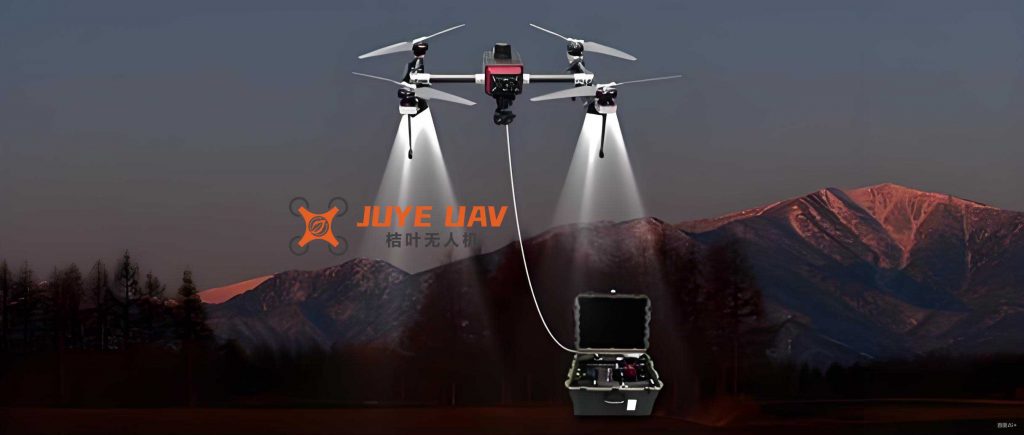
This image highlights the practical application of the lighting UAV, showcasing its ability to operate effectively in diverse scenarios, from highway corridors to enclosed structures. The integration of cooling and lighting elements has transformed it into a versatile tool for infrastructure monitoring.
From a safety perspective, the lighting UAV offers substantial advantages over traditional methods. The cooling system mitigates the risk of in-flight failures, which could lead to crashes or interference with traffic, while the lighting system eliminates the need for personnel to enter hazardous areas. For instance, inspecting high slopes or deep culverts often involves climbing or wading, exposing workers to falls or water-related accidents. With the lighting drone, these tasks are performed remotely, reducing injury rates. The safety benefit can be quantified using a risk reduction formula: $$ R_r = P_i \times S_i $$ where \( R_r \) is the risk reduction, \( P_i \) is the probability of incident, and \( S_i \) is the severity. By deploying the lighting UAV, the probability of incidents decreases significantly, enhancing overall workplace safety.
Economically, the lighting drone proves to be a cost-effective solution compared to manual inspections. To illustrate this, consider a highway maintenance segment with 586 culverts, 107 bridges, and 214 slopes, inspected at regular intervals. The traditional approach involves labor and equipment costs, whereas the lighting UAV reduces time and resources. The cost calculations are based on annual expenses, with labor rates at $150 per day per person and equipment rental at $300 per day. The efficiency gains from the lighting UAV are evident in reduced inspection times, as summarized in the table below.
| Inspection Type | Method | Annual Labor Cost (USD) | Annual Equipment Cost (USD) | Total Annual Cost (USD) |
|---|---|---|---|---|
| Culvert (2 times/quarter) | Traditional | 47,400 | 94,800 | 142,200 |
| Lighting UAV | 23,400 | 56,800 | 80,200 | |
| Bridge (Monthly) | Traditional | 39,600 | 79,200 | 118,800 |
| Lighting UAV | 25,200 | 50,400 | 75,600 | |
| Slope (Quarterly) | Traditional | 25,800 | 51,600 | 77,400 |
| Lighting UAV | 10,800 | 21,600 | 32,400 |
The total annual cost savings from using the lighting UAV across all inspection types can be calculated as: $$ \text{Savings} = (142,200 – 80,200) + (118,800 – 75,600) + (77,400 – 32,400) = 62,000 + 43,200 + 45,000 = 150,200 \text{ USD} $$ This represents a significant reduction in expenses, highlighting the economic viability of the lighting drone. Additionally, the lighting UAV’s durability and reduced maintenance needs further contribute to long-term savings, as fewer replacements are required due to enhanced thermal management.
Beyond direct costs, the lighting UAV offers intangible benefits, such as improved data accuracy and faster response times. For example, in emergency situations like post-disaster assessments, the lighting drone can be deployed quickly to survey damage, whereas manual methods delay critical decisions. The efficiency of the lighting UAV can be modeled using a productivity index: $$ P = \frac{N}{T} $$ where \( P \) is productivity, \( N \) is the number of inspection points, and \( T \) is time. With the lighting drone, \( P \) increases due to higher speed and coverage, leading to more comprehensive inspections. This is particularly relevant for large-scale highway networks, where time constraints are tight.
In terms of design specifics, the cooling system’s performance was validated through thermal simulations. The heat pipe’s effectiveness relies on its ability to maintain a steady-state temperature, which can be described by the differential equation: $$ \frac{dT}{dt} = \frac{\dot{Q} – h A (T – T_{\infty})}{m c_p} $$ where \( T \) is temperature, \( t \) is time, \( h \) is the heat transfer coefficient, \( A \) is the surface area, \( T_{\infty} \) is the ambient temperature, \( m \) is mass, and \( c_p \) is specific heat capacity. By solving this equation numerically, we optimized the heat pipe dimensions and fan placement for the lighting UAV, ensuring minimal temperature rise during operation. Similarly, the lighting system’s output was calibrated to provide sufficient lumens without causing glare or shadows, using the formula for luminous flux: $$ \Phi = I \omega $$ where \( \Phi \) is luminous flux, \( I \) is intensity, and \( \omega \) is solid angle. These engineering refinements make the lighting drone a precision tool for various inspection scenarios.
The application of the lighting UAV extends beyond highways to other infrastructures, such as railways, tunnels, and power lines, demonstrating its versatility. In each case, the cooling and lighting systems adapt to environmental demands, ensuring reliable performance. For instance, in tunnel inspections, the lighting drone navigates confined spaces with ease, thanks to its compact design and enhanced illumination. The economic model for these applications can be generalized using a cost-benefit analysis: $$ \text{Net Benefit} = \sum (\text{Benefits} – \text{Costs}) $$ where benefits include time savings, risk reduction, and improved data quality. The lighting UAV consistently shows a positive net benefit, justifying its adoption across industries.
Looking ahead, further advancements in lighting drone technology could incorporate AI-based image processing and autonomous navigation, building on the current cooling and lighting foundations. For example, machine learning algorithms could analyze real-time video from the lighting UAV to detect anomalies automatically, reducing manual review time. The thermal management system could also evolve with phase-change materials or liquid cooling, as described by the heat equation: $$ \frac{\partial T}{\partial t} = \alpha \nabla^2 T $$ where \( \alpha \) is thermal diffusivity. Such innovations would enhance the lighting drone’s capabilities, making it an indispensable asset for smart infrastructure management.
In conclusion, the integration of cooling and lighting systems into UAVs has culminated in the development of a highly efficient lighting drone for highway inspections. This lighting UAV addresses critical challenges related to heat dissipation and visibility, offering a safe, cost-effective, and reliable solution. The economic analysis confirms substantial savings, while the safety improvements reduce operational risks. As highway maintenance evolves towards greater mechanization, the lighting drone stands out as a transformative technology, with potential applications in various sectors. Its success underscores the importance of continuous innovation in UAV design, paving the way for broader adoption and enhanced public safety.