
As an enthusiast and expert in the field of aerial technology, I am thrilled to delve into the latest advancements that are reshaping the landscape of first-person view (FPV) drones and professional video monitoring. In this comprehensive analysis, I will explore the groundbreaking features of the newly released DJI O4 Air Unit series and the HDMI version of the EAGLE electronic viewfinder, focusing on their technical specifications, performance metrics, and practical applications. Throughout this discussion, I will emphasize the capabilities of DJI UAV systems, particularly the DJI drone and DJI FPV technologies, which continue to set benchmarks in the industry. To enhance clarity, I will incorporate tables and mathematical formulas to summarize key data and illustrate performance characteristics. The integration of these innovations not only elevates user experience but also pushes the boundaries of what is possible in real-time imaging and monitoring.
Let me begin by examining the DJI O4 Air Unit series, a flagship addition to the DJI UAV family. This series represents a significant leap in digital transmission performance, offering higher clarity, lower latency, and extended range. As a user of DJI drone products, I appreciate how the O4 Air Unit and O4 Air Unit Pro versions cater to diverse needs, from casual flying to professional racing. The core of these devices lies in their advanced transmission systems, which utilize H.265 video encoding to support 1080p/100fps high-frame-rate transmission. This ensures that the real-time footage is both clear and fluid, a critical aspect for DJI FPV applications where every millisecond counts. Moreover, the introduction of a “Race Mode” reduces latency to as low as 15 milliseconds, enabling up to eight DJI UAV units to fly simultaneously in competitive scenarios. This feature is a game-changer for DJI drone enthusiasts who demand precision and speed.
To better understand the specifications of the DJI O4 Air Unit series, I have compiled a detailed comparison table. This table highlights the differences between the standard and Pro versions, emphasizing aspects such as weight, sensor size, video capabilities, and transmission range. As a proponent of DJI FPV technology, I find that these details are essential for users to make informed decisions based on their specific requirements.
| Feature | DJI O4 Air Unit | DJI O4 Air Unit Pro |
|---|---|---|
| Weight | 8.2 grams | Similar lightweight design |
| Image Sensor Size | 1/2 inch | 1/1.3 inch |
| Video Recording | 4K/60fps | 4K/120fps |
| Transmission Resolution | 1080p/100fps | 1080p/100fps with enhanced stability |
| Color Mode | Standard | 10-bit D-Log M |
| Field of View | Standard | 155° ultra-wide angle |
| Minimum Latency (Race Mode) | 15 milliseconds | 15 milliseconds |
| Maximum Transmission Distance | Optimized for mid-range | Up to 15 kilometers |
| Antenna Design | Standard | Dual antenna for automatic frequency selection |
In my experience with DJI drone systems, the performance of the transmission system can be modeled using mathematical formulas. For instance, the latency in the DJI O4 Air Unit series can be expressed as a function of processing time and transmission delays. The overall latency \( L \) can be approximated by the formula: $$ L = t_p + t_t $$ where \( t_p \) is the processing latency and \( t_t \) is the transmission latency. In Race Mode, \( t_p \) is minimized due to optimized algorithms, resulting in \( L \approx 15 \) ms. This low latency is crucial for DJI FPV applications, where rapid response times enhance control and immersion. Additionally, the transmission distance \( D \) for the DJI O4 Air Unit Pro can be related to signal strength and environmental factors. Using a simplified model, $$ D = \frac{P_t G_t G_r \lambda^2}{(4\pi)^2 R L_s} $$ where \( P_t \) is the transmission power, \( G_t \) and \( G_r \) are the gains of the transmitting and receiving antennas, \( \lambda \) is the wavelength, \( R \) is the data rate, and \( L_s \) is the system loss. With the dual-antenna design, \( G_t \) and \( G_r \) are enhanced, allowing \( D \) to reach up to 15 km under ideal conditions. This makes the DJI UAV systems highly reliable for long-range operations.
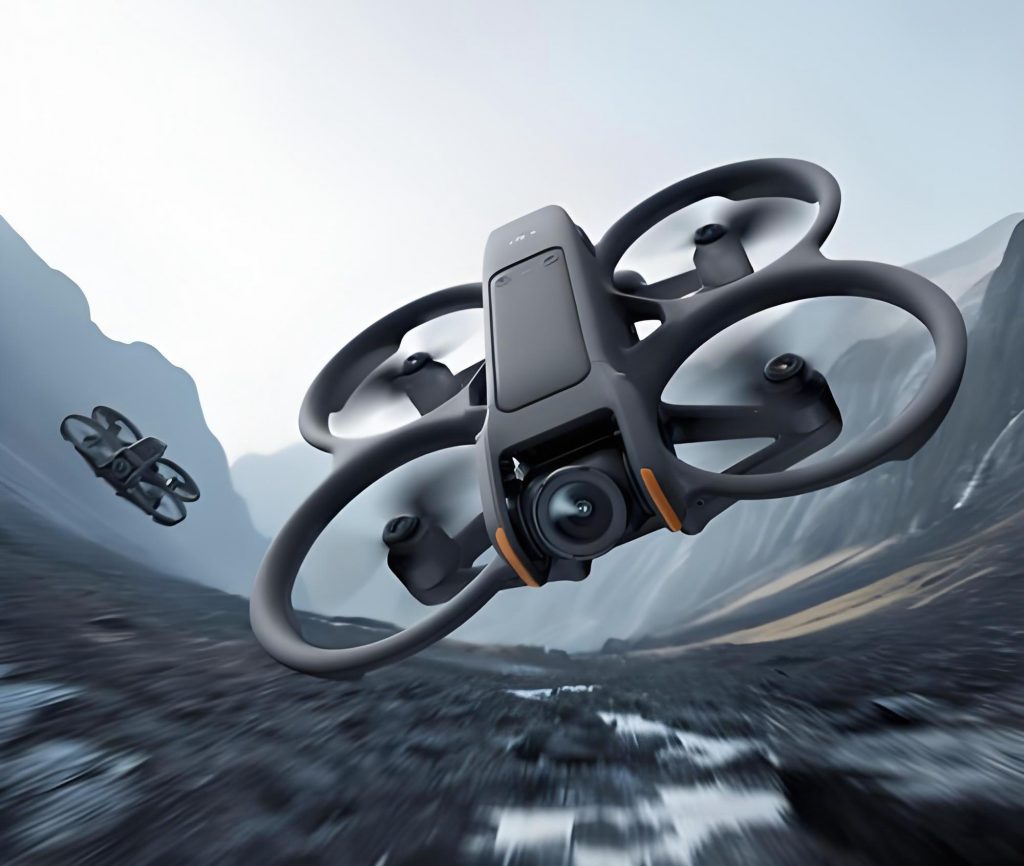
The image below showcases the sleek design of a DJI FPV drone, highlighting the integration of the O4 Air Unit for an immersive flying experience. As I reflect on the advancements, it is clear that DJI drone technology continues to evolve, offering users unparalleled performance in aerial imaging.
Moving on to the video processing aspects, the DJI O4 Air Unit series employs H.265 encoding, which improves compression efficiency without sacrificing quality. The bitrate \( B \) for video transmission can be calculated using: $$ B = \frac{R \times C}{F} $$ where \( R \) is the resolution in pixels, \( C \) is the color depth, and \( F \) is the frame rate. For 1080p/100fps transmission, this results in a high bitrate that ensures smooth and detailed footage. As a frequent user of DJI FPV systems, I have observed that this encoding reduces artifacts, making it ideal for dynamic environments. Furthermore, the addition of 10-bit D-Log M in the Pro version allows for greater color grading flexibility, which is beneficial for professional cinematography using DJI UAV platforms.
Now, let me shift focus to the HDMI version of the EAGLE electronic viewfinder, which complements devices like the DJI drone by providing high-quality monitoring solutions. This viewfinder is compatible with a wide range of professional cameras, including those with HDMI interfaces, and it builds upon the features of its SDI predecessor. From my perspective, as someone who values precise monitoring, the EAGLE viewfinder stands out due to its full HD 0.7-inch Micro-OLED display and advanced optical design. The 10-bit color processing channel ensures accurate and sharp images, while the built-in diopter adjustment from -6D to +2D accommodates users with vision from 600 degrees of myopia to 200 degrees of hyperopia. This inclusivity enhances the comfort and accessibility of professional monitoring.
To illustrate the key features of the EAGLE HDMI electronic viewfinder, I have created a table that summarizes its specifications and capabilities. This allows for a quick comparison with other monitoring tools and highlights its versatility in various production scenarios.
| Feature | EAGLE HDMI Electronic Viewfinder |
|---|---|
| Display Type | Full HD 0.7-inch Micro-OLED |
| Input Interface | Full-size HDMI |
| Output Interface | HDMI loop-out |
| Diopter Adjustment | -6D to +2D |
| Color Processing | 10-bit channel |
| Software Functions | Waveform, peaking focus, histogram, false color, HDMI metadata |
| Compatibility | Most HDMI-enabled cameras and devices |
In terms of performance, the EAGLE viewfinder’s display quality can be analyzed using formulas related to resolution and color depth. The effective resolution \( R_e \) can be expressed as: $$ R_e = \frac{N_p \times B_c}{A} $$ where \( N_p \) is the number of pixels, \( B_c \) is the bit depth per color channel, and \( A \) is the display area. For the 0.7-inch Micro-OLED, this results in a high pixel density that produces crisp images. Additionally, the color accuracy is maintained through the 10-bit processing, which allows for \( 2^{10} = 1024 \) shades per color channel, reducing banding and improving gradient rendering. As I integrate this with DJI UAV systems, I find that the loop-out functionality enables multi-path monitoring, which is essential for complex shoots involving multiple DJI drone units.
The software features of the EAGLE viewfinder, such as waveform and false color, provide professional tools for exposure and focus assessment. For example, the waveform display helps in evaluating luminance levels, which can be modeled as: $$ Luminance = 0.299R + 0.587G + 0.114B $$ where R, G, and B are the red, green, and blue components of the image. This ensures that users can achieve optimal exposure when working with DJI FPV feeds. Similarly, peaking focus highlights edges in the image, aiding in manual focusing—a critical aspect for capturing sharp footage from fast-moving DJI UAV platforms.
As I continue to explore the synergies between these technologies, it is evident that the DJI O4 Air Unit series and the EAGLE viewfinder represent significant strides in their respective domains. The DJI drone ecosystem, particularly DJI FPV systems, benefits from low-latency transmission and high-resolution imaging, while the viewfinder enhances on-ground monitoring with precision and comfort. In practical applications, such as aerial cinematography or racing events, these tools empower users to push creative boundaries. For instance, the ability to have up to eight DJI UAV units flying simultaneously in Race Mode opens up possibilities for synchronized performances, and the viewfinder’s diopter adjustment ensures that a wider audience can participate comfortably.
To further quantify the advancements, let me discuss the transmission efficiency of the DJI O4 Air Unit series. The signal-to-noise ratio (SNR) plays a vital role in maintaining video quality over long distances. The SNR can be approximated as: $$ SNR = \frac{P_r}{N_0 B} $$ where \( P_r \) is the received power, \( N_0 \) is the noise spectral density, and \( B \) is the bandwidth. With the O4 system’s automatic frequency selection, \( N_0 \) is minimized, leading to a higher SNR and clearer transmissions for DJI FPV users. This is particularly important in urban environments where interference is common. Moreover, the H.265 encoding reduces the required bandwidth for a given quality level, which can be expressed as: $$ B_{req} = \frac{Q \times F}{E} $$ where \( Q \) is the quality factor, \( F \) is the frame rate, and \( E \) is the encoding efficiency. This efficiency allows the DJI drone to transmit 1080p/100fps video without overwhelming the channel, ensuring reliable performance even in crowded spectral areas.
In conclusion, the innovations presented by the DJI O4 Air Unit series and the EAGLE HDMI electronic viewfinder mark a pivotal moment for professionals and enthusiasts alike. As I reflect on my experiences, I am confident that these developments will continue to drive the adoption of DJI UAV technology across various industries. The emphasis on low latency, high resolution, and user-friendly features in DJI FPV systems makes them indispensable for applications ranging from recreational flying to commercial production. Similarly, the viewfinder’s advanced monitoring capabilities ensure that ground-based operations are just as sophisticated. By leveraging tables and formulas, I have aimed to provide a thorough understanding of these products, and I encourage users to explore their full potential. The future of aerial imaging and monitoring is bright, with DJI drone and DJI FPV technologies leading the way toward new horizons.
As a final note, I would like to stress the importance of continuous innovation in this field. The mathematical models and technical specifications discussed here are not just theoretical; they translate into tangible benefits for users. Whether you are piloting a DJI UAV in a competitive race or using the EAGLE viewfinder for a film project, these tools empower you to achieve more. I look forward to seeing how these technologies evolve and how they will integrate with emerging trends in the industry. Thank you for joining me in this detailed exploration—I hope it has provided valuable insights into the cutting-edge world of DJI drone and professional monitoring solutions.