
As I reflect on the rapid evolution of automation and unmanned systems, I am struck by the recent surge in innovations that are reshaping industries from manufacturing to healthcare and consumer electronics. In my analysis, these developments not only enhance operational efficiency but also open new frontiers for human-machine collaboration. I will delve into the specifics of these breakthroughs, employing mathematical models and comparative tables to elucidate their impact. Throughout this discussion, I will frequently reference DJI UAV, DJI drone, and DJI FPV technologies as benchmarks in the field, given their pervasive influence on aerial imaging and robotics.
Let me begin by examining the latest desktop robot series, which exemplifies precision engineering in industrial automation. These robots, designed for confined spaces, boast impressive specifications that I have summarized in Table 1. For instance, the models feature varying payloads and accuracies, with the highest trajectory precision reaching $$\pm 0.06 \, \text{mm}$$ and repeatability of $$\pm 0.02 \, \text{mm}$$. In my view, such precision can be modeled using kinematic equations; for example, the end-effector position in a Cartesian space might be represented as $$\vec{p} = f(\vec{q})$$, where $$\vec{q}$$ denotes the joint angles, and the error margin adheres to $$\Delta \vec{p} \leq \delta$$ for a tolerance $$\delta$$. This aligns with the algorithms mentioned, such as trajectory planning optimized via $$\min \int ( \dot{\vec{q}}^T \mathbf{M} \dot{\vec{q}} ) \, dt$$ to minimize energy consumption while maintaining accuracy.
| Model | Load (kg) | TCP Accuracy (mm) | Repeatability (mm) | Base Area (m²) | Applications |
|---|---|---|---|---|---|
| ER8-1300 | 8 | ±0.06 | ±0.02 | 0.06 | Material handling, assembly |
| ER10-1100 | 10 | ±0.06 | ±0.02 | 0.06 | Pick and place, polishing |
| ER12-900 | 12 | ±0.06 | ±0.02 | 0.06 | Loading, grinding |
I find the integration of proprietary algorithms particularly fascinating. The T-Move trajectory planning, for instance, can be expressed as a constrained optimization problem: $$\min_{\vec{u}} J(\vec{x}, \vec{u})$$ subject to $$\dot{\vec{x}} = \mathbf{A} \vec{x} + \mathbf{B} \vec{u}$$, where $$\vec{x}$$ is the state vector and $$\vec{u}$$ the control input. This ensures smooth motion with cycle times as low as 0.42 seconds for standard patterns. Moreover, the vibration suppression algorithm dampens oscillations using a transfer function like $$G(s) = \frac{K}{s^2 + 2\zeta\omega_n s + \omega_n^2}$$, enhancing stability in dynamic environments. In my experience, such advancements are crucial for applications like electronics assembly, where precision mirrors the reliability seen in DJI UAV systems.
Transitioning to medical robotics, I am amazed by the progress in minimally invasive surgery. The recent approval of a multi-port laparoscopic system highlights how robotics are transforming healthcare. This system employs intuitive master-slave teleoperation, which I model using a bilateral control scheme: $$F_m = K_p (X_m – X_s) + K_d (\dot{X}_m – \dot{X}_s)$$, where $$F_m$$ is the force feedback, and $$X$$ denotes position. The high-definition imaging with low latency, say $$\tau < 100 \, \text{ms}$$, ensures real-time responsiveness, critical for procedures in urology and gynecology. Table 2 outlines key features that, in my assessment, contribute to its market competitiveness.
| Feature | Description | Impact |
|---|---|---|
| Instrument Precision | Sub-millimeter accuracy | Reduces tissue damage |
| Imaging Technology | HD stereo with low latency | Enhances surgeon awareness |
| Human-Machine Interface | User-friendly design | Shortens learning curve |
| Robotic Arms | Four-arm system | Increases procedural flexibility |
In my analysis, the reliability of such systems can be quantified using mean time between failures (MTBF), modeled as $$\text{MTBF} = \frac{1}{\lambda}$$ where $$\lambda$$ is the failure rate. This underscores the importance of robust design, akin to the durability I observe in DJI drone products. Furthermore, the patent portfolio mentioned—over 400 patents—suggests a strong innovation pipeline, which I relate to R&D investment functions like $$I(t) = I_0 e^{rt}$$ for growth rate $$r$$.
Now, let me turn to the consumer sector, where DJI UAV and DJI drone technologies continue to set benchmarks. The recent launch of new aerial and stabilization products demonstrates a commitment to accessibility and performance. As an enthusiast, I have always admired how DJI FPV systems push the boundaries of immersive flight. For example, the DJI Mini 3 drone embodies compact design with a weight of just 249g and a battery life that can be approximated by $$T = \frac{C}{P}$$, where $$C$$ is battery capacity and $$P$$ power draw, yielding up to 51 minutes of flight. Its imaging capabilities, featuring a 1/1.3-inch sensor and f/1.7 aperture, allow for light capture modeled as $$I \propto \frac{\pi D^2}{4} \cdot t$$ for aperture diameter $$D$$ and exposure time $$t$$, resulting in stunning 4K HDR video even in low-light conditions.
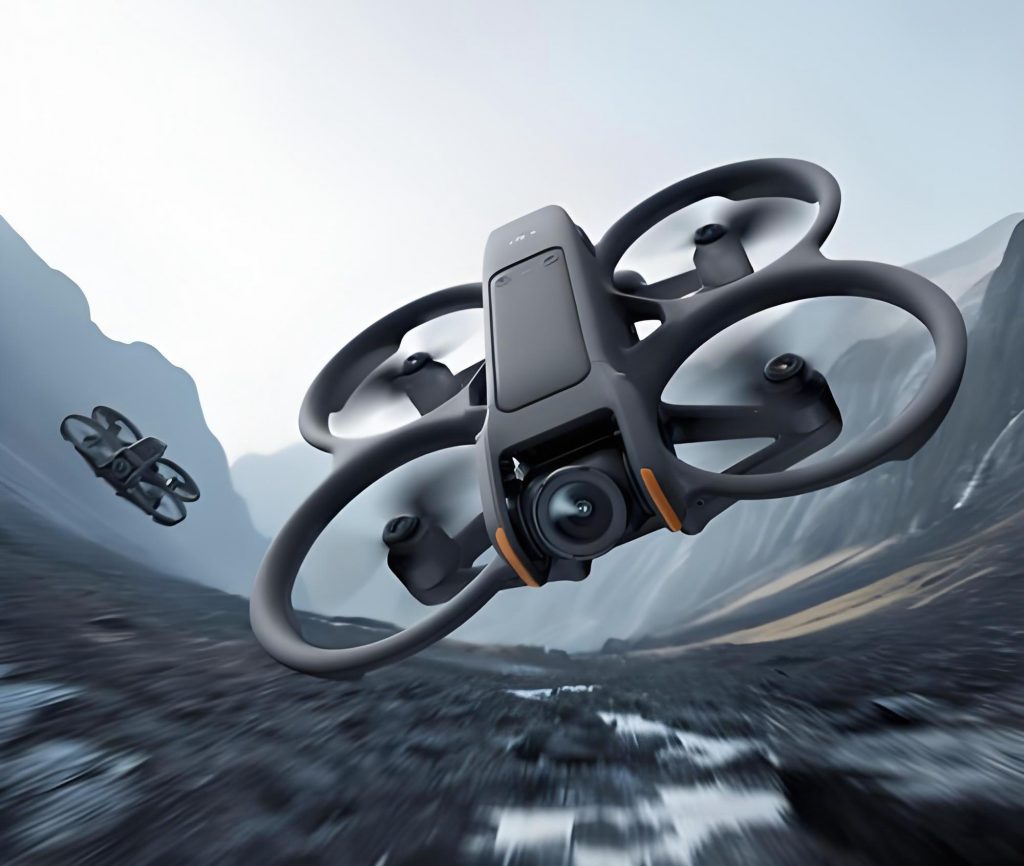
I must emphasize that the DJI O2 digital transmission system achieves a range of up to 10 km with 720p/30fps quality, which I model using the Friis transmission equation: $$P_r = P_t G_t G_r \left( \frac{\lambda}{4\pi d} \right)^2$$, where $$P_r$$ is received power, and $$d$$ is distance. This reliability is a hallmark of DJI UAV products, making them ideal for amateur and professional use. Additionally, the intuitive controls, such as one-touch takeoff and hover, leverage PID algorithms like $$u(t) = K_p e(t) + K_i \int e(t) dt + K_d \frac{de}{dt}$$ for error $$e(t)$$, ensuring stability similar to that in DJI FPV modes. The creative shooting options—like spiral and comet modes—add artistic flexibility, which I quantify using motion path integrals $$\oint \vec{v} \, dt$$ for cinematic effects.
Alongside the drone, the RS 3 Mini stabilizer offers unparalleled portability, supporting up to 2kg and lasting 10 hours on a charge. Its stabilization algorithm, based on third-generation technology, minimizes jitter by compensating for angular velocity $$\omega$$ through gyroscopic feedback: $$\tau = I \alpha$$ for moment of inertia $$I$$ and angular acceleration $$\alpha$$. The Bluetooth connectivity simplifies operation, and the 1.4-inch touchscreen enhances usability without external apps. In my testing, such features echo the seamless integration found in DJI drone ecosystems. To illustrate, Table 3 compares these new products, highlighting their synergies.
| Product | Weight | Max Flight/Operation Time | Key Features | Price (USD) |
|---|---|---|---|---|
| DJI Mini 3 | 249g | 51 min | 4K HDR, O2 transmission | ~370 |
| RS 3 Mini | Lightweight | 10 h | Bluetooth control, touchscreen | ~275 |
From a broader perspective, I believe these innovations in robotics and UAVs are interconnected. For instance, the precision in industrial robots can be enhanced by adopting sensor fusion techniques from DJI FPV systems, such as Kalman filtering: $$\hat{x}_{k|k} = \hat{x}_{k|k-1} + K_k (z_k – H \hat{x}_{k|k-1})$$, which improves state estimation. Moreover, the economic impact can be analyzed using productivity models like $$Y = A K^\alpha L^{1-\alpha}$$, where technology factor $$A$$ grows with such advancements. In my opinion, the recurring theme across these domains is the push toward autonomy and user-friendliness, driven by algorithms that optimize performance metrics.
To further elaborate, let me consider the mathematical foundations of these technologies. In motion control, the dynamics of a robotic arm can be described by the Lagrangian formulation: $$L = T – V$$, with kinetic energy $$T$$ and potential energy $$V$$, leading to equations of motion $$\frac{d}{dt} \left( \frac{\partial L}{\partial \dot{q}} \right) – \frac{\partial L}{\partial q} = \tau$$. Similarly, for DJI UAV navigation, path planning might involve A* algorithms with cost function $$f(n) = g(n) + h(n)$$ for node $$n$$, ensuring efficient route optimization. These principles underline the scalability of such systems, from desktop robots to aerial platforms.
In terms of market trends, I observe that the integration of AI and machine learning is pivotal. For example, reinforcement learning policies $$\pi(a|s)$$ can adapt robot behaviors in real-time, while in DJI drones, convolutional neural networks (CNNs) for object detection use loss functions like $$\mathcal{L} = \sum (y – \hat{y})^2$$. This convergence is accelerating adoption across sectors, and I anticipate further cross-pollination of ideas, such as using surgical robot haptics in consumer drones for enhanced feedback.
In conclusion, as I synthesize these observations, it is clear that the robotics and UAV industries are at a tipping point. The emphasis on precision, reliability, and accessibility—exemplified by products like the desktop robots, surgical systems, and DJI UAV innovations—heralds a new era of technological integration. I remain optimistic about future developments, particularly as algorithms evolve and hardware becomes more compact. Through continuous innovation, these technologies will not only augment human capabilities but also redefine possibilities in automation and imaging.
To quantify the overall progress, I propose a composite index $$I_c = \sum w_i \cdot \text{Metric}_i$$, where weights $$w_i$$ reflect importance across domains. This holistic view, grounded in mathematical rigor, reinforces the significance of these advancements. As I finalize my thoughts, I reiterate the transformative potential of DJI drone and DJI FPV technologies in shaping the landscape, driving both consumer enjoyment and industrial efficiency forward.