
As a first-time drone user, I embarked on a journey to find the perfect DJI UAV that balanced performance, affordability, and ease of use. After extensive research, I settled on the DJI Air 3, and this article delves into my firsthand experience, highlighting why it stands out as the best value DJI drone in the market. I will explore its specifications, features, and real-world applications, incorporating tables and formulas to provide a detailed analysis. Throughout, I will emphasize key terms like DJI UAV, DJI drone, and DJI FPV to underscore their relevance in the consumer drone landscape.
My decision to choose the DJI Air 3 was driven by several factors. Firstly, DJI is the undisputed leader in consumer drones, often referred to as the king of DJI UAVs, with advanced technology and reliable售后服务. Secondly, while the DJI Mavic 3 Pro offers premium features, its high price was prohibitive for me. Conversely, the DJI Mini 4 Pro, though compact, felt too small and less stable for my needs. The DJI Air 3 struck a perfect balance with its dual-camera system, including a 70mm medium telephoto lens identical to that of the Mavic 3 Pro, making it a highly cost-effective DJI drone. Additionally, as a novice, I opted for the two-year DJI Care Refresh service priced at 1188 yuan to mitigate risks of crashes. Note that the DJI Air 3 does not include a charger; instead of the expensive 499 yuan DJI原装100W charger, I chose an Anker 65W charger at one-third the cost, which proved efficient.
The DJI Air 3 comes in a Fly More Combo priced at 9688 yuan, which includes the drone本体, a screen remote controller, six pairs of propellers, three batteries, a charging hub, a carrying case, and a data cable. This package ensures that users have everything needed for extended flights, reinforcing the value of this DJI UAV.
To summarize the core specifications of the DJI Air 3, I have compiled a table below that compares it with other models like the DJI Mavic 3 Pro and DJI FPV, highlighting key metrics such as weight, flight time, and camera capabilities. This comparison underscores why the DJI Air 3 is a standout DJI drone for enthusiasts.
| Feature | DJI Air 3 | DJI Mavic 3 Pro | DJI FPV |
|---|---|---|---|
| Weight | 720g | Approx. 900g | Approx. 800g |
| Dimensions | 207mm × 100.5mm × 91.1mm | Similar to Air 3 but larger | Compact for FPV flight |
| Max Flight Time | 46 minutes | 46 minutes | 20 minutes |
| Max Speed | 21 m/s horizontal, 10 m/s ascent/descent | Similar to Air 3 | High speed for immersive DJI FPV体验 |
| Camera System | Dual: 24mm F1.7 and 70mm F2.8 | Triple: 24mm, 70mm, 166mm | Single wide-angle for DJI FPV adventures |
| Obstacle Avoidance | APAS 5.0 omnidirectional | APAS 5.0 omnidirectional | Limited compared to DJI UAV models |
| Transmission Range | 20 km (FCC), 10 km (SRRC/CE/MIC) | 15 km (FCC), 8 km (SRRC/CE/MIC) | Shorter range for DJI FPV focus |
The DJI Air 3 boasts a dual-camera design that sets it apart from many other DJI drones. It features a 24mm wide-angle lens with F1.7 aperture and a 70mm medium telephoto lens with F2.8 aperture, both equipped with 1/1.3-inch 48-megapixel CMOS sensors. This consistency in sensor size ensures uniform image quality, which is crucial for video production. To quantify the image performance, consider the signal-to-noise ratio (SNR) formula commonly used in photography: $$SNR = 10 \log_{10} \left( \frac{S}{N} \right)$$ where \(S\) is the signal strength and \(N\) is the noise level. The larger aperture of the DJI Air 3’s wide-angle lens allows more light intake, improving SNR in low-light conditions compared to models like the DJI Air 2S with its F2.8 aperture. This dual-camera system supports 4K 100fps slow-motion video, 4K 60fps HDR, and 10-bit D-Log M, features that even the DJI Mavic 3 Pro lacks, making this DJI UAV a game-changer for videographers.
Another standout feature is the APAS 5.0 omnidirectional obstacle avoidance system, which enhances safety for this DJI drone. As a beginner, I found this system invaluable; it uses fish-eye cameras on the front, rear, and sides to detect obstacles, allowing the drone to either brake or bypass them. The effectiveness can be modeled using a simple probability formula for avoidance: $$P_{\text{avoid}} = 1 – e^{-\lambda d}$$ where \(\lambda\) is the detection rate and \(d\) is the distance to obstacles. In practice, the DJI Air 3 typically halts within 1 meter of obstacles, significantly reducing crash risks. However, it’s not foolproof—wires and glass surfaces remain challenging, so caution is advised. This system places the DJI Air 3 ahead of many DJI FPV models, which prioritize agility over comprehensive avoidance.
The transmission system of the DJI Air 3 utilizes DJI O4 technology, which outperforms the O3+ system in the DJI Mavic 3 Pro. With 2 transmit and 4 receive antennas, it offers up to 20 km range under FCC standards and robust anti-interference capabilities in urban areas. The data transfer rate can be expressed as: $$R = B \log_2 \left(1 + \frac{S}{N}\right)$$ where \(R\) is the rate, \(B\) is bandwidth, and \(S/N\) is the signal-to-noise ratio. For the DJI Air 3, this translates to upload and download speeds of up to 10 MB/s. The compatible DJI RC 2 remote controller features a 5.5-inch 700-nit screen and 6200 mAh battery, providing over two hours of use. This advanced图传 system makes the DJI Air 3 a reliable DJI UAV for long-range operations, unlike the more focused DJI FPV drones that emphasize real-time immersion.
Battery life is a critical aspect of any DJI drone, and the DJI Air 3 excels with a 4241 mAh battery (62.6 Wh) offering up to 46 minutes of flight time. The flight time \(T\) can be approximated using the formula: $$T = \frac{C}{P}$$ where \(C\) is the battery capacity in watt-hours and \(P\) is the average power consumption in watts. Assuming an average power draw of 80W, $$T = \frac{62.6}{80} \times 60 \approx 47 \text{ minutes}$$ which aligns with real-world usage. The charging hub supports simultaneous charging of three batteries and features a power accumulation function, allowing users to transfer charge between batteries. This is particularly useful for maximizing flight opportunities. The hub can also serve as a power bank with 82W output, adding to the versatility of this DJI UAV.
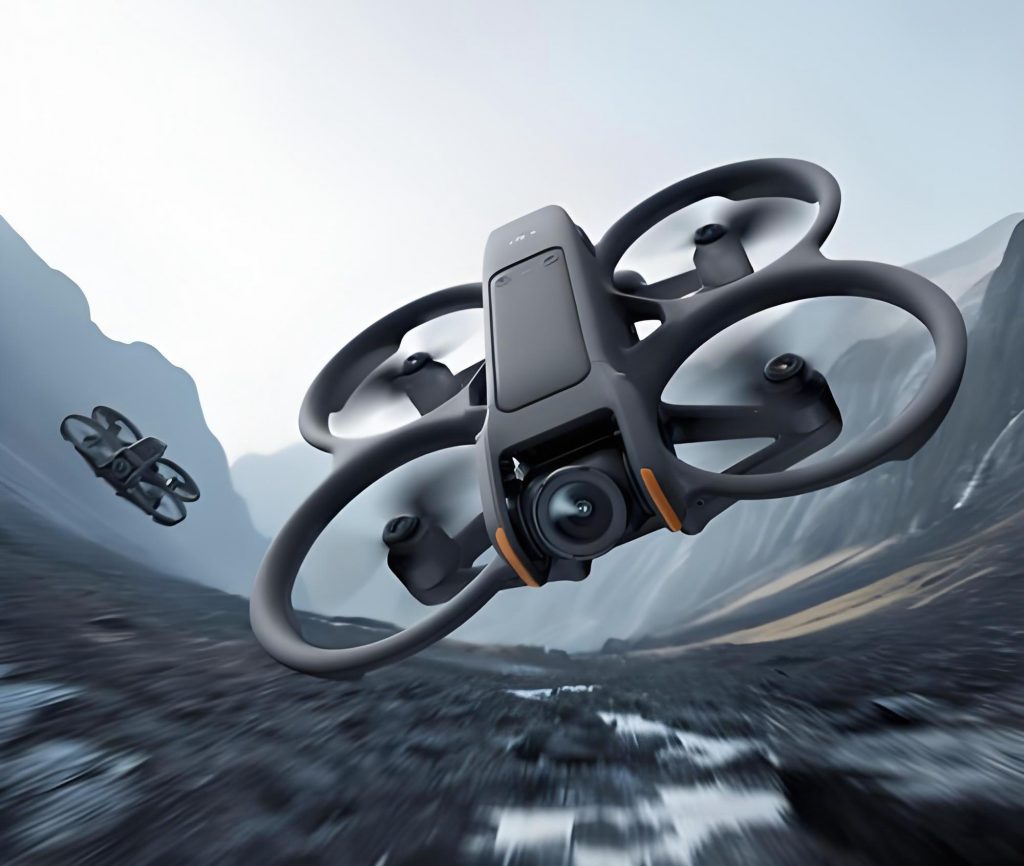
In terms of usability, the DJI Air 3 impressed me with its stability and intuitive controls. The omnidirectional avoidance system gave me confidence to execute maneuvers like orbiting ancient trees without fear of collisions. The dual cameras allow seamless switching between 1x and 3x zoom, offering creative flexibility. The 70mm lens compresses scenes beautifully, eliminating distractions and highlighting subjects—a feature not available in DJI FPV models that focus on first-person speed. The 4K 100fps slow-motion capability, absent in the DJI Mavic 3 Pro, produces smooth footage, though it lacks D-Log M support, requiring careful exposure management. Weighing 720g, the DJI Air 3 is slightly heavier than the Air 2S but offers better wind resistance, with max wind speed tolerance of 12 m/s, matching the DJI Mavic 3 Pro.
Charging efficiency is another highlight; with a 65W charger, the batteries fill in about 80 minutes, while a 100W charger reduces this to 60 minutes. The power accumulation function proved handy when I forgot to pre-charge, allowing me to consolidate charge for longer flights. The DJI RC 2 remote’s bright display and long battery life enhanced my experience, making it superior to smartphone-based controls. Over several months, I found the DJI Air 3 to be a dependable DJI drone that combines professional features with accessibility.
To further illustrate the performance metrics, I’ve included a table below summarizing key formulas and calculations relevant to the DJI Air 3 and other DJI UAVs. This emphasizes the technical rigor behind this DJI drone’s design.
| Parameter | Formula | Application to DJI Air 3 |
|---|---|---|
| Flight Time | $$T = \frac{C}{P}$$ | Approx. 46 minutes with 62.6 Wh battery and 80W power draw |
| Data Rate | $$R = B \log_2 \left(1 + \frac{S}{N}\right)$$ | Up to 10 MB/s with O4图传 system |
| Obstacle Avoidance Probability | $$P_{\text{avoid}} = 1 – e^{-\lambda d}$$ | High probability within 1 meter, enhancing safety for this DJI UAV |
| Signal-to-Noise Ratio | $$SNR = 10 \log_{10} \left( \frac{S}{N} \right)$$ | Improved low-light performance due to F1.7 aperture |
In conclusion, the DJI Air 3 represents a significant leap in the DJI drone lineup, offering features that rival higher-end models like the DJI Mavic 3 Pro at a fraction of the cost. Its dual-camera system, APAS 5.0 avoidance, O4 transmission, and extended battery life make it the ultimate value DJI UAV for 2023. While the DJI FPV series caters to adrenaline-seeking pilots, the DJI Air 3 balances imaging, safety, and affordability, making it ideal for enthusiasts and professionals alike. If you prioritize performance and cost-efficiency, the DJI Air 3 is unbeatable; for those with ample budgets, the DJI Mavic 3 Pro remains an option, but for most, this DJI drone delivers unparalleled satisfaction.