
As an avid enthusiast of aerial photography, I have always been fascinated by the rapid advancements in DJI UAV technology. The release of the DJI Air 3S in October 2024 caught my attention immediately, especially since it arrived just 15 months after its predecessor, the Air 3. I decided to upgrade my old DJI drone to the new model through a trade-in program, eager to explore its capabilities firsthand. In this comprehensive report, I will share my experiences and insights into this remarkable piece of engineering, focusing on its innovative features, performance, and overall value. Throughout my testing, I was consistently impressed by how DJI continues to push the boundaries of what consumer drones can achieve, making the DJI Air 3S a standout in the crowded market of DJI drones.
The DJI Air 3S embodies a significant leap forward, incorporating multiple cutting-edge technologies that enhance both usability and creative potential. One of the most notable improvements is the larger image sensor in the wide-angle camera. Compared to the Air 3, which featured a 1/1.3-inch sensor, the Air 3S boasts a 1-inch CMOS sensor with 50 million effective pixels, up from 48 million. This upgrade translates to better light capture and improved image quality, particularly in low-light conditions. The medium-telephoto camera retains a 1/1.3-inch sensor with 48 million pixels, ensuring consistency in video specs and color modes across both lenses. This dual-camera setup allows for seamless transitions between wide and telephoto perspectives, a hallmark of DJI UAV design. To quantify the sensor advantage, consider the sensor area formula: for a rectangular sensor, the area is given by width times height. For a 1-inch sensor, the typical dimensions are approximately 13.2 mm × 8.8 mm, resulting in an area of about 116 mm², whereas a 1/1.3-inch sensor has dimensions around 9.6 mm × 7.2 mm, yielding an area of roughly 69 mm². The ratio of sensor areas can be expressed as: $$\frac{A_{\text{1-inch}}}{A_{\text{1/1.3-inch}}} = \frac{116}{69} \approx 1.68$$ This means the 1-inch sensor has about 68% more surface area, leading to better signal-to-noise ratio and dynamic range, which is crucial for high-quality aerial shots.
| Feature | DJI Air 3S Wide-Angle Camera | DJI Air 3 Wide-Angle Camera | DJI Air 3S Medium-Telephoto Camera | DJI Air 3 Medium-Telephoto Camera |
|---|---|---|---|---|
| Sensor Size | 1-inch CMOS | 1/1.3-inch CMOS | 1/1.3-inch CMOS | 1/1.3-inch CMOS |
| Effective Pixels | 50 MP | 48 MP | 48 MP | 48 MP |
| Lens Equivalent Focal Length | 24 mm | 24 mm | 70 mm | 70 mm |
| Aperture | F1.8 | F1.7 | F2.8 | F2.8 |
| ISO Range | 100-3200 | 100-3200 | 100-3200 | 100-3200 |
| Shutter Speed | 2-1/8000 s | 2-1/8000 s | 2-1/8000 s | 2-1/8000 s |
Another groundbreaking feature is the new Free Panorama mode, which DJI has introduced for the first time in any consumer drone, including the DJI FPV series. This innovation allows both the wide-angle and medium-telephoto cameras to capture panoramic images by automatically stitching multiple shots together. As a user, I simply select the subject on the remote controller’s screen, and the DJI UAV autonomously takes the necessary photos and composites them into a seamless panorama. The wide-angle camera covers a broader field of view, making it efficient for vast landscapes, while the telephoto lens minimizes distortion and offers a unique perspective. The number of images required for a panorama depends on the selected range; for instance, if I choose a 360-degree horizontal sweep, it might capture around 32 images. The stitching process can be modeled using homography transformations in computer vision, where each image is projected onto a common plane. The composite image quality, Q, can be approximated by: $$Q = \sum_{i=1}^{n} w_i \cdot I_i$$ where \(I_i\) represents the i-th image, \(w_i\) is a weighting factor based on overlap and alignment, and n is the total number of images. This functionality greatly enhances creative flexibility, setting the DJI Air 3S apart from other DJI drones.
Nighttime flying has always been a challenge for drones due to limited visibility, but the DJI Air 3S addresses this with its Night-Grade Omnidirectional Active Obstacle Avoidance. This is another world-first technology in consumer drones, utilizing a forward-facing LiDAR sensor combined with downward-facing infrared TOF sensors and three pairs of low-light visual sensors on the front, rear, and bottom of the aircraft. The LiDAR system emits laser pulses and measures the time of flight to detect obstacles, even in complete darkness. The effective range, R, can be calculated using the formula: $$R = \frac{c \cdot \Delta t}{2}$$ where c is the speed of light and Δt is the time difference between emission and reception. This, along with visual data, enables the drone to create a 3D map of its surroundings and avoid collisions autonomously. During my tests, I flew the DJI UAV in poorly lit urban areas, and it consistently navigated around buildings and trees without any issues. This feature not only enhances safety but also opens up new possibilities for night photography, making the DJI Air 3S a reliable tool for all lighting conditions.
The advanced intelligent return-to-home function is another highlight, leveraging visual simultaneous localization and mapping (vSLAM) technology. In well-lit environments, the drone memorizes its flight path, allowing it to return safely even in scenarios with no GPS signal, such as under balconies. With the addition of forward LiDAR, it can detect and avoid obstacles like tall structures during night returns. The probability of safe return, P_s, can be expressed as: $$P_s = P_{\text{GPS}} \cdot P_{\text{vSLAM}} + (1 – P_{\text{GPS}}) \cdot P_{\text{LiDAR}}$$ where \(P_{\text{GPS}}\) is the reliability of GPS, \(P_{\text{vSLAM}}\) is the accuracy of visual mapping, and \(P_{\text{LiDAR}}\) is the effectiveness of LiDAR-based avoidance. This multi-layered approach ensures that the DJI drone can handle diverse environments, giving users peace of mind.
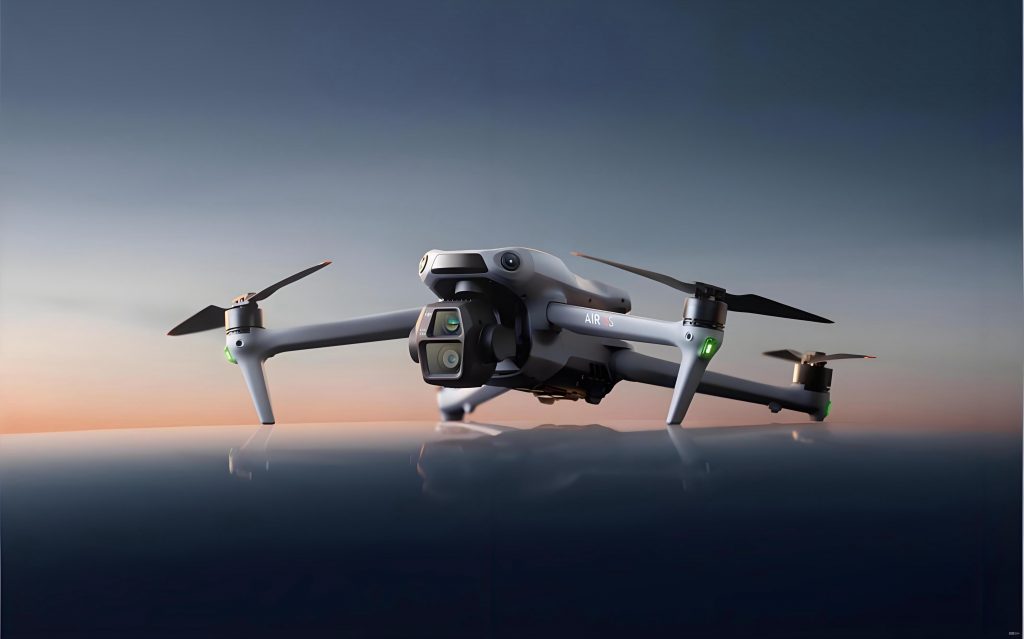
Intelligent following capabilities have also been upgraded in the DJI Air 3S. The omnidirectional tracking system not only locks onto subjects steadily but also plans optimal shooting paths based on the environment and adjusts framing for better composition. Even if the subject is partially obscured, such as behind bushes or on a bridge, the drone maintains tracking reliably. Additionally, the new subject focus tracking ensures sharp focus regardless of the subject’s position in the frame. This is achieved through deep learning algorithms that continuously update the target’s position. The focus accuracy, A_f, can be modeled as: $$A_f = \alpha \cdot \text{IoU} + \beta \cdot \text{confidence}$$ where IoU is the intersection over union between predicted and actual target bounding boxes, and α and β are weighting coefficients. This makes the DJI Air 3S ideal for dynamic video shoots, rivaling even specialized DJI FPV models in certain scenarios.
Storage capacity has seen a significant boost, with the internal memory increasing from 8GB in the Air 3 to 42GB in the Air 3S. This larger storage allows for more spontaneous shooting without worrying about carrying extra cards. The relationship between storage space and shooting time can be approximated by: $$T = \frac{S \cdot C}{R}$$ where T is the recording time in minutes, S is the storage capacity in GB, C is a compression factor (e.g., for H.265 video), and R is the data rate in GB per minute. For instance, at 4K resolution, R might be around 0.5 GB/min, giving T ≈ 84 minutes of continuous recording, which is ample for most sessions.
In terms of design, the DJI Air 3S is nearly identical to its predecessor, weighing about 724 grams—just 4 grams heavier. The battery capacity has increased slightly to 4276 mAh from 4241 mAh, but the flight time is reduced by one minute to 45 minutes due to the added power demands of the new sensors. The battery life, L, can be estimated using: $$L = \frac{C \cdot V}{P}$$ where C is the capacity in mAh, V is the voltage (typically 11.55V for DJI drones), and P is the average power consumption in watts. Assuming P ≈ 40W for hover, L calculates to approximately 45 minutes, consistent with my observations. Compatible accessories like propellers, batteries, charging hubs, and shoulder bags are shared with the Air 3, making upgrades convenient for existing users of DJI drones.
| Parameter | DJI Air 3S | DJI Air 3 |
|---|---|---|
| Weight | 724 g | 720 g |
| Battery Capacity | 4276 mAh | 4241 mAh |
| Flight Time | 45 minutes | 46 minutes |
| Internal Storage | 42 GB | 8 GB |
| Obstacle Avoidance | Night-Grade Omnidirectional | Standard Visual |
My shooting experience with the DJI Air 3S has been overwhelmingly positive. The dual-camera system, with the wide-angle lens (24mm equivalent) below and the telephoto lens (70mm equivalent) above on the gimbal, offers versatile framing options. In tests, I captured scenes ranging from expansive landscapes to distant details, with both cameras delivering sharper images and better noise handling than the Air 3. For example, in low-light urban settings, the wide-angle camera produced clean, vibrant shots with minimal grain, while the telephoto lens allowed for compelling close-ups without loss of detail. The high pixel counts—50MP and 48MP—provide ample room for cropping in post-production, though this comes at the cost of storage; saving both JPG and RAW formats consumes about 1GB for every 13 photos. The signal-to-noise ratio (SNR) for images can be described by: $$\text{SNR} = 20 \log_{10} \left( \frac{\mu}{\sigma} \right)$$ where μ is the mean pixel intensity and σ is the standard deviation, indicating the clarity of images even in challenging conditions.
The Free Panorama mode was particularly impressive. I experimented with both cameras, capturing sweeping horizontal panoramas that covered nearly 360 degrees with the wide-angle lens and distortion-free compositions with the telephoto. The process involves hovering the DJI UAV steadily, selecting the corners of the desired frame on the remote, and letting the drone automatically capture and merge the shots. The synthesis time depends on the number of images; for a 32-image panorama, it took about 30 seconds, but the results were stunningly seamless. This feature outperforms previous fixed panorama modes and adds a new dimension to aerial photography, something I haven’t seen in other DJI drones or even the DJI FPV range.
Digital zoom is another area of improvement, with the wide-angle camera supporting 1x to 2.9x zoom and the telephoto offering 3x to 9x zoom. Unlike the Air 3, which limited digital zoom to video mode, the Air 3S allows it in photo mode as well. I tested this by zooming in on distant landmarks from about 1.5 km away, and the results were surprisingly usable for web sharing or small prints. The zoom factor, Z, relates to the effective focal length, f, by: $$Z = \frac{f_{\text{effective}}}{f_{\text{native}}}$$ For the telephoto lens, Z=9 corresponds to an effective focal length of 630mm, enabling detailed captures of far-off subjects. This flexibility is a boon for photographers who need to frame shots precisely without moving the drone.
However, the DJI Air 3S isn’t without its drawbacks. For instance, in photo mode, it only captures horizontal images and doesn’t allow rotating the gimbal 90 degrees for vertical shots like the Mini 3 does. The vertical video mode is essentially a cropped version of the horizontal frame, which reduces resolution. Additionally, the drone doesn’t include a charger, requiring separate purchase—a minor inconvenience for new users unfamiliar with DJI UAV ecosystems. Despite these points, the overall package is compelling, especially for those valuing innovation.
Pricing for the DJI Air 3S is slightly higher than the Air 3’s launch price, with three variants: the standard version at $6988 (with basic remote), the Fly More Combo at $8788 (with standard remote and three batteries), and the Fly More Combo with screen remote at $9988. Trade-in programs offer discounts, but unless you specifically need the new panorama or night avoidance features, the upgrade might not be essential given the incremental image quality improvements. That said, DJI’s relentless innovation ensures that technologies like Free Panorama and night-grade obstacle avoidance will likely trickle down to other models, such as the future Mavic 4 series, keeping the brand at the forefront of the DJI drone market.
In conclusion, the DJI Air 3S represents a significant step forward in consumer drone technology, blending enhanced imaging capabilities with intelligent features that simplify complex shoots. From the larger sensor and Free Panorama mode to the robust obstacle avoidance and smart tracking, it excels in diverse scenarios. While it has minor quirks, its strengths make it a worthy investment for serious aerial photographers and videographers. As DJI continues to lead the industry, I anticipate even more groundbreaking developments in future DJI UAV models, including potential integrations with DJI FPV for immersive experiences. This drone has not only met but exceeded my expectations, solidifying my appreciation for the evolution of DJI drones.