
In the contemporary digital era, I observe that drone performances have emerged as a pivotal form of media installation art, transcending the boundaries between virtual and real worlds. As a scholar examining this phenomenon, I argue that drone shows represent a significant evolution in how technology mediates cultural expression. These performances, orchestrated through intricate programming, transform the sky into a dynamic canvas for technical images, while simultaneously reshaping urban spaces into interactive interfaces. This article delves into the technical practices, media interactions, and cultural implications of drone performances, emphasizing their role in redefining public engagement and aesthetic experiences.
Drone performances, often referred to as drone shows or drone performances, involve the coordinated flight of multiple unmanned aerial vehicles (UAVs) to create luminous, animated displays in the night sky. Unlike traditional media, drone performances leverage digital code to manipulate physical objects in real-time, resulting in a seamless blend of data and materiality. The core of this practice lies in the programming of drones, where algorithms dictate their movements, forming complex patterns that captivate audiences. This process exemplifies what I term “sky encoding”—a method where the atmosphere becomes a medium for symbolic representation.
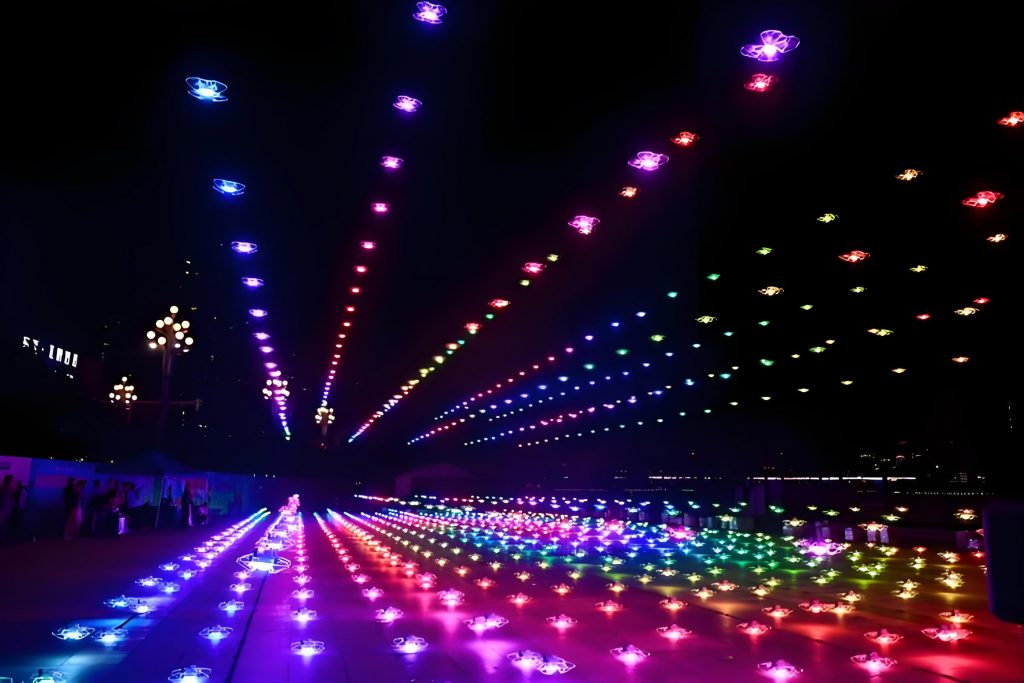
From a technical standpoint, drone performances rely on advanced computational systems to execute precise formations. Each drone in a performance acts as a pixel in a larger image, controlled by a central program that translates digital instructions into physical motions. The mathematical foundation of this can be expressed through equations describing drone trajectories. For instance, the position of a drone i at time t can be modeled as: $$ \vec{p_i}(t) = \vec{p_0} + \int_0^t \vec{v_i}(s) \, ds $$ where $\vec{p_0}$ is the initial position and $\vec{v_i}(s)$ is the velocity vector determined by the control algorithm. This integration of calculus and real-time data processing highlights the sophistication of drone show technologies.
Moreover, the programming of drone performances involves a dual-layered data operation. First, human inputs are converted into digital codes, which are then processed to generate machine-readable commands for the drones. This can be summarized by the transformation: $$ \text{Human Intent} \rightarrow \text{Digital Code} \rightarrow \text{Machine Instruction} \rightarrow \text{Physical Manifestation} $$ This chain underscores how drone performances operate as cybernetic systems, where the boundary between operator and apparatus blurs. The drones themselves become digital objects—entities whose existence is defined by their relational properties within the network, rather than their material alone.
To illustrate the technical aspects, consider the following table comparing key elements of traditional performances and drone performances:
| Aspect | Traditional Performances (e.g., fireworks) | Drone Performances |
|---|---|---|
| Control Mechanism | Manual or pyrotechnic triggers | Digital programming and GPS coordination |
| Flexibility | Fixed sequences with limited variability | Dynamic, real-time adjustments and infinite pattern generation |
| Environmental Impact | High (e.g., noise, pollution) | Low (electric-powered, reusable drones) |
| Interactivity | Passive viewing | Potential for audience engagement via interfaces |
In terms of media interaction, drone performances transform urban landscapes into what I call “screenless interfaces.” By projecting technical images onto the sky, these shows engage viewers in a multisensory experience that transcends typical screen-based media. The city itself becomes a medium, with buildings, streets, and open spaces serving as backdrops for the drone display. This interfacing effect can be analyzed through the lens of attention economics, where the drone show captures and directs collective focus. The intensity of this engagement can be quantified using a formula for attention allocation: $$ A(t) = \frac{I \cdot S}{D} $$ where $A(t)$ is attention at time $t$, $I$ is the intensity of visual stimuli, $S$ is the symbolic relevance, and $D$ is the cognitive distraction. In drone performances, high $I$ and $S$ values ensure deep immersion.
Culturally, drone performances foster a revival of public space by facilitating collective viewing experiences. In an age dominated by personalized screens, drone shows create temporary micro-publics—groups of individuals sharing a common visual and emotional event. These performances often incorporate cultural symbols, such as national emblems or historical motifs, which resonate with diverse audiences. For example, a drone show might depict a dragon or a phoenix, invoking shared myths and reinforcing social bonds. The cultural impact can be modeled as a function of collective identity formation: $$ C = \sum_{i=1}^{n} w_i \cdot e_i $$ where $C$ represents cultural cohesion, $w_i$ is the weight of symbol $i$, and $e_i$ is the emotional engagement level. Drone performances optimize this by curating symbols that maximize $e_i$.
Furthermore, drone performances disrupt the mundane rhythms of urban life, introducing moments of aesthetic rupture. These events create what I refer to as “poetic instants”—brief periods where everyday functionality is suspended in favor of artistic appreciation. The temporal structure of a city during a drone show shifts from linear, utilitarian time to a cyclical, festive temporality. This can be expressed using a rhythm analysis equation: $$ R(t) = \alpha \cdot \cos(\omega t + \phi) + \beta $$ where $R(t)$ is the rhythmic intensity, $\alpha$ is the amplitude of disruption, $\omega$ is the frequency of events, $\phi$ is the phase shift, and $\beta$ is the baseline rhythm. Drone performances increase $\alpha$, leading to heightened public engagement.
In conclusion, as I reflect on the proliferation of drone shows, it is evident that they are more than mere entertainment; they are symptomatic of a broader technological shift. Drone performances exemplify how digital code can permeate physical reality, creating new forms of cultural expression and social interaction. The continued evolution of drone performance technologies promises further innovations in media art, potentially leading to even more immersive and participatory experiences. As we navigate this digitally mediated world, understanding the implications of such practices is crucial for fostering meaningful public spaces and collective identities.
To summarize the key points, I have outlined the technical, interactive, and cultural dimensions of drone performances. The integration of formulas and tables helps elucidate the underlying mechanisms, while emphasizing the repetitive use of terms like drone show and drone performance reinforces their centrality to this discourse. Ultimately, drone performances represent a fusion of art and technology that challenges traditional boundaries, inviting us to reimagine the possibilities of media in the digital age.